
 Volodymyr Lukaniuk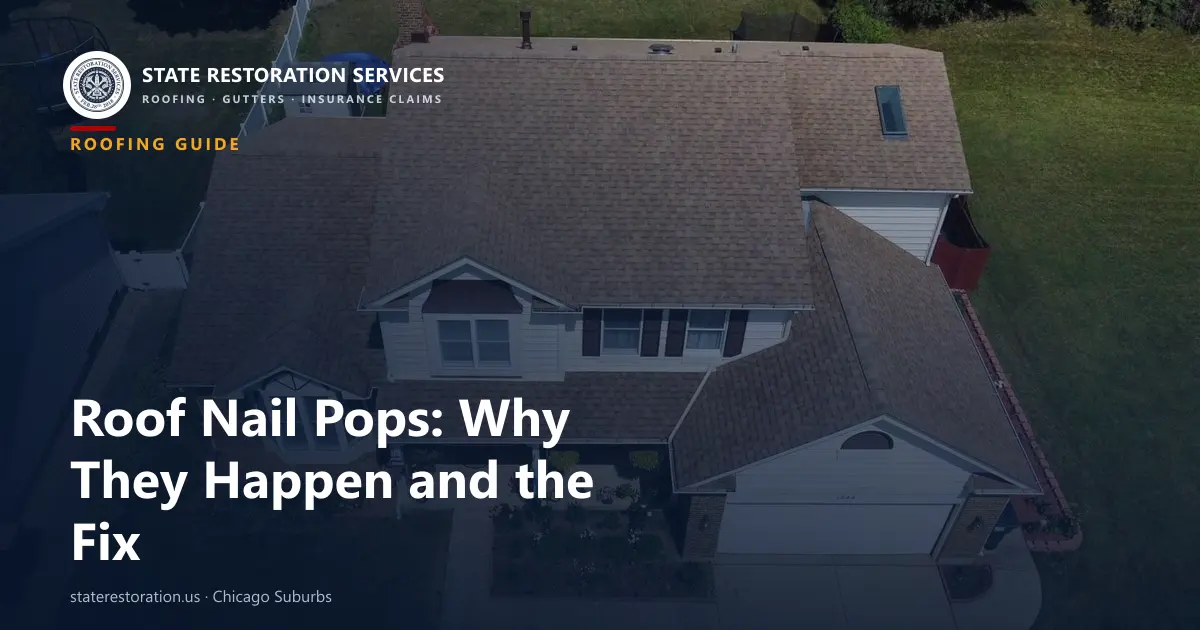
Quick answer: A nail pop is a roofing nail that has worked back up out of the roof deck and is pushing on the shingle above it. It rarely leaks at first, but it can break the shingle seal, wear a hole and let water follow the nail down. The proper fix is a new nail beside the old one.
Roof nail pops look, from the driveway, like small bumps in an otherwise flat row of shingles, as if something is hiding under one tab. Up close, it is usually a roofing nail that has backed out of the wood deck and is pressing on the shingle that covers it. Nail pops are one of the smaller problems a shingle roof can have, and one of the easiest to fix correctly, but only if the fix deals with why the nail came up in the first place.
We are a family-owned roofing company in Lincolnshire serving the north and northwest Chicago suburbs. This guide covers what a nail pop is, why nails back out, when a pop turns into a leak, the repair the shingle industry itself describes, and when a scattering of pops is telling you something about the deck or the attic underneath.
What is a nail pop on a roof?
A nail pop is a shingle nail that has lifted out of the roof deck after the roof was installed. The head rises under the shingle course above it and pushes that shingle up into a visible bump or tent. In worse cases the head wears or punches through the shingle above, and the nail head becomes visible from outside.
It helps to know how the nails are meant to sit. Each shingle is nailed through a band just below its sealant strip, and the next course up covers those nails completely. The Asphalt Roofing Manufacturers Association (ARMA) nailing bulletin is plain about it: "Never place nails where they will be fully or partially visible after the roof is complete," and "Nails are to be applied so the entire head bears tightly against the shingle." A nail pop is a nail that started out that way and did not stay there.
That is different from a nail placed too low in the shingle, where the next course never covered it. That one is an installation problem from the day the roof went on. Nail pops develop later, sometimes years after the crew has left.
Why do roof nails back out of the deck?
A nail stays put because the wood grips its shank. Anything that weakens that grip lets the nail creep upward: decking that swells and shrinks as its moisture changes, a nail too short to bite deep enough, a nail driven into a gap or knot, or a nail gun that never set the head flush in the first place.
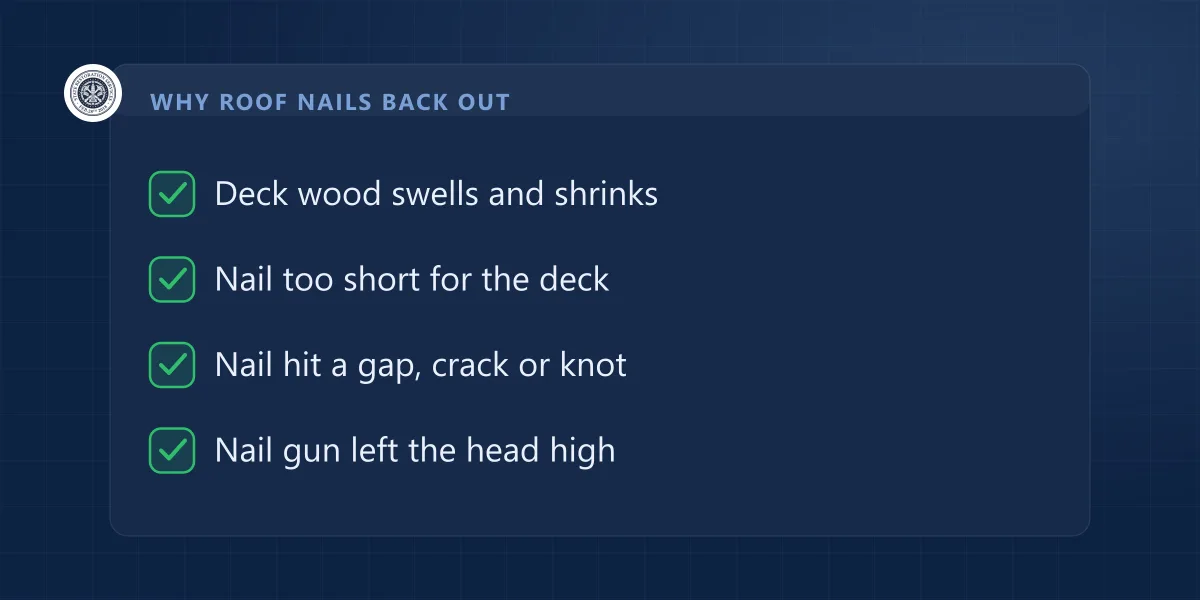
Here are the four causes, and what the published guidance says about each:
| Cause | What is going on | What the guidance says |
|---|---|---|
| Deck movement from moisture | The plywood, OSB or boards under the shingles take on moisture from attic air or rain, grow, then dry and shrink again | ARMA: "As moisture content increases in the wood, movement of the decking can occur." APA, the engineered wood association, says panels "will increase in length and width as they absorb moisture" |
| Nail too short | The point only holds in a thin layer of wood, so it has less to grip | ARMA: nails "long enough to penetrate at least ¾" (19 mm) into the roof deck," or through a thinner deck by at least 1/8" |
| Nail in a gap, crack or knot | The shank sits in a space or a split and never has solid wood around it | ARMA: "Do not drive nails into knot holes, cracks, or spaces in the roof deck" |
| Nail left standing high | A nail gun set too light leaves the head proud of the shingle from the start | ARMA: "Nails are not to be underdriven, overdriven ... or driven crookedly" |
Moisture is the cause that the homeowner has the most influence on after the roof is done. ARMA ties deck movement to ventilation directly: a lack of proper attic ventilation "can create problems with moisture and temperature management in the attic space, contributing to wood deck movement." APA's builder guidance on shingle buckling adds that moisture from showers, dishwashers, humidifiers and clothes dryers "must not be ducted into attics." Our guides to attic ventilation and shingle life and to bathroom exhaust fans that vent through the roof cover both halves of that.
Older houses add a fifth wrinkle. Many were built with board decking, individual planks instead of sheets. ARMA notes that shingles installed on "dimensional lumber (aka board or plank decks) may lead to buckling due to differential expansion or contraction of individual/adjacent boards as their moisture content varies." A nail that lands near the edge of a board, or in the gap between two boards, has little to hold on to.
The nail count and nail placement rules themselves are covered in our guide to how many nails go in each shingle. This post picks up where that one ends: what happens when a nail that went in fine starts coming back out.
Does a nail pop cause a roof leak?
Not right away, in most cases. A popped nail is still under the shingle course above it. The trouble starts when the head lifts that shingle off its seal, rubs a hole through it, or breaks through entirely. Then rain can run in at the hole and follow the nail shank down into the deck.
There are three ways a pop gets worse:
- The seal breaks. Shingles are held down against wind partly by the sealant strip bonding each course to the one below. ARMA lists "sealing failures, raised tabs, distortions, and blow-offs of shingles" among the results of poorly driven nails. A shingle propped up by a nail head is not bonded, and a strong gust can get under it.
- The shingle wears through. Shingles expand and contract with every hot afternoon and cold night. A nail head pressing on the underside of a shingle rubs at the same spot through all of that movement.
- The head breaks through. Once the nail head is exposed, water has a path straight down the nail hole into the deck.
A wet spot on the deck around a single nail is not a disaster. Left for a few seasons, it can soften the wood around the hole, and soft wood holds a nail even less well. If a pop has been leaking for a long time, the sheathing around it may need replacing, which we explain in our guide to roof decking replacement.
How do you spot nail pops without climbing on the roof?
Look for small bumps or tented spots in otherwise flat shingle rows, best seen in low morning or evening sun from across the street or with binoculars. In the attic, look at the nail tips poking through the deck: rust rings, dark stains or winter frost on them point you to where moisture is.
Please do this from the ground. ARMA's own warning reads: "Because it is dangerous to walk, climb or work on a roof, ARMA recommends that only trained professionals engage in such activity." A walk on the roof can also scuff granules and break seals, which is the opposite of what you are trying to protect.
- Use low sun. Early or late in the day, shadows exaggerate any bump in the shingle rows.
- Look for a pattern. One or two random bumps are usually isolated nails. Bumps lined up in straight rows up the slope can match the joints between deck panels, which ARMA says is the signature of moisture-driven deck movement.
- Check the shingle above the bump. Through binoculars, look for a tab that is not lying flat, a lifted edge, or a shiny spot where a nail head shows through.
- Go into the attic with a flashlight. On a cold winter day, look for frost on the nail tips; on a mild day, look for dark rings or stains around them on the underside of the deck.
About those nail tips: they are supposed to be there. ARMA's bulletin explains that with correct-length nails, "the nail points penetrating through the deck" will be "exposed to view" from below. What matters is what is on them. Frost or drips around many nail tips in winter point to warm, humid house air is getting into a cold attic, which is a ventilation and air-leak problem, and the same moisture is what makes decking move.
A bump in a straight line along a nailing row is not a hail hit, either. Hail bruises are scattered across the slope and show crushed granules at the impact point. If someone at your door calls a line of nail pops "hail damage," that is worth a second opinion from a local roofer; our guide to storm chasers vs. a local roofer explains why.
How is a nail pop repaired properly?
ARMA describes the repair: unseal the shingle directly upslope, pull the nail that is backing out, and drive a new nail in an adjacent spot, then hand-seal the upslope shingle back down. If the shingle has been punctured or torn, it is replaced rather than patched with roofing cement.
The wording in ARMA's repairability bulletin is worth quoting in full, because it describes a real repair rather than a quick dab of sealant: "if a fastener is backing out of the roof deck, unsealing the shingle that is directly upslope will allow for a quick removal of the fastener and then replacement with a new fastener in an adjacent location. After the new fastener is in place, the upslope shingle can be hand sealed in place to ensure it will properly adhere to the shingle below."
The nailing bulletin adds what to do with the old hole: "Remove overdriven or crooked nails, repair the hole with asphalt roof cement complying with ASTM D4586, and place another nail nearby. If this is not practical, replace the entire shingle."
| Approach | What it does | Our view |
|---|---|---|
| New nail beside the old one, old hole sealed, upslope shingle hand-sealed | Puts the fastener into fresh wood and restores the seal | The proper repair for a sound shingle |
| Replace the shingle above the pop | Removes a shingle that was worn or punched through by the nail head | Needed when the shingle is damaged; matching an older color takes some work |
| Hammer the popped nail back down | Drives the same nail into the same hole that already failed to hold it | Not the repair ARMA describes; the nail goes back into a hole that already let it go |
| A blob of caulk or cement over the head | Covers the head for a while | ARMA calls roofing cement on a punctured shingle a temporary fix, not "a suitable long-term repair" |
Two practical points. Separating a sealed shingle without cracking it is easier in mild weather than on a cold winter day, when asphalt is brittle. And a repaired spot will not look identical to the roof around it at first; ARMA notes that new shingles "may be aesthetically different initially" and blend in as they age. Keeping the spare bundle from your installation helps a lot here.
When are nail pops a sign of a bigger problem?
When there are many of them, when they line up with the deck joints, when they keep coming back after repair, or when they show up on a roof that is only a year or two old. Those patterns point to deck moisture, attic ventilation, board decking, the wrong nail length, or the way the roof was installed.
The patterns we look at:
- Pops lined up along deck joints. ARMA: "Moisture-induced deck effects typically show a pattern of shingle distortions coincidental with joints in the roof deck panels/lumber." Fixing individual nails helps, but the attic moisture has to be fixed too or new ones will follow.
- Pops on a second layer of shingles. A re-cover over existing shingles needs longer nails to reach the deck. ARMA tells installers to consider "the number of layers of shingles" when choosing nail length. We cover when a second layer is allowed at all in roofing over existing shingles.
- Pops on a very new roof. A handful soon after installation points to how the roof was nailed, or to deck panels installed without the expansion gap APA recommends against shingle buckling: "1/8 inch at ends and sides." Call the installer.
- Pops together with wavy, buckled rows. ARMA lists "fasteners backing out of the deck" alongside structural issues and debris under the shingles as root causes a professional should evaluate.
Are nail pops covered by insurance or a warranty?
Usually not by insurance. A nail working its way out over time is treated as wear, deck movement or an installation issue, and standard homeowners policies exclude wear and tear. On a young roof, the installer's workmanship warranty is the right place to start. A shingle manufacturer's warranty covers defects in the shingles, not how they were nailed.
We explain the difference between the two kinds of warranty in roof warranties: manufacturer vs. workmanship. On the insurance side, a slow leak from a popped nail runs into the same wear-and-tear and maintenance language we walk through in does homeowners insurance cover a roof leak in Illinois.
The picture changes if a windstorm tears off shingles, whether or not some were loose beforehand. That is storm damage and a separate question. If it comes to a claim, here is how we work: we inspect, photograph and document the damage and build a code-compliant estimate. Illinois law does not allow a roofing contractor to negotiate your insurance claim, so if you want someone to represent you on the claim itself, our affiliated licensed public adjuster, State Adjusting Services, can do that. More on our storm and insurance claim page.
Do nail pops mean you need a new roof?
Not by themselves. A few pops on a roof in good condition are a repair. Replacement becomes the honest answer when pops come with the other signs of an aging roof, such as widespread granule loss, curling or cracking, or when damage to the deck means the shingles have to come off anyway.
We lay out how we make that call in roof replacement vs. repair: how we decide. If a replacement is due, our residential roofing page covers the GAF, Owens Corning and IKO systems we install, and the new roof is the moment to fix the causes too: correct nail length, sound decking and a ventilated attic.
If a roofer proposes a whole new roof over three bumps on a roof that is otherwise in good shape, ask what else they found. If the answer is nothing, get a second opinion. When a pop is a small repair, we will tell you so.
Related reading: What a real free roof inspection covers · How many nails per shingle, and why placement matters more
Frequently asked questions
Can I just hammer a popped roof nail back down?
It is not the fix the shingle industry describes. The nail backed out because the wood around it stopped holding it, so driving it back into the same hole puts it where it already failed. ARMA describes pulling the backed-out nail and driving a new one in an adjacent spot, then hand-sealing the shingle above it.
Are nail pops a sign of a bad roofing job?
Sometimes. Nails that are too short, driven into gaps or knots, or left standing high by a badly adjusted nail gun are installation faults. But decking that swells and shrinks with moisture can push correctly driven nails up too. A few pops on an older roof are a different matter from dozens on a roof that is two years old.
Does homeowners insurance cover nail pops?
Usually not on their own. A nail backing out over time is treated as wear, installation or deck movement, which standard policies exclude. If a storm then tears off shingles that were lifted, that storm damage is a separate question. On a young roof, the installer's workmanship warranty is the first place to look.
What is the rusty spot or drip at a nail in my attic ceiling?
The nail points that stick through the underside of the roof deck are normal; with the nail length ARMA calls for, the points usually come through. In winter, those cold nail tips can collect frost from moist attic air and drip when it thaws. That points to an attic moisture or ventilation problem more than to a roof leak.
Seeing bumps in your shingles? Book a free roof inspection or contact us at (866) 992-2982, Monday to Friday, 8:00 AM to 5:00 PM. We serve the north and northwest Chicago suburbs.