
 Volodymyr Lukaniuk
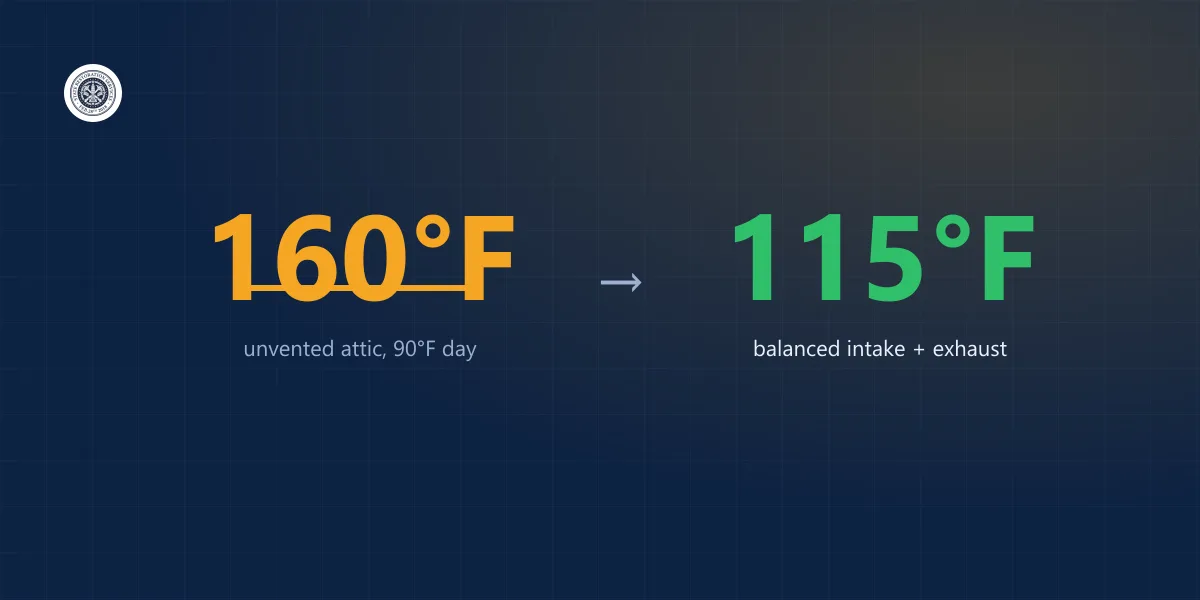
Quick answer: Roof ventilation is a balanced system of intake (soffit vents low on the roof) and exhaust (ridge or box vents high on the roof) that moves attic air continuously. Without it, a Chicago attic can hit 150-160°F in July, which bakes your shingles from underneath, and it lets warm, moist air pool against a cold roof deck in January, which feeds ice dams. Get the balance right and both problems shrink.
Roof ventilation is one of those things nobody notices until the shingles start curling ten years early or an ice dam takes out a bedroom ceiling. We get called out to plenty of both, and more often than homeowners expect, the real problem isn't the shingles at all — it's what's happening in the attic underneath them. A roof that looks fine from the curb can be quietly cooking itself from the inside.
What does roof ventilation actually do?
It keeps attic air moving so heat and moisture don't build up against the underside of your roof deck. Cooler air enters low through soffit vents, warm air exits high through a ridge or box vents, and that constant exchange keeps summer attic temperatures closer to outdoor air and keeps winter attic air dry. No ventilation, and the attic becomes a sealed box that amplifies whatever the weather is doing.
In summer, an unventilated attic in the Chicago suburbs can climb to 150-160°F on a sunny 90°F day — asphalt shingles are only rated to handle so much heat from below before the asphalt binder starts breaking down early, which shows up as granule loss and brittle, curling shingles years before they should be failing. In winter, the same sealed attic traps warm air rising from the living space below. That heat melts snow on the upper roof, the meltwater refreezes at the cold eaves, and you've got an ice dam — we cover that whole mechanism in our guide to ice dams in Illinois. Ventilation doesn't fix either problem by itself, but it takes the fuel away from both.
The warning signs your attic isn't breathing right
The clearest tells are a hot upper floor in summer, frost or dark staining on the attic underside of the roof deck in winter, and shingles that look older than the roof's actual age. Any one of these is worth a look before it turns into a bigger repair.
- Upstairs rooms run noticeably hotter than the rest of the house in summer, even with the AC keeping up everywhere else.
- Frost or dark water staining on the underside of the roof deck when you look up in the attic on a cold morning — that's warm, moist house air condensing where it shouldn't be.
- Shingles curling, cracking, or shedding granules well before the material's expected lifespan — we walk through realistic lifespans by material in our roof lifespan guide.
- Ice dams forming most winters along the same stretch of eave, even on a roof that isn't especially old.
- Musty smell or visible mold on attic framing — trapped moisture has to land somewhere, and untreated wood is where it shows up first.
- Rising summer energy bills with no other explanation, because your AC is now fighting a 150°F attic instead of a properly vented one.
Intake vs. exhaust: the systems homeowners actually see
Intake vents (usually in the soffit, sometimes a lower gable vent) let cool outside air in low on the roof. Exhaust vents (ridge vents, box vents, power fans, or upper gable vents) let hot air out high on the roof. You need both, sized to match each other — a roof with plenty of exhaust and blocked or missing intake just pulls conditioned air out of your living space instead of fresh air from outside.
| Vent type | Role | Our honest take |
|---|---|---|
| Soffit vents | Intake | The workhorse. Almost every ventilation problem we find traces back to these being painted over, blocked by insulation, or simply too few. |
| Ridge vent | Exhaust | Our default recommendation on a full re-roof — runs the whole ridge, no moving parts, pairs cleanly with soffit intake. |
| Box vents (static) | Exhaust | Fine on roofs without enough ridge length, but several small boxes are less efficient than one continuous ridge vent. |
| Power attic fans | Exhaust (powered) | Can help on tricky roof shapes, but a fan with no ridge vent nearby will happily pull air from your soffits or from your living space through can lights and attic hatches — whichever path is easier. |
| Gable vents | Either, depending on placement | Common on older Chicago-area homes; fine on their own, but mixing them with a ridge vent can short-circuit the airflow (more on that below). |
The 1:300 rule, and why more vents isn't automatically better
Building code generally calls for 1 square foot of net free vent area for every 300 square feet of attic floor, split roughly evenly between intake and exhaust. More exhaust vents than intake doesn't move more air — it just gives the system more places to pull from your living space instead of the soffits, which is the opposite of the goal.
We still run into roofs with a ridge vent and gable vents and a power fan, all fighting each other. The ridge vent and the closest gable vent end up exhausting each other's air in a short loop instead of pulling fresh air the full length of the soffit — roofers call this short-circuiting. If you're adding a ridge vent during a re-roof, the gable vents usually need to come out of the equation, not stack on top.
Does bad ventilation actually void your shingle warranty?
Often, yes. Most major shingle manufacturers, including GAF, Owens Corning, and IKO — the systems we install — list adequate, balanced attic ventilation as a condition of their full material warranty, because trapped heat is a documented cause of premature shingle failure. If a warranty claim gets denied, an under-ventilated attic is one of the first things an inspector checks.
That's part of why we look at soffit and ridge airflow on every roof replacement, not just the shingles themselves. A beautiful new roof over a sealed, overheating attic is just a slower-motion version of the same problem you started with.
What we check during a ventilation assessment
We measure your attic square footage, count and inspect every existing intake and exhaust vent, and check for blockage, mixed vent types, and insulation that's crept over the soffits. Then we size a balanced system instead of just adding more of whatever's already there.
On a full roof replacement, correcting ventilation is usually a modest add-on to the job rather than a separate expense, since the roof is already open. On an existing roof, adding soffit intake or converting to a ridge vent is a standalone project we can quote on its own — ask about it as part of our inspection process. If ice dam damage from years of poor airflow has already reached your ceiling or insulation, that repair may fall under your homeowner's insurance claim rather than routine maintenance, and it's worth having it documented properly either way.
We serve homeowners across the north and northwest suburbs — from Buffalo Grove to Lincolnshire and the surrounding Lake and Cook County communities — and attic ventilation gets checked as a standard part of every roof inspection we do, not an upsell we tack on afterward.
Frequently asked questions
Is roof ventilation really necessary, or is it something roofers push to add to the bill?
It's necessary. Manufacturer warranty requirements, building code minimums, and the plain physics of heat and moisture movement all point the same direction. It's not an upsell — it's part of what makes the shingles above it last as long as they're supposed to.
How many vents does my roof actually need?
Code generally calls for 1 square foot of net free vent area per 300 square feet of attic floor, split between intake and exhaust. For a typical 1,800 square foot attic, that's roughly 6 square feet of total vent area — we calculate the exact number and vent count for your specific roof.
Can I just add a ridge vent to an attic that already has a power fan or gable vents?
Not without a plan. Mixing exhaust types without accounting for how they interact usually causes short-circuiting, where vents pull air from each other instead of the soffits. We typically recommend picking one primary exhaust system, most often a ridge vent, and removing or disconnecting the others.
Will fixing ventilation stop ice dams completely?
It removes one of the two main causes. Ice dams need trapped attic heat and snow cover on the roof; ventilation addresses the heat side, and attic air sealing and insulation address the rest. We go through the full picture in our ice dam guide.
Not sure if your attic is part of the problem? Book a free inspection or call (866) 992-2982 — we check ventilation on every roof we look at, no charge, no pressure.