
 Volodymyr Lukaniuk
Quick answer: Almost every skylight leak repair starts at the flashing, not the glass. If the unit is under about 10 years old and the leak is at the frame edge, reflashing usually fixes it for $350–$700. If the glass seal has fogged, the dome is cracked, or the unit is past 12–15 years, replacement runs roughly $600–$3,000 installed depending on type and size. A lot of what homeowners call a "skylight leak" in January is actually condensation, not water getting in from outside.
We get more skylight calls in late fall and after a hard freeze than any other time of year, and about half of those turn out to be skylight leak repair that never needed to happen — the ceiling around the skylight is wet, but nothing outside is failing. The other half really is a leak, and it's almost never the glass itself. Here's how to tell which one you've got, what it actually costs to fix in the Chicago suburbs, and when replacing the whole unit beats patching it.
Is it really a leak, or is it condensation?
Look at the timing and the pattern first: condensation shows up on cold, calm mornings and dries out by afternoon, while a real leak tracks with rain or a hard melt and keeps showing up regardless of temperature. Condensation also tends to sit right at the inside edge of the frame in a thin, even ring; a real leak usually stains unevenly and often shows up a foot or more away from the skylight itself, because water is running along the underside of the roof deck before it drips.
| Sign | Condensation | Real leak |
|---|---|---|
| When it shows up | Cold, still mornings, any season | During or right after rain, or fast snowmelt |
| Where the water sits | Even ring right at the glass edge | Uneven, can trail well past the frame |
| Does it dry on its own | Usually gone by afternoon | Comes back every time it rains |
| What fixes it | Better attic/room ventilation, sometimes a storm-window insert | Reflashing or unit replacement |
If you're only ever seeing it on cold mornings, don't pay anyone to reflash a skylight that isn't actually leaking — the fix is airflow, not roofing.
What actually causes a real skylight leak
It's almost always the flashing, not the glass. A skylight is a hole cut in your roof, and the flashing kit around it — the same head, step, and apron pieces that fail around a chimney — is what keeps water out, the way we've covered in our roof flashing guide. Sealant at the corners dries out, step flashing pieces work loose under 40–50 freeze-thaw cycles a Chicago winter throws at them, or the flashing was never properly woven into the shingle courses in the first place — a shortcut we see from crews who don't do a lot of skylight work. Actual glass or dome failure (a cracked pane, a blown seal on a double-glazed unit) is a smaller share of the calls we run, and it's usually obvious: fogging between the panes or a visible crack, not a mystery stain.
Reflash it or replace the whole unit? How we decide
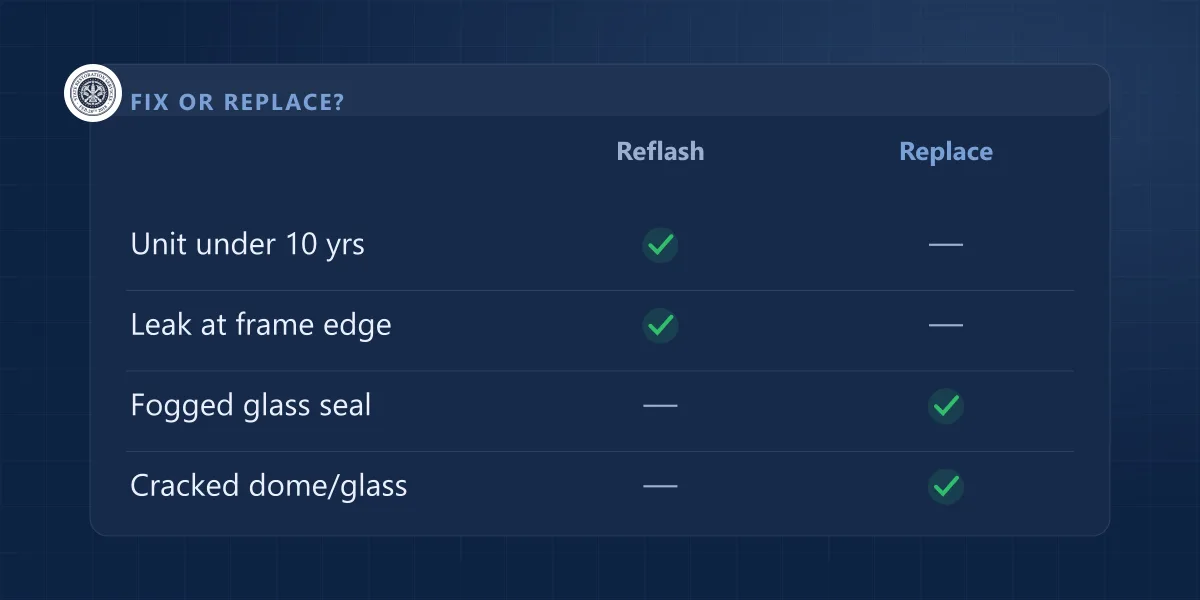
Age and where the leak is coming from settle it most of the time. A unit under about 10 years old with a leak at the frame edge almost always just needs new flashing and fresh sealant — the glass and frame are fine, water is getting in around them. Once the glass seal has fogged (you'll see a permanent haze or moisture trapped between the panes that never clears) or the dome is cracked, no amount of reflashing fixes it, because the leak point is the unit itself, not what's around it.
Age matters even if nothing looks wrong yet: most skylight seals and gaskets are rated for roughly 10–15 years, and Chicago's freeze-thaw cycle is hard on rubber and sealant the same way it's hard on shingles and flashing everywhere else on the roof (see our roof lifespan guide for why that cycle count matters). A 14-year-old skylight that's holding for now is a candidate for replacement on your terms, before it leaks on its own schedule.
What does skylight replacement actually cost in the Chicago suburbs?
Installed cost depends mainly on whether it opens and how it opens, plus size. These are realistic ranges for the north and northwest suburbs, not a quote — your actual price depends on roof pitch, access, and whether the curb or decking underneath needs repair.
| Type | Installed cost range | Notes |
|---|---|---|
| Flashing reseal / reflash (unit stays) | $350 – $700 | Unit is sound, leak is at the frame |
| Fixed skylight, like-for-like | $600 – $1,200 | Doesn't open; standard 2x2–2x4 ft sizes |
| Manual venting skylight | $1,200 – $2,000 | Crank or pole-operated, opens for airflow |
| Solar-powered venting skylight | $1,800 – $3,000 | Remote/rain-sensor operated, no household wiring |
| Larger or custom size / curb repair | Add $300 – $800 | Oversized units or rotted curb framing |
Removing a skylight entirely and roofing over the opening is also an option we get asked about, usually on an older unit nobody uses — it's less common than replacement, but if a skylight has leaked more than once, closing it up is a legitimate way to stop worrying about it for good.
Should you add a skylight during a roof replacement, or as its own project?
During the tear-off is the right time, if you're already planning one. When we're already down to the decking as part of a full roof replacement, cutting the opening and building the flashing into fresh underlayment and shingle courses (part of what we cover in what's included in a proper roof replacement) is cleaner and cheaper than doing it as a standalone job later, when a crew has to cut into shingles that are already sealed down. If your roof isn't due for replacement, a standalone skylight install is still routine — it just costs a bit more in labor to tie the flashing into existing shingles without disturbing more of the roof than necessary.
Does homeowners insurance cover a leaking or cracked skylight?
It depends on why it's leaking. A skylight cracked by hail or blown loose by wind is typically a covered peril, the same as hail damage anywhere else on the roof — that's a claim, not a maintenance bill. A skylight leaking because the flashing sealant dried out over 12 years, or because the glass seal aged out, is wear and tear, and wear and tear isn't a covered loss on a standard policy. Illinois law doesn't allow a roofing contractor to negotiate your claim for you — we document the damage and build the estimate, and if you want someone representing you directly with the adjuster, our affiliated licensed public adjuster, State Adjusting Services, can do that part.
Frequently asked questions
How do I know if my skylight is leaking or just has condensation?
Condensation shows up on cold, still mornings in a thin ring right at the glass edge and dries out on its own by afternoon. A real leak tracks with rain or a fast snowmelt, can stain a foot or more away from the frame, and keeps coming back regardless of temperature. If it only ever appears on cold mornings, it's almost always condensation, not a roofing problem.
Can a leaking skylight be repaired, or does the whole unit need to be replaced?
Most of the time it's a repair. If the unit is under about 10 years old and the leak is at the frame edge, new flashing and sealant usually fixes it. If the glass seal has fogged, the dome is cracked, or the unit is past 12–15 years old, replace the whole unit — reflashing a failed unit just delays the same call.
How much does it cost to replace a skylight in the Chicago suburbs?
A like-for-like fixed skylight runs roughly $600–$1,200 installed, a manual venting unit $1,200–$2,000, and a solar-powered venting unit with a remote and rain sensor $1,800–$3,000. A flashing-only reseal, when the unit itself is still good, is typically $350–$700.
Does homeowners insurance cover a leaking skylight?
Only if a covered peril caused it — hail cracking the glass or wind tearing the flashing loose is generally covered, the same as storm damage anywhere else on the roof. A leak from aged-out sealant or a worn gasket is maintenance, and standard policies don't cover wear and tear.
Skylight acting up? Book a free inspection or call (866) 992-2982 — we serve the north and northwest Chicago suburbs.