
 Volodymyr Lukaniuk
Quick answer: Roof flashing is the strip of metal that seals every place your roof isn't just flat shingles — chimneys, valleys, sidewalls, skylights, and pipe penetrations. It costs a few dollars a foot, but in our experience it's behind more roof leaks than worn-out shingles ever are.
In eight years of climbing roofs across the north and northwest Chicago suburbs, we've chased down more mystery leaks than we can count, and the answer is almost never the shingles. It's the roof flashing — the bent metal tucked into every valley, chimney, and wall intersection — that gives out first. Know what flashing actually is and where it tends to fail, and you'll know exactly what to ask the next person who climbs up on your roof.
What is roof flashing, exactly?
Roof flashing is sheet metal — usually galvanized steel or aluminum — installed at every joint and penetration on your roof to keep water moving over the shingles instead of into the deck. It's not one product; it's a family of pieces, each doing a different job.
- Drip edge — the strip along the eaves and rakes that kicks water off the roof edge instead of behind the gutter or fascia.
- Step flashing — small L-shaped pieces woven in with every shingle course where a roof plane meets a wall or dormer.
- Valley flashing — the metal (or ice-and-water shield) running down a valley where two roof planes meet and water concentrates.
- Counter-flashing — the metal let into a chimney's mortar joint that overlaps the step flashing below it, keeping water out of the joint itself.
- Pipe boots — the rubber-collared metal base sealing a plumbing vent stack where it pokes through the roof.
Why does flashing fail before the shingles do?
A 25–30 year shingle is built to shed sun and weather for decades. Flashing usually depends on something softer — sealant, caulk, or a rubber boot — to stay watertight, and those wear out years earlier. Add Chicago's freeze-thaw cycle, which swings roughly 40–50 times a season, and every joint is expanding and contracting on a schedule shingles alone don't have to deal with.
Rubber pipe boots typically crack from UV exposure around year 8–10. Sealant dries, shrinks, and hairline-cracks well before that. Nails holding flashing to the deck back out slightly every freeze-thaw cycle. And on some corner-cutting installs, we find flashing that was never woven into the shingles at all — just caulked over the top and called done, which fails the moment that bead of caulk does.
Where do we find flashing leaks most often on Chicago-area roofs?
Almost every leak call we run down traces back to one of five spots. Here's what we check first, and why.
| Spot | Why it fails | What you'll notice |
|---|---|---|
| Chimney counter-flashing | Mortar joint erodes or was never properly cut in; counter-flashing pulls loose | Water stains on the ceiling near the chimney chase |
| Valleys | Undersized or worn valley metal; ice damming backs water up under it | A stain that grows along a diagonal line under a roof valley |
| Sidewalls & dormers | Step flashing caulked instead of woven course-by-course | Staining where a lower roof section meets a wall or second story |
| Pipe boots | Rubber collar cracks with UV exposure over time | A ring-shaped stain around a bathroom or kitchen vent stack |
| Skylights | Factory flashing kit installed wrong, or reused during a re-roof | Staining at the corners of the skylight frame |
Sealant vs proper flashing: which is the real fix?
A bead of sealant can buy you time, but it isn't a repair — it's a countdown. Woven or soldered flashing, installed correctly, doesn't depend on anything degrading to keep working.
| Approach | Typical lifespan | Installed cost | Our honest take |
|---|---|---|---|
| Sealant/caulk over existing flashing | 1–3 years | $50–$150 | Fine as a stop-gap before a real repair, not a fix on its own |
| New step, valley, or counter-flashing, woven or soldered in | 15–25+ years | $300–$1,200 | The actual fix — matches the shingle system's own lifespan |

What does a flashing repair actually cost?
Prices vary with roof pitch and access, but the ranges above hold true across most jobs we run in the north and northwest suburbs: a single pipe boot swap is the cheapest fix, a full chimney re-flash is the most involved because it means cutting a new reglet into the mortar joint. If more than one spot is failing at once, that's often a sign the roof itself is nearing the end of its life rather than a one-off flashing problem — worth a real inspection before you spend on patches.
Can a flashing leak be an insurance claim?
Sometimes. Wind can lift or peel back step flashing and counter-flashing in a straight-line wind event, and hail can dent exposed valley metal and drip edge the same way it dents shingles. If the damage traces to a specific storm date, it's worth documenting. Illinois law doesn't let a roofing contractor negotiate your claim for you — we can inspect, document, and put together a code-compliant estimate, and our partner, the licensed public adjuster State Adjusting Services, can represent you directly with the carrier. Gradual wear from an old rubber boot or dried-out caulk, on the other hand, is maintenance, not a claim — no adjuster is going to call an 11-year-old pipe boot storm damage.
How we prevent flashing failures on a new roof
The fixes are boring, which is exactly why they work: ice-and-water shield laid into every valley before the shingles go on, step flashing woven into each course instead of caulked over the top, drip edge run continuously along every eave and rake, and chimney counter-flashing cut into the mortar joint rather than just sealed to the brick face. None of it is glamorous. All of it is the difference between a roof that's dry in year 15 and one that's calling us back in year 3.
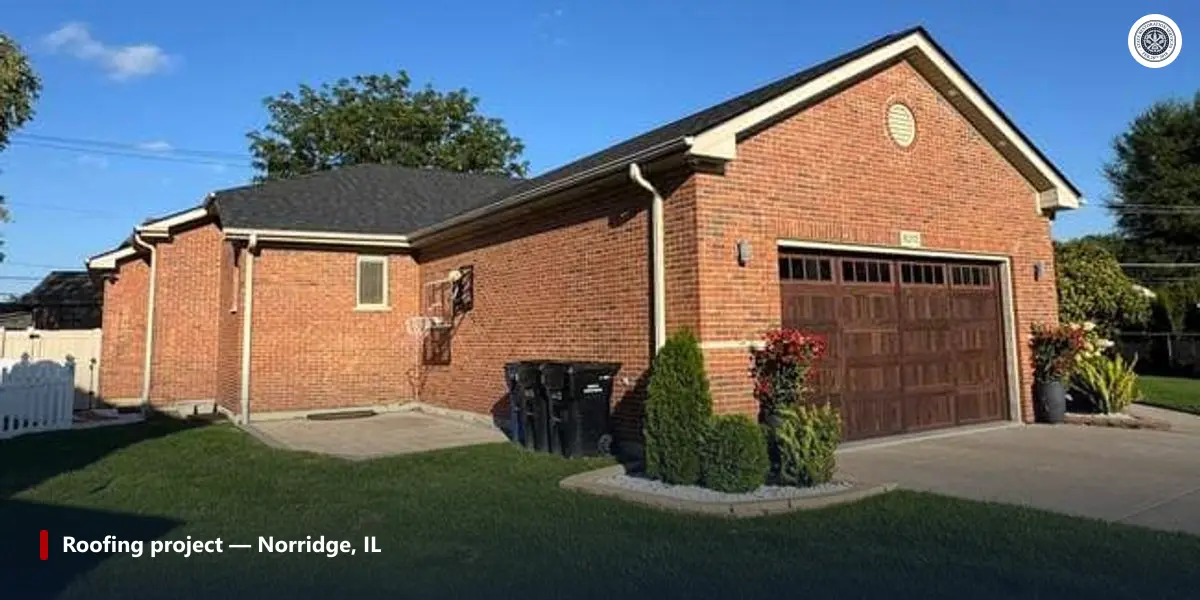
We see the payoff on projects like this Norridge roofing job — flashing done right the first time, not caulked as an afterthought. It's the same standard we build into every residential roofing project, and it's part of how we run a tear-off from the first nail to the last.
Frequently asked questions
How do I know if my roof leak is from flashing and not the shingles?
Look at where the stain lines up: leaks near a chimney, a valley, a wall intersection, a skylight, or a vent pipe are almost always flashing, not a failed shingle field. Shingle-only leaks are rare until a roof is genuinely near the end of its life.
How often does roof flashing need to be replaced?
Properly installed step, valley, and counter-flashing can last as long as the shingles, 20–25+ years. The weak links are the softer parts: rubber pipe boots (8–10 years) and any sealant-dependent patch (1–3 years), which need earlier attention.
Can I just caulk a flashing leak myself?
You can as a temporary stop-gap on a dry day, but treat it as buying time, not fixing the problem. Caulk over bad flashing fails again within a year or two, and climbing on a wet or pitched roof isn't worth the risk — call it in instead.
Does homeowners insurance cover a flashing leak?
It can, if the damage ties to a specific wind or hail event. Gradual failure from age — cracked caulk, a worn pipe boot — is considered maintenance and isn't covered. A dated inspection helps establish which one you're dealing with.
Have a leak you can't place? Book a free inspection or call (866) 992-2982 — we serve the north and northwest Chicago suburbs.
Related reading: roof ventilation and attic heat, what code-upgrade coverage pays for on a roof claim.