
 Volodymyr Lukaniuk
Quick answer: Class 4 impact-resistant shingles passed the toughest level of the UL 2218 lab test: a 2-inch steel ball dropped from 20 feet without cracking the shingle through. That buys real toughness and, with some carriers writing policies in Illinois, a premium credit. It does not make a roof hail-proof, and manufacturers exclude hail damage from the shingle warranty.
Class 4 impact-resistant shingles come up often in the conversations we have after a hailstorm in the north and northwest suburbs, usually right after a homeowner has spent a week looking at dented gutters and a patched ceiling. Some of what gets said about them is true. Some of it comes from a stranger with a clipboard on your porch, with a promise that "the insurance discount pays for the roof."
This guide sorts the two. It covers what the rating actually tests, what the test leaves out, how the insurance credit works in Illinois according to the carriers' own documents, and the one sentence in the manufacturers' fine print that every buyer should read before paying for the upgrade. We quote sources directly where the wording matters, and we link every one of them.
What does "Class 4" mean on a shingle?
Class 4 is the highest rating in UL 2218, the standard for impact resistance of roof coverings. Lab technicians drop steel balls of set sizes onto new shingle samples from set heights. To earn Class 4, the shingle has to take a 2-inch ball dropped from 20 feet with no crack or tear showing through the back.
There are four classes, and each one uses a bigger ball from a greater height. The sizes below are the ones IKO publishes and the ones described by Asphalt magazine, the asphalt roofing industry's own publication:
| Class | Steel ball diameter | Drop height | Roughly the energy of |
|---|---|---|---|
| Class 1 | 1.25 in. | 12 ft | ~1 in. hail |
| Class 2 | 1.50 in. | 15 ft | ~1.5 in. hail |
| Class 3 | 1.75 in. | 17 ft | ~1.75 in. hail |
| Class 4 | 2.00 in. | 20 ft | ~2 in. hail |
The pass mark is worth reading closely. In IKO's words, "A shingle passes if it shows no cracking, tearing or fracturing on the back surface after impact. Granule loss or denting visible only on the top doesn't count as a failure under UL 2218." Asphalt magazine describes the check the same way: a light is shone behind the sample, and no light may come through the impact site.
So a Class 4 shingle can come out of the test dented and missing granules and still pass. The rating measures whether the shingle keeps water out after the hit. It says nothing about how the roof looks afterward, and that difference matters a great deal once an adjuster is standing on your roof (more on that below).
Some products are also tested to FM 4473, a second standard that fires ice balls at the shingle instead of dropping steel. IKO's Nordic product page lists its rating as "FM 4473/UL 2218 Class 4." Either way, the certificate describes a new shingle in a lab, not a ten-year-old one on a south-facing slope.
Does a Class 4 shingle survive a real hailstorm?
A Class 4 shingle holds up to hail far better than a standard one, but no rating guarantees it comes through undamaged. IKO states plainly that test performance "can't be compared directly to its performance in a hailstorm," and that no test or standard indicates how a shingle will perform in giant hail.
The Insurance Institute for Business & Home Safety (IBHS), an insurance-industry research group, runs its own tests on impact-rated shingles using lab-made hailstones up to two inches across. Its protocol grades three kinds of damage separately: dents, tears and granule loss. In other words, it grades the damage UL 2218 lets through.
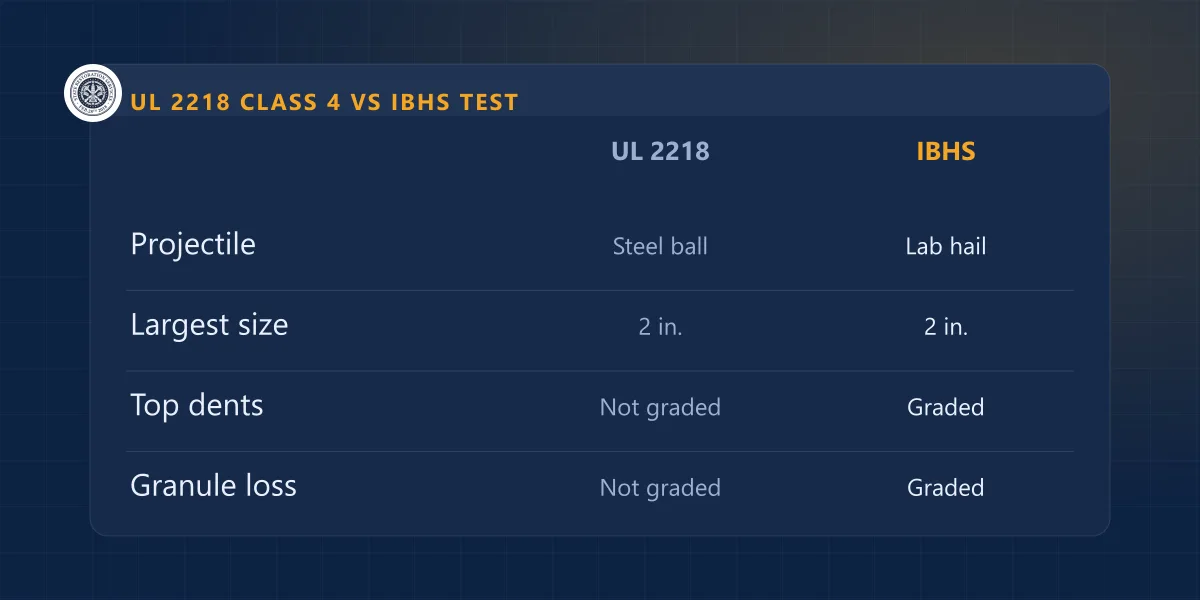
The results are worth knowing before you pay for a label. In its November 2025 ratings release, IBHS rated 24 impact-resistant products, which it says represent about 95% of annual sales. "Although most products earned a 'Good' rating, none achieved 'Excellent.'" IBHS's Dr. Anne Cope added: "If a product rates Marginal or Poor, we do not recommend using it in areas that experience hail."
The trend has been in the right direction. In 2021, IBHS reported that the market had grown "from five good or excellent performing products in the initial release to eight." IKO's own guide sums up the honest version: "The rating means a shingle met the certification threshold, not that every square inch survived without damage."
What that means on a roof in Palatine or Northbrook: a Class 4 shingle is tested at the energy of two-inch hail, so storms well below that size are the ones it is built to handle, with the caveat that dents and granule loss can still appear. Hail larger than two inches is bigger than the largest ball in the test. We are careful with anyone who promises a roof that hail cannot touch.
Does a Class 4 roof lower your insurance premium in Illinois?
It can, but only through your carrier's own program. State Farm lists Illinois among the states where its impact-resistant roofing discount is available, and at least one other carrier publishes an Illinois hail-resistant roof credit. Neither page publishes a percentage, and every program we read requires documentation from the roofer.
Here is what the carriers' own documents say:
- State Farm. Its discounts page says that with "certain impact resistant roofing products, like hail resistant shingles or class 4 shingles, you may be eligible for a discount," lists Illinois among the eligible states, and adds: "Please check with your State Farm agent before installing a new roof." It also states that "Premium reductions are not available for roofs that have been overlaid onto existing roofs, except for certain qualifying metal roofs."
- The State Farm certification form. The Roofing Installation Information and Certification form is signed by an authorized representative of the roofing company. It records the manufacturer, the brand name, the date of installation and the UL 2218 or FM 4473 class. One copy stays with the homeowner and one goes to the insurer.
- Homeowners of America Insurance Company. Its Illinois underwriting guideline allows "an additional discount for a Class 3 or 4 new roof" on policies that qualify. The roof must be non-wood (synthetic polymer excluded), rated Class 3 or 4 under UL 2218, and either new construction or a complete roof replacement.
We could not find an Illinois statute that requires insurers to offer this credit, so treat it as a carrier program that can differ from company to company and change at renewal. Percentages you see quoted online come from roofing company blogs, not from the carriers, and we are not going to repeat them. Your agent can give you the actual dollar figure for your policy, and that is the only number worth using.
The overlay rule connects to a separate decision. If you are weighing a second layer to save on tear-off, our guide to roofing over existing shingles covers when Illinois villages allow it, and State Farm's wording means that choice can also close the door on this credit.
What does the Class 4 label not cover?
It does not put hail damage under the shingle warranty. IKO's Nordic page says the impact rating exists "solely for the purpose of enabling residential property owners to obtain a reduction in their residential insurance premium, if available. This is not a guarantee of impact resistance against hail. Damage from hail is not covered under the limited warranty."
State Farm's form carries matching language: it is "solely for the purpose of enabling residential property owners to apply for a reduction in their residential insurance premium" and is not to be read as a warranty by the manufacturer, supplier, installer or insurer. If hail damages a Class 4 roof, the path to getting it fixed is your homeowners insurance claim, the same as for any other roof.
That leads to the question we would ask first. A Class 4 shingle is built to dent without cracking through, and a dent that does not let water in is the textbook example of cosmetic damage. Some carriers attach a cosmetic damage exclusion endorsement to the policy, and where one is in force, dents that change how the roof looks but not how it works may not be paid. We explain how that endorsement reads in our post on hail damage to gutters and downspouts.
State Farm's form shows the trade-off in writing for metal roofs: "To receive a premium reduction for qualifying metal products, you must accept an exclusion of certain damages to metal roof products outlined in an endorsement that will be a part of your policy." The form ties that condition to metal roofs only. For shingles, read your own declarations page and ask the agent directly whether taking the credit changes how dents are handled on a future claim.
Which shingles carry a Class 4 rating?
All three manufacturers we install, GAF, Owens Corning and IKO, sell impact-rated lines, but a brand name alone does not tell you the rating. Confirm the exact product name on the estimate and check it against your insurer's qualifying list before you sign, because families of shingles can mix Class 3 and Class 4 products.
Two examples from the manufacturers' own pages:
- Owens Corning TruDefinition Duration FLEX. Owens Corning's launch announcement describes it as made "with a proprietary blend of SBS polymer modified asphalt" (a rubberized asphalt blend that makes the shingle more flexible), with "the highest impact rating available: UL 2218 Class 4."
- IKO Performance shingles. On the same IKO product page, "Dynasty shingles provide a Class 3 impact rating, while Nordic shingles carry Class 4." Same product family, two different ratings, and only one of them clears a Class 4-only insurance program.
We could not read GAF's product pages directly when we wrote this, so we are not quoting GAF's line-up here. The practical step is the same for every brand: the estimate should name the specific shingle, not "architectural shingles, Class 4." State Farm publishes a qualifying roofing products listing on the same page as its form. Ask which hip and ridge cap shingle goes on with it, since the caps are a separate product from the field shingle.
The rest of the roof system matters just as much with either shingle: underlayment, ice-and-water shield, flashing and ventilation are part of the job either way. If you want the full list of what a replacement should include, our residential roofing page walks through how we build it.
Is the upgrade worth it for your house?
It is worth it when you plan to stay long enough for the premium credit to repay the price difference, or when your area has already taken repeated hail. It is harder to justify on a house you will sell in a few years, or when your carrier offers no credit at all.
The arithmetic is simple once you have two real numbers. Ask us, or any roofer you are considering, to price the same roof twice on one estimate: once with a standard architectural shingle, once with a Class 4 product. The tear-off, decking, flashing and labor lines should not change, so the difference is the true cost of the upgrade. Then ask your agent for the yearly premium credit in dollars. Divide the first number by the second, and you have the number of years to break even.
| Your situation | Leans toward Class 4 | Leans toward standard |
|---|---|---|
| How long you will stay | Longer than the break-even years | Selling before you break even |
| Your carrier's program | Written credit for Class 4, amount confirmed | No credit offered, or amount unknown |
| Hail history on this house | More than one hail claim or repair | No hail damage in years |
| Type of job | Full tear-off and replacement | Layover or partial repair (credit usually unavailable) |
| Cosmetic damage exclusion | You have read your endorsements and accept the terms | You have not checked whether dents would be paid |
If the roof is being replaced on a hail claim, remember that the claim pays for like kind and quality. The upgrade is a separate decision with its own price tag, and it should appear as its own line. Our guides to what a new roof costs in the Chicago suburbs and how we handle storm and insurance work cover the rest of the picture. Illinois law does not allow a roofing contractor to negotiate your claim, so if a dispute comes up, our affiliated licensed public adjuster, State Adjusting Services, can represent you.
Related reading: what hail damage on an asphalt roof actually looks like and architectural vs 3-tab shingles for Illinois weather.
Frequently asked questions
Are Class 4 shingles hail-proof?
No. Class 4 means a new shingle passed a lab test with a 2-inch steel ball without cracking through the back. IKO, which makes Class 4 shingles, states that no test or standard indicates how a shingle will perform in giant hail, and that test results cannot be compared directly to a real storm.
Do I get the insurance discount automatically when the roof goes on?
Usually not. The carrier programs we have read require paperwork: State Farm uses a certification form signed by the roofing company that names the product, its UL 2218 or FM 4473 class and the installation date. Ask your agent which form they need before the job starts.
Can I get the Class 4 credit on a roof laid over old shingles?
Generally no. State Farm states that premium reductions are not available for roofs overlaid onto existing roofs, except certain qualifying metal roofs, and the Illinois guideline we read from Homeowners of America requires new construction or a complete roof replacement.
Will insurance pay for Class 4 shingles after a hail claim?
A standard replacement cost policy pays to replace damaged property with material of like kind and quality. If your old roof was a standard shingle, the difference in price for a Class 4 upgrade is normally yours to pay, unless your policy says otherwise. Ask the carrier before you choose.
Thinking about Class 4 shingles for your next roof? Book a free inspection and we will price a standard and a Class 4 option side by side, or call (866) 992-2982, Monday to Friday, 8:00 AM to 5:00 PM. We serve the north and northwest Chicago suburbs, from Arlington Heights to Mundelein.