
 Volodymyr Lukaniuk
Quick answer: Most hail damage to gutters is cosmetic. A dimple in the front face does not change where the water goes, and a gutters-only claim is usually smaller than an Illinois wind-and-hail deductible. The dents are worth far more as evidence: soft metal marks at hail sizes too small to bruise a shingle, so your gutters are what proves the storm was real. Leave them alone until an adjuster has seen them.
Hail damage to gutters is the first thing most people notice after a Chicago-area storm, because the gutters are the only part of the roof system you can inspect from the driveway. They are also the part that gets misread most often, in both directions. Some homeowners write off a whole run of dimples as "just cosmetic" and never mention it. Others get told by somebody with a clipboard and an out-of-state plate that dented gutters mean a new roof is coming. Neither is dependably true, and the gap between them is worth a few thousand dollars.
What does hail damage to gutters actually look like?
Round, shallow dimples scattered along a whole run rather than clustered in one spot, concentrated on the elevation the storm came from, with bright unoxidized metal showing inside each dent. You will almost always see the same marks on roof vents, flashing, window screens and the fins of the air-conditioning condenser. One or two dents in a single spot usually means something else.
Hail arrives at an angle, so it hits the surfaces that face upward and into the wind: the top of the outer bead, the hood of a gutter guard, the upper face of a downspout, the drip edge along the rakes. Aluminum dents easily. Most residential seamless gutter in the north suburbs is rolled on site from .027-inch aluminum coil, with .032 available as the heavier option at roughly 19 percent more metal and noticeably better dent resistance. If you are getting a quote for replacement, ask which gauge is in the price, because the two are not the same product and they do not always appear on the estimate.
| Hail dents look like this | Everyday damage looks like this |
|---|---|
| Round and shallow, scattered along an entire run | One or two dents in a single place |
| Worst on one or two elevations, matching the storm track | Wherever the ladder, the mower or the basketball was |
| Same pattern on vents, flashing, screens and AC fins | Nothing else on the property is marked |
| Bright bare metal inside the dent for the first few weeks | Chalky or oxidized inside the dent |
| Above head height, on the upward-facing surfaces | Waist height and below, on corners and elbows |
Why dented gutters are worth more as evidence than as a repair
Soft metal dents at hail sizes well below what it takes to bruise an asphalt shingle. That makes your gutters, vents and flashing the clearest physical proof that hail reached your house at all, and how big it was when it got there. That proof is what supports the roof portion of a claim. Straighten the dents or swap a run before the adjuster arrives and the proof is gone.
When an adjuster gets on the roof, the decision on the shingles comes from a test square: a ten-foot by ten-foot area marked out on each slope, with the hits inside it counted. As our guide to hail damage on an asphalt roof explains, eight or more hits per test square is the rough threshold insurers and adjusters use. Your gutters are not inside that square. They are the calibration around it, telling the adjuster that hail genuinely fell here, roughly what size it was, and which sides of the house took the brunt.
Size matters more than most people expect. The National Weather Service defines a severe thunderstorm partly by hail at least one inch in diameter, which is quarter size. Below that, soft metal often marks while shingles come through fine. That is exactly the storm where a homeowner sees dented gutters, assumes the roof is finished, and is disappointed by the inspection.
Before anyone touches anything, spend fifteen minutes with a phone:
- Photograph each elevation as a whole, then move in close on the worst run.
- Put something in frame for scale on the close-ups. A quarter held next to a dent settles an argument that words will not.
- Write down which direction each damaged run faces. North, south, east or west is enough.
- Shoot the other soft metals too: roof vents, flashing, window screens, the AC condenser, the mailbox.
- Note the date of the storm while you still remember it.
- Do not let anyone bend dents out, replace a run, or "tidy up" the downspouts before the adjuster has been.
There is one thing worth being blunt about. Dented gutters prove hail arrived, and they say nothing about whether the shingles are finished. If a stranger at your door reads the dents from the sidewalk and tells you a full replacement is already approved, you are hearing a sales script, not an inspection. Our piece on telling a storm chaser from a local roofer covers the rest of that conversation.
Cosmetic or functional? Where the dent sits decides it
An insurer pays to restore function, and on a gutter that means moving water from the roof edge to the ground without spilling. A dent that does not interfere with that job is cosmetic, whatever it looks like from the street. A dent that changes the path of the water, holds a puddle, or narrows the outlet is functional. Location does almost all of the deciding.
| Where the dent is | What it does to the water | How it usually scopes |
|---|---|---|
| Front face, the ogee curve you see from the street | Nothing. The water runs in the trough behind it | Cosmetic |
| Top of the outer bead | Can roll the lip inward or outward and change where an overflow lands | Depends on how far it moved |
| Bottom of the trough | A deep dent can hold standing water on a run with marginal pitch | Argued case by case |
| Hood or mesh of a gutter guard | Dished metal sheds water over the front instead of into the trough | Functional |
| Upper face of a downspout | Pinches the cross-section and slows how fast the trough can empty | Functional once the section is visibly crushed |
| Elbow at the bottom, waist height | Nothing, and it was almost certainly a mower or a ladder | Not a storm claim |
The trough-bottom row is where most disagreements happen. A gutter hung correctly at a quarter inch of drop for every ten feet of run carries water past a shallow dent without noticing it. A gutter hung flat, which is more common than anyone admits, turns the same dent into a puddle that breeds mosquitoes and freezes solid in January. The dent is the same in both houses; the pitch behind it decides whether it matters, which is why we check the slope of a run before scoring the dent.
Can you file a claim for hail-damaged gutters alone?
You can, and it usually pays nothing. Replacing gutters on a typical two-story suburban home runs $1,300 to $2,400 in 5-inch and $1,600 to $3,000 in 6-inch, installed. A wind-and-hail deductible of one percent on a $350,000 dwelling limit is $3,500. The deductible swallows the entire job before depreciation is even subtracted.

| Your wind-and-hail deductible | On a $350,000 dwelling limit | Left of a $2,400 gutter replacement |
|---|---|---|
| Flat, all perils | $1,000 | $1,400, before depreciation comes off |
| 1% of Coverage A | $3,500 | Nothing. The deductible exceeds the job |
| 2% of Coverage A | $7,000 | Nothing |
| 5% of Coverage A | $17,500 | Nothing |
Separate percentage deductibles for wind and hail have become common on Illinois homeowners policies, and the number people remember from their paperwork is usually the all-other-perils one. We wrote a full breakdown of that in your roof insurance deductible in Illinois, including how to find both figures on your declarations page. The short version is that the flat row above is the only one where a gutters-only claim produces a check, and even there the first payment is actual cash value, so depreciation on fifteen-year-old aluminum can close the remaining gap on its own.
Where gutters genuinely do get paid is as a line inside a roof claim. If the shingles are being replaced, the gutters come off or get worked around anyway, the hail damage to them is part of the same loss, and the deductible is already being absorbed by a much bigger scope.
There is also a quieter cost to filing something that pays nothing. A claim with no payment still appears in your claims history, and carriers look at frequency as well as amount. If the numbers above say your gutters fall under the deductible, the useful move is to get them documented and then decide, not to file first and read the policy afterwards.
What about gutter guards, hoods and downspouts?
These are the parts of the system where hail does real functional damage rather than cosmetic damage. A guard or hood lives on top, fully exposed, and its whole job depends on its shape. A downspout carries the entire volume of a run through a small rectangle, so anything that narrows that rectangle shows up in heavy rain.
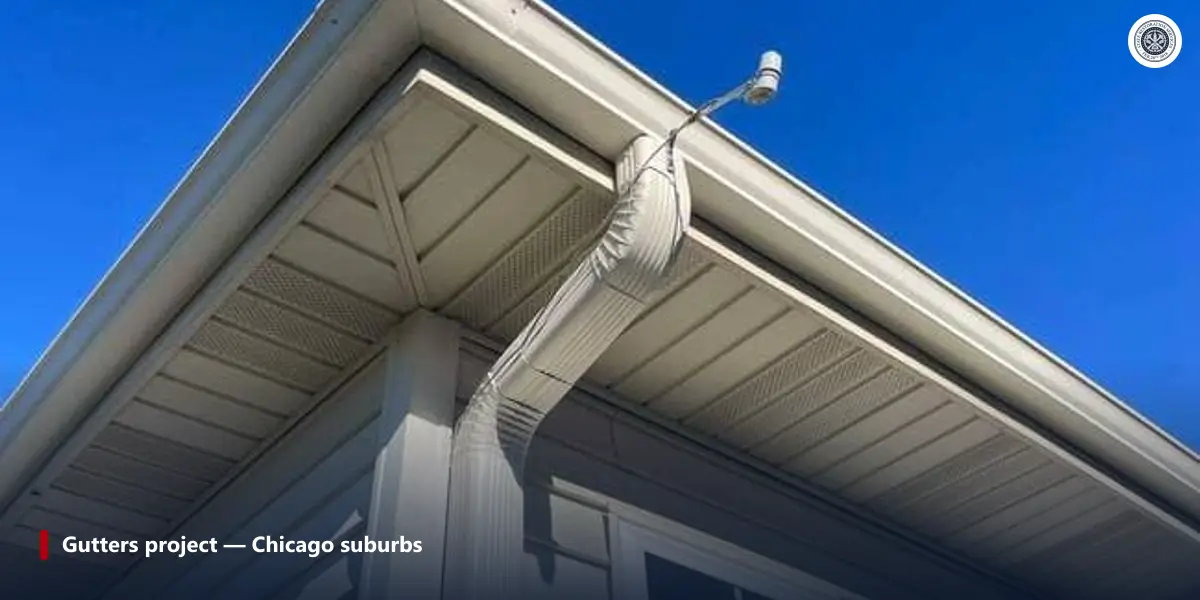
Reverse-curve guards work by surface tension pulling water around a curved nose. Dent that nose and the water stops following it, which means the guard now throws water over the front of the gutter in exactly the storms it was bought for. Micro-mesh panels are more forgiving of a dent but can be pushed out of their clips, and a dished aluminum frame lets debris sit where it used to slide off. Our honest take on gutter guards in the north suburbs goes through what each type is good for in the first place.
Downspouts are simpler arithmetic. A 2x3 downspout comfortably handles up to around 600 square feet of roof and a 3x4 handles closer to 1,200. Crush the 2-inch dimension to an inch and you have roughly halved the outlet on a run that was already sized to the roof above it. A halved outlet is a flow problem, and the downspout is one of the few gutter components where we will argue the functional case without hesitating. If your house sits at the edge of what a 2x3 can carry, the sizing question in 5-inch vs 6-inch gutters is worth reading before you replace like for like.
The endorsement that settles most of these arguments
A cosmetic damage exclusion is an endorsement some carriers now attach to a homeowners policy. It removes coverage for wind and hail damage that changes how something looks without changing how it works. Where one is in force, a dented gutter is denied by name, however obvious the dents are and however clearly the storm caused them.
This is not part of the standard HO-3 form that most homeowners policies are built on. It is added on top, usually as its own page in your declarations packet, with a title along the lines of "Cosmetic Damage Exclusion - Windstorm or Hail." Carriers have leaned on it more heavily in hail-exposed markets over the past several years, and the Midwest is one of them. We cannot tell you what your policy says. We can tell you that this page is where the answer lives, and that reading it before a storm is a great deal more pleasant than reading it after one.
If you find one, it narrows the argument rather than ending it. The exclusion turns on function, so a crushed downspout and a dished guard are still argued on that basis while the front-face dimples come off the table from the start.
Will new gutters match the ones already on the house?
Not exactly, and you should plan for that. Baked-enamel aluminum fades and chalks over a decade of Illinois sun, so a fresh run of the same catalog color will read a shade cleaner next to a twelve-year-old one. On a single elevation nobody notices. Around a corner where two runs meet in the same line of sight, people do.
Illinois has no matching statute and no insurance regulation requiring an insurer to replace undamaged material so that everything matches. That means the question falls back on your own policy's loss-settlement wording, usually a "like kind and quality" phrase, and on how your carrier chooses to read it. We went through this in detail for shingles in shingle color matching on a partial roof claim, and the reasoning transfers directly to gutter coil.
Two practical things help. Get the actual color name off the coil that is going up, not a description, so there is a record if another elevation needs work later. And ask to see a sample piece held against the existing run in daylight rather than under a garage light, because that is where a near-match either passes or fails.
What we do, and what Illinois law will not let us do
We come out, photograph every elevation, check the roof, the flashing, the vents and the gutters together, and write a code-compliant estimate you can hand to your carrier. Inspections are free and we schedule them during normal business hours, roughly Monday through Saturday. After a big storm we prioritize homes with active water coming in, so tell us if that is you.
Illinois law does not permit a roofing contractor to negotiate an insurance claim, and we do not work around that. Documenting the loss properly and pricing the repair correctly is most of what a carrier needs to see anyway. If you want somebody representing you on the claim itself, our affiliated licensed public adjuster, State Adjusting Services, can take that role. Our residential roofing and storm and insurance pages cover how a roof and a gutter scope get written together, and seamless gutter installation covers what a replacement run actually includes.
One more rule worth knowing, because it comes up every hail season. Under the Illinois Home Repair and Remodeling Act, a contractor may not advertise, promise, pay or rebate any part of your insurance deductible to win the work. Anyone offering to make your deductible disappear is showing you how they treat rules before you have signed anything. That is worth knowing.
Related reading: Hail damage on an asphalt roof: what it actually looks like and your roof insurance deductible in Illinois. More in our gutter guides.
Frequently asked questions
Does hail damage to my gutters mean my roof needs replacing?
No. Dented gutters prove hail reached your house and give a rough idea of how big it was. They say nothing about whether the shingles are finished. A roof gets paid when an adjuster counts enough hits inside a test square on the slopes themselves, and plenty of storms dent soft metal without doing that.
Can I just hammer the dents out of my gutters?
You can reshape a shallow dent in aluminum with a rubber mallet from behind, and on a front face that nobody can see from the ground it is a reasonable thing to do. Do not do it before an adjuster has inspected. Those dents are the physical record of the storm, and once they are gone you cannot get them back.
How long do I have to file a hail claim in Illinois?
Check your own policy, because the deadline lives there rather than in state law. On Illinois homeowners policies the window is commonly around one year from the date of the storm. Waiting also makes the claim harder to prove, because a second season of weather blurs which storm did what.
Will you handle the insurance claim for me?
Illinois law does not allow a roofing contractor to negotiate an insurance claim. We inspect, document every elevation with photos and measurements, and write a code-compliant estimate you can hand to your carrier. If you want somebody representing you on the claim itself, our affiliated licensed public adjuster, State Adjusting Services, can do that.
Dents in your gutters after a storm? Book a free inspection or call (866) 992-2982 — we serve the north and northwest Chicago suburbs, and we will tell you straight whether it is worth a claim.