
 Volodymyr Lukaniuk
Quick answer: A storm chaser is an out-of-town crew that follows hailstorms across the country, knocks doors for a few weeks, and is usually gone before your warranty would ever matter. Check for a local Illinois address, a license you can actually verify, and a track record before you sign anything — and never let anyone "handle your insurance claim" for you, since Illinois law doesn't let a roofing contractor negotiate a claim in the first place.
Storm chasers vs. a local roofer isn't a close call once you know what to look for, but right after a hailstorm hits the north and northwest Chicago suburbs, it doesn't feel that way. Your adrenaline's up, someone's already knocking, and they're telling you your insurance will "probably cover the whole thing" before you've even filed a claim. We've watched this cycle play out after every major hail event we've worked since 2018 — a wave of unmarked trucks and magnetic door signs shows up within 48 hours, and three months later, half of them are gone. We'd rather you know the difference before you sign a contract than after.
What exactly is a "storm chaser" roofing crew?
A storm chaser is a roofing operation that travels from state to state chasing hail and wind events, sets up temporary local presence for a few weeks or months, and moves on once the claims dry up. Some are licensed and do decent work; the real problem is that when your roof leaks in year three, there's no local office, no local crew, and often no company left to call.
Not every out-of-town crew is a scam — some legitimate regional companies do follow storm season because that's where the work is. The distinction that matters isn't "local vs. not local" on day one, it's whether there's still a business standing behind that roof five years from now. A magnetic sign on a truck door and a rented storage unit for materials aren't a company — they're a pop-up.
Why do storm chasers show up so fast after a hailstorm?
They show up fast because speed is the entire business model — get contracts signed before homeowners compare bids, get insurance checks written before anyone asks questions, and move to the next hail-hit town before warranty claims start rolling in. That urgency is the tell, not a coincidence.
We get calls from homeowners two days after a storm asking if it's normal that someone's already on their roof taking photos and offering a same-day signature discount. It's not that we're offended by fast service — we move quickly too when a storm hits our own service area. The difference is what happens after the contract's signed. A legitimate local roofer is quoting a job they'll be around to warranty. A storm chaser is often quoting a job designed to close before you've had a second opinion, which is exactly why they lean so hard on urgency: "sign today," "insurance is basically guaranteed," "we'll handle everything." That last line should always make you pause — see the claims-handling section below.
What are the actual warning signs of a storm chaser?
The clearest signs: no permanent local address, a magnetic sign instead of a lettered truck, pressure to sign the same day, a promise to "handle your insurance claim," and a company that didn't exist in this area before the storm and won't be findable after it.
- No verifiable local address. A P.O. box or a residential address that turns out to be a rented apartment isn't a business you can find in two years.
- Can't produce a real Illinois roofing license on request. Ask for the license number and check it — a legitimate contractor won't blink at the request.
- "We'll handle your whole insurance claim." Under Illinois law, a roofing contractor cannot negotiate an insurance claim on a homeowner's behalf. Anyone offering to do this either doesn't know the law or is ignoring it — neither is a good sign.
- Same-day contract pressure. "Sign today for the best price" on a five-figure decision is a pressure tactic, not a real deal.
- Upfront cash or a check made out to the contractor before any work starts. Reputable roofers get paid on a schedule tied to work completed, not entirely upfront.
- No references you can actually call. A real local roofer has neighbors, past customers, and Google reviews with names and dates attached — not a folder of stock photos.
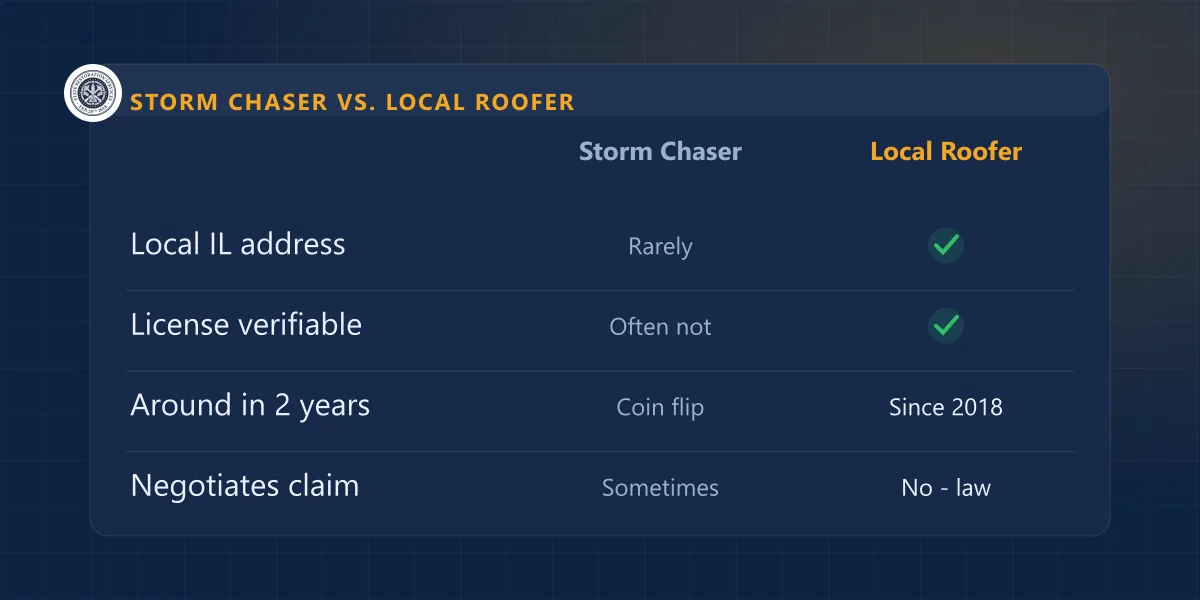
Storm chaser vs. local roofer: the honest comparison
| What to check | Typical storm chaser | Established local roofer |
|---|---|---|
| Local Illinois address | Rarely — often a rented space or none at all | Yes, a real office you can visit |
| License you can verify | Sometimes unlicensed or borrowed license | Yes, verifiable with the state |
| Track record in your area | New to town, no local history | Years of completed local jobs and reviews |
| Still around when the warranty matters | Often gone within a year | Yes — same company, same phone number |
| Offers to "handle" your insurance claim | Common pitch, often not legal in Illinois | Documents damage, refers claims work to a licensed public adjuster |
Can a roofer legally negotiate your insurance claim for you?
No — Illinois law does not allow a roofing contractor, local or otherwise, to negotiate an insurance claim on a homeowner's behalf. Any contractor who tells you they'll "handle everything with your insurance company" is either misunderstanding the law or ignoring it, and that's a real problem if your claim gets disputed later.
This rule exists to stop contractors from having a financial stake in how a claim gets negotiated, and honestly, it's a reasonable one. What a licensed roofer can do is document the damage, build an honest and complete estimate, and hand it to you and your insurer. If the claim needs an actual advocate — say, the adjuster's first number comes in low or a supplement gets pushed back — that's the job of a licensed public adjuster, which is why we work alongside our affiliate, State Adjusting Services, rather than trying to play that role ourselves. A storm chaser who promises to "take care of your insurance" is often crossing a line they shouldn't, and if that promise falls apart, you're the one left holding a half-negotiated claim and a contractor who's already left the state.
How do you vet a roofer before signing anything?
Ask for a physical local address, a verifiable Illinois license number, proof of insurance, and at least a few local references you can actually call. Then take 24 hours before signing — a legitimate contractor's price won't disappear overnight, no matter what the pitch says.
| Ask for | Why it matters |
|---|---|
| Physical business address | Confirms there's a real, findable company behind the truck |
| Illinois roofing license number | Lets you verify they're actually authorized to do this work here |
| Certificate of insurance | Protects you if a worker is injured on your property |
| Manufacturer certification (GAF, Owens Corning, IKO) | Confirms proper installation for a real material warranty, not just a paper one |
| Three local references with dates | Shows completed work you can actually verify, not a sales script |
We'd rather lose a bid to a homeowner who took an extra day to check us out than win one because someone felt rushed. If a company can't survive that 24-hour pause, that tells you something on its own.
Frequently asked questions
Is every out-of-town roofing crew a scam?
No. Some legitimate regional companies genuinely follow storm season, and a handful do quality work. The real test isn't where they're based on day one — it's whether there's still a real business behind that roof in five years when the warranty might actually matter.
Can a storm chaser legally handle my insurance claim for me?
No. Illinois law doesn't allow any roofing contractor, local or out-of-town, to negotiate an insurance claim on a homeowner's behalf. That job belongs to a licensed public adjuster. Any contractor who promises to "handle your whole claim" is making a promise the law doesn't let them keep.
What's the single biggest red flag after a hailstorm?
Pressure to sign a contract the same day, especially paired with a promise that insurance will "basically cover everything." A legitimate estimate and a real license number don't expire overnight — the urgency is usually the tell.
How do I check if a roofing license is real?
Ask the contractor for their license number directly and don't accept a vague answer. A roofer with nothing to hide will hand it over without hesitation, along with proof of insurance and a local address you can independently verify.
Just had a storm come through and someone's already knocking? Schedule a free inspection with a roofer who's actually local, and we'll give you an honest read on the damage before you sign anything with anyone. We've served Arlington Heights, Buffalo Grove, Northbrook, and the rest of the north and northwest Chicago suburbs since 2018, and our insurance claim and process pages explain exactly how we work a claim the right way. Related reading: what real hail damage looks like and filing a storm-damage roof claim in Illinois.