
 Volodymyr Lukaniuk
Quick answer: Hail damage on an asphalt roof usually looks like random, dark, irregular dents in the shingle mat, not a pattern. You'll see granules missing down to the black felt underneath, soft or bruised spots you can feel with your fingers, and matching dings on soft metal like vents, gutters, and downspouts. Cosmetic bruising alone often isn't a claim; damage that exposes the mat or breaks the seal usually is.
After almost every hailstorm that rolls through the north and northwest Chicago suburbs, we get the same call: "Someone knocked on my door and said my roof is destroyed, but from the driveway it looks fine — is that hail damage on my asphalt roof, or is this guy just trying to sell me something?" Fair question. Hail damage is genuinely hard to see from the ground, and it's just as easy to miss real damage as it is to get talked into a roof you don't need. Here's what we actually look for when we're up there.
What does hail damage look like on an asphalt shingle roof?
Real hail damage shows up as random, irregular bruises scattered across the roof — not a pattern, because hail doesn't fall in rows. On a shingle you'll see a soft dent you can feel when you press it, often with the granules knocked loose or missing entirely, exposing the black asphalt mat underneath. From the ground it can look like nothing at all; from six feet away with the sun at the right angle, it looks like the shingle has been sandblasted in spots.
The size and shape depend on the stone. Smaller hail (pea to quarter-size, roughly 3/4") mostly strips granules and leaves cosmetic bruising. Golf-ball-size hail and up (1.5" or bigger) is what tends to actually crack the mat, split the shingle, or knock a piece clean off. We've pulled shingles off roofs after a bad Lake County storm that had visible fractures you could see light through — that's not cosmetic, that's a hole waiting to leak.

Where else on the property does hail leave clues?
The roof isn't the only evidence. Check gutters, downspouts, window screens, roof vents, and AC fins — softer metal dents easier than shingles and tells you honestly whether the storm was strong enough to matter. If those are untouched, we're usually skeptical about roof damage too.
- Gutters and downspouts: small round dents, often on the upper, storm-facing side.
- Aluminum roof vents and flashing: soft metal bruises easily — this is often the clearest tell.
- Window screens and AC fins: bent mesh or crushed fins in a scatter pattern.
- Siding (if vinyl or aluminum): small cracks or dents, usually on the side the storm hit from.
- Granules in the gutters: a normal amount collects over years; a fresh pile after one storm is a signal, not proof on its own.
Hail damage vs. normal wear: how we tell the difference
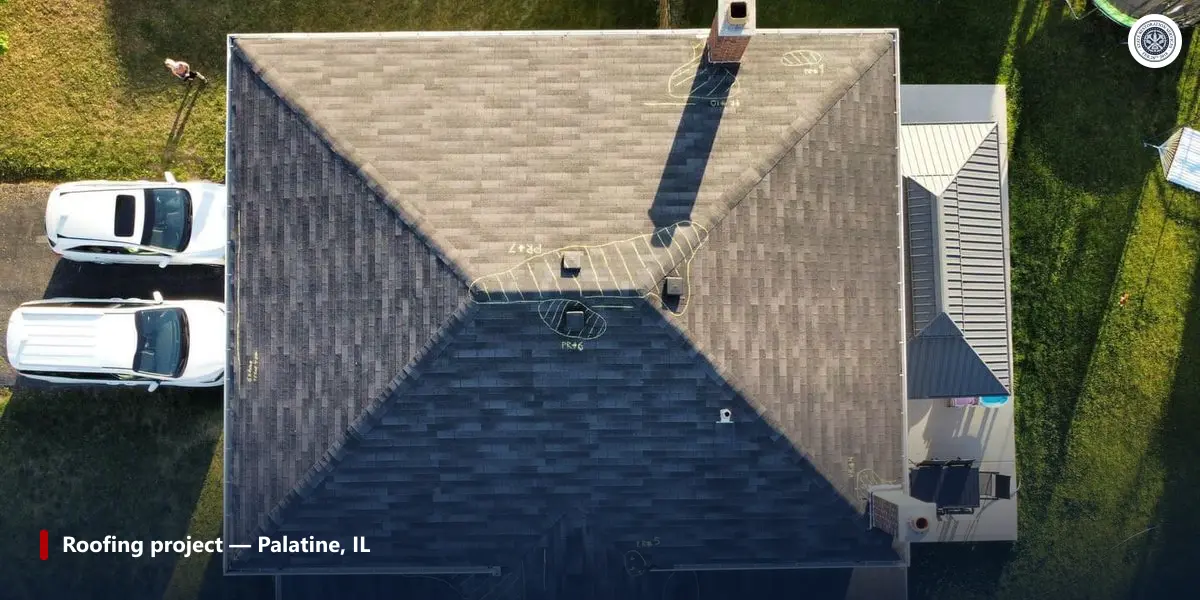
Normal wear is gradual, even, and follows the roof's age — granule loss spread evenly, curling at the edges, fading color. Hail damage is sudden, random, and doesn't respect a pattern; it shows up as isolated bruises you can trace to a specific storm date. We test-square a roof — mark off a 10-square-foot patch and count actual hits — rather than eyeballing the whole thing, because eight or more hits per test square is the rough threshold insurers and adjusters use to call it storm-related rather than age-related.
| Sign | Cosmetic (bruise only) | Functional (claim-worthy) |
|---|---|---|
| Granules | Some scattered loss | Stripped down to bare mat |
| Feel | Slightly soft spot | Cracked or split mat |
| Seal | Still intact | Broken, shingle can lift |
| Leak risk | Low, watch it | High, active or near-term |
| Typical outcome | Often not covered | Usually covered |
How big does hail have to be to actually damage a roof?
As a rule of thumb, quarter-size hail (about 1 inch) is where cosmetic bruising starts to show up on asphalt shingles, and golf-ball-size hail (1.5 inches) and larger is where you start seeing real, functional damage — cracked mats, torn tabs, punctures. Wind speed and the age of your shingles matter too: a 12-year-old roof takes a hit a lot harder than one installed two years ago.
You can check what actually fell over your address using the National Weather Service's Chicago office storm reports — it won't tell you your roof's condition, but it confirms whether a storm strong enough to matter actually hit your street, which is useful before you let anyone up on your roof.
When is hail damage actually worth an insurance claim?
It's worth filing when the damage is functional — exposed mat, cracked shingles, broken seals, or anything letting water in — not when it's a handful of cosmetic bruises on an otherwise sound roof. Illinois homeowners' policies generally give you a set window (commonly one year from the storm date) to file, so if a storm hit and you're not sure, it costs nothing to have it looked at before that window closes.
Here's where people get it wrong in both directions. Some homeowners sit on real, leaking damage for two years assuming their insurer won't care — the claim gets denied for being reported too late, unrelated to the actual damage. Others file for a few cosmetic dings on a roof that's otherwise fine, which can trigger a wasted adjuster visit or, on architectural shingles, an outright denial since many carriers no longer pay for cosmetic-only hail damage. The honest answer is usually in between: get an inspection, find out which category you're actually in, then decide.
One more Illinois-specific detail worth knowing: a roofing contractor legally cannot negotiate your insurance claim for you — we can document damage and hand you a code-compliant estimate, but if you need someone to push back on a lowball adjuster number, that's the job of a licensed public adjuster, and our partner firm, State Adjusting Services, does exactly that.
What actually happens once you file a hail damage claim?
You report the claim, your insurer sends an adjuster to inspect, and — assuming the damage qualifies — they issue an estimate and a payment (often ACV first, with the depreciated amount recoverable after the work is done, under an RCV policy). Where it gets contentious is the adjuster's number: a ten-minute walk-around from the ground or a quick look with binoculars can miss real damage, especially on a roof with two or three layers of shingles or steep pitch sections nobody wants to climb.
| Step | What happens | Who's involved |
|---|---|---|
| 1. Document | Roof inspected, photos and test squares taken | Your roofer |
| 2. File | Claim opened with your carrier | You + insurer |
| 3. Adjust | Insurance adjuster inspects, writes estimate | Insurer's adjuster |
| 4. Reconcile | If the numbers don't match, negotiate the scope | Public adjuster (if needed) |
| 5. Repair | Approved work gets built to code | Your roofer |
That's also where storm chasers do their worst work — the door-knocker crews who show up two days after a storm, offer a "free roof" nobody in Illinois can actually promise, and are back in Texas by the time your shingles start leaking. If you want the longer version of how to tell a legitimate local roofer from a chaser, we cover it in a companion piece on RCV vs. ACV claim payouts, which explains why the “free roof” pitch rarely survives contact with your actual policy.
Frequently asked questions
Can I check for hail damage myself without getting on the roof?
You can get a good first read from the ground: check gutters, downspouts, roof vents, window screens, and AC fins for dents, and look at the shingles with binoculars in raking light. That tells you whether a storm was strong enough to matter, but it won't catch cracked mats or broken seals — for that, you need someone walking the actual roof.
Does hail damage always mean I need a full roof replacement?
No. A lot of hail damage is a repair — replacing individual damaged shingles and resealing tabs. Full replacement usually comes into play when the damage is widespread across multiple slopes, the roof was already near the end of its life, or your insurer's own estimate calls for full replacement because matching shingles aren't available.
Will my insurance rates go up if I file a hail damage claim?
Storm and weather-related claims are typically treated differently than claims caused by neglect, and a single legitimate hail claim usually has a smaller effect than people assume — but every carrier is different, so it's worth a quick call to your agent to ask directly rather than guessing.
How long do I have to file a hail damage claim in Illinois?
Most Illinois homeowners' policies set a filing window, commonly around one year from the date of the storm, though the exact language varies by policy. If a storm hit your area and you're unsure whether you're covered or damaged, get it checked well before that window closes.
Not sure if that last storm actually did anything to your roof? Book a free inspection and we'll walk it, test-square it, and give you an honest answer — no pressure, no door-knocking. We serve the north and northwest Chicago suburbs, including Arlington Heights, Buffalo Grove, and Northbrook. Related reading: what a new roof actually costs in the Chicago suburbs and RCV vs. ACV explained. Questions before then? Contact us any time.