
 Volodymyr Lukaniuk
Quick answer: A full roof replacement in the Chicago suburbs runs roughly $9,000–$18,000 for a standard architectural asphalt shingle roof on an average single-family home in 2026, and $20,000+ for standing-seam metal. Tear-off, decking repairs, steep pitch, and material choice are what actually move that number.
"What's a new roof going to cost me?" is the first question almost every homeowner asks when we walk their property, and it's a fair one — a roof is one of the biggest checks you'll ever write on your house. The honest answer to roof replacement cost in the Chicago suburbs is a range, not a number, because your price depends on your roof's size, pitch, current condition, and the material you pick. Below are the real 2026 ranges we see across Lake and Cook County, plus exactly what pushes a bid toward the low end or the high end.
How much does a roof replacement cost in the Chicago suburbs?
For a typical single-family home with a standard-pitch roof, a full tear-off-and-replace with architectural (dimensional) asphalt shingles runs about $9,000–$18,000 installed in 2026, or roughly $450–$1,150 per "square" (100 sq. ft. of roof). Premium designer shingles push that to $18,000–$28,000. Standing-seam metal typically starts around $20,000 and climbs from there. These are installed totals — materials, labor, tear-off, disposal, and permits — not material-only pricing.
| Roofing material | Installed cost (avg. home) | Typical lifespan |
|---|---|---|
| Architectural asphalt shingles | $9,000 – $18,000 | 25–30 years |
| Premium / designer asphalt shingles | $18,000 – $28,000 | 30+ years |
| Standing-seam metal | $20,000 – $40,000+ | 40–60 years |
| Flat roof (TPO/EPDM, additions & garages) | $6,000 – $14,000 | 20–30 years |
If you only want the raw price of shingles and underlayment, we've broken that down separately in our roofing material cost guide — this article is about the installed, out-the-door number.
What's actually included in that price?
A properly installed roof isn't just shingles nailed to plywood — it's a system, and every piece of that system is in your quote whether you notice it or not. On a typical 20–24 square home in the north and northwest suburbs, here's roughly where the money goes.
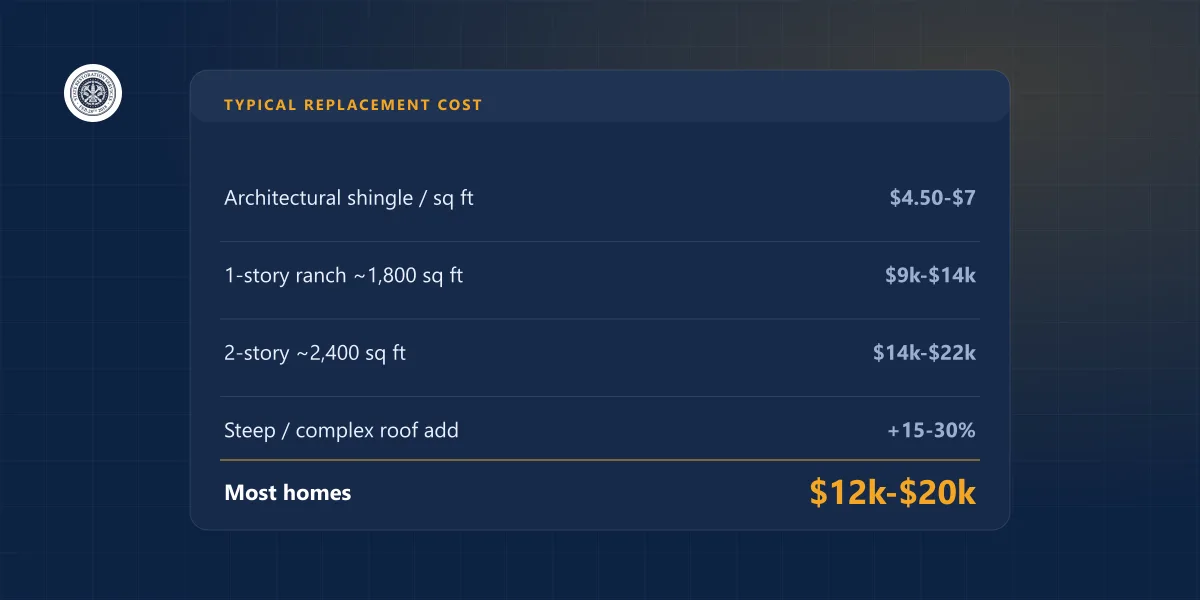
Tear-off and dump fees, a full GAF, Owens Corning, or IKO shingle system with synthetic underlayment and ice-and-water shield (non-negotiable in Illinois — more on that below), the labor to actually install it correctly, and the permit your municipality requires. Skip any one of those and you didn't get a real roof, you got a cheaper version of one.
What actually drives your price up or down?
Two houses of the same size can get bids $4,000 apart, and it's almost never random. The roof's pitch, how many layers are coming off, what's underneath the old shingles, and how hard the crew has to work to get material up there all move the number.
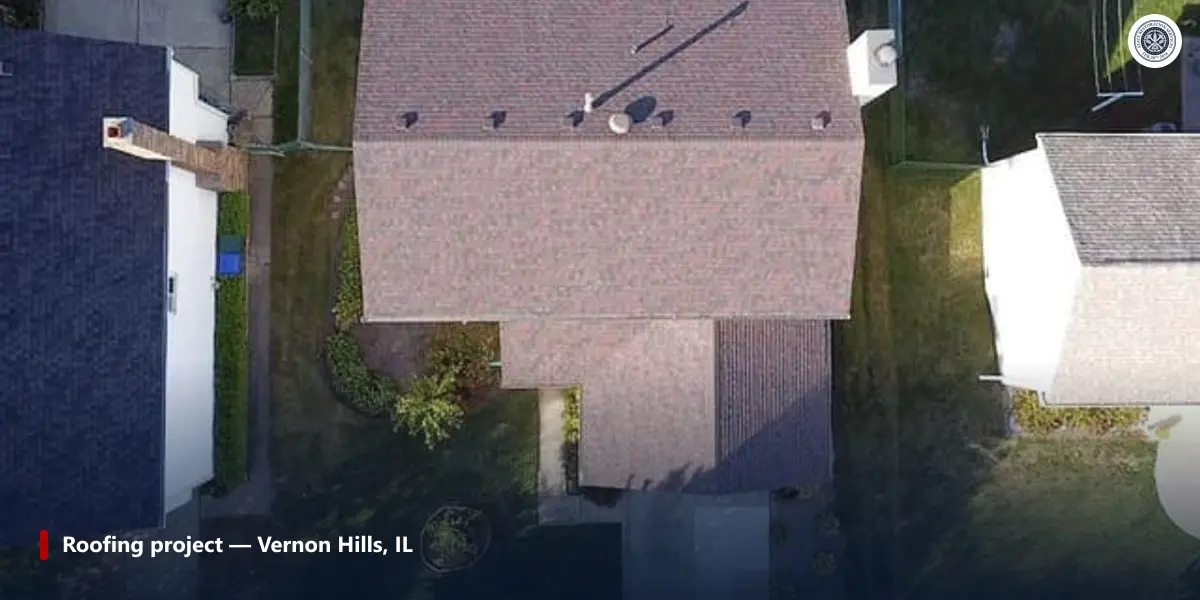
Pitch and complexity. A steep or cut-up roof (lots of valleys, dormers, hips) takes longer, needs more safety gear, and wastes more material to cut around. Layers. If you've already got two layers of shingles up there, Illinois code generally requires stripping down to the deck — that's extra labor and dump fees a single-layer tear-off doesn't have. Decking. Rotten or soft plywood under the old shingles has to be replaced before a new roof goes on; we won't nail a warranty-backed roof to bad wood, and neither should anyone else. Access. A roof boxed in by a tight side yard, power lines, or a pool costs more to stage than a wide-open lot.
Why does ice-and-water shield add to my bid — can I skip it?
No, and here's why: Illinois winters mean ice dams, and ice-and-water membrane at the eaves, valleys, and penetrations is what actually keeps meltwater from backing up under your shingles and into your ceiling. It typically adds a few hundred dollars to the job. Skipping it to save money is the single most common shortcut we see on a lowball bid, and it's the one that causes the $3,000 ceiling repair two winters later.
Is a much cheaper quote ever a good sign?
Occasionally — but treat a bid that's thousands under everyone else's as a question, not a gift. We've all seen the door-knocker who rolls into a neighborhood the week after a hailstorm, offers a "$99 whole roof" special, and is back in Florida by the time the shingles start sliding off. A real, local, licensed crew prices in code-required underlayment, proper flashing, disposal, and a workmanship warranty they'll actually still be around to honor. If a number looks too good, ask what's missing — it's usually the ice-and-water shield, the permit, or the cleanup.
| What a real bid includes | What a lowball bid often skips |
|---|---|
| Ice-and-water shield at eaves & valleys | Felt paper only, or none |
| New flashing at chimneys, walls, vents | Reused old flashing |
| Permit & municipal inspection | Unpermitted work |
| Written workmanship warranty | Verbal promise, no paperwork |
Does insurance ever cover roof replacement cost?
Yes, if the damage is from a covered event like wind or hail — not from age or wear. If a storm is the cause, your homeowner's policy may cover most or all of the replacement cost, minus your deductible. Illinois law doesn't allow a roofing contractor like us to negotiate your claim on your behalf; we document the damage and build a code-compliant estimate, and our partner, the licensed public adjuster State Adjusting Services, can represent you directly with the carrier so the payout actually matches the real cost of the work.
If your roof is aging out rather than storm-damaged, that's an out-of-pocket project, and it's worth asking about financing options that spread the cost over time instead of draining savings in one shot.
How do I get an accurate number for my own roof?
Square footage, pitch, and material choice all have to be measured against your actual roof, not a national average. We walk every roof in person, get on it when it's safe to, and give you a written price based on what we find — not a phone-quote guess. See our inspection and installation process or browse residential roofing for the systems we install. We're based in Lincolnshire and work throughout Lake and Cook County, including Arlington Heights and Northbrook.
Frequently asked questions
How much does a new roof cost in the Chicago suburbs in 2026?
Most homes with standard architectural asphalt shingles land between $9,000 and $18,000 installed. Premium shingles run $18,000–$28,000, and metal roofing typically starts around $20,000. Your exact number depends on roof size, pitch, and how much of the old roof needs to come off first.
Why do roof replacement quotes vary so much between contractors?
The biggest gaps usually come from what's included, not the labor rate. A bid that skips ice-and-water shield, new flashing, permits, or disposal will look cheaper on paper but isn't pricing the same job as a full, code-compliant replacement.
Is it cheaper to repair my roof instead of replacing it?
For small, isolated damage, yes — a repair can run a few hundred to a couple thousand dollars. But if your roof is past 20 years old or has widespread wear, repeated repairs often cost more over a few years than one properly done replacement.
Will my homeowner's insurance pay for my roof replacement?
Only if the damage is from a covered event like a windstorm or hailstorm, not normal aging. A roofing contractor can't negotiate the claim for you under Illinois law, but a partner licensed public adjuster can represent you with the insurance company.
Thinking about your roof? Book a free inspection or call (866) 992-2982 — we serve the north and northwest Chicago suburbs.
Related reading: How much is roofing material? and what's included in a roof replacement.