
 Volodymyr Lukaniuk
Quick answer: Usually yes if something sudden started it — wind, hail, a branch through the deck. Usually no if the roof simply wore out, because wear and tear is excluded. But even when your policy will not pay a dollar toward the roof itself, it normally still pays for the ceiling, insulation and floors the water ruined on the way through.
Does homeowners insurance cover a roof leak? We get that call more than any other, usually from somebody standing in a hallway with a bucket under a brown ring. The answer turns on one thing: what started it. Wind that peeled shingles back in an April storm is a different conversation from a twenty-six-year-old roof that finally gave up in a slow drizzle — even though the stain on the ceiling looks the same either way.
We have been doing roofing and storm work out of Lincolnshire since 2018, across Lake and Cook County, and we read a lot of denial letters. Most of them are not the carrier being difficult. They are the carrier applying two or three sentences that were in the policy the whole time and that almost nobody reads until there is water coming in. So this guide quotes those sentences from the actual homeowners form — the standard ISO HO-3 your policy is almost certainly built on — and then covers what Illinois adds on top.
Does homeowners insurance cover a roof leak?
Usually yes for sudden accidental damage, and no for age. A standard HO-3 insures your house against everything except what the policy specifically takes away, so the burden is on the carrier to name an exclusion. Wear and tear is the exclusion that stops most roof-leak claims, and it stops them before anyone argues about price.
The wording on the dwelling is one line: “We insure against direct physical loss to property described in Coverages A and B.” That is open perils. Nobody has to prove your leak was caused by a listed event. Your personal property — Coverage C, the furniture and the electronics — works the opposite way, off a named list of sixteen perils. Two different tests inside one policy, and a lot of bad advice comes from applying the contents rule to the house.
So a claim rarely turns on whether the roof leaks. It turns on whether the carrier can point at a sentence that removes your particular cause. Here is where the common ones land.
| What actually happened | Usually covered? | The words that decide it |
|---|---|---|
| Wind peeled shingles back or off | Yes | Open perils, no exclusion fits |
| Hail split the shingle mat | Yes | Open perils, no exclusion fits |
| A limb punched through the deck | Yes | Open perils, no exclusion fits |
| Ice dam forced water under the shingles | Usually | Not excluded — but expect a maintenance argument |
| Pipe-boot collar cracked with age | No | “Wear and tear, marring, deterioration” |
| Chimney flashing sealant dried out | No | Wear and tear, and faulty maintenance |
| Valley packed with debris, water backed up | No | Faulty, inadequate or defective maintenance |
| Roof installed wrong three years ago | No | Faulty workmanship — go back to the installer |
| Twenty-six-year-old roof failing all over | No | Wear and tear |
What does “wear and tear” actually mean on a roof?
In the policy it is three words with no definition attached: “Wear and tear, marring, deterioration.” On a roof it means the failure the shingles were always going to have — granules gone, mats brittle, sealant strips let go, nail heads backed out, boot collars split. Age is not the legal test, but it is the evidence everyone reaches for first.
There is a second exclusion sitting right next to it. The form also removes loss caused by “faulty, inadequate or defective … maintenance” and, separately, faulty “workmanship, repair, construction, renovation, remodeling.” Between those two, a roof nobody ever looked at and a roof somebody installed badly both land outside coverage. The workmanship half matters more than people expect: if a three-year-old roof is leaking at the step flashing, the money is with the contractor who put it on, under their workmanship warranty, and not with your insurer.
What an adjuster is doing on the roof is separating one event from twenty years of weather. Directional damage on the storm-facing slope reads as an event; uniform granule loss on all four slopes reads as a roof reaching the end of its life. Ice dams sit in the middle, because the water intrusion is not excluded but the attic heat leak behind the dam is arguably maintenance — which is why the attic side of an ice dam fix matters for coverage as much as for comfort.
Why did my insurer pay for the ceiling but not the roof?
Because of one sentence most homeowners never see. Right after the exclusions, the form says: “any ensuing loss to property described in Coverages A and B not precluded by any other provision in this Policy is covered.” The worn-out roof is excluded. The damage the water did on its way through the house is not, and that clause appears twice — once after wear and tear, once after faulty maintenance.
So a check arrives for the drywall, the paint, the ruined batt insulation, the trim, sometimes the flooring and the contents underneath. And nothing arrives for the roof. We have watched people open that envelope, see a number around a few thousand dollars, and assume the carrier is paying for the roof in stages. It is not. That money is for the hole in the ceiling, and the roof above it is still yours to solve.
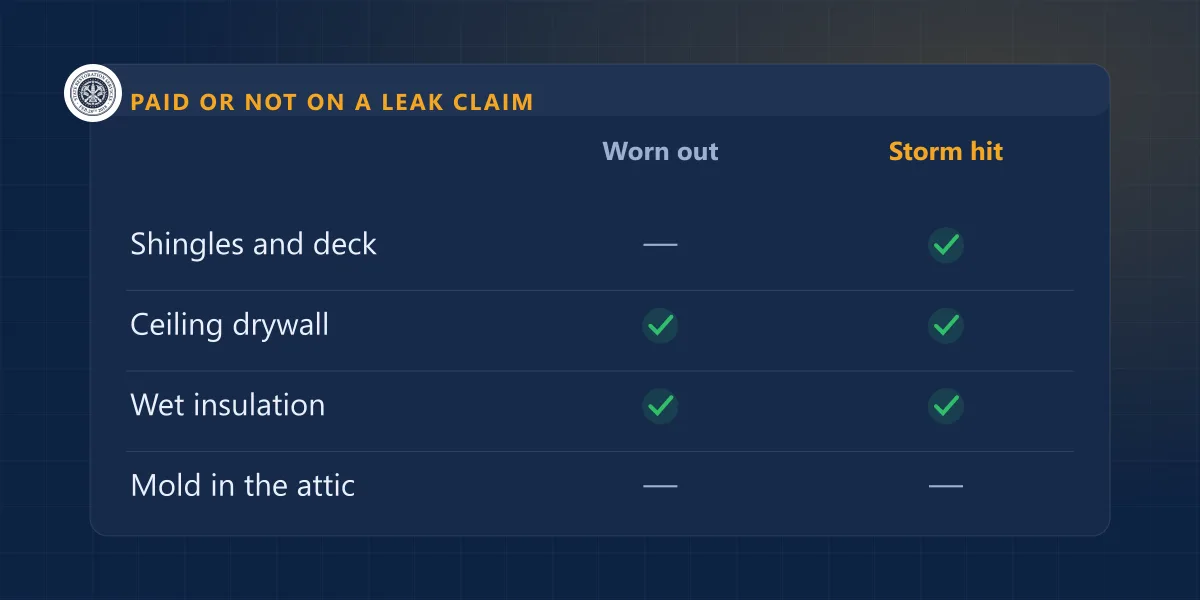
Repair the ceiling before the roof and you will be repairing the ceiling again next spring. Anyone booking the interior repair should have a plan for the roof in the same week, which is most of what our residential roofing crews do between storms.
Does the rain have to come in through a hole the wind made?
For your furniture, yes. For the house itself, no. That rule appears exactly once in the HO-3 form, and it sits under Coverage C — personal property. It does not govern Coverage A, which is the building. If somebody quotes it at you about the roof deck, they are quoting the wrong half of the policy.
The actual text, under the Windstorm Or Hail peril for personal property: “This peril does not include loss to the property contained in a building caused by rain, snow, sleet, sand or dust unless the direct force of wind or hail damages the building causing an opening in a roof or wall and the rain, snow, sleet, sand or dust enters through this opening.”
So your soaked sofa is only covered if wind or hail actually opened the roof; wind-driven rain that works its way through a tired but intact roof does not get the sofa paid for. The dwelling is judged on the open-perils test and the exclusions above instead, and no visible hole is required.
One honest caveat, and it is the reason to go find your declarations page: not every homeowner in Illinois has an HO-3. An HO-2 named-perils form, or a dwelling-fire policy on a rental, can apply that opening rule to the building itself. The form number is printed on the declarations page. It takes ten seconds, and it decides which of the answers above apply to you.
Is mold from a roof leak covered by insurance?
Almost never, and this is the one that costs people real money. The form excludes “mold, fungus or wet rot,” then carves out a single exception: hidden mold inside walls, ceilings or floors, but only where it results from an accidental discharge of water or steam from a plumbing system, heating system, air conditioning, a fire sprinkler, or a household appliance. A roof is none of those things.
The same paragraph shuts one more door that people expect to be open. Three separate times, the form specifies that a plumbing system “does not include a sump, sump pump or related equipment or a roof drain, gutter, downspout or similar fixtures or equipment.” An overflowing gutter that soaks the fascia for two winters is not a plumbing discharge, so the rot behind it is not the exception either — it is maintenance, which is why we spend so much time on gutters and downspouts and on how soffit and fascia actually fail.
That is also why the timing matters so much. A stain you catch in week one is a drywall repair, and drywall repair is ensuing loss the policy will usually pay. The same leak left through a humid Illinois summer turns into a mold problem the policy explicitly will not pay, and the whole cost moves from your carrier to you.
What do I have to do the moment I find water coming in?
Three things, and two of them are contractual obligations rather than good advice. Give prompt notice to your insurer. Protect the property from further damage and keep receipts for whatever you spend doing it. Photograph everything before you touch it. The form is explicit that failing the middle one can cost you coverage.
Under Duties After Loss you must “protect the property from further damage” and, if repairs are needed, “make reasonable and necessary repairs to protect the property” and “keep an accurate record of repair expenses.” Doing nothing has its own exclusion, called Neglect: “neglect of an ‘insured’ to use all reasonable means to save and preserve property at and after the time of a loss.” Going the other way, the Reasonable Repairs provision has the carrier pay the reasonable cost of measures taken solely to protect covered property from further damage — so a tarp after a storm is generally reimbursable, while a tarp over a roof that simply wore out generally is not. You still put the tarp on.
- Photograph the ceiling, the stain, the attic and the roof from the ground before anything is moved or dried.
- Move furniture and electronics out from under it; a wet ceiling drops without warning.
- If a ceiling is bulging with trapped water, put a bucket underneath and pierce the low point so it drains in one place instead of collapsing across a room.
- Call your insurer and open the claim, even if you expect a denial. The report date starts every clock in the next section.
- Keep every receipt — tarps, plastic, fans, the service call.
- Call a roofer for a tarp and a real look at the cause. We work normal business hours, roughly Monday to Saturday 8 to 6, and we prioritize storm calls inside those hours.
How long does my insurer have to decide, and how long do I have?
Illinois puts clocks on both sides, and they are enforceable. Your insurer has to affirm or deny within a reasonable time and offer payment within 30 days of affirming liability. If a homeowners claim is still unresolved past 75 days from the date you reported it, or 25 days after your proof of loss, whichever comes first, it owes you a written explanation for the delay.
| Clock | How long | Where it comes from |
|---|---|---|
| Payment offered after the carrier affirms liability | 30 days | 50 Ill. Adm. Code 919.50(a) |
| Written explanation when the claim drags | 75 days from report, or 25 days after proof of loss — whichever is less | 50 Ill. Adm. Code 919.80(b)(7)(B) |
| You return a signed, sworn proof of loss after it is requested | 60 days | HO-3, Duties After Loss |
| You can bring suit on the policy | 2 years from the date of loss | HO-3, Suit Against Us |
| That 2-year clock is paused | From proof of loss until the claim is denied | 215 ILCS 5/143.1 |
That last row is the one worth remembering. Illinois law says that where a policy limits the time to sue, “the running of such period is tolled from the date proof of loss is filed, in whatever form is required by the policy, until the date the claim is denied in whole or in part.” A carrier cannot run your two years out by sitting on the file — but the tolling only starts if you actually filed the proof of loss the policy asked for. File it, and keep proof that you filed it.
The delay-letter rule has a detail people miss too: the regulation requires that “Notice of Availability of the Department of Insurance shall accompany the written explanation to the insured.” If a claim of yours has gone quiet for months and no such letter ever arrived, that itself is worth raising when you file a complaint with the Illinois Department of Insurance. It costs nothing, the Department states that Illinois law allows the insurer 21 days to respond, and it asks consumers to allow four to six weeks for the investigation.
My roofer’s estimate is thousands more than the adjuster’s. Now what?
Illinois has a rule written for exactly that situation and hardly anybody uses it. If you produce your own written estimate showing the repairs will cost more than the insurer’s figure, the company has to respond to you in writing and name a contractor who will do the work in a workmanlike manner for its number. If it will not name one, it has to tell you in writing that it will reimburse your reasonable excess costs.
The text, from 50 Ill. Adm. Code 919.80(b)(7)(C), is worth quoting because it is short and specific: the company “shall review and respond promptly in writing to the insured in regard to his written estimate and provide the insured with the name of a repair shop or contractor that will make the repairs in a workmanlike manner. Failure of the company to so inform the insured of the name of a contractor shall require the company to provide written notice to the insured that any and all reasonable costs incurred for repair or replacement related to the partial loss in excess of the company’s estimate will be reimbursed.”
Two things make that rule usable. Your estimate has to be written, and it has to be itemized well enough to compare line for line against theirs — which is the whole point of reading a roofing estimate properly before you send it anywhere.
Now the part every homeowner here should understand, because storm season fills the north suburbs with people cheerfully offering to do it for you. Illinois defines adjusting a claim as “negotiating values, damages, or depreciation or applying the loss circumstances to insurance policy provisions,” and the Public Adjusters Article says nobody may do that without a public adjuster license. There is an exemption for estimators and engineers, but read it carefully — it covers a person furnishing technical assistance to a licensed public adjuster. So the door-knocker promising to “handle your insurance for you” is describing licensed work, and that license is usually the one document they cannot produce.
| On your claim | Your roofer | Licensed public adjuster | You |
|---|---|---|---|
| Inspect, photograph and document the damage | Yes | Yes | Yes |
| Write an itemized construction estimate | Yes | Yes | No |
| Meet the adjuster on the roof and point out damage | Yes | Yes | Yes |
| Negotiate values, damages or depreciation | No | Yes | Yes |
| Apply your loss facts to your policy provisions | No | Yes | Yes |
| Pay, rebate or waive your deductible | No | No | — |
That is why we do the top three rows and hand the next two to State Adjusting Services, the licensed public adjuster we are affiliated with. We document the roof and price the repair; they are the ones licensed to argue depreciation and policy language. Our storm and insurance claim page sets out how the two roles fit together, and the licensing and insurance checklist covers the deductible rule and the cancellation rights that come with an insurance-funded contract.
What does the repair cost if it turns out not to be covered?
Most non-storm leaks cost less than the deductible, and that is worth working out before you call the carrier. A cracked pipe-boot collar is $250–$450. New step, valley or counter-flashing is $300–$1,200. The three to six sheets of soft decking a twenty-year-old roof usually hides is $225–$720. Against a 1% wind-and-hail deductible of $3,500 on a home insured for $350,000, none of that is a claim worth filing.
| The actual repair | Typical cost in the north and northwest suburbs | Worth filing? |
|---|---|---|
| Pipe boot replaced, first one on the trip | $250–$450 | No |
| Each additional boot, same visit | $100–$200 | No |
| New step, valley or counter-flashing | $300–$1,200 | No |
| Skylight reflashed, unit still good | $350–$700 | No |
| Decking, typical find of 3–6 sheets | $225–$720 | No |
| Full architectural shingle replacement | $9,000–$18,000 | Only if a storm caused it |
There is a second reason to think before filing a small one. A claim that pays nothing still sits on your loss history, and a filed roof claim can follow you into renewal pricing for years — we go through the deductible arithmetic in detail in your roof insurance deductible in Illinois. A $400 boot on a $3,500 deductible buys you a file note and no money.
The one case where filing is obvious: a storm went through, the damage is directional, and the repair is well above your deductible. That is the claim the policy was sold for, and it is the one we document every week.
Related reading: Filing a storm-damage roof claim in Illinois, step by step and what hail damage on an asphalt roof actually looks like.
Frequently asked questions
Does homeowners insurance cover a roof leak from an old roof?
Generally no. A leak that comes from age — brittle mats, lost granules, split boot collars, failed sealant — falls under the policy’s wear and tear exclusion, and a roof that was never maintained can also fall under the faulty maintenance exclusion. The interior damage the water caused is usually still covered.
Will insurance pay to fix my ceiling if it will not pay for the roof?
Usually yes. The homeowners form covers ensuing loss that is not itself excluded, so drywall, paint, insulation, trim and often flooring get paid even when the roof does not. Mold is the exception: it is excluded, and the exception for hidden mold applies only to plumbing and appliance leaks.
How long do I have to file a roof insurance claim in Illinois?
Report it as soon as you find it. The standard homeowners form gives you two years from the date of loss to sue on the policy, and Illinois law pauses that period from the date you file your proof of loss until the claim is denied. Waiting also risks a denial for failing to protect the property.
Can my roofer negotiate with my insurance company for me?
No. Illinois defines negotiating values, damages or depreciation and applying loss facts to policy provisions as adjusting a claim, which requires a public adjuster license. A roofer can inspect, document and write a construction estimate, and meet your adjuster on the roof. Anything beyond that needs a licensed public adjuster.
Water coming through the ceiling? Book a free inspection or call (866) 992-2982 — we will tell you what caused it and whether it is worth a claim, and we serve the north and northwest Chicago suburbs Monday through Saturday.