
 Volodymyr Lukaniuk
Quick answer: A legitimate roofing estimate breaks out every major cost — tear-off and disposal, decking repair, underlayment, ice-and-water shield, drip edge and flashing, the shingle system itself, ventilation, permit, and cleanup — with a real number next to each one. If a bid is a single lump total with vague phrases like “as needed” or “code compliance fee,” you can't tell what you're actually paying for, and that's exactly where markups and skipped scope hide.
We read a lot of other contractors' paperwork, because a good chunk of the roofing estimates that land on our kitchen table are homeowners asking us to sanity-check one they already got from somewhere else. The good ones are almost boring to read — line after line of specific materials and specific prices. The bad ones are one paragraph and one number. Learning how to read a roofing estimate the way we do takes about ten minutes, and it's one of the cheapest forms of insurance you can buy against paying for a job that isn't the job you were promised.
What should a real roofing estimate include, line by line?
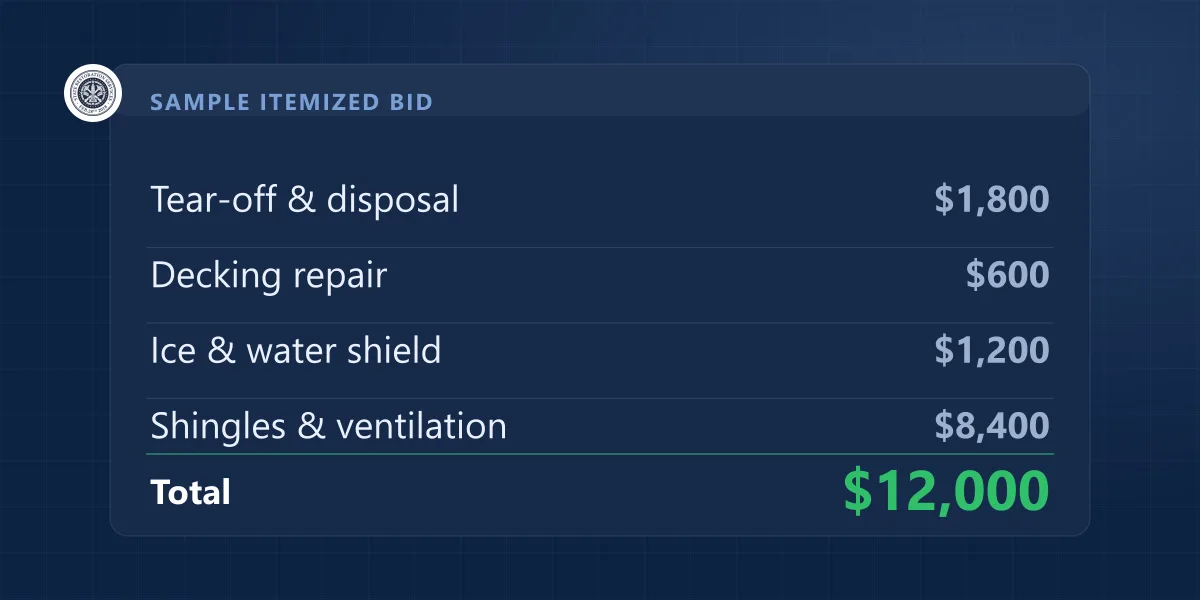
A complete estimate lists eight to ten separate cost categories instead of one bundled price: tear-off and disposal, decking inspection and repair, underlayment, ice-and-water shield, drip edge and flashing, the shingle or metal system with the manufacturer named, ventilation, permit, and cleanup. Each line carries either a firm price or a clearly stated unit price for anything that depends on what turns up once the old roof comes off.
| Line item | What it should specify |
|---|---|
| Tear-off & disposal | Number of dumpster loads or a flat local-disposal fee, not just “removal” |
| Decking | A per-sheet price for any plywood found rotted, not a vague allowance |
| Underlayment & ice-and-water shield | Which product, and where code requires it (eaves, valleys, penetrations) |
| Drip edge & flashing | Whether step flashing, counter flashing, and drip edge are included or priced separately |
| Shingle or metal system | Manufacturer and product line named, not just “architectural shingles” |
| Ventilation | Ridge and soffit vents specified, and whether existing vents are reused or replaced |
| Permit | Listed as its own line item, not folded quietly into labor |
| Cleanup | Magnetic nail sweep and yard cleanup named, not assumed |
What are the vague line items that actually hide the real price?
The riskiest wording on any estimate isn't a high number — it's no number at all. Phrases like “as needed,” “per current code,” or “tear-off included” without a dollar figure attached let a contractor fill in the blank after you've already signed, which is exactly the moment you have the least leverage to push back.
A decking allowance written as “replace as needed” with no per-sheet price can turn a $9,000 job into $12,000 once the roof is open and you're being billed at whatever rate they choose that day. A flat “code upgrade fee” that isn't broken into the actual items driving it — drip edge, ice-and-water shield extension, extra ventilation — is impossible to check against what your municipality actually requires. “Tear-off and disposal included” sounds generous until you realize it's hiding the dumpster fee, which changes depending on how many layers of old shingles are coming off. And an estimate with no permit line at all often means no permit is getting pulled, which can come back to bite you at resale or if an inspector ever looks at the roof for an unrelated reason.
How do you compare two estimates that use completely different wording?
Normalize both bids into the same eight or nine cost categories before you compare a single dollar figure, then ask each contractor the identical specific questions — their per-sheet price for rotted decking, the manufacturer and product line by name, whether the permit fee is included or separate. Comparing bottom-line totals alone tells you almost nothing, because a $2,000 gap usually means one bid dropped an entire category, not that one contractor is simply cheaper.
Get every verbal promise put in writing before you sign anything. If a salesperson tells you “don't worry, we'll take care of the decking,” that sentence needs to become a line item with a number, or it isn't a commitment — it's a sales pitch. We'll write a per-sheet decking price into every estimate we hand a homeowner precisely so nobody's guessing what happens if we find rot once the tear-off starts.
What red flags mean you should ask more questions before signing?
- No permit line item anywhere on the estimate
- No per-sheet or per-unit price listed for decking replacement if damage is found
- Manufacturer and product line never named — just “shingles” or “architectural shingles”
- No workmanship warranty length stated in writing
- A deposit larger than about a third of the total due before any work starts
- Heavy pressure to sign the same day, especially right after a storm
That last one is a specialty of the out-of-town storm-chaser crews that roll through after every hailstorm with a truck, a magnetic sign, and a contract they need signed before they leave the neighborhood. A local roofer who's going to be here for your next roof, and the one after that, doesn't have the same reason to rush you past reading your own paperwork.
What's a fair price range for each line item in the Chicago suburbs?
For an average-size asphalt roof in our service area, a full itemized estimate typically lands between $9,000 and $18,000 depending on pitch, layers, and material grade, broken out roughly as: tear-off and disposal $1,000–$2,500, decking repair $75–$120 per sheet if any is needed, underlayment and ice-and-water shield $800–$1,800, drip edge and flashing $400–$900, the shingle system itself $5,000–$10,000, ventilation $300–$700, and a municipal permit $150–$400.
Those ranges shift with your specific municipality's permit fees, how steep and how cut-up your roof is, and which manufacturer's system you choose. None of that replaces a real inspection — we walk every roof before we put a number on paper, because guessing at decking condition from the ground is how estimates turn into surprises.
Frequently asked questions
What's the biggest red flag on a roofing estimate?
No permit line item and a lump-sum tear-off number with no breakdown are the two things we see hide the most cost. Both let a contractor add charges later that you had no way to see coming when you signed.
Should I ever just pick the cheapest estimate?
Not automatically. If the scope matches line by line against a competing bid, the lower itemized total is a fine reason to choose it. But a bid that's dramatically lower than the others usually means an entire category got dropped from the paperwork, not that you found a genuine discount.
Can a contractor legally skip pulling a permit?
No, most municipalities in our service area require a permit for a full tear-off reroof. Skipping it can create problems at resale, complicate an insurance claim later, and occasionally surfaces during an unrelated inspection years down the road.
Does my insurance company require an itemized estimate?
Generally yes, and especially for a storm claim, since your insurer's adjuster compares your contractor's itemized scope against their own estimate line by line. Illinois law doesn't allow a roofing contractor to negotiate your claim directly, which is why our documentation goes to you and, if you want it, to our partner licensed public adjuster at State Adjusting Services to handle that conversation with your insurer.
Got an estimate you want a second set of eyes on? Book a free inspection and we'll walk the roof, tell you honestly what we find, and hand you a fully itemized roofing estimate you can actually compare line by line. If a storm is behind the damage, we can also walk you through the insurance claim process, and financing options are available either way. We serve homeowners across the north and northwest Chicago suburbs, including Arlington Heights and Northbrook — or just reach out with questions. For more on what drives the total, see our guide on what a new roof really costs in the Chicago suburbs, and for the full line-by-line scope of a proper job, read what a roof replacement actually includes. To see how we run a job once you've signed, check out our process.