
 Volodymyr Lukaniuk
Quick answer: A steep charge is extra labor priced per square because the pitch is too steep to walk. A high roof charge is extra labor because the roof sits above one story. They are separate lines, they are both priced per square, and on plenty of Chicago-area houses both belong on the same estimate.
Two roofers measure the same house and come back with the same square count, and the bids are still hundreds of dollars apart. The gap is usually one of two labor lines rather than the shingle: a steep charge, a high roof charge, or both. They sit on top of the price per square, and plenty of estimates never spell them out. This guide covers what each one is, what triggers it, and how to check that the quantity on your estimate is the right one.
We are going to stay off one subject on purpose: how many squares your roof has. That is its own piece of arithmetic and we already wrote it up in what a square is and how the pitch factor works. This guide starts after the square count is settled, and deals with why the price of each square changes.
What is a steep charge on a roofing estimate?
A steep charge is a labor surcharge added because the crew cannot simply walk the slope. In the estimating software carriers use on storm claims it appears as its own line, coded RFG/STEEP, measured in squares. It escalates in tiers as the pitch climbs, and it should be applied only to the squares that are actually steep.
That last part is easy to miss, and it cuts both ways. The Estimate Company's breakdown of roofing line items describes the steep charge as a labor surcharge that starts above a 6/12 pitch and escalates in tiers (RFG/STEEP, RFG/STEEP>, RFG/STEEP>>)
and notes it is applied to the squares on the steep faces only, not to the whole roof.
So if your house has a steep main roof over a shallow garage and porch, the steep-charge quantity should come in below your total square count. A line reading 30 SQ of steep charge on a 30-square roof with a walkable garage is worth a question — and so is a missing line on a roof you can't stand up on.
At what pitch does a steep charge actually start?
Pricing starts somewhere around 7/12, but the word "steep" carries a second definition that begins much lower. OSHA's fall-protection rules treat anything over 4 in 12 as a steep roof. The two thresholds exist for different reasons, and mixing them up is how a 5/12 roof ends up with a surcharge attached to the wrong rulebook.
The federal definition is short enough to quote in full. Under 29 CFR 1926.500(b), Steep roof means a roof having a slope greater than 4 in 12 (vertical to horizontal)
, and Low-slope roof means a roof having a slope less than or equal to 4 in 12 (vertical to horizontal).
That boundary decides what equipment has to come off the truck. Pricing uses a higher one, which is why a 5/12 roof can require fall protection and still carry no steep charge.
Where exactly does the pricing threshold sit? Published guidance disagrees, and it is worth knowing that before you argue about it. The Estimate Company puts the surcharge above a 6/12 pitch
; Roofing Software Guide's list of commonly missed lines describes Steep-slope or high-roof charges
as applying to Jobs over 2 stories or steeper than 7/12
. The practical read is that the line starts right around 7/12 — so on a 6/12 or 7/12 roof, ask which trigger the estimate was written to instead of assuming.
| Slope | OSHA fall-protection category | Steep charge on the estimate? |
|---|---|---|
| 4/12 and under | Low-slope roof | No |
| Over 4/12 to 6/12 | Steep roof | Generally no — walkable for most crews |
| Around 7/12 | Steep roof | The boundary — ask which trigger was used |
| Steeper than 7/12 | Steep roof | Yes, rising through three tiers |
What is a high roof charge, and why is it a separate line?
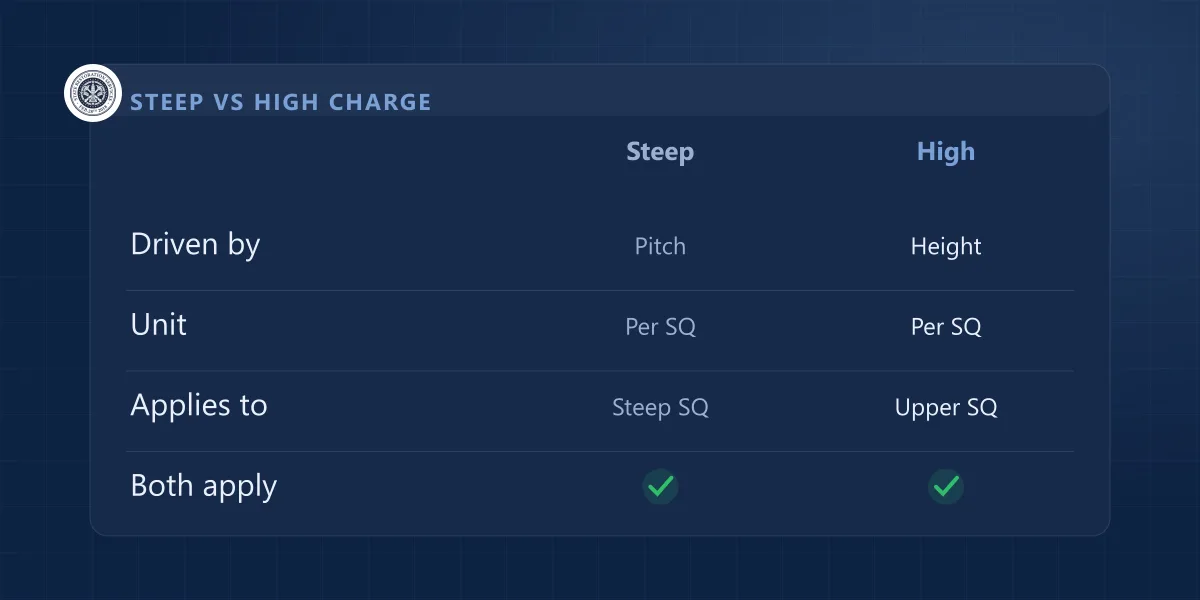
A high roof charge is driven by height above the ground, not by pitch. It covers the longer ladder work, the staging, and the extra handling to get bundles and tear-off debris up and down. It is coded RFG/HIGH, it is also measured in squares, and it applies to the squares that sit above one story.
The reason it is a separate line is that a roof can be one, the other, both, or neither. A sprawling single-story ranch with a 10/12 roof earns a steep charge and no high charge. A two-story colonial with a plain 5/12 roof earns the high charge and no steep charge. The same source describes the high roof charge as applying when the roof is above one story, which changes staging, ladder work, and material handling
, and is explicit that it is separate from steep charge, and both can legitimately apply to the same roof.
The height trigger has the same fuzziness as the pitch one. That source sets it at anything above one story, while Roofing Software Guide describes the charge on jobs over 2 stories
. For a standard two-story suburban house that difference decides whether the line belongs on your estimate at all, so it is a fair question to put to whoever wrote it.
Why does a steep roof genuinely cost more to install?
Because above a certain slope the cheap ways of complying with fall-protection rules stop being available. On a low-slope roof a crew has several options, including some that cost nothing but attention. On a steep roof the rules take those away and leave only the equipment-based ones, and equipment means setup time.
Compare the two paragraphs side by side. For low-slope roofing work, 29 CFR 1926.501(b)(10) allows protection by guardrail systems, safety net systems, personal fall arrest systems, or a combination of warning line system and guardrail system
— and on roofs 50 feet or less in width, the use of a safety monitoring system alone [i.e. without the warning line system] is permitted.
OSHA defines that last one as a safety system in which a competent person is responsible for recognizing and warning employees of fall hazards
— a trained person on the roof, with nothing to rent and nothing to rig.
Now the steep paragraph, (b)(11), in full: Each employee on a steep roof with unprotected sides and edges 6 feet (1.8 m) or more above lower levels shall be protected from falling by guardrail systems with toeboards, safety net systems, or personal fall arrest systems.
The warning line and the safety monitor are gone. What is left has to be rigged, anchored, and taken back down.
In practice that means roof brackets — the steel jacks that carry a plank so the crew has somewhere level to stand. OSHA's scaffold rules require that Scaffold brackets shall be constructed to fit the pitch of the roof and shall provide a level support for the platform
, and that they shall be anchored in place by nails unless it is impractical to use nails.
Those nails go through the deck. On a steep roof there are a lot of them, the brackets move up the slope as the work progresses, and each hole has to end up covered by the course above and sealed on the way past. That is time, and time is what the steep charge is paying for. Our installation process covers where that staging fits into the day.
How do I check whether my estimate includes them?
Read the estimate looking for two things: whether the lines exist at all, and whether their quantities make sense against your own house. Neither check requires you to know anything about roofing software — you are comparing numbers on a page against a house you can see from the driveway.
| Check | What you are looking for | Worth a question if… |
|---|---|---|
| Is there a pitch on the estimate? | A stated slope, like 8/12 | The pitch is blank or "assumed" |
| Steep charge quantity | Squares on the steep slopes only | It equals your total square count while part of the roof is shallow |
| High roof charge quantity | Squares above one story | Your house is a single-story ranch and the line is there anyway |
| Tier | Matches the measured pitch | A 13/12 roof priced at the first tier |
If the pitch on the paperwork is a guess, that is the thing to fix first, because every other line follows from it. An aerial measurement report states the pitch per slope and settles the argument in a page. We bring the measurements to the free inspection rather than asking you to take our word for the number.
What if the insurance estimate left them off?
It happens often, and it is usually not anyone being difficult. An adjuster who measured from the ground, or whose software defaulted to a walkable pitch, produces an estimate that is short by exactly these lines. The fix is a supplement: the measured pitch, the slope-by-slope square count, and the line items that follow from them, sent back with documentation.
Here is where we have to be straight about our own limits. Illinois law does not allow a roofing contractor to negotiate your insurance claim. What we can do is measure the roof properly, document what is there, and write a code-compliant estimate that shows the pitch and the quantities. If the claim itself needs representing, that is work for a licensed public adjuster — our affiliated firm, State Adjusting Services, does that side. More on how the two halves fit together is on our storm and insurance claims page, and the broader process is in filing a storm-damage roof claim in Illinois.
One thing worth saying plainly: a steep charge earns its place on a bid. A 12/12 roof takes a crew appreciably longer than the 5/12 next door for the same number of squares, and that time has to land somewhere. Where a steep roof gets bid without one, the cost usually resurfaces as a change order once the crew is on site, so it is worth raising before anyone signs. Our residential roofing estimates show the pitch and the quantity on the page.
Related reading: How to read a roofing estimate and what a square on a roof actually is.
Frequently asked questions
Can a roofer charge both a steep charge and a high roof charge on the same roof?
Yes. They measure two different things — pitch and height above the ground — and a two-story house with a steep roof genuinely costs more on both counts. Both lines are priced per square, so check that each quantity matches the part of the roof it applies to.
Is a 6/12 roof considered steep?
Under OSHA's fall-protection definition, yes, because anything over 4 in 12 is a steep roof. For pricing, a 6/12 sits right on the boundary: published guidance puts the surcharge above 6/12 or above 7/12 depending on the source. The same word is doing two different jobs, so ask which trigger your estimate used.
Why does my estimate show fewer steep-charge squares than total squares?
That is normally correct. The steep charge applies only to the slopes that are actually steep, so a house with a steep main roof and a shallow garage or porch should show a smaller steep-charge quantity than its total square count.
What do I do if the insurance estimate has no steep charge and my roof is 10/12?
Ask for the pitch the estimate was written at, and supply a measurement report showing the real pitch per slope. In Illinois a roofing contractor cannot negotiate the claim, but we can document the roof and write the estimate; a licensed public adjuster can represent the claim itself.
Not sure what is on your estimate? Bring it to us — book a free inspection or call (866) 992-2982. We are in Lincolnshire and we work the north and northwest Chicago suburbs, Monday to Friday, 8:00 AM to 5:00 PM. If a storm has just come through, we prioritize your home during those hours. You can also reach us through the contact page.