
 Volodymyr Lukaniuk
Quick answer: Illinois has no stand-alone bad-faith lawsuit against your own homeowners carrier. The remedy is 215 ILCS 5/155, and it only works bolted onto a breach-of-contract case you have to win first. Before any of that, a written statement of the dispute and a free Department of Insurance complaint cost nothing and often move a file that has gone quiet.
When an insurance company is delaying a roof claim in Illinois, the question homeowners ask us is some version of: can I make them move? There is a law with teeth behind that question — Section 155 of the Illinois Insurance Code — and it covers a much narrower set of situations than most of what you will read online. We install roofs for a living. We are not lawyers and none of this is legal advice. What we can do is lay out the actual text, what Illinois courts have said the key words mean, the free step that is easy to overlook, and the deadline in your own policy that can end the whole question before bad faith is ever argued.
My insurance company is dragging out my roof claim. What can I actually do?
Three steps, in ascending order of cost. Put the specific dispute in writing to the carrier. File a complaint with the Illinois Department of Insurance — it is free, it goes on the company’s record, and Illinois law allows the insurer 21 days to respond. Then, and only with a lawyer, a suit on the policy with a Section 155 count attached to it.
Step one does more work than it looks like it should, and it is easy to skip because writing it out feels like nagging. “In writing” does not mean asking for a call back. It means naming the disputed items — the slope the adjuster left off, the drip edge that is not on the estimate, the ridge vent that got priced as ridge cap — and attaching the photographs and the itemized scope that support each one. That letter is what a written response gets measured against later. The Illinois claims regulations already put clocks on the carrier once a claim starts to drag; we published the full table of those in our guide to whether homeowners insurance covers a roof leak in Illinois, and there is no reason to repeat it here.
Step two costs nothing at all. The Department of Insurance takes consumer complaints at no charge, and it is candid about the limits of what it does. Its own page on the complaint process says to “allow four to six weeks for completion of our investigation,” and lists what it cannot do — it cannot “act as your lawyer or give you legal advice,” and it cannot “make determinations related to the facts of a case – for example, we cannot determine the value of damaged or stolen property.” Read that limit carefully, because it decides whether a complaint is worth your afternoon. Against a carrier that has gone silent, missed a required letter or never explained its number, a complaint is a real lever. As a way to settle whether your roof needs a repair or a full replacement, it is the wrong tool.
| Step | What it costs you | What it can do | What it cannot do |
|---|---|---|---|
| Written statement of the dispute | An afternoon | Creates the record; gives the carrier something specific it has to answer in writing | Nothing at all, if it only asks for a phone call |
| Department of Insurance complaint | Nothing | Puts the file on the company’s record; 21 days for the insurer to respond; four to six weeks for the investigation | Decide what your roof is worth, act as your lawyer, or force a settlement |
| Suit on the policy with a Section 155 count | A lawyer, and likely years | Recover what the policy owes, plus fees, costs and one capped extra amount | Do anything for you unless you win the contract claim |
What does 215 ILCS 5/155 actually say?
It says that where the fight is over whether the company owes on a policy, or how much, or over an unreasonable delay in settling, and it appears to the court that the action or delay is “vexatious and unreasonable,” the court may allow reasonable attorney fees and other costs, plus one extra amount capped by the statute. That is the whole of it.
“In any action by or against a company wherein there is in issue the liability of a company on a policy or policies of insurance or the amount of the loss payable thereunder, or for an unreasonable delay in settling a claim, and it appears to the court that such action or delay is vexatious and unreasonable, the court may allow as part of the taxable costs in the action reasonable attorney fees, other costs, plus an amount not to exceed any one of the following amounts: (a) 60% of the amount which the court or jury finds such party is entitled to recover against the company, exclusive of all costs; (b) $60,000; (c) the excess of the amount which the court or jury finds such party is entitled to recover, exclusive of costs, over the amount, if any, which the company offered to pay in settlement of the claim prior to the action.” — 215 ILCS 5/155
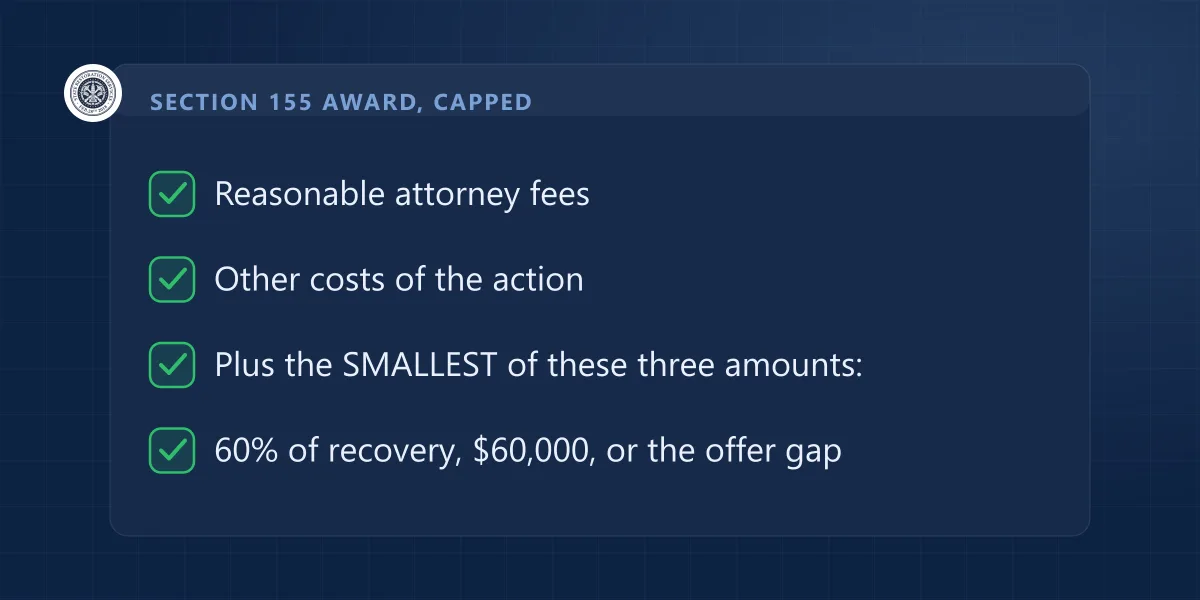
Read subsection (a) on its own and you picture 60% of a large number. The practical effect runs the other way. The published commentary on this section reads the three alternatives as amounts the court takes the smallest of, which puts a working ceiling of $60,000 on the extra award, on top of fees and costs. Whether that reading governs a particular case is a question for a lawyer; the point for a homeowner is that Section 155 is not a jackpot provision. It covers the cost of having had to fight, and Illinois courts have held that punitive damages are not available under it (Combs v. Insurance Co. of Illinois, 146 Ill. App. 3d 957 (1986)).
One housekeeping note, because it trips people up. Older summaries of this section still print smaller figures than the ones above. The version in force today reads 60% and $60,000, and has since Public Act 93-485 took effect on January 1, 2004. The statute runs to a single paragraph, so read it at the source rather than trusting a summary.
What actually counts as “vexatious and unreasonable”?
There is no checklist. Illinois courts weigh the totality of the circumstances, and one rule does a great deal of the work: a genuine disagreement is allowed. If your carrier has a real argument about coverage — even one it eventually loses — the delay generally is not vexatious.
The two sentences to keep in your head both appear in Marcheschi v. Illinois Farmers Insurance Co. (Ill. App. Ct. 1998). The first, quoting Buais v. Safeway Insurance Co.: “In deciding whether an insurer is liable under section 155, a trial court should consider the totality of the circumstances, including the insurer’s attitude.” The second, citing Bedoya v. Illinois Founders Insurance Co.: “Section 155 is not implicated as long as there is a bona fide dispute about coverage.”
| What an Illinois court weighs | Where it comes from | What it means at your kitchen table |
|---|---|---|
| The totality of the circumstances, including the insurer’s attitude | Marcheschi, quoting Buais; Green v. International Insurance Co., 238 Ill. App. 3d 929, 935 (1992) | No single fact decides it, and how you were treated is part of the record |
| Whether a bona fide dispute existed | Marcheschi, citing Bedoya | A real disagreement, even a losing one, is a defense to the whole claim |
| Whether the insured was forced to file suit | Mohr v. Dix Mutual County Fire Insurance Co., 143 Ill. App. 3d 989, 999 (1986) | Being pushed into court to get what was never really in question counts |
| Whether the insured was deprived of the use of the property | Mohr, 143 Ill. App. 3d at 999 | A tarped, leaking roof is a different fact than a paperwork delay |
Read that list honestly and the conclusion is uncomfortable. A carrier that answers your calls, sends an adjuster, writes an estimate you hate and pays that estimate is disputing, not stalling — and disputing is legal. Section 155 is aimed at the file that goes quiet for months, the required letters that never arrive, and the number that never gets explained. If you are angry about the size of the check rather than the conduct behind it, the tool you want is probably not this one. The appraisal clause inside your own policy exists precisely for a disagreement about the amount of loss.
Can I sue for bad faith on its own in Illinois?
No. If you have been reading homeowner forums you have probably been told to “file a bad-faith claim.” In Illinois that phrase does not describe anything you can actually file on its own. Section 155 gives you a remedy, and a remedy has to ride along with a breach-of-contract claim on the policy, and if the contract claim fails the Section 155 count falls with it — including when the contract claim fails for a reason that has nothing to do with how the company behaved.
The Illinois Appellate Court put it plainly in Hoover v. Country Mutual Insurance Co., 2012 IL App (1st) 110939, ¶ 40: section 155 “presupposes an action on the policy, and therefore, in order for a plaintiff to recover under section 155, he must also succeed in the action on the policy.” That single sentence explains why the paperwork half of a claim — proof of loss, dates, documentation, deadlines — carries the bad-faith half. Lose the first and the second goes with it.
A real Illinois roof case: Tyler v. Allstate, August 2026
On August 20, 2026 the First District revived a Cook County couple’s claim against Allstate arising from a 2021 storm. The court decided nothing about whether Allstate behaved badly. It decided the case had been thrown out too early on a timing question — and the reason it was thrown out is the most useful part of the order for any homeowner.
Before the numbers, the honest caveat: Tyler v. Allstate Insurance Co., 2026 IL App (1st) 250998-U is a Rule 23 order, and its own first page says it “is not precedent except in the limited circumstances allowed under Rule 23(e)(1).” Nothing below is a rule anyone has to follow. It is a public record of how one of these files actually ran.
| What the record shows | Figure or date |
|---|---|
| Claim reported for storm damage to the roof and interior ceiling | August 26, 2021 |
| Allstate’s valuation of the damage | $1,900.86 |
| Check issued to the homeowners | $1,400.86 |
| Estimate from the adjuster the homeowners retained | $56,305.52 |
| Reduced figure the appraiser agreed and Allstate paid | $36,941.28 |
| Date of that payment, to the homeowners and their mortgagees | July 21, 2023 |
The distance between $1,900.86 and $36,941.28 is not a rounding error, and it comes from a court file rather than from a story we are telling you. Read it in both directions, though. The first figure was the carrier’s number before anyone else had been on the roof; the larger one arrived nearly two years later, after the homeowners had retained their own adjuster, demanded appraisal, and come down from their own $56,305.52 to get there. The record does not say the house sat untouched in the meantime — the Tylers alleged they paid to repair it themselves — but the money question stayed open for nearly two years.
Now the part worth taking to your own kitchen table. In earlier versions of their complaint, the homeowners had written that Allstate knew their roof “has continued to leak since 2017.” Allstate seized on that sentence: if the loss began in 2017, the suit was years past the policy’s deadline. The trial court agreed and dismissed the case. The appellate court reversed, holding that those earlier, unverified pleadings were evidentiary admissions rather than binding judicial admissions — the kind that “may be controverted or explained” — so there was a genuine dispute about when the loss actually occurred.
The couple got their case back. They also spent more than four years in court, and a good deal of that turned on one sentence they had written about their own roof. How you describe damage sets a date, whether you intend it to or not. “It has been leaking for years” is an honest sentence that reads as a date of loss. When you write to a carrier, name the storm and its date, describe the condition you are claiming for, and if there is older damage on the same roof, say so separately and precisely instead of in one sweeping line.
The deadline in your policy that can end this before bad faith is ever argued
Your policy contains a suit-against-us clause with its own deadline, and it is usually shorter than the statute of limitations you have in mind. The Allstate form in the case above read: “Any suit or action must be brought within one year after the inception of loss or damage.” One year from the inception of the loss — not from the denial, and not from the day you gave up on the adjuster.
That is not a universal number. The standard ISO homeowners form gives two years from the date of loss, which is the figure we quoted in our own coverage guide. Two Illinois homeowners policies, two different clocks. The only one that matters is the one printed in your form, and the time to read it is the week the adjuster comes out, not the month you decide to fight.
Illinois does pause that clock, but narrowly. 215 ILCS 5/143.1 provides that where a policy limits the period for bringing suit, “the running of such period is tolled from the date proof of loss is filed, in whatever form is required by the policy, until the date the claim is denied in whole or in part.” Three conditions hide in that sentence. A proof of loss has to have been filed. It has to be in the form the policy requires. And the pause ends at the denial, in whole or in part. A claim that limps along for a year with no proof of loss on file and no formal denial is a claim whose clock never stopped. The sequence for getting that paperwork right is in our step-by-step on filing a storm-damage roof claim in Illinois.
What should you be doing right now, while the claim is still open?
Build the record the carrier’s file will eventually be measured against. Date-stamped photographs, a written itemized scope of the damage, every letter kept, the proof of loss actually filed in the form the policy asks for, and a number of your own from somebody who put a name on it. Most of that costs nothing and takes one weekend.
- Fix the date of loss once and write it the same way in every document. This is the single detail the Tyler record turns on.
- Photograph before any temporary repair, then photograph the temporary repair. Protecting the roof from further damage is your duty under the policy; losing the evidence under the tarp is not part of that duty.
- Get an itemized written scope from somebody who has actually been on the roof, not a range quoted over the phone.
- Keep every letter, including the envelopes. The written delay explanations and the Notice of Availability of the Department of Insurance are the ones that matter later.
- File the proof of loss in the policy’s form, and keep proof that you filed it. The tolling in 143.1 depends on it existing.
- Keep a one-line log of who said what and when. Under Marcheschi, the insurer’s attitude is part of what a court looks at, and a phone call from March is hard to reconstruct the following winter.
Here is where we stop, and it matters. Illinois law does not permit a roofing contractor to negotiate your insurance claim, and we do not. What we do is get on the roof, document what is genuinely up there, and write a code-compliant itemized scope with real Chicago-market numbers behind it — a full architectural asphalt roof replacement in the north and northwest suburbs runs roughly $9,000–$18,000 installed, about $450–$1,150 per square, and the scope should show how it reached that number. If the claim needs somebody to represent you on it, that is a licensed public adjuster; our affiliated one is State Adjusting Services, and if you would rather choose your own, how to choose a public adjuster covers what to look at. The wider picture of how a storm and insurance claim runs from first inspection to final payment is on our claims page.
Related reading: does homeowners insurance cover a roof leak in Illinois and insurance non-renewal because of your roof.
Frequently asked questions
How long can an insurance company take to pay a roof claim in Illinois?
There is no one number. The Illinois claims regulations give a carrier 30 days to offer payment once it affirms liability, and require a written explanation when a claim drags on; we set out that whole table in our guide to roof leaks and Illinois coverage. Section 155 adds no clock of its own — a court weighs the whole picture instead.
Is bad faith a lawsuit I can file against my own insurance company in Illinois?
Not on its own. Section 155 of the Illinois Insurance Code is a remedy bolted onto a breach-of-contract claim on the policy. Illinois courts have held that it presupposes an action on the policy, so if the contract claim fails, the Section 155 count fails with it.
What can a homeowner actually recover under 215 ILCS 5/155?
Reasonable attorney fees, the other costs of the action, and one extra amount measured by the three alternatives in the statute: 60% of the recovery, $60,000, or the excess of the recovery over what the company offered before suit. Commentary treats the smallest of the three as the ceiling, which puts that extra amount at $60,000 or less.
Does filing an Illinois Department of Insurance complaint cost anything or hurt my claim?
The complaint is free and it goes on the company record. Illinois law allows the insurer 21 days to respond, and the Department asks consumers to allow four to six weeks for its investigation. It will not settle a valuation fight: the Department states it cannot determine the value of damaged or stolen property.
Claim gone quiet, or a number that nobody will explain? Book a free inspection or call (866) 992-2982 and we will document what is actually on your roof, in writing. We are a family-owned Illinois roofing contractor based in Lincolnshire, rated 4.9 stars from 92 Google reviews, and we work across the north and northwest Chicago suburbs Monday through Saturday.