
 Volodymyr Lukaniuk
Quick answer: When you and your carrier agree a storm damaged your roof but cannot agree on the cost, the appraisal clause in your policy sends the number to two independent appraisers and an umpire. Either side can demand it. A figure signed by any two of the three sets the amount of loss and binds you both. It settles price and scope, never coverage.
The insurance appraisal clause is the paragraph most homeowners never read until a claim stalls. The carrier’s estimate says repair one slope. Your roofer measured the same house and says the hail is on all four and the shingle has been discontinued. Both letters are polite, neither side is moving, and the file just sits there. That deadlock has a built-in exit, and it has been in your policy since the day you bought it.
We have been roofing and doing storm work out of Lincolnshire since 2018, across Lake and Cook County. What follows is what the clause actually says — quoted off the standard ISO homeowners form and off a carrier’s own version reproduced in a 2025 Illinois appellate opinion — what Illinois courts have done with it, and where a roofing contractor is and is not allowed to stand. We build roofs; we are not lawyers, and nothing here is legal advice.
What is the appraisal clause and where is it in your policy?
It is one of the Section I — Conditions near the back of the policy, usually a single paragraph under the heading “Appraisal.” It gives either party the right to demand that the amount of loss be set by two appraisers and an umpire instead of by argument. It is a contract right, so it works without anyone filing a lawsuit.
Here is the whole thing, verbatim, from the current ISO HO-3 special form (HO 00 03 03 22), Section I — Conditions, paragraph F:
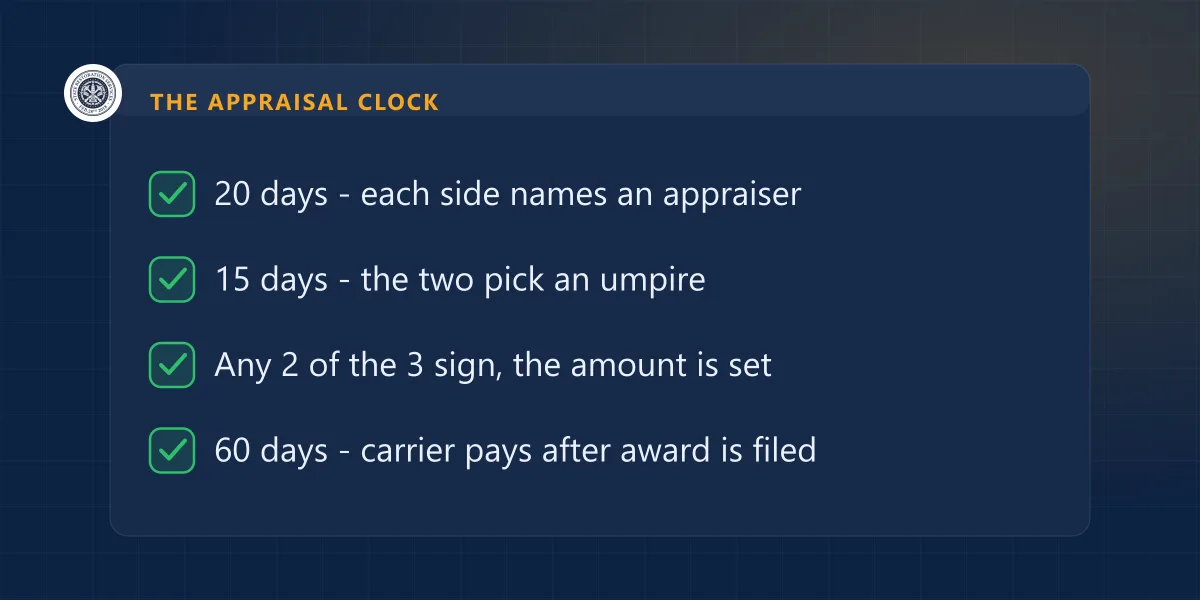
“If you and we fail to agree on the amount of loss, either may demand an appraisal of the loss. In this event, each party will choose a competent and impartial appraiser within 20 days after receiving a written request from the other. The two appraisers will choose an umpire. If they cannot agree upon an umpire within 15 days, you or we may request that the choice be made by a judge of a court of record in the state where the ‘residence premises’ is located. The appraisers will separately set the amount of loss. If the appraisers submit a written report of an agreement to us, the amount agreed upon will be the amount of loss. If they fail to agree, they will submit their differences to the umpire. A decision agreed to by any two will set the amount of loss. Each party will: 1. Pay its own appraiser; and 2. Bear the other expenses of the appraisal and umpire equally.”
Two things worth knowing before you go looking for it. First, the letter moves. In the 2022 edition it is paragraph F; in the 2000 edition of the same form the identical wording sits at paragraph E. Look for the word “Appraisal,” not for a letter somebody quoted in a blog post.
Second, plenty of carriers file their own version instead of the ISO paragraph, and the newer ones are far longer and far more procedural. The version State Farm had in force on a Vernon Hills home, reproduced in full in the appellate opinion discussed below, adds a documentation step before you may even demand appraisal, puts a 30-day clock on the two appraisers, requires the report to state actual cash value and replacement cost separately for every disputed item, and expressly strips the appraisers of authority to decide anything except amount.
| Step | ISO HO-3 (HO 00 03 03 22) | A modern carrier version (State Farm, quoted in Zhao) |
|---|---|---|
| What triggers it | Failure to agree on the amount of loss | Failure to agree on the amount of loss |
| Before you may demand | Nothing stated | Comply with Your Duties After Loss, then give the other side written, itemized documentation of the specific dispute at least 10 days ahead |
| Naming appraisers | “Competent and impartial,” within 20 days of the written request | “Competent, disinterested,” within 20 days of receipt of the demand |
| Time for the appraisers to agree | Not stated | 30 days, unless both sides extend it |
| Umpire | Chosen by the two appraisers; if not within 15 days, a judge of a court of record where the residence premises is located | Same 15 days, plus 10 days’ written notice naming the court before the application is filed |
| What the written report must say | The amount of loss | Itemized, stating actual cash value, replacement cost and, if applicable, market value for each disputed item |
| Effect on coverage arguments | Not stated | Neither side waives any rights; both keep all contractual rights to decide whether coverage applies to each item |
| After you file suit | Not stated | A party may not demand appraisal after bringing suit about the amount of loss |
That last row is the one that costs people the remedy. Under a clause worded that way, suing first closes the door on appraisal. Read your own form before you do anything else, and if you cannot find it, ask your carrier to email you the policy form number printed on your declarations page.
When does appraisal apply — and when is it the wrong tool?
Appraisal is for the amount of loss. Coverage questions belong to a court. That line is where the argument happens, because carriers and homeowners use the word “coverage” to mean two different things: the legal sense, meaning what risk the policy assumed, and the everyday sense, meaning “something the insurance company will pay for.”
An Illinois appellate court took that distinction apart in Xiang Zhao v. State Farm Fire & Casualty Co., 2025 IL App (2d) 240723, decided 12 May 2025 out of Lake County. A hailstorm hit Vernon Hills on 20 April 2023. The carrier inspected, agreed there was hail damage, and paid $12,677.94 actual cash value for gutters, downspouts and the aluminum wraps on some window frames and trim. The homeowner’s contractor looked at the same windows and wrote $133,817.82 to replace all of them. The carrier refused the homeowner’s appraisal demand, saying the gap was a coverage dispute.
The court disagreed, in language worth keeping:
“There may be a dispute as to whether the windows were damaged by the hailstorm, but that is not an issue of coverage. It is an issue of loss. And appraisal is ideally suited to resolve disputes over loss.”
And on the argument the carrier pressed hardest — that deciding what caused the damage is beyond an appraiser’s job:
“While questions of law and coverage are to be decided by the court, resolving some questions of causation will be necessarily included in the appraisal process.”
Read that carefully, because it is narrower than it looks. The court did not hold that appraisers decide exclusions. It held that once the carrier has conceded a covered event and paid something toward it, sorting out which of the damage came from that event is part of setting the amount. Where the disagreement really is about what the policy means — the Illinois case the carrier leaned on, Lytle, involved whether the cost of complying with building ordinances was covered at all — appraisal is the wrong forum and a court decides. If your gap is about code-upgrade coverage, expect that argument.
| Your disagreement | Appraisal | Court |
|---|---|---|
| Price per square, or the labor rate in the estimate | Yes | — |
| Four slopes damaged or only the north one | Yes | — |
| Repair the slope or replace the roof | Yes | — |
| How much of the damage came from the storm | Usually, once a covered loss is conceded | — |
| Whether an exclusion applies at all | — | Yes |
| Whether ordinance-and-law costs are covered | — | Yes |
| Whether you reported the loss too late | — | Yes |
| Whether the carrier acted in bad faith | — | Yes |
How do you actually demand appraisal?
In writing, after you have done what the policy requires of you, and with the disputed items itemized. The demand starts a 20-day clock for both sides to name appraisers. Under a clause written like State Farm’s, skipping the documentation step leaves your demand defective, which hands the carrier a cheap reason to stall.
- Finish your Duties After Loss first. Report the loss, protect the property from further damage, and submit the signed, sworn proof of loss if the carrier asked for one. Modern clauses make this an express precondition to demanding appraisal.
- Build the itemized dispute document. Not “we disagree with your estimate” — line by line: what your side says needs doing, in what quantity, at what price, and what the carrier’s estimate says instead. This is the document a roofing contractor can legitimately produce for you, and it is covered in more depth in our guide to reading a roofing estimate line by line.
- Send the written demand. Some clauses require the itemized documentation to reach the carrier at least 10 days before the demand, so check the order of operations in your own form. Name your appraiser in the letter and ask for theirs.
- Twenty days to name appraisers. Both sides. If the carrier misses it, keep the proof of when your request was received.
- Fifteen days for the two appraisers to pick an umpire. If they cannot agree, either side can apply to a judge of a court of record in the county where the home sits to appoint one.
- The award. If the two appraisers agree, that figure is the amount of loss. If they do not, they hand their differences to the umpire, and a decision signed by any two of the three sets the amount.
- Payment. The homeowners form makes loss payable 60 days after the insurer receives your proof of loss and one of three things happens: agreement with you, entry of a final judgment, or “a filing of an appraisal award with us.”
Who can be your appraiser in Illinois?
Anyone you trust to read a roof and hold a position under pressure, as long as they meet the policy’s test: “competent and impartial” under the ISO wording, or “competent, disinterested” under many carrier forms. There is no state license for the appraiser role itself. What Illinois does license is anyone adjusting your claim, and that catches more of the work than people expect.
Under 215 ILCS 5/1515, a person may not act or hold themselves out as a public adjuster, or be in the business of adjusting insurance claims in Illinois, without a public adjuster license. Subsection (d) lists five exemptions: an attorney acting in that capacity; someone handling life or health claims; a person employed only to obtain facts about a loss or to furnish technical assistance to a licensed public adjuster, which is where photographers, estimators, private investigators and engineers sit; a health care provider filing a patient’s claim form; and a person settling subrogation between insurers. There is no exemption on that list for “a person serving as an appraiser under the policy.”
So the practical question to ask anyone who offers to be your appraiser is a plain one: are you a licensed Illinois public adjuster, an attorney, or something else — and if something else, which exemption are you relying on? A licensed public adjuster and a lawyer both have a clear answer. Get it before you name them, not after the carrier challenges them.
The fee arrangement deserves the same question. Appraisers are usually paid hourly or on a flat fee. A fee set as a percentage of the award has been fought over in other states, with courts splitting on whether it destroys the “disinterested” requirement, and we did not find an Illinois decision that settles it. Ask anyway, because if the carrier challenges your appraiser the process stops while that gets sorted out.
What does appraisal cost, and who pays for it?
The policy sets the structure, not the price. Each side pays its own appraiser. The umpire’s bill and the other expenses of the appraisal are split down the middle. Nothing in the clause makes the losing side pay the winner’s costs, and some carrier versions say outright that neither party will be awarded attorney fees.
| Cost | Who pays |
|---|---|
| Your appraiser | You |
| The carrier’s appraiser | The carrier |
| The umpire | Split equally |
| Other expenses of the appraisal | Split equally |
| Attorney fees | Your own, and some clauses bar an award of them entirely |
We do not publish other people’s rates, so ask both your appraiser and the proposed umpire for their fee basis in writing before anyone is named. Then do the arithmetic against the gap. Appraisal earns its keep when the disagreement is five figures on a full replacement, and a full asphalt roof replacement in the north suburbs typically runs $9,000 to $18,000, or roughly $450 to $1,150 per square. On a gap of a few hundred dollars over a repair, the process can cost more than the argument is worth. We will tell you that rather than let you find out.
What appraisal will not do for you
It sets a number. It does not rewrite the policy around that number, and four things survive an award completely intact.
Your deductible still comes off. The award is the amount of loss, not a check. Your wind-and-hail deductible applies to it exactly as it applied to the original estimate, and on a percentage deductible that can be a serious figure — we cover the mechanics in our guide to the Illinois roof deductible.
Depreciation still works the normal way. On a replacement cost policy the carrier still holds back recoverable depreciation until the work is done. The better carrier clauses require the award to state actual cash value and replacement cost separately for every disputed item, which is what lets you recover the holdback afterwards without a second argument. If those two numbers are not separated, ask for them — and here is the difference between RCV and ACV if the terms are new.
Coverage defenses survive. In Zhao, the carrier had pleaded that the damage came from wear and tear, poor installation and age rather than hail. The court sent the parties to appraisal anyway and was explicit that neither side waived anything: the carrier’s defenses “have no bearing on” the homeowner’s right to demand appraisal, and both parties kept every right they had. An award can be filed and a carrier can still deny on an exclusion, which is the honest ceiling on what appraisal does for you.
The clock keeps running. The standard homeowners form gives you two years from the date of loss to sue on the policy. Illinois tolls that period, but only in a specific way: under 215 ILCS 5/143.1 the running of the suit-limitation period is paused “from the date proof of loss is filed … until the date the claim is denied in whole or in part.” An appraisal is not a denial. So if your claim was never denied and appraisal takes most of a year, that statute does not on its face pause the two-year clock while you wait. Put the question to a lawyer early rather than in month twenty-three.
Where does a roofing contractor fit in this?
On the roof and in the estimate, not at the negotiating table. Illinois defines adjusting a claim to include negotiating values, damages or depreciation and applying the loss circumstances to policy provisions, and doing that for you requires a public adjuster license. A roofer who tells you they will “fight your insurance company” is describing licensed work, and it is a fair question to put to them.
What we do on a stalled claim is the part appraisal actually runs on. We get on the roof and document the damage properly, including the test squares and the slope-by-slope count — the same work described in our guide to what a real free roof inspection covers. We write a code-compliant construction estimate for the repair or the replacement, itemized line by line so it can be set beside the carrier’s estimate and compared item against item. That itemized document is what your side’s dispute list gets built from. And we meet your adjuster on the roof so the disagreement is at least about the same shingles.
Where the claim itself needs representing, our affiliated licensed public adjuster, State Adjusting Services, can take that on — and if you would rather choose your own, how to choose a public adjuster covers what to look for. If the carrier will not move and will not appraise, the Illinois Department of Insurance complaint process is free and it is on the record. More on how the whole sequence fits together is in our storm and insurance claim page.
Related reading: does homeowners insurance cover a roof leak in Illinois and filing a storm-damage roof claim, step by step.
Frequently asked questions
What is the appraisal clause in a homeowners insurance policy?
It is a condition in the policy that lets either you or your insurer demand an independent valuation when the two of you cannot agree on the amount of a covered loss. Each side names an appraiser, the two appraisers pick an umpire, and a figure agreed to by any two of the three sets the amount of loss.
Can my insurance company refuse to go to appraisal?
It can refuse, and Illinois homeowners have gone to court over exactly that. An Illinois appellate court affirmed an order compelling a carrier into appraisal in 2025, holding that a dispute over whether a hailstorm damaged the windows was a question of the amount of loss rather than a question of coverage.
Is an appraisal award binding in Illinois?
The award binds both sides on the amount of loss, and the standard homeowners form makes payment due 60 days after the insurer receives your proof of loss and a filed appraisal award. It does not bind anyone on coverage. A carrier can still deny on an exclusion or a policy condition after an award is filed.
Is insurance appraisal the same as the appraisal my mortgage lender orders?
No. A lender orders a licensed real estate appraiser to value the whole property for the loan file. Insurance appraisal is a dispute-resolution condition inside your policy, it values only the damage in dispute, and the people who do it are not required to be licensed real estate appraisers.
Claim stalled over the number? Book a free inspection or call (866) 992-2982 — we will document the roof, put an itemized estimate in writing, and tell you honestly whether the gap is worth the process. We serve the north and northwest Chicago suburbs, Monday through Saturday.