
 Volodymyr Lukaniuk
Quick answer: Your deductible is the part of a covered loss you pay before your insurer pays anything. Many Illinois policies now carry a separate wind-and-hail deductible of 1–5% of your dwelling coverage instead of a flat $1,000 — on a home insured for $350,000 that is $3,500 or more. No contractor in Illinois may legally pay it for you.
The most common surprise we run into after a hailstorm has nothing to do with shingles. A homeowner files a claim, the claim gets approved, and then they find out their roof insurance deductible is not the $1,000 they had in mind — it is a percentage of what the house is insured for, and it is several thousand dollars. Nobody hid it from them. It is printed on the declarations page that arrives at renewal and goes straight into a drawer.
So here is the part of a storm claim nobody explains until the check arrives: how the deductible actually works, why your first payment is so much smaller than the roof, and what your legal options are for covering the difference. We have walked a lot of Lake and Cook County homeowners through this since 2018, and the conversation goes better when it happens before the storm.
What is a roof insurance deductible?
It is the amount of a covered loss you pay yourself before your insurance company pays anything. It never arrives as a bill — it is simply subtracted from what the insurer sends you. On a $16,400 roof with a $3,500 deductible, your insurer’s side of the math starts at $12,900, and the $3,500 is yours to cover.
Two things trip people up. First, a homeowner deductible applies per claim, not per year the way most health plans work — two separate storms in one season generally means two deductibles. Second, the deductible you remember is usually your all-other-perils deductible: the one that applies to a kitchen fire or a burst pipe. Wind and hail may be sitting on a different, larger number entirely.
Why does my policy have a separate wind-and-hail deductible?
Because hail got expensive. After several heavy hail years across the Midwest, many carriers writing in Illinois moved wind and hail onto their own deductible — typically 1% to 5% of Coverage A, your dwelling limit — while everything else keeps the old flat amount. It usually appears at renewal, not mid-term.
The difference between those two structures is not small. Here is the same $16,400 asphalt roof claim on a home insured for $350,000, under four deductibles we see on real declarations pages in the north and northwest suburbs.
| Deductible on your policy | What you pay | What is left for the insurer to cover |
|---|---|---|
| Flat $1,000 (all perils) | $1,000 | $15,400 |
| 1% of Coverage A | $3,500 | $12,900 |
| 2% of Coverage A | $7,000 | $9,400 |
| 5% of Coverage A | $17,500 | Nothing — the deductible is larger than the roof |
That last row is not a hypothetical to be clever about. At 5% on a $350,000 home, an entire hail-damaged roof falls under the deductible and there is no claim worth filing. If that is your policy, you are effectively self-insuring your roof, and it is worth knowing that on a quiet Tuesday rather than the week after a storm.
Finding your number takes about two minutes. Pull the declarations page your insurer mails at renewal and look for a line reading Windstorm or Hail Deductible, Percentage Deductible, or a footnote attaching a percentage to Coverage A. If it is a percentage, multiply it by the dwelling limit on the same page — that is the figure that matters, not the flat amount printed at the top. Your agent can change it at renewal. We cannot, and neither can any other roofer; anyone who implies otherwise is selling something.
Why is the first insurance check so much smaller than the roof?
Because two things come out of it, not one. Most policies pay replacement cost, but they pay it in two instalments: an actual cash value check up front with depreciation held back, minus your deductible — then the held-back depreciation released after the work is finished and invoiced.
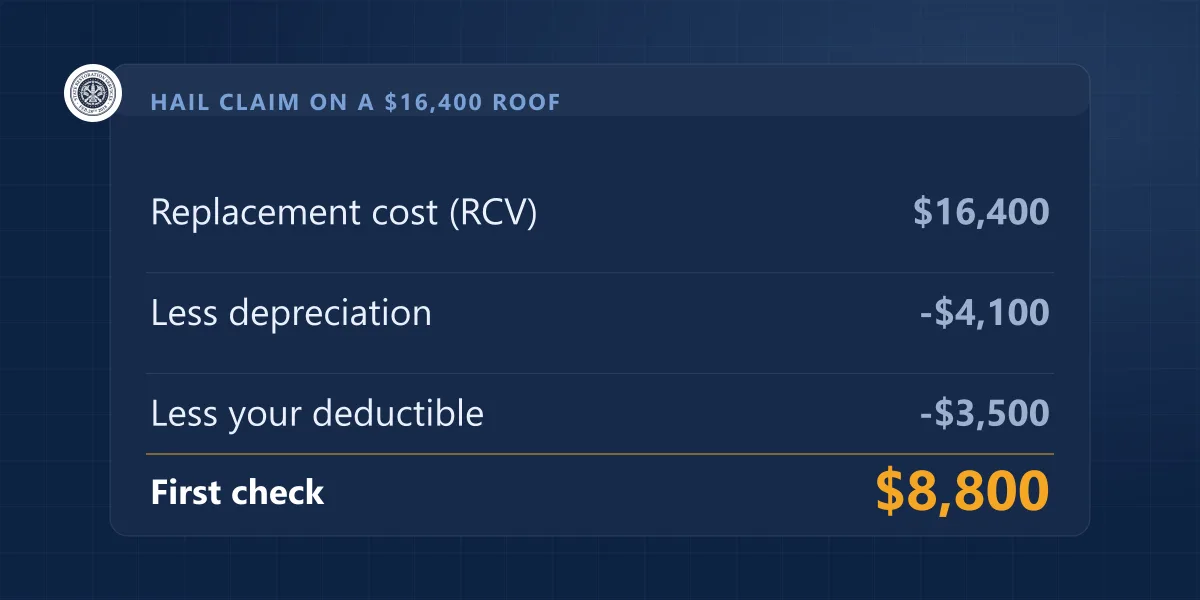
Run the numbers on a seven-year-old architectural shingle roof, approved at $16,400 with a 1% wind-and-hail deductible on a $350,000 dwelling limit:
| Line | Amount |
|---|---|
| Roof replacement cost (RCV) | $16,400 |
| Less depreciation on a seven-year-old roof | −$4,100 |
| Actual cash value (ACV) | $12,300 |
| Less your deductible | −$3,500 |
| First check from your insurer | $8,800 |
| Recoverable depreciation, released after completion | $4,100 |
| Total the insurer pays | $12,900 |
| Your out-of-pocket | $3,500 |
The $8,800 is what alarms people. It looks like the insurer has decided the roof is worth half of what it costs, and it is a common reason homeowners call us convinced the claim was lowballed. In this case it was not: $4,100 of that gap is money the policy still owes, it just does not release until the roof is actually on the house. Our estimates for residential roof replacement are built to that final RCV number, not to the first check, so the invoice that triggers the depreciation release is already in the right shape.
One honest exception. If your policy carries an ACV endorsement or a roof payment schedule — common on older roofs — that depreciation is not recoverable. You get the $12,300 minus the deductible and nothing more, and the real out-of-pocket on this example becomes $7,600. That single line on the declarations page is worth more attention than the premium is. We go deeper on how RCV and ACV behave through the whole claim in our guide to filing a storm-damage roof claim in Illinois.
Can a roofer pay or waive my deductible?
No. Illinois law makes it illegal for a home repair contractor to advertise or promise to pay or rebate all or any part of your insurance deductible as an inducement to sign. That is Section 18 of the Home Repair and Remodeling Act, 815 ILCS 513/18, and it applies to every roofer working in this state.
The statute also closes the obvious workaround: a “promise to pay or rebate” includes granting an allowance, offering a discount against the fee, or handing the homeowner any other form of compensation. So “we’ll waive it,” “we’ll write it off,” and “zero out of pocket, guaranteed” are all the same offer wearing different hats, and all of them are prohibited.
It is also worth understanding why the law bothers. The deductible is the homeowner’s share of the loss, and the insurer set the premium around it, so no contractor has anything to forgive. There are only two ways to make it disappear. Either the estimate gets padded by the amount of the deductible so the insurance company unknowingly funds it, which is fraud on a claim filed in your name, or the crew genuinely does the job for several thousand dollars less than it quoted, which comes out of the roof somewhere you cannot see from the driveway. Neither one ends with you ahead.
This pitch shows up hardest in the two weeks after a hailstorm, from trucks that were in another state last month and will be in a third one next month. We wrote the field guide to that pattern in storm chasers vs. a local roofer, and the paperwork you should verify before signing anything is in how to choose a roofing contractor in Illinois.
How do people actually pay the deductible?
Out of savings when it is there, and out of a payment plan when it is not. We run a 0% in-house plan for up to 24 months with soft-pull pre-qualification, and we work with 11 home-improvement lenders on 10–30 year terms for larger projects. Both are legal, and both are ordinary.
| Option | How it works | Honest catch |
|---|---|---|
| Pay from savings | Deductible due as the project completes, alongside the insurance proceeds | Cheapest by a wide margin if the cash is available |
| Our in-house plan | 0% interest, terms up to 24 months, small one-time origination fee, soft-pull pre-qualification | Built for a payoff inside about two years, so payments are higher |
| Long-term lender financing | 10–30 year terms through 11 lenders that work only with licensed contractors, $0 down | Interest applies — ask for the total cost, not just the monthly payment |
| “We’ll cover your deductible” | Not an option — prohibited under 815 ILCS 513/18 | The cost is still in the job, just not on the contract |
A pre-qualification is a soft pull, so checking what you would actually pay does not touch your credit score. Homeowners also use the same plan to fund upgrades the claim will not cover — a heavier shingle, impact-rated material, ventilation the old roof never had — while the insurance proceeds handle the like-for-like replacement. The terms, the fees and the two structures are laid out on our roofing financing page.
One thing we cannot do, and want to be plain about: under Illinois law a roofing contractor may not negotiate your insurance claim. We document the damage and build a code-compliant estimate, and if the claim itself needs someone arguing your side of it, that work belongs to a licensed public adjuster — our affiliate State Adjusting Services does exactly that. The division of labour is explained on our storm and insurance claim page.
Frequently asked questions
Does my roof deductible apply once per claim or once per year?
Homeowner policies are generally written per claim, not per policy year, so two separate storms usually mean two deductibles. Your declarations page is the authority on this — read the deductible section rather than assuming, and ask your agent if the wording is ambiguous.
Should I raise my deductible to lower my premium?
That is a question for your agent, not your roofer, and the honest trade-off is simple: a higher deductible lowers the premium every year and costs you more the one year you have a claim. What we would push back on is agreeing to a percentage wind-and-hail deductible without doing the multiplication first.
What if the repair costs less than my deductible?
Then there is nothing for the insurer to pay and no reason to file. A $1,900 flashing repair against a $3,500 deductible pays out nothing at all, and a filed claim can follow you into renewal pricing for years. Get the repair quoted first and compare the two numbers before you call anyone.
Is the deductible taken out of every check or only the first?
Only once, out of the first payment. When the recoverable depreciation is released after the work is complete, it comes in full — the deductible has already been accounted for. If you are being asked for it twice, stop and have the settlement paperwork read line by line.
Related reading: Filing a storm-damage roof claim in Illinois and what code-upgrade coverage adds to a roof claim.
Not sure what your deductible actually is? Bring us the declarations page and we will read it with you before there is a storm to argue about. Book a free roof inspection or call (866) 992-2982 — we are a family-owned contractor in Lincolnshire working across the north and northwest Chicago suburbs, from Arlington Heights to Vernon Hills, rated 4.9 stars from 92 Google reviews.