
 Volodymyr Lukaniuk
Quick answer: An assignment of benefits hands your roofer the right to collect your insurance money directly. In Illinois a post-loss assignment is generally allowed, but no contractor may negotiate or represent your claim — that is Section 18(i) of the Home Repair and Remodeling Act. Read what you sign: the same page usually carries a cancellation right the person holding the clipboard will not mention.
Two days after a hailstorm, somebody knocks. They are friendly, they are already holding a clipboard, and the form on it has a heading like Insurance Restoration Agreement or Authorization to Repair. Somewhere in the middle of it is a paragraph nobody reads out loud, and that paragraph is an assignment of benefits on your roof claim. Sign it and you have changed who collects the insurance money, and possibly who talks to your carrier about it.
We are a family-owned roofing contractor in Lincolnshire working across the north and northwest Chicago suburbs, and homeowners bring us these forms and ask what they just agreed to. So here is the honest version, read out of the Illinois statutes rather than out of a sales script: what the document does, what Illinois law lets it do, what it can never do, and the cancellation right that is supposed to be printed on it in bold.
What is an assignment of benefits on a roof claim?
An assignment of benefits is a written transfer of your right to collect insurance money for a loss that has already happened. Instead of the carrier paying you and you paying the roofer, the roofer becomes the one entitled to the proceeds for that damage. Three quite different documents get handed over under the same friendly name, and they do not do the same thing.
| What it gets called | What it actually does | Who is still the claimant |
|---|---|---|
| Direction to pay, authorization to pay, insurance proceeds authorization | Tells your insurer to include the contractor on the payment, or tells you to endorse proceeds over when they arrive | You. You are still the person the carrier owes. |
| Assignment of benefits, assignment of claim, assignment of proceeds | Transfers your right to collect some or all of the money for that loss to the contractor | You still carry the policy duties, but the contractor collects |
| Power of attorney on the claim | Lets another person act in your place on the claim itself | Nobody in your repair chain is allowed to hold this — see below |
The practical difference is who your insurer has to deal with, and what happens if the claim goes sideways. A direction to pay is a payment instruction. An assignment moves a legal right. People use the three phrases interchangeably. The heading on the form does not control what it does; the sentences inside it do.
Can you even assign a roof insurance claim in Illinois?
Generally yes, after the loss. Your homeowners policy almost certainly contains a clause saying the policy may not be assigned without the insurer's written consent. Illinois courts have drawn a line between assigning the policy before anything happens and assigning a claim for money after the damage is done. In Illinois Tool Works v. Commerce and Industry Insurance Co., 2011 IL App (1st) 093084, the First District held that an insured's assignment of the right to coverage after a covered loss does not require the insurer's consent, because at that point it is the assignment of payment on a claim that has already accrued.
Two honest caveats, because this is the part where a website usually overclaims. That case was a commercial pollution-coverage dispute, not a hail claim on a house in Palatine, and one appellate decision does not control how your carrier handles your file. Carriers can and do refuse to deal with an assignee, and sorting that out means a lawyer and time. The question of whether your particular assignment is enforceable against your particular insurer is a legal question, and we are roofers.
What does an assignment not buy the contractor?
It does not buy the right to run your claim. The sales pitch and the law point in opposite directions here, so it is worth being precise. Illinois puts a hard prohibition on the contractor side, and no signature of yours removes it.
Section 18(i) of the Home Repair and Remodeling Act (815 ILCS 513/18) says a contractor offering home repair or remodeling services "shall not represent, or offer or advertise to represent, on behalf of a homeowner on any insurance claim in connection with the repair or replacement of roof systems." The same subsection adds two more flat rules: a contractor "shall not call in or file a claim to an insurance carrier on the insured's behalf," and "shall not climb on a roof or inspect for exterior damage without the insured's express permission."
Then it does something useful, which is list what is not prohibited. A residential contractor may still give you an estimate for the repair, and that estimate may be submitted to your insurance company. A contractor may confer with the insurance company's representative about damage to your property. And a contractor may discuss repair or replacement options with the carrier's representative or with you. Those three permissions are what let a roofer document your damage, put it in writing, and hand you an estimate you can file yourself.
The reason for the prohibition sits in the Insurance Code. Under the Public Adjusters Law (215 ILCS 5, Article XLV), "adjusting a claim for loss or damage covered by an insurance contract" is defined as "negotiating values, damages, or depreciation or applying the loss circumstances to insurance policy provisions." Section 1515(a) bars any person from acting, advertising, soliciting, or holding out as a public adjuster, or attempting to obtain a contract for public adjusting services, without a license. Section 1515(e) finishes the thought in one line: "All contracts entered into that are in violation of this Section are void and invalid."
Put those definitions next to each other and the boundary is easy to apply. Arguing depreciation with your adjuster is adjusting. Writing an estimate and handing it to you is not. A door-knocker promising to "handle the whole claim" is describing licensed work, and the paper they want signed can be void for exactly that reason. One small oddity worth knowing if you go looking: Section 18(i) still names Public Act 96-1332, the public adjuster statute that was repealed in 2021 and replaced by Article XLV. The act number printed in that sentence is out of date; the duty it puts on your roofer still applies.
If you hire a public adjuster, the check question lives in that contract
You are allowed to hire a licensed public adjuster, and Section 1575(f)(2) says plainly that you are not required to. If you do, the document that decides whether that adjuster's name lands on your insurance check is the public adjuster contract you signed, and the law is unusually specific about what it may and may not contain.
| Contract term | Allowed? | Where it says so |
|---|---|---|
| Naming the public adjuster as a co-payee on the insurer's payment | Yes, if the contract says so | Section 1575(b) |
| Requiring you to have the check issued only in the adjuster's name | No | Section 1575(e)(2) |
| A power of attorney letting the adjuster act in your place | No | Section 1575(e)(5) |
| A power of attorney letting the adjuster choose who does the repair work | No | Section 1590(j)(5) |
| A fee above 10% of the settlement on a personal residence | No | Section 1570(e) |
Carriers have not always respected that. On January 9, 2026 the Illinois Department of Insurance issued Company Bulletin 2026-01, Public Adjuster as Co-Payee, because insurers were adding public adjusters as co-payees "regardless of whether the insured agreed to have the public adjuster as a co-payee in the public adjuster contract," and some were mailing checks straight to the adjuster. The Department told insurers to review the contracts they receive and not to add the co-payee or redirect the check unless the contract contains such provisions. If your check came back with a name on it you never agreed to, that bulletin is the thing to point at.
Two more numbers worth carrying. Section 1590(i) says the proceeds go to the named insured or a designee, and where a check is paid jointly you have 30 calendar days to release the adjuster's share, or to give a written explanation of the delay. Section 1575(j) makes the public adjuster contract voidable at your option for five business days after the insurer receives it, and Section 1575(k) gives the adjuster 15 business days to return anything of value if you use that right.
There is also a disclosure rule that matters if the same office offers you both a roof and an adjuster. Section 1575(d) requires a public adjuster to give you a written disclosure of any direct or indirect financial interest with any other party involved in the claim, specifically including any construction firm that provides estimates or performs the work. Ask for it in writing. If you get the answer verbally, send a short email repeating it back so the disclosure exists on paper.
The cancellation right that is supposed to be printed in bold
If you signed a contract for work to be paid out of a property and casualty insurance policy, Section 18(e) of the Home Repair and Remodeling Act gives you a cancellation right that runs on two clocks, and it ends on whichever one expires first.
| Clock | Deadline | What you have to do |
|---|---|---|
| Your insurer tells you in writing that all or part of the claim or contract is not a covered loss | Midnight on the 5th business day after you receive that notice | Written cancellation to the contractor's address in the contract, with a copy of the insurer's letter |
| Your insurer receives your properly executed proof of loss | Midnight on the 30th business day after that | Written cancellation to the contractor's address in the contract |
| Whichever arrives first | The earlier deadline is the one that governs | Notice by mail counts on deposit, postage prepaid and properly addressed |
Section 18(f) requires the contract to carry that right in at least 10-point boldface, and Section 18(g) requires a separate detachable form captioned "NOTICE OF CANCELLATION," in duplicate, with the contractor's name and business address already filled in. If neither is in the stack you were handed, the contract is not compliant, and that is worth knowing before the tear-off starts rather than after.
Section 18(h) handles the money. Within 10 days of cancellation the contractor must return your payments, deposits and any note of indebtedness. The one thing the contractor may still charge for is emergency work related to the catastrophe that you agreed in writing was needed to prevent further damage, such as an emergency tarp. And the statute closes the escape hatch: any provision requiring a fee for anything other than that catastrophe work "shall not be enforceable against any insured who has cancelled a contract pursuant to this Section." So a cancellation penalty printed on the back of that clipboard form is, on an insurance-funded job you cancelled under Section 18, not something you owe.
What to actually read before you sign anything
Take the stack to the kitchen table. Nobody legitimate needs your signature in the driveway. Here is what we would check, in order.
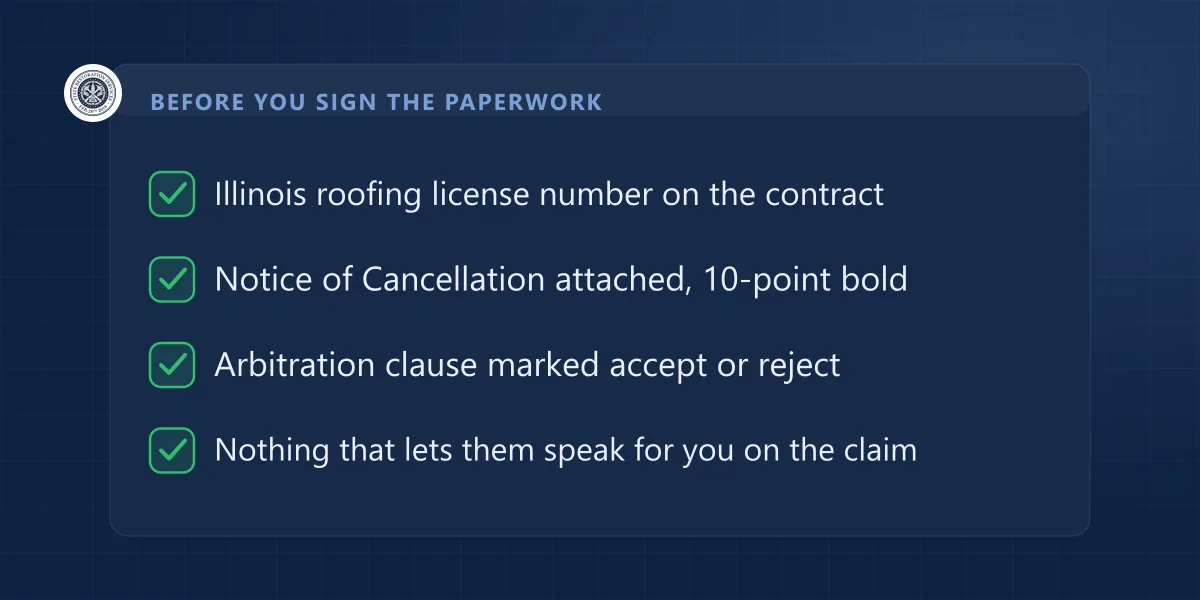
- The Illinois roofing license number. Section 18(d) requires a contractor to print its Illinois roofing contractor license name and number, exactly as it appears on the license, on every contract, bid and advertisement involving roofing work. Look it up at IDFPR before you sign. Ours is 104.018671, and it is on our license page with the municipal ones.
- The cancellation notice. The bold paragraph and the detachable NOTICE OF CANCELLATION form, per Sections 18(f) and 18(g).
- The arbitration and jury-waiver clauses. Section 15.1 requires the contractor to point out any binding arbitration clause and any jury trial waiver before you sign, and to let you accept or reject each one. Proof is you writing "accept" or "reject" in the margin next to the clause and signing it. If nobody offered you that choice, Section 15.1(c) makes the unmarked clause null and void.
- The total price and the scope. Section 15 requires a written contract for work over $1,000 that states the total cost with parts and materials listed with reasonable particularity, plus the business name and address. "Insurance proceeds plus deductible" is a payment method, not a price. Our guide to reading a roofing estimate covers the line items that hide the real number.
- Any sentence that speaks for you. Words like represent, negotiate, adjust, settle, appoint, or power of attorney in a contractor's agreement are the ones to stop on. Strike them or take the whole thing to an attorney.
- The deductible. If anyone offers to absorb it, that is Section 18(b) territory and the answer is no. We cover why in our piece on the roof insurance deductible.
One more thing that changed recently, and it is worth looking for near the signature block. Section 31 of the Act, effective August 1, 2025, provides that if a home repair contract contains a clause awarding attorney's fees to any party, that clause is construed to permit reasonable attorney's fees to all parties, whatever the contract says. The one-way fee clause pointed at you now points both ways.
How we handle it, and why we keep the two roles apart
We do not ask homeowners to assign us their claim. We inspect the roof, photograph what we find, and build a code-compliant replacement-cost estimate that you submit to your carrier. If you want somebody licensed to argue the claim itself, our partner State Adjusting Services is a licensed Illinois public adjuster and can represent you on the claim; the roofing contract and the adjusting contract stay separate documents with separate signatures. We keep those apart because Section 18(i) and the Public Adjusters Law require it, and because it leaves you holding your own claim.
When it is time to pay, you can pay from the insurance proceeds, out of pocket, or through financing if the timing is awkward. Our process page walks through the sequence from inspection to final nail sweep, and the storm and insurance page lays out who is legally permitted to do what on a claim in this state.
Related reading: Storm chasers vs. a local roofer and mechanics liens on an Illinois roof job, which is the other piece of paperwork that can cost you twice.
Frequently asked questions
Does signing an assignment of benefits mean I lose control of my roof claim?
It depends entirely on what the document says. A narrow direction to pay leaves you as the claimant and only tells your insurer where the money goes. A broad assignment transfers your right to collect the proceeds for that loss, and the contractor can then deal with the insurer about the money. Either way, no Illinois roofing contractor may negotiate or represent the claim itself, because Section 18(i) of the Home Repair and Remodeling Act forbids it regardless of what you signed.
Can my roofer talk to my insurance adjuster in Illinois?
Yes, within limits the statute spells out. Section 18(i) of the Home Repair and Remodeling Act expressly permits a contractor to give you an estimate that you may submit to your insurer, to confer with the insurance company representative about the damage, and to discuss repair or replacement options. What it forbids is representing you on the claim, and filing or calling in the claim on your behalf.
My contract says I owe a cancellation fee. Is that enforceable?
Not if you cancel under Section 18 of the Home Repair and Remodeling Act. The statute says a provision requiring payment of any fee for anything except goods or services related to a catastrophe is not enforceable against an insured who cancelled under that Section. The contractor may still charge the reasonable value of emergency work you agreed in writing was needed to prevent further damage, such as a tarp.
Does my insurance company have to put my public adjuster on the check?
No. In Company Bulletin 2026-01, issued January 9, 2026, the Illinois Department of Insurance told property and casualty insurers not to add a public adjuster as co-payee and not to mail claim checks to the adjuster unless the public adjuster contract they received contains those provisions. Under Section 1575(b) of the Public Adjusters Law it is the contract you signed that decides, not the carrier.
Handed a form you are not sure about? Bring it to a free inspection and we will read it with you, whether or not you hire us. Book a free roof inspection or call (866) 992-2982 — we work across the north and northwest Chicago suburbs, seven days a week. For anything about whether an assignment binds your carrier, talk to a real estate or insurance attorney; that call is worth more than any page on the internet, this one included.