
 Volodymyr Lukaniuk
Quick answer: In an Illinois condominium the roof is a common element, so the association owns the problem and every owner pays a share through assessments. In a townhome association it depends entirely on your declaration. That one difference decides who hires the roofer, whose insurance pays, and who gets the bill.
Every spring after a hail run through Lake and Cook County we get the same phone call from a condo or townhome owner: who pays for the roof — me, or the association? It is a fair question, because the honest answer is that Illinois law settles it for condominiums and leaves it almost entirely to your paperwork for townhomes. We are a family-owned roofing company in Lincolnshire, we bid association buildings as well as houses, and we have watched enough boards and owners talk past each other to know that most of the confusion comes from documents nobody has read.
This guide walks the whole thing: who owns the roof, who decides to replace it, where the money comes from, whose insurance pays, and how to get the documents that answer it for your specific building. Every legal point below links to the statute itself so you can read the sentence, not our summary of it. None of this is legal advice — for a real dispute you want a community association attorney reading your declaration.
Is the roof yours or the association's?
In a condominium, the roof is not yours. The Illinois Condominium Property Act defines common elements as all portions of the property except the units, and your unit is the space you live in. In a townhome or single-family association, ownership follows your declaration, and it can go either way.
That definition has practical consequences. If the roof is a common element, then it is owned in common by every owner in the building, and no single owner can hire a roofer for it, refuse to fund it, or negotiate its insurance claim alone. The same section defines limited common elements as the parts reserved for certain units — the statute names balconies, terraces, patios and parking spaces. A private roof deck is usually a limited common element. The roof deck's structure underneath it usually is not.
Townhomes are a different animal. The Common Interest Community Association Act defines a common interest community as "real estate other than a condominium or cooperative with respect to which any person by virtue of his or her ownership of a partial interest or a unit therein is obligated to pay for the maintenance, improvement, insurance premiums or real estate taxes of common areas described in a declaration which is administered by an association." Notice what that definition does not do: it never says the roof is a common area. Some townhome declarations put the roofs in; plenty leave each owner responsible for the building shell over their own unit.
So the first job is to find out which one you are. Two documents settle it:
- Your deed and plat of survey. A condominium deed conveys a unit plus an undivided percentage interest in the common elements. A townhome deed usually conveys a lot with a building on it.
- The declaration. Search it for "roof". In a condominium it will appear under common elements. In a townhome community it will appear in a maintenance article that assigns the duty to the association or to the owner, item by item — often splitting roof, siding, gutters and windows between them.
Who decides to replace it, and where does the money come from?
The board decides. The money comes from reserves, from an assessment, or from an insurance claim, and the approval path is different for each one. In a condominium the board has the express duty under Section 18.4 "to provide for the operation, care, upkeep, maintenance, replacement and improvement of the common elements." Owners fund it in proportion to their ownership share.
Your share is not negotiable and it is not per unit. Section 9 sets each owner's proportionate share of the common expenses "in the same ratio as his percentage of ownership in the common elements." If your declaration puts your unit at 4.2 percent of the ownership, you pay 4.2 percent of the roof, whether you are on the top floor watching the ceiling stain spread or on the ground floor wondering why this is your problem.
The same section is why a well-run association has money for this at all: budgets adopted on or after July 1, 1990 "shall provide for reasonable reserves for capital expenditures and deferred maintenance." That is a real obligation, but it comes with a real escape hatch — an association whose condominium instruments contain no reserve requirement can waive it, in whole or in part, by a vote of two thirds of the total votes. A roof is the single largest predictable expense most associations will ever face, and a waived reserve is exactly how a building ends up funding one entirely by special assessment.
| Where the money comes from | Who approves it | What you can do about it |
|---|---|---|
| Reserve fund | Board, from the budget already adopted | Read the reserve study before the budget meeting; ask what the roof line item assumes for age and cost |
| Special assessment | Board, subject to the 115 percent petition right below | Organize 20 percent of the votes within 14 days if the threshold is crossed |
| Insurance claim | Board files it; the master policy responds | Ask which deductible option under Section 12(c) the board chose, and check your own loss assessment limit |
| Emergency assessment | Board alone — no owner vote available | Ask the board to record in the minutes what the emergency was |
Now the part worth knowing before your next budget meeting. Under Section 18(a)(8), if an adopted budget or any separate assessment would push the year's total of regular plus separate assessments past 115 percent of last year's total, owners holding 20 percent of the votes can deliver a written petition within 14 days of the board action and force a meeting. At that meeting the budget or assessment is ratified "unless a majority of the total votes of the unit owners are cast at the meeting to reject" it. Read that threshold carefully — the assessment stands unless a majority of all the votes in the association are actually cast against it at that meeting, so an owner who stays home has effectively let it pass.
And there is a carve-out that swallows a lot of roof assessments. Separate assessments "for expenditures relating to emergencies or mandated by law may be adopted by the board of managers without being subject to unit owner approval," with an emergency defined as "an immediate danger to the structural integrity of the common elements or to the life, health, safety or property of the unit owners." A roof actively letting water into units is a plausible emergency. A roof at the end of its service life that the board would like to get ahead of is a budget decision, and it is worth asking which of the two the board is calling it.
Whose insurance pays after a hailstorm?
The association's master policy pays for the roof, and by statute it is the primary policy. Section 12 requires the association to carry property insurance "on the common elements and the units, including the limited common elements and except as otherwise determined by the board of managers, the bare walls, floors, and ceilings of the unit," for not less than full insurable replacement cost less deductibles.
Two details in that section save arguments. First, the required coverage explicitly includes the cost of rebuilding to current code after a loss — the statute names demolition costs and increased cost of construction coverage. That matters on an older Illinois building where a re-roof triggers ice-and-water-shield requirements the original roof never had. Second, Section 12(f) settles the overlap with your own policy: "If at the time of a loss under the policy there is other insurance in the name of a unit owner covering the same property covered by the policy, the association's policy is primary insurance." You do not get to file your own claim on the building roof and let the carriers sort it out.
What actually lands on you is the deductible. Section 12(c) gives the board three choices, and they are not equivalent for your wallet. The board may "(i) pay the deductible amount as a common expense, (ii) after notice and an opportunity for a hearing, assess the deductible amount against the owners who caused the damage or from whose units the damage or cause of loss originated, or (iii) require the unit owners of the units affected to pay the deductible amount."
Hail does not originate in anybody's unit, so option (ii) rarely fits a storm loss on a roof — it is built for the burst washer hose upstairs. Options (i) and (iii) are the live ones, and on a master policy with a percentage-of-value wind and hail deductible, the difference between spreading it across the whole association and charging it to one building can be tens of thousands of dollars. If you want to know what hail damage on a shingle roof actually looks like before that conversation starts, our guide on hail damage on an asphalt roof walks the evidence, and the numbers behind deductibles are in your roof insurance deductible in Illinois.
What is loss assessment coverage, and why is the default only $1,000?
Loss assessment coverage is the part of your own unit-owner policy that reimburses your share of an association assessment caused by a covered loss — including your share of the master policy deductible. The standard ISO HO-6 form builds in a limit of $1,000, which is the number most owners are carrying without knowing it.
A thousand dollars was a sensible default when master policy deductibles were flat and small. On a wind and hail deductible written as a percentage of the building's insured value, an association's share of a roof loss can run well into six figures, and your slice of it will not stop at a thousand. Raising the limit is one of the cheapest changes available on a unit-owner policy — carriers commonly offer $50,000 or $100,000, and the added premium is typically a few tens of dollars a year. Ask your agent for the endorsement by name, ask whether it responds to the association's deductible specifically, and ask what it does not cover. The design of an HO-6 policy has more moving parts than a house policy, and this endorsement is the one that decides how much of the association's deductible ends up on your own bill.
One caution we give every owner: loss assessment coverage follows a covered loss. An assessment to replace a worn-out roof that nobody ever claimed is deferred maintenance, and no endorsement pays for it.
Townhomes: where the Condominium Property Act stops applying
None of the sections above govern a townhome association. Common interest communities run under a separate statute with weaker defaults, and the biggest gap is insurance: there is no townhome equivalent of Section 12 forcing the association to insure the buildings. What the Act does require is that the "bylaws or operating agreement shall provide for the maintenance, repair, and replacement of the common areas and payments therefor" — the statute tells your association to write the rule, not what the rule has to say.
Six differences are worth knowing before you assume your townhome works like a condominium:
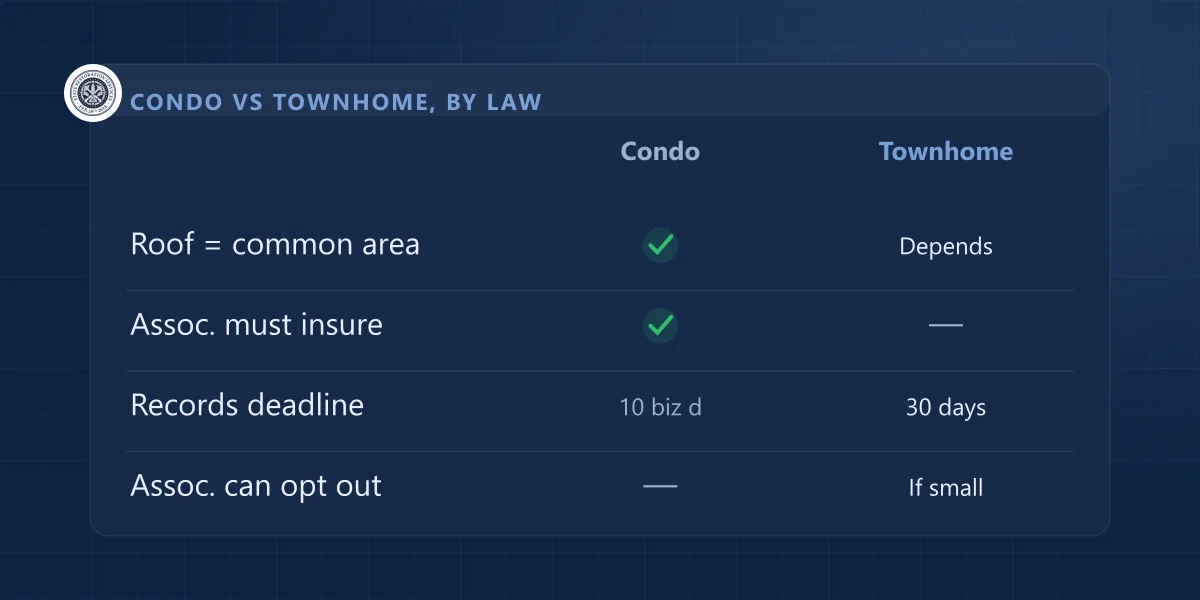
| Question | Condominium (765 ILCS 605) | Common interest community (765 ILCS 160) |
|---|---|---|
| Is the roof a common element or area? | Yes — everything except the units | Only if the declaration says so |
| Must the association insure the building? | Yes, full insurable replacement cost, by statute | No statutory requirement; the declaration controls |
| Deadline to produce records you request in writing | 10 business days | 30 days |
| Are current insurance policies on the records list? | Yes, expressly | Not listed in the Act's records section |
| Can the association be exempt from the Act? | No | Yes, if small — see below |
| Owner petition on a 115 percent assessment increase | Yes, 20 percent of votes within 14 days | Yes, same threshold and clock |
The exemption is the one that catches people out. Under Section 1-75, an association organized under the General Not For Profit Corporation Act of 1986 with either ten units or fewer, or annual budgeted assessments of $100,000 or less, is exempt from the Act entirely unless it affirmatively elects to be covered. A great many small suburban townhome associations sit under that line. If yours does, the statutory protections above are not your protections — your declaration and bylaws are the whole rulebook, and they are worth reading closely.
The budget mechanics do carry over for associations that are covered. Section 1-45 uses the same 115 percent trigger, the same 20 percent of the votes, and the same 14-day window, and it exempts assessments "relating to emergencies or mandated by law" from member approval. Its emergency definition is slightly broader than the condo version: "a danger to or a compromise of the structural integrity of the common areas," or "a danger to the life, health or safety of the membership."
How to get the documents that actually answer this for your building
Ask in writing, and ask for specific documents by name. In a condominium, Section 19 entitles you to inspect and copy a defined list, and failing to produce them within 10 business days of a written request counts as a denial. In a common interest community the equivalent right sits in Section 1-30 and the clock is 30 days.
The six documents that answer the roof question, in the order we would ask for them:
- The declaration, bylaws and plat of survey, with all amendments. This is where roof ownership actually lives. Everything else is commentary.
- All current policies of insurance of the association. Named in Section 19 for condominiums. You are looking for the wind and hail deductible and how it is calculated — flat dollar or percentage of insured value.
- Any reserve study. Also named in both statutes. It will tell you what remaining life the association assumed for the roof and what it budgeted to replace it.
- Board meeting minutes. Condominium associations keep them for at least seven years; so do common interest communities. The vote that adopted the assessment, and the reasoning, are in here.
- All contracts then in effect. If a roofer has already been engaged, the scope and the price are in the contract, and Section 19 lists contracts expressly.
- The books and records. Condominium owners are entitled to the current and ten immediately preceding fiscal years — enough to see whether reserves were funded or quietly waived.
Send the request by a method that creates a date, keep a copy, and diary the deadline. Board members are usually unpaid volunteers, and a specific written request naming the documents tends to get a faster and more useful answer than a frustrated one at an open meeting.
What we tell owners and boards who call us
If you own a unit, we will look at your roof and tell you honestly what we see, but we will not sign you up for work on a roof you do not own. That conversation belongs to the board. If you are on the board, we survey the whole property, photograph every building, and give you a written scope you can put in front of owners and a carrier.
Two things we say every time. First, be skeptical of anyone who works down a row of townhome doors after a hailstorm collecting individual signatures. The most generous reading is that they have not read your declaration. Second, Illinois law does not allow a roofing contractor to negotiate an insurance claim, which is why our partner licensed public adjuster handles the claim side and we handle the roof. If you are choosing one, we wrote up how to choose a public adjuster, and the rules on signing away claim rights are in assignment of benefits on a roof claim.
On price, we quote association work per building after a survey, because a six-unit building with three chimneys and a four-unit building with none are not the same roof. The useful sanity check is our published Chicago-suburb cost guide: architectural asphalt runs roughly $450 to $1,150 per square (100 square feet) installed on residential work, so a board looking at a bid can at least check whether the per-square math lands in a normal range. Multi-unit and low-slope buildings are covered on our commercial roofing page, houses on residential roofing, and the claim side on storm and insurance.
For an active leak, call during business hours and we will prioritize getting out to tarp it. We are open Monday through Friday, 7:00 AM to 7:00 PM, and Saturday and Sunday, 9:00 AM to 5:00 PM.
Frequently asked questions
My ceiling is leaking. Do I call a roofer or the association?
In a condominium, call the association first. The roof is a common element under 765 ILCS 605/2, and the board has the duty to maintain and replace it under Section 18.4, so a roofer you hire yourself is working on property you do not own. Report the leak in writing, keep the date, and photograph the ceiling. In a townhome common interest community, read your declaration first, because the answer genuinely varies.
Can the association make me pay the insurance deductible?
Sometimes. Section 12(c) of the Condominium Property Act lets the board pay the deductible as a common expense, assess it against the owners the damage originated from after notice and an opportunity for a hearing, or require the owners of the affected units to pay it. Which of the three applies is a board decision, so ask which one they used and where it is recorded in the minutes.
We are a nine-unit townhome association. Does the state law even apply to us?
Probably not, and that surprises people. Under 765 ILCS 160/1-75 a common interest community association organized under the General Not For Profit Corporation Act of 1986 with either ten units or fewer, or annual budgeted assessments of 100,000 dollars or less, is exempt from the Act unless it elects to be covered. If yours is exempt, your declaration and bylaws are doing all of the work.
Can I refuse to pay a special assessment for a roof I think is fine?
Not on your own, and not by withholding payment. What the law gives you is a group process: if the year total of regular plus separate assessments would exceed 115 percent of last year, owners holding 20 percent of the votes can petition within 14 days for a meeting, and the assessment stands unless a majority of the total votes are cast to reject it. Assessments for a genuine emergency skip that vote entirely.
Roof question in a condo or townhome building? Book a free inspection or call (866) 992-2982 — we survey association properties as well as houses across the north and northwest Chicago suburbs, and we will put the findings in writing for your board.