
 Volodymyr Lukaniuk
Quick answer: A mechanics lien is a recorded claim against your house filed by someone who worked on it and did not get paid — and in Illinois that can be a crew or a supply house you never hired. Under the Mechanics Lien Act, two documents keep you out of it: a sworn contractor’s statement, and a signed lien waiver from every name on it.
Here is the scenario nobody warns a homeowner about. You hire a roofer. The tear-off goes fine, the new roof looks good, you pay in full. Four months later a letter arrives from a lumberyard two counties over saying it has recorded a mechanics lien against your address for the shingles currently nailed to your house. You paid. Your roofer did not pay them. Under the Illinois Mechanics Lien Act that is now your problem, and it becomes your problem a second time at closing, when the title company finds it.
We are a family-owned roofing contractor in Lincolnshire working across the north and northwest Chicago suburbs, and this is the part of a roofing contract homeowners ask about least and should ask about most. Below is the homeowner’s side of that law: who can lien your house, what the clocks are, the two pieces of paper that stop the whole thing, and what your moves are if one is already on record.
What is a mechanics lien on a roof job, exactly?
It is a claim recorded against your property by anyone who furnished labor or materials that improved it. Section 1 of the Act (770 ILCS 60/1) gives that lien to the contractor for the amount due plus interest at 10% per year, and says the lien “attaches as of the date of the contract” — the date you signed, not the date anyone recorded anything.
That last detail is why lenders and title companies treat these seriously. A lien recorded in November on a contract signed in June takes its priority from June, ahead of anything recorded in between. The lien also runs against the house rather than against you personally: it will not appear on your credit report, but it clouds the title, and a clouded title stops a sale or a refinance dead.
Recording one is also cheap, and nobody has to prove anything first. The Act itself sets the recording fee at $12 for the first four pages. There is no hearing and no finding that the money is genuinely owed — someone signs an affidavit and it goes on record against your address. Filing one is trivial and arguing one off your title is expensive, which is why the paperwork you collect before paying matters far more than anything you can do afterwards.
Who can put a lien on a house you already paid for?
Anyone in the chain who improved it. Section 1 covers the contractor you actually hired and signed with. Section 21 gives the same lien rights to every subcontractor, worker and material supplier who furnished labor or material to that contractor — people you never hired, never met, and in most cases never heard of until the letter arrives.
| Who | What they must do first | Their clock |
|---|---|---|
| Your roofing contractor | Record a claim for lien with the county | 4 months after completion to bind a later buyer or lender; 2 years as against you |
| Any subcontracted crew, worker or material supplier | Notify the occupant in writing that they are furnishing labor or material, then serve a written notice of the claim on you and your lender | 60 days from first furnishing (§ 21(c)), then 90 days after completion (§ 24) |
| Equipment rental company | Nothing — § 1.2 excludes single-family homes from rental-equipment liens | No lien on your house |
On an owner-occupied single-family residence the Act builds in protections that do not exist on a commercial job. Section 21(c) requires a subcontractor to notify the occupant, personally or by certified mail, within 60 days of first furnishing labor or material — and the notice has to carry a specific warning in at least 10-point bold face type. The statute writes the warning for them, and it ends by telling you exactly what to do: “A lien waiver will be provided to your contractor when the subcontractor is paid, and you are urged to request this waiver from your contractor when paying for your home improvements.”
Miss that 60-day window and the subcontractor still keeps the lien — but only to the extent you have not already been prejudiced by payments you made before the notice reached you. That is the most useful sentence in the Act for a homeowner: if you have already paid the money out properly against waivers, a notice that arrives late buys the claimant nothing.
How does a homeowner end up paying for the same roof twice?
By paying the contractor without the paperwork. Section 21(d) says you cannot be compelled to pay more than the price stipulated in your original contract — with one exception, and it is the exception that decides these cases: unless payment was made to the contractor “in violation of the rights and interests of the persons intended to be benefited by this Act.”
In plain English: the cap protects you if you paid the way the Act tells you to. It does not protect you if you handed over the full amount without ever asking who else was owed. Produce the sworn statement listing that supplier plus a signed waiver from them, and you paid properly. Produce neither, and you are in an argument about facts that costs more than the paper would have.
Storm work makes this harder, because insurance money arrives in stages. The carrier releases actual cash value first and the recoverable depreciation later, so partial payments to the roofer are normal on a claim job — and each one is another moment where a waiver should change hands. If a mortgage servicer is holding the money as a loss draft, the file usually demands lien waivers before releasing the final funds, which is one of the few places the paperwork gets forced on everybody. That whole process is in why your mortgage company is on the roof insurance check.
Illinois does put teeth in the Act on the contractor’s side. Section 21.02 makes money received in exchange for a lien waiver trust money, held for whoever furnished the labor or material. Section 21.01 makes it a Class A misdemeanor to induce a subcontractor to sign a waiver, collect on it, then willfully fail to pay that subcontractor within 30 days. Both are real, and neither takes the lien off your house — they punish the contractor afterwards, which is cold comfort when you are the one holding a clouded title.
What are the actual deadlines?
Five clocks matter to a homeowner, and they run from two different events: the day that particular party first furnished labor or material, and the day the job was completed. Here they are in the order you would encounter them.
| Clock | What has to happen | Section |
|---|---|---|
| 60 days from first furnishing | Subcontractor or supplier notifies the occupant of an owner-occupied single-family home, in writing, with the statutory warning | § 21(c) |
| 90 days after completion | Subcontractor or supplier serves a written notice of claim on the owner of record and the lending agency | § 24 |
| 4 months after completion | Claim for lien recorded, if it is to be enforced against a later purchaser or lender | § 7(a) |
| 10 days after recording | The contractor must give you written notice that it recorded a lien against your home | § 7(d) |
| 2 years after completion | Outside limit to record as against you, and to bring suit to enforce | § 7(a), § 9 |
That 10-day rule in Section 7(d) is worth knowing by name, because it exists specifically for owner-occupied single-family homes. If your contractor records a lien and does not tell you within 10 days, and you suffer damages before the notice arrives, the lien is extinguished to the extent of those damages. The statute is careful to add that the mere recording of the claim is not itself damages, and the rule does not apply to subcontractors.
One correction worth flagging, because a lot of what is written online is now pointing at a blank subsection. Public Act 103-827, effective January 1, 2025, rewrote Sections 5, 21 and 24 of the Act. The subcontractor’s 60-day notice to the occupant used to live in Section 5(b)(ii); it now lives in Section 21(c), and 5(b)(ii) and (iii) read “(Blank).” The duty did not go away — it moved. The same Act also widened how a Section 24 notice may be served: registered or certified mail with return receipt, a nationally recognized delivery company with tracking, or personal service. If a page cites “Section 5(b)(ii)” to you today, it was written before 2025.
The two pieces of paper that stop all of this
A sworn contractor’s statement, and lien waivers. That is the whole defense, and Section 5 makes both of them somebody’s legal duty rather than a favor you are asking for.
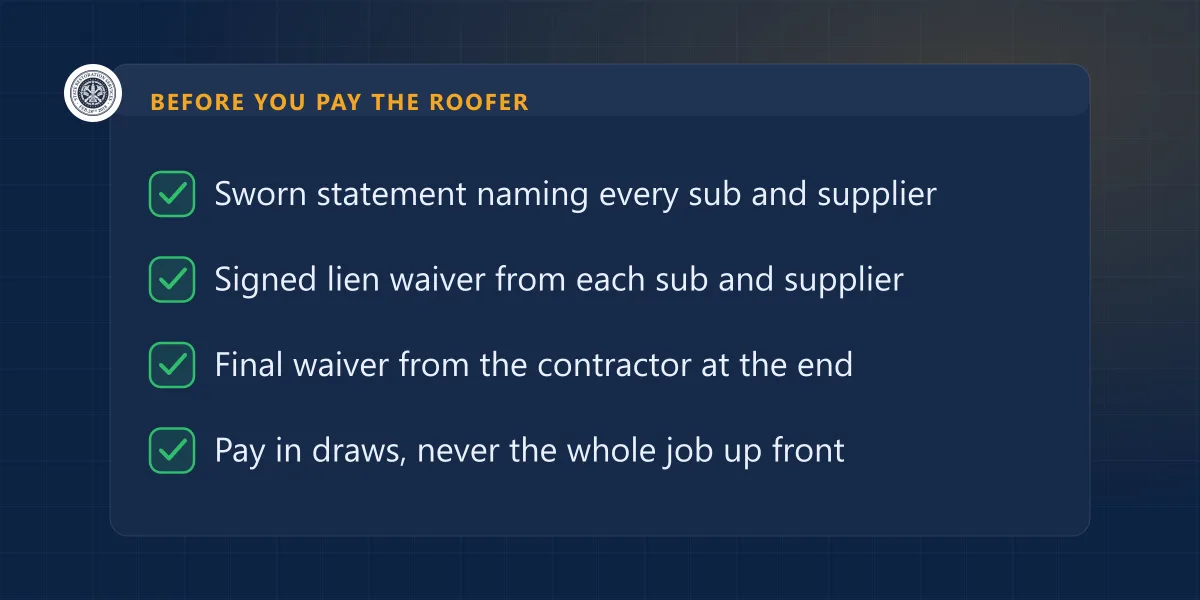
The sworn statement. Section 5(a) makes it the duty of the contractor to give you — and your duty to require — a written statement, under oath or verified by affidavit, listing the names and addresses of everyone furnishing labor, services or material, and the amount due or to become due to each. It has to come before you pay or advance anything. Section 5(b)(i) then requires your contractor to hand you this notice, in the contract itself or as a separate printed statement, in at least 10-point bold face type, before your first payment:
“THE LAW REQUIRES THAT THE CONTRACTOR SHALL SUBMIT A SWORN STATEMENT OF PERSONS FURNISHING LABOR, SERVICES, MATERIAL, FIXTURES, APPARATUS OR MACHINERY, OR FORMS OR FORM WORK BEFORE ANY PAYMENTS ARE REQUIRED TO BE MADE TO THE CONTRACTOR.”
Once you have that statement you know every party who could possibly lien your house, and the rest is bookkeeping against a list.
The waivers. A lien waiver is a signed document giving up the right to lien for the amount received. Take a partial waiver at each draw covering that draw, and final waivers at the end from the contractor and from every name on the sworn statement. The supply house signs one too — on a typical suburban tear-off the shingle package is usually the largest single amount your contractor owes to somebody else, which makes the supplier the most likely lien claimant in the whole chain.
Pay in draws, not in one lump. Material on delivery or at tear-off, balance at completion against final waivers, is a normal and defensible rhythm on a residential roof. A contractor asking for the entire contract price before a single bundle is on the roof is asking you to finance the job, and it hands away every bit of leverage the Act was written to give you. Same goes for the door-knocker after a hailstorm quoting a whole roof at a suspiciously round number and wanting cash today: the payment terms are the bigger warning, not the price.
A lien is already recorded against your house. What are your moves?
Three of them, and all three are in the Act itself. You are not limited to calling the roofer and hoping. Before anything else, confirm it is actually recorded and read what it says: in Cook County recording moved into the County Clerk’s office in December 2020 and there is no separate Recorder of Deeds any more, and in Lake County it is the County Clerk’s Recording Division in Waukegan. Both run an online search.
| Move | What it does | The catch |
|---|---|---|
| Section 34 demand to commence suit | Forces the claimant to sue within 30 days of receipt or forfeit the lien entirely | The demand must contain this exact sentence in at least 10-point bold: “Failure to respond to this notice within 30 days after receipt, as required by Section 34 of the Mechanics Lien Act, shall result in the forfeiture of the referenced lien.” Serve it by certified mail or personally |
| Section 35 demand for release | Once the claim is paid, or forfeited under Section 34, the claimant must acknowledge satisfaction in writing on your written demand | Ten days of neglect makes them liable to you for $2,500 plus costs and your reasonable attorney’s fees. The release still has to be filed with the county to actually clear the record |
| Section 38.1 bond substitution | Swaps a surety bond in as the security so the lien comes off your title and the fight continues against the bond | The bond must be 175% of the lien claim from a surety meeting the statute’s rating test, and objections get 30 days. This is the route when a closing is on the calendar |
Two honest notes on that table. First, the Section 34 demand is the cheapest and most underused tool in the whole Act — a lot of liens are recorded as pressure and were never going to be litigated, and a properly worded demand makes the claimant either sue or lose it. Second, we are roofers, not lawyers. Section 39 says the Act “shall be liberally construed as a remedial act,” which is exactly the kind of sentence that makes outcomes fact-specific. If a lien is on your title, the demand letters are worth sending, and an hour with a real estate attorney is worth paying for.
What to ask any roofer for — including us
None of this requires you to become suspicious of everyone with a ladder. It requires four requests, each either required by statute or standard practice, and each of which a contractor running a clean job will hand over without blinking.
- The Section 5(a) sworn statement before the first payment, listing every sub and supplier and the amount due to each.
- The Section 5(b)(i) notice — in the contract or on its own sheet, in 10-point bold.
- Waivers that match the money: a partial waiver with each draw, final waivers from every name on the sworn statement at the end.
- Proof of licensing and insurance, and the name of anyone subcontracted onto the job. Our licensed and insured page shows what that documentation looks like, and we walked through how to verify it on choosing a roofing contractor in Illinois.
If the job is a storm claim, one more thing is worth saying plainly, because it is Illinois law and not a policy of ours: a roofing contractor is not permitted to negotiate your insurance claim. We document the damage and build a code-compliant estimate on the roofing side, and our partner, the licensed public adjuster State Adjusting Services, can represent you on the claim itself. How that division of labor works is set out on our storm and insurance claims page, and the sequence we follow on a job is on our process.
Related reading: how to read a roofing estimate covers the line items that hide the real price, and storm chasers vs a local roofer covers the crews most likely to leave a supplier unpaid on their way out of the state.
Frequently asked questions
Can a subcontractor put a lien on my house if I already paid my roofer in full?
Yes. Section 21 of the Illinois Mechanics Lien Act gives a subcontractor or material supplier its own lien on your property, separate from your contract with the roofer. Section 21(d) does cap you at the original contract price, but only if you did not pay the contractor in a way that ignored the sworn statement and waivers the Act requires.
How long does a mechanics lien stay on a property in Illinois?
Until it is released or the time to enforce it runs out. A claimant has two years from completion of the work to record a claim against the owner and to file suit under Sections 7 and 9. You do not have to wait that out: a written demand under Section 34 forces the claimant to sue within 30 days or forfeit the lien.
Does a mechanics lien show up on my credit report?
No. A mechanics lien is recorded against the property, not against you personally, so it is not a consumer credit item. It clouds the title instead, which is what a lender or a buyer sees when you refinance or sell, and it usually has to be cleared before a closing can happen.
What is a lien waiver, and who should sign one on a roof job?
A lien waiver is a signed document in which someone who worked on your house gives up the right to lien it for the amount they were paid. Every name on the contractor sworn statement should sign one: the roofing contractor, any subcontracted crew, and the supply house that delivered the shingles. Collect partial waivers at each payment and final waivers at the end.
Thinking about your roof, or holding a letter you do not like the look of? Book a free inspection or call (866) 992-2982 — we are a family-owned roofing contractor serving the north and northwest Chicago suburbs, including Buffalo Grove, Arlington Heights, Northbrook and Vernon Hills, Monday through Friday during business hours.