
 Volodymyr Lukaniuk
Quick answer: How long does a roof last in the Chicago suburbs really depends on more than the shingle you pick. A properly installed, well-ventilated architectural asphalt roof typically delivers 25–30 real years here; a 3-tab roof realistically gives you 15–20; standing-seam metal can run 40–70. But the material is only part of it — we've torn off 12-year-old architectural roofs that were cooked from underneath by a hot, unvented attic, and we've patched 24-year-old roofs that were still tight because the attic and gutters were kept in shape the whole way.
We get asked how long does a roof last almost as often as we get asked what a new one costs, usually by someone standing in their driveway squinting at shingles that look fine from the ground but are pushing 20 years old. The honest answer isn't a single number off a warranty sheet. It's a range that swings by a decade or more depending on how the roof was built, how the attic underneath it breathes, and how many freeze-thaw cycles our Illinois winters have put it through.
What actually determines how long a roof lasts?
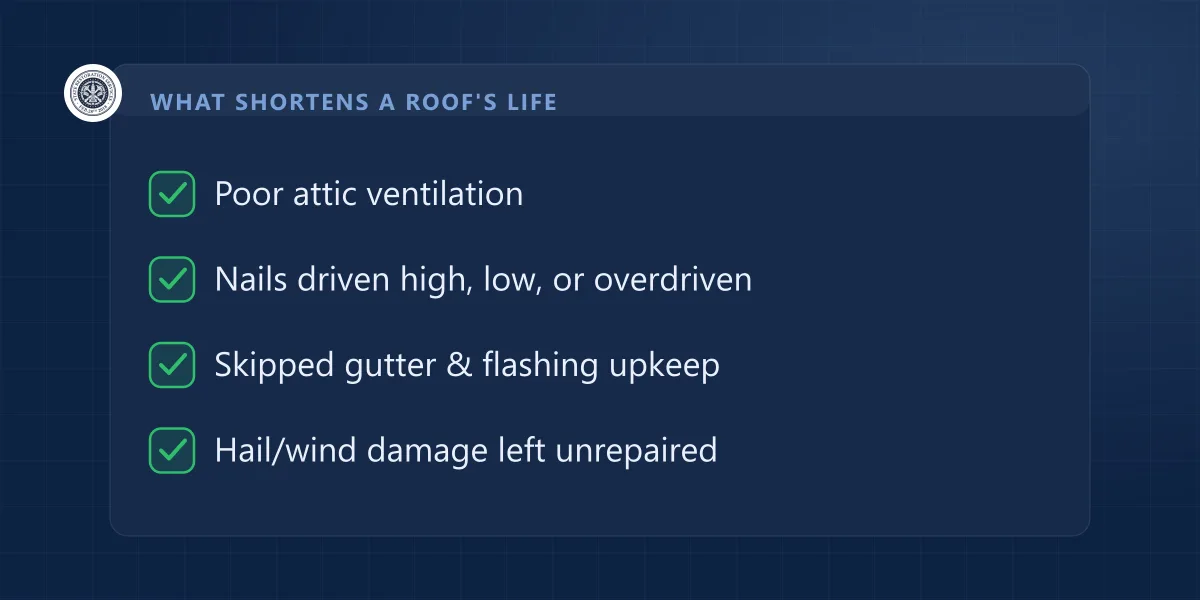
Five things decide it: the material itself, how well the attic is ventilated, how carefully the shingles were nailed, how consistently gutters and flashing get maintained, and how much storm damage the roof has absorbed without repair. Get all five right and a roof will outlive its own warranty. Get two or three wrong and it can fail a decade early.
Material sets the ceiling — a 3-tab shingle is never going to out-survive an architectural one, no matter how well it's installed. But installation and airflow set how close a roof gets to that ceiling. We've seen identical shingle lines on identical Chicago-suburb homes age at completely different rates because one attic had balanced intake and exhaust ventilation and the other one was sealed up tight, baking the underside of the deck every summer. Heat does almost as much damage to a roof as cold does — it just does it slower and quieter, so nobody notices until the shingles are curling and brittle years ahead of schedule.
How long does each roofing material actually last here?
3-tab asphalt realistically runs 15–20 years in our climate against a 20–25 year warranty; architectural asphalt runs 25–30 real years against a 30-year-to-lifetime warranty; standing-seam metal, which we also install, can run 40–70 years. The gap between the warranty number and the realistic number is exactly what freeze-thaw and Chicago storms account for.
| Material | Manufacturer warranty | Realistic Chicago-area lifespan |
|---|---|---|
| 3-tab asphalt | 20–25 years | 15–20 years |
| Architectural asphalt | 30-year to limited lifetime | 25–30 years |
| Standing-seam metal | Lifetime (finish 30–40 yr) | 40–70 years |
Metal costs roughly two to three times more upfront, which is why most homes in the north and northwest suburbs still get architectural asphalt — it's the best balance of cost and durability for someone who isn't planning to own the home for 40 years. If you're staying put long-term or want the modern standing-seam look, we'll walk you through both options during a residential roofing consultation.
Why does our freeze-thaw climate age a roof faster than other regions?
Illinois doesn't hand a roof one hard winter — it hands it forty to fifty freeze-thaw cycles in a single season. Every one of those cycles expands and contracts the shingle mat, the nails, the flashing, and the decking underneath, and that repeated movement is what ages a roof faster here than in a climate with one long, steady cold snap.
A shingle that's warrantied assuming "normal" weathering doesn't get normal weathering in Lake and Cook County. It gets a freeze-thaw grind that most of the country never experiences, plus the Illinois specialty of ice dams — snow melting off a warm roof deck and refreezing at a cold eave — which can work water back up under the shingles at the exact edge where a roof is weakest. We've written a full breakdown of why ice dams form and the real fix if that's the piece of this you're dealing with right now.
How can you tell your roof is actually done, versus just old?
Age alone isn't the test. Granule loss down to the bare mat, shingles that crack instead of flex when you lift a corner, soft or spongy decking underfoot, and daylight or staining in the attic are the real signs a roof is at the end of its life. A 22-year-old roof with none of those signs still has service left in it; an 8-year-old roof with two of them may already need a replacement.
| Sign | What it means |
|---|---|
| Granules collecting in gutters/downspouts | Shingle surface is wearing through — expect acceleration |
| Shingles curl or crack when lifted | Asphalt has lost its flexibility, brittle failure is near |
| Soft or spongy decking | Moisture has reached the wood — repair alone won't fix it |
| Daylight or water stains in the attic | Active leak path, not a cosmetic issue |
| Widespread hail bruising after a storm | May be a repair or a claim — worth a free inspection either way |
If you're not sure which column your roof falls in, that's exactly what our free inspection is for — we walk the roof, take photos, and give you a straight answer instead of a sales pitch either way.
Does regular maintenance actually add years to a roof?
Yes, genuinely. Clean gutters, sealed flashing, and a quick attic check once a year routinely add five or more years to a roof's real service life, because most early failures start with trapped water, not worn-out shingles. It's the cheapest insurance a roof ever gets.
We'll be straight with you: nobody wants to pay someone to climb up and look at a roof that seems fine. But the roofs we replace early almost always share the same story — a clogged gutter that backed water under the drip edge, a chimney flashing nobody resealed after year ten, or an attic vent that got covered in blown-in insulation and quietly stopped working years before anyone noticed the shingles curling. None of that shows up from the driveway. If budget is what's holding back a repair now that keeps a bigger bill away later, ask about financing options before you let a small fix wait.
We're based in Lincolnshire and inspect roofs throughout Lake and Cook County, including Northbrook and Buffalo Grove — if your roof is somewhere past year 15 and you're not sure where it stands, get it looked at before you have to guess during a storm.
Frequently asked questions
How long does a roof really last in Illinois?
Realistically, 15 to 20 years for 3-tab asphalt, 25 to 30 years for architectural asphalt, and 40 to 70 years for standing-seam metal, assuming proper installation, attic ventilation, and basic maintenance. Poor ventilation or storm damage left unrepaired can cut any of those numbers significantly short.
Does the warranty number match how long a roof actually lasts?
Not exactly. Warranties are based on ideal conditions, and our freeze-thaw winters and hail events are harder on a roof than the national average the warranty assumes. Realistic Chicago-area lifespans usually run a few years below the printed warranty term.
What's the single biggest factor in how long a roof lasts?
Attic ventilation. A hot, unvented attic bakes the underside of the shingles every summer and can shave a decade off an otherwise well-installed roof, which is why we check ventilation on every inspection, not just the shingles themselves.
Can maintenance really extend a roof's life?
Yes. Clean gutters, resealed flashing, and an annual attic check catch the small water-intrusion problems that cause most early roof failures, and can realistically add five or more years of service life for very little cost.
Not sure where your roof stands? Book a free inspection or call (866) 992-2982 — we serve the north and northwest Chicago suburbs.
Related reading: roof replacement vs. repair, how we decide and ice dams in Illinois, causes and the real fix.