
 Volodymyr Lukaniuk
Quick answer: Shingle blisters are small bubbles that rise from inside an asphalt shingle when heat works on the asphalt, and when they burst they leave tiny, steep-sided pits. Hail leaves a soft, bruised dent where the stone struck the surface. Blisters are wear or a defect; only the hail damage belongs on an insurance claim.
Shingle blisters and hail damage are easy to mix up, and the mix-up can cost people money in both directions. A salesman who knocks on the door after a storm can point at a field of burst blisters and call it hail. An adjuster looking at an older, blistered roof can write off a real hail bruise as more of the same wear. Both mistakes are avoidable once you know what each one actually looks like.
We are a family-owned roofing company in Lincolnshire serving the north and northwest Chicago suburbs. This guide explains what a blister is, what causes it, how to tell it apart from a hail strike, and what a shingle warranty and a homeowners policy each do with it. Where we quote someone, we quote the source: the Asphalt Roofing Manufacturers Association (ARMA), a hail study by Haag Engineering, and the GAF shingle warranty.
What is a shingle blister?
A shingle blister is a small raised bubble in the surface of an asphalt shingle, lifting the granules with it. Over time the bubble bursts and leaves a little pit with steep sides, often deep enough to reach the fiberglass or felt mat. Blisters are usually a quarter inch across or smaller.
ARMA's Residential Asphalt Roofing Manual defines them in one line: "Bubbles that may appear on the surface of asphalt roofing after installation." The most useful description we have found comes from a paper by three engineers at Haag Engineering, a firm that investigates roof damage, titled Hail Damage to Asphalt Roof Shingles (American Meteorological Society, 2004):
"They appear as small bubbles in the shingle surfaces where a portion of the granule surface is raised. Eventually, the shingle bubbles rupture exposing steep-sided voids in the shingle surfaces that frequently extends down to the shingle mat."
So there are two stages. A closed blister is a raised bump that still has its granules on top. An open blister is the pit left after it bursts, with dark asphalt showing at the bottom. The open ones are the ones that get called hail, because from the ground they look like small dark spots scattered over the slope.
What causes asphalt shingles to blister?
Blisters form when heat acts on the asphalt inside the shingle. Haag puts it as poor quality asphalt combined with heat. ARMA lists blistering among the results of poor attic ventilation, which makes a roof run hotter, and warns that too much asphalt roof cement under a shingle can cause blistering as well. Age, color and slope direction also matter.
Here is what each source says, and what it means on a real house:
| Cause | What the source says | What it means for your roof |
|---|---|---|
| The asphalt itself | Haag: "Shingle blisters occur from a combination of poor quality asphalt combined with heat." | Some shingles are simply more prone to it than others. This is the part that can make blistering a warranty question. |
| A hot attic | ARMA: overlooking proper ventilation may result in "Premature failure of the roofing including blistering." | A poorly vented attic lets heat build up under the deck, so the shingles take heat from below as well as from the sun above. |
| Too much roof cement | ARMA: "Excessive use of asphalt roofing cement may cause blistering." | Blisters clustered around a pipe, a wall or a patched spot, rather than spread across a slope, can point to too much cement used there. |
| Age and exposure | Haag: aging depends on "the quality of the asphalt, shingle color, roof pitch, slope direction, and attic ventilation." | That is why blistering on one house can differ from one slope to the next. |
The ventilation link is the one you can do something about. If the attic is hot enough to shorten shingle life, fixing it protects the next roof too. Our guide to attic heat and shingle life explains how intake and exhaust vents are balanced. The cement caution matters on repairs and around flashings, where roof cement is used; ARMA repeats it throughout the flashing chapter of the same manual.
How do you tell shingle blisters from hail damage?
Look at size, shape, spread and the metal around the house. Blisters are usually a quarter inch or smaller, with steep sides. A hail bruise is a dent where the stone hit, soft to the touch, with the granules knocked off. Hail spreads across the windward slopes and marks metal vents and gutters too. Blisters leave metal alone.
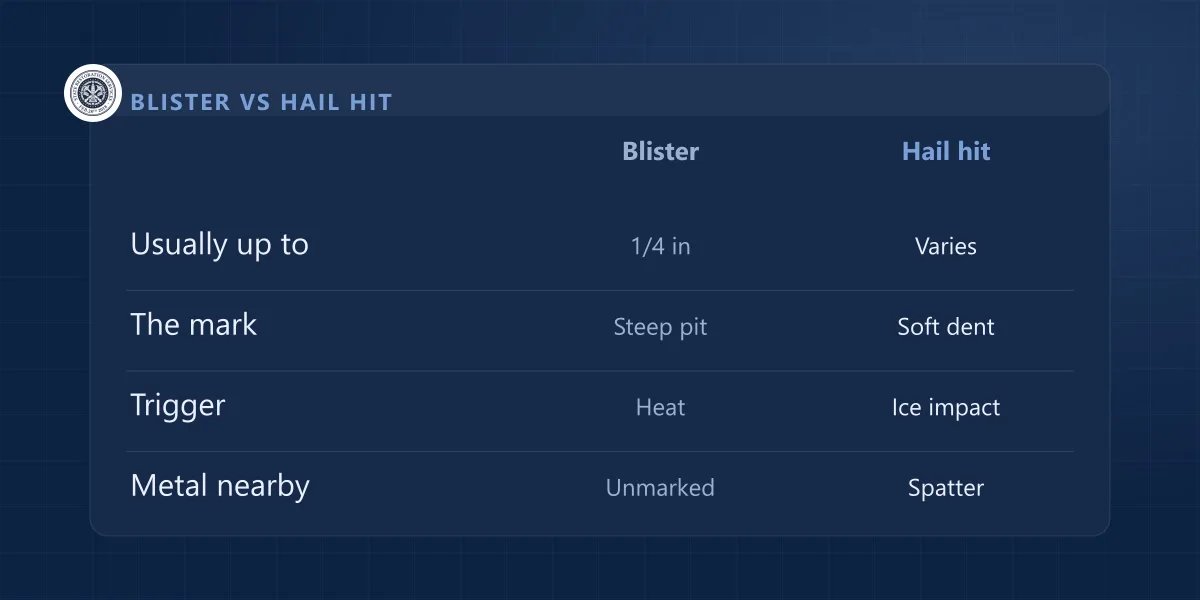
Haag's paper defines what counts as functional hail damage to a shingle: "punctures, tears, or fractures (bruises) in the shingle mats." It describes a bruise as "an indentation with fracture in the mat that feels soft like that of an apple bruise," and adds that granules are knocked off the impact area too. A blister, by contrast, pushes up from inside the shingle. It is not the mark of an impact.
| What to check | Blister | Hail hit |
|---|---|---|
| Size | Usually 1/4 inch across or less, per Haag | Depends on the size of the hailstones |
| Shape of the mark | A raised bubble, or a small pit with steep sides after it bursts | A dent, often with a soft, spongy center where the mat fractured |
| Where on the roof | Wherever heat and the asphalt allow; can differ from slope to slope | Spread at random over the slope, heaviest on the side facing the storm |
| Metal on and around the house | No effect on metal | Dents or "spatter" marks on vents, gutters, downspouts, AC units |
| When it appeared | Develops over time | Tied to a specific storm date |
The spread matters. Haag: "hail would leave a random distribution of damage on the roof. The windward slope typically sustains the most concentrated and direct hail impacts whereas the leeward slopes have fewer, glancing hail impacts."
So does the metal. Haag's inspectors look for hail "spatter" marks, which it says "are usually found on faded metal surfaces such as air conditioners, electrical junction boxes, and metal window frames," and for dents in the aluminum fins of air conditioners. Haag uses these marks to estimate hail size and direction, and writes that the evidence on and around the house "should match" the damage claimed on the shingles. Blisters, being a shingle condition and not a weather event, leave nothing on the metal. If the gutters, downspouts, roof vents and AC fins are clean and the only marks are small pits on the shingles, you are probably looking at blisters. Our guide to what hail damage on an asphalt roof looks like goes through the hail side in more detail.
You can check the metal from the ground. Please leave the shingles to someone with fall protection; a walk across a hot roof in summer can mar the shingles, which Haag lists as another mark that gets mistaken for hail.
Why do blisters get called hail damage, and the other way round?
Because the two show up at the same moment: when someone finally looks at the roof, which is often right after a storm. Old blisters get noticed for the first time and blamed on the hail. And on a roof already covered in blisters, a real hail bruise is easy to dismiss as one more sign of age.
Haag's authors write that "damage inspectors frequently mistake various shingle anomalies such as foot scuffs, adhesive spots, etc., as hail damage," and that the common conditions of aged shingles, blistering among them, are often "not discovered until after a hailstorm; however, this does not mean they were created or aggravated by the storm."
That cuts both ways. A storm salesman who calls burst blisters hail is setting you up for a denied claim, or for a roof paid for by a claim that should not have been paid. We wrote about how to spot that in storm chasers vs. a local roofer. But a blistered roof can also take real hail, and those bruises deserve to be counted. The fair way to inspect it is one hit at a time: is this mark a dent with a fractured mat, or a pit that pushed up from inside?
There is also a real disagreement in the industry about granules. Haag's paper notes that many shingle manufacturers have issued technical bulletins stating that granules lost to hail shorten a shingle's life, and then argues from its own ten-year study that small granule losses without a bruise or puncture do not. We are not going to settle that here. For a homeowner, the practical point is simpler: the damage Haag defines as functional is in the mat (punctures, tears and bruises), so that is the evidence to look for, not loose granules alone. Our guide to granules in your gutters covers what normal shedding looks like.
Are blistered shingles covered by the manufacturer's warranty?
Sometimes. A shingle warranty covers manufacturing defects, and poor quality asphalt is a manufacturing question. But the GAF Shingle & Accessory Limited Warranty, for one, excludes damage caused by inadequate ventilation, so the attic will be looked at. The manufacturer decides, and there are deadlines you have to meet.
The GAF warranty promises the shingles "will remain free from manufacturing defects that adversely affect their performance." Its list of what is not covered includes damage from "inadequate ventilation" and from "acts of nature, such as hail." In plain terms: a blister caused by the asphalt is a warranty question, a blister caused by a hot attic is not, and hail is not a warranty question at all. It belongs to your insurer.
If you think you have a defect, note three lines in that warranty:
- The clock. "You must notify GAF about any claim within 30 days after you notice a problem."
- Who you tell. "Notice to your contractor, dealer, or home builder is NOT notice to GAF." Telling your roofer does not start the claim.
- Do not fix it first. "If you repair or replace your GAF Products before you notify GAF about your claim or before GAF has completed its evaluation of your claim, your claim may be denied." GAF also says it may ask for photographs and sample shingles for testing.
Owens Corning and IKO write their own warranties, and the wording is different, so read the one for the shingles on your house. You will need the installation date and the shingle name, which should be on your original contract. The difference between the manufacturer's paper and the installer's workmanship warranty is covered in roof warranties: manufacturer vs. workmanship.
Does homeowners insurance pay for blistered shingles?
No, not for the blisters themselves. Standard homeowners policies exclude wear and tear, deterioration and defects, and blistering falls on that side of the line. What insurance can pay for is hail damage on the same roof. That is judged separately, by bruises, punctures and tears in the shingle mat, and blisters should not be counted as hail hits.
A carrier can use the difference between wear and storm damage as a defense, and it can end up in a dispute. In the Illinois appraisal case we covered in the insurance appraisal clause, the carrier argued the damage came from wear and tear, poor installation and age rather than hail. The exclusion wording itself is walked through in does homeowners insurance cover a roof leak in Illinois.
If there is a hail claim on a blistered roof, the evidence that carries it is the evidence Haag describes: marks in the mat, a random spread favoring the windward side, and matching marks on the metal. That is what we document. We inspect, photograph the individual hits, record the damage to gutters and vents, and build a code-compliant estimate. Illinois law does not allow a roofing contractor to negotiate your insurance claim, so if you want someone to represent you on the claim itself, our affiliated licensed public adjuster, State Adjusting Services, can do that. More on our storm and insurance claim page.
Should blistered shingles be repaired or replaced?
It depends on how many there are and how old the roof is. A few blisters on a sound roof are something to watch, not an emergency. A roof where many have burst and the dark asphalt is showing on a whole slope is wearing out early, and patching individual shingles will not stop the rest.
We would not recommend replacing a roof over a handful of bumps, and we would be suspicious of anyone who proposes it without other findings. When a roof has blistering along with curling, cracking or heavy granule loss, replacement becomes the honest answer, and we lay out how we make that call in roof replacement vs. repair: how we decide.
If you do replace, fix the cause at the same time. A new roof over the same hot attic will face the same heat. Check the ventilation, and if the old shingles were a warranty candidate, get the manufacturer's answer before the old roof comes off, not after. Our residential roofing page covers the GAF, Owens Corning and IKO systems we install.
Related reading: Class 4 impact-resistant shingles · What a real free roof inspection covers
Frequently asked questions
Can a hailstorm cause shingles to blister?
No. Blisters form from inside the shingle, when heat works on the asphalt. The Haag Engineering paper on hail damage lists blistering among the conditions of aged shingles and says that finding them after a hailstorm does not mean the storm created or aggravated them. A storm can still damage a roof that happens to be blistered, and that damage is judged on its own.
Do blistered shingles leak?
Usually not at first. A blister that is still closed leaves the shingle intact. Once it ruptures, it leaves a small, steep-sided pit that can reach down to the shingle mat, and the asphalt there is exposed to the sun and weathers faster. A roof covered in open blisters is wearing out faster than it should, even if it is not leaking yet.
Is shingle blistering a manufacturing defect?
It can be. Haag attributes blisters to poor quality asphalt combined with heat, and a GAF warranty covers manufacturing defects that adversely affect performance. But the same warranty excludes damage caused by inadequate ventilation, so the attic will be part of the question. The manufacturer makes that call and may ask for photos and a shingle sample.
Will my insurance company pay for a blistered roof?
Not for the blisters. Homeowners policies exclude wear, deterioration and defects, and blistering falls on that side. If hail also hit the roof, the carrier should evaluate the hail damage on its own: bruises, punctures and tears in the shingle mat. A blistered roof can still have a valid hail claim, and the blisters should not be counted as part of it.
Not sure if those spots are hail or blisters? Book a free roof inspection or contact us at (866) 992-2982, Monday to Friday, 8:00 AM to 5:00 PM. We serve the north and northwest Chicago suburbs.