
 Volodymyr Lukaniuk
Quick answer: Shingle granules in your gutters are normal on a new roof: manufacturers add extra granules at the factory, and those loose ones wash off over the first several months. It becomes a problem when the loss is sudden after a storm, keeps increasing on an older roof, or leaves bald, dark patches on the shingles.
You clean the gutters, and the bottom of the trough looks like a sandbox: coarse, dark grit that crunches under your glove. Those are shingle granules in your gutters, and the obvious next question is whether the roof is falling apart. Sometimes it is. On a roof that is only months old, it is usually the shedding the shingle maker itself describes as normal. This guide walks through how we tell the difference, what the shingle maker's own bulletin says, and when a handful of grit turns into a warranty question or an insurance claim.
We are a family-owned roofing company in Lincolnshire serving the north and northwest Chicago suburbs. Granules are also a favorite prop for out-of-town storm salesmen: a fistful of grit from a roof that went on in spring, and the words "hail damage." So we will be specific.
What are shingle granules, and what do they actually do?
Granules are the colored, sand-sized stone that coats the top of an asphalt shingle. Their main job is to shield the asphalt underneath from the sun's ultraviolet light, which dries asphalt out and makes it crack. They also give the shingle its color. A shingle that loses them ages much faster.
The Asphalt Roofing Manufacturers Association defines granules as "Ceramic-coated colored crushed rock that is applied to the exposed surface of asphalt roofing products." IKO, one of the shingle makers we install, describes them as a shield designed to protect the asphalt coating from harsh UV sunlight, and gives the size range: from about 0.425 mm up to 1.7 mm, blended so the particles interlock and cover as much of the asphalt as possible.
That is why granule loss matters. The asphalt layer is what keeps water out, and the granules are what keep the asphalt from baking. Once a patch of shingle is bare, the sun works on it directly, and that spot turns brittle and cracks sooner than the shingles around it.
Is it normal to find granules in the gutters of a new roof?
Yes. GAF's technical bulletin on the subject says loose "rider" granules are added during manufacturing to make sure the rest embed properly, and that losing them is normal, not a manufacturing defect. The loss is usually heaviest right after installation and gradually tapers off. GAF often suggests waiting several months to see it correct itself.
The bulletin is GAF Technical Advisory Bulletin TAB-R-112, "Granule Loss on New Shingles". It calls the extra granules "riders", "hitchhikers", or "sleepers", and says their loss:
- "Usually is most severe right after shingles are installed"
- "Gradually reduces over time"
- "This is normal and is not a manufacturing defect"
GAF adds that this "presents no potential for premature aging of the shingles," and that, based on its experience, the condition is "more often than not" self-correcting. Some riders come off while the bundles are handled and installed, and rain washes the rest into the gutters and out the downspouts.
So if your roof went on this spring and you see an even, light layer of grit in the gutter and at the downspout outlet, that is what you are looking at. The honest test is the shingles themselves: from the ground, they should look uniform in color, with no dark blotches.
When do granules in the gutter mean something is wrong?
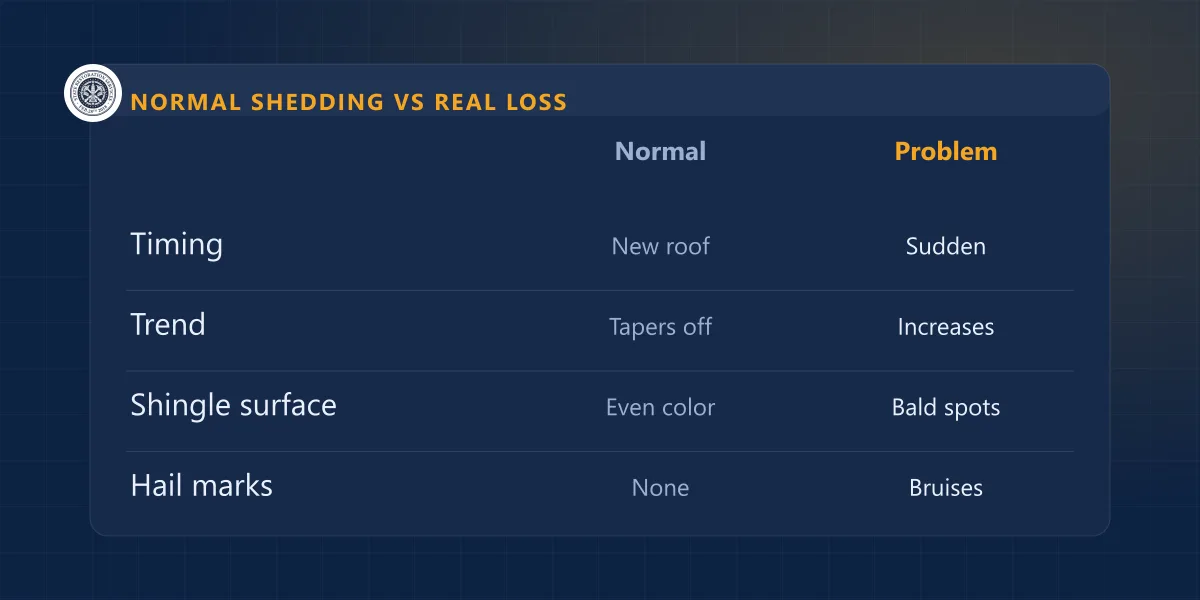
Pay attention when the loss shows up suddenly after a storm, keeps growing year over year on a roof past its first season, or leaves bare, darker patches you can see from the ground. Each pattern has a different cause, and the cause decides whether it is a repair, a replacement or an insurance claim.
| What you see | Most likely cause | What to do |
|---|---|---|
| Light, even grit on a roof installed in the last several months | Factory rider granules washing off | Nothing yet; check again after a few months |
| A sudden, heavy amount right after a hailstorm, plus dents in gutters, vents or screens | Hail knocking granules loose on impact | Photograph it, then get the roof inspected |
| A little more every year on a roof around 20 years old or older | Normal weathering near the end of the roof's life | Start planning a replacement |
| Bare patches in one spot: under a tree limb, near where a dish was mounted, at a walkway to a chimney | Abrasion or foot traffic | Trim the limb; repair the shingles in that area |
| Granule loss after the roof was power-washed | Water pressure stripping the surface | Stop washing; have the damage assessed |
Hail deserves a closer look, because it is the one that turns into a claim. A hailstone hits a shingle, crushes the granules into the asphalt or knocks them off, and leaves a dark, round spot that can feel soft when pressed. We explain what that looks like up close in hail damage on an asphalt roof. Granules alone never prove hail, though. The storm chaser holding a handful from a roof that went on this spring is showing you factory riders and a sales pitch.
The age pattern matters just as much. ARMA's homeowner guidance puts it plainly: "If a residential roof is more than 20 years old, it is a prime candidate for reroofing." On a roof that old, steady granule loss is usually the shingles wearing out on schedule, and our guide to how long a roof lasts in the Chicago freeze-thaw climate covers what our winters do to shingles.
How can you check your roof without climbing on it?
Stay on the ground. ARMA tells homeowners to walk around the house with binoculars and look for cracked, curled or missing shingles and excessive granule loss, and says in capital letters not to climb on the roof. Add a look in the gutters, at the downspout outlets and in the attic.
Here is the walk-around we suggest:
- Check the downspout outlets. Granules collect where the water leaves the downspout, on the splash block or at the end of the extension. A dark, gritty fan there is the easiest sign to spot.
- Look in the gutter. From a ladder at the gutter, not on the roof, see how much has settled in the trough. A light dusting is common; a layer you can scoop with your hand is worth noting.
- Compare over time. Take a dated photo each spring and fall when you clean the gutters. A roof that sheds a little less every season is settling; one that sheds more every season is likely wearing out.
- Scan the slopes with binoculars. Look for patches darker than the rest, where the black asphalt or mat shows through. Check the slopes that face south and west first, since they take the most sun.
- Check the soft metal after a storm. Fresh dents in gutters, downspouts, roof vents and window screens tell you hail hit the house hard enough to leave marks.
- Look in the attic. With a flashlight, check the underside of the roof deck for stains or wet spots, which ARMA also recommends. Granule loss by itself does not leak, but a roof that is losing granules and staining the deck needs a roofer to look at it soon.
Granules also settle in the trough and the downspout elbows over time, so they are one more reason to keep gutters clean. If you would rather not be on a ladder at all, we offer gutter cleaning too.
Is granule loss covered by the shingle warranty or by insurance?
It depends on the cause. A shingle warranty covers manufacturing defects, and GAF's bulletin says light to moderate loss is normal and the color variation it causes is not covered. Weathering on an old roof is wear and tear, which homeowners policies exclude. Granule loss from a hailstorm is storm damage, which is what homeowners insurance is for.
On the warranty side, GAF's bulletin tells homeowners to contact GAF Warranty Services if, several months after installation, "The granule loss is still significant," "The roof starts changing color, due to granule loss," or "the shingles exhibit other signs of damage." It also says the warranty does not cover shading, meaning visual issues, caused by light to moderate granule loss, but that severe loss caused by a manufacturing defect may be covered under GAF's limited warranty. If you think your new roof falls in that category, call your installer first, because the warranty claim will need the installation date and product. Our guide to roof warranties, manufacturer vs workmanship explains which paper covers what.
On the insurance side, the line is between time and a storm. A standard homeowners policy excludes wear and tear and deterioration, which we cover in does homeowners insurance cover a roof leak in Illinois. Hail that bruises shingles and strips granules is a sudden, dated event, which is the kind of loss a claim is for, subject to your deductible. One more wrinkle: even impact-rated shingles are tested in a way that ignores top-surface granule loss, which we explain in our Class 4 impact-resistant shingle guide.
If it is storm damage, here is how we work. We inspect, photograph and document the damage and build a code-compliant estimate. Illinois law does not allow a roofing contractor to negotiate your insurance claim, so if you want someone to represent you on the claim itself, our affiliated licensed public adjuster, State Adjusting Services, can do that. You can read more about the process on our storm and insurance claim page.
What strips granules that you can actually prevent?
Three things a homeowner controls: pressure washing, foot traffic and tree limbs. The shingle industry says flatly never to pressure wash an asphalt roof. ARMA tells homeowners to stay off the roof, because walking on it is dangerous and can damage it. And a branch that rubs the roof in the wind can grind a bare patch into the shingles below it.
ARMA's guidance on algae and moss cleaning reads: "Never use a pressure washer to clean an asphalt shingle roof as this will cause granule loss and very likely premature failure of the roof system." If the reason for washing was black streaks, those are algae, and our guide to black streaks and moss on your roof covers the gentler way to deal with them.
Foot traffic is the second. Trips to adjust a satellite dish, hang lights or reach a chimney scuff granules along the path, so keep them to the ones that are truly needed. Tree limbs are the easiest fix of the three: trim anything that touches or hangs close enough to brush the shingles in a wind.
Does granule loss mean you need a new roof?
Not by itself. A new roof shedding factory granules needs nothing. A small bare patch from a tree limb or foot traffic usually needs a repair to those shingles. Widespread loss across several slopes on a roof near or past 20 years old, or hail damage across the roof, is when replacement becomes the honest answer.
The deciding factors are age, how much of the roof is affected, and whether the shingles still flex and seal. We lay out how we make that call, and how to tell when you are being upsold, in roof replacement vs. repair: how we decide. If it does come to a full replacement, our residential roofing page covers the GAF, Owens Corning and IKO systems we install.
One thing we will not do is condemn a roof over a scoop of grit. If your roof is young and the granules are riders, we will tell you that and leave. If it is hail, we will show you the hits on the shingles themselves, not a handful from the gutter.
Related reading: How to spot storm damage after a Chicago storm · Storm chasers vs. a local roofer
Frequently asked questions
How long do new shingles shed granules?
GAF says loss of the extra factory granules is usually most severe right after the shingles are installed and gradually reduces over time. GAF often recommends letting several months go by to see if it corrects itself. If the loss is still significant after that, or the roof starts changing color, contact the shingle manufacturer and your installer.
Are granules in my gutters a sign of hail damage?
They can be. A sudden pile of granules after a dated storm, together with fresh dents in gutters, downspouts, vents or window screens, points to hail. A light, even sprinkle on a roof that is only months old usually points to normal new-roof shedding. An inspection of the shingles themselves is what settles it.
Can I pressure wash my roof to clean it?
No. The Asphalt Roofing Manufacturers Association says never to use a pressure washer on an asphalt shingle roof, because it will cause granule loss and very likely premature failure of the roof system. For black streaks or moss, use a gentle, manufacturer-approved cleaning method instead of water pressure.
Should I clean the granules out of my gutters before an adjuster comes?
Photograph them first. Take wide and close photos of the gutter, the downspout outlet and the ground below it, with the date, and keep a small sample in a sealed bag. Then clean the gutters so they drain. The photos and the damage on the roof itself are what an adjuster will look at.
Finding granules and not sure what they mean? Book a free roof inspection or contact us at (866) 992-2982, Monday to Friday, 8:00 AM to 5:00 PM. We serve the north and northwest Chicago suburbs, and after a storm we prioritize getting to your home during business hours.