
 Volodymyr Lukaniuk
Quick answer: Those black streaks are almost always algae — Gloeocapsa magna, an organism that feeds on the limestone filler in your shingles and is mostly cosmetic. Green, fuzzy patches are moss, which holds moisture against the shingle and can lift edges over time. Algae you clean; moss you remove and fix the cause, or it comes back worse.
If you've noticed dark streaks running down your roof — usually on the north-facing slope, usually worse by late summer — you're looking at roof algae, not dirt and not storm damage. It's one of the most common things we get asked about on Chicago-area homes, right behind "do I need a whole new roof for this?" Short version: almost never, at least not because of the streaks themselves. Moss is a different story. Here's what's actually growing on your shingles, whether it's hurting anything, and what actually removes it instead of just moving it around.
What are those black streaks on my roof, really?
The streaks are a colony of Gloeocapsa magna, a blue-green algae that feeds on the limestone filler used in most asphalt shingles. It spreads by airborne spores, thrives in humid, shaded conditions, and shows up worst on north-facing slopes that stay damp longest after a Chicago summer storm.
It isn't mold and it isn't rotting your decking — it's a surface organism that secretes a dark, protective coating as it grows, which is the streaking you see. It's more visible on lighter shingle colors and on older roofs, because most manufacturers now mix copper or zinc granules into new shingles specifically to slow it down, and that protection wears off with age and sun exposure.
Is algae actually damaging my shingles?
Mostly no. Algae doesn't eat through the asphalt or shorten the shingle's structural life — it's living on the surface, not in it. The real cost is curb appeal, and on a heavily streaked dark roof, a slightly lower reflectivity that can nudge attic temperatures up a few degrees in summer.
We'll say this straight because we've seen the pitch: some out-of-town crews use black streaks as an opener to sell a full tear-off that isn't needed. If the only issue is streaking and the roof is otherwise sound, cleaning solves it — not a new roof installation. If you've also had a recent storm and you're not sure which problem you actually have, that's worth a real look, not a guess from the driveway.
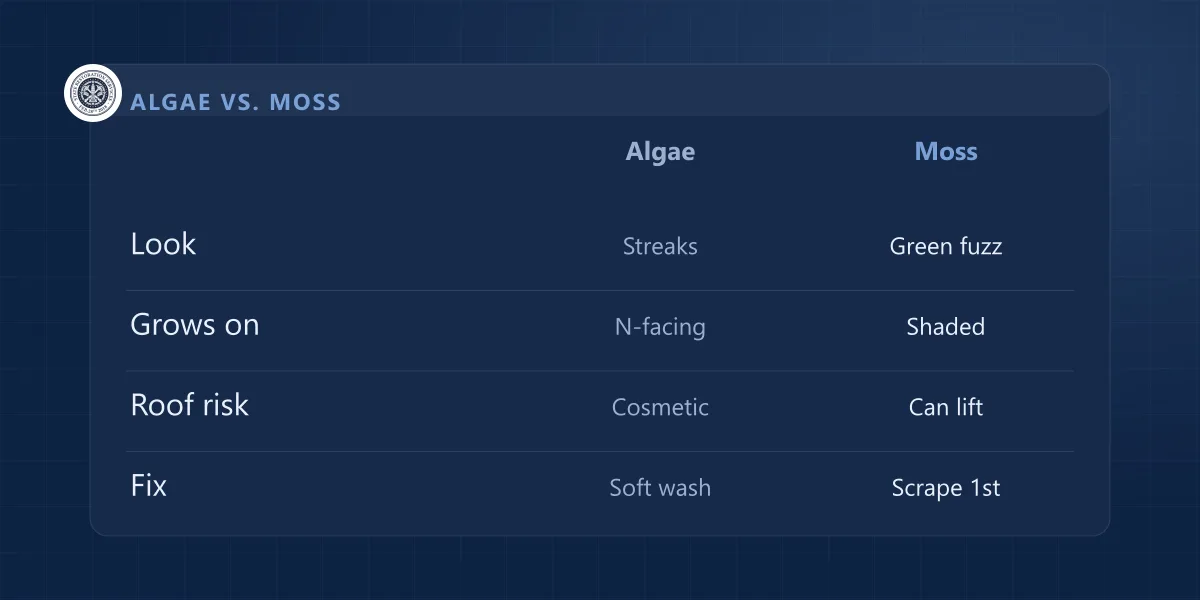
| Signal | Algae (Gloeocapsa magna) | Moss |
|---|---|---|
| Look | Black or dark green streaks | Green, fuzzy, raised patches |
| Where it shows up | North-facing slopes, shaded areas | Deep shade, valleys, debris pockets |
| What it does to the shingle | Surface stain only | Works under the tab, can lift edges |
| Structural risk | Low — cosmetic | Moderate if left for years |
| Fix | Soft wash | Physical removal, then soft wash |
Is moss actually worse than algae?
Yes, more than algae. Moss is a plant, not a surface stain — it puts down rhizoids that work under the shingle tab, holds constant moisture against the mat, and can physically lift the shingle edge. Left long enough on a shaded, poorly-drained slope, that's how a maintenance issue turns into a leak.
Moss favors the same spots every time: deep tree shade, north-facing valleys, and anywhere debris collects and holds water — pine needles caught against a chimney cricket, leaves packed into a valley, or a slope that drains slowly because the gutters below it are undersized or clogged. If your attic runs warm and humid underneath, that moisture has nowhere to go but up through the deck, which is the same mechanism behind the ice buildup we cover in our ice dam guide. Catch moss early — a light green haze, not yet raised — and it brushes off clean. Let it establish for a season or two and removal risks tearing granules with it, which is why timing matters more with moss than with algae.
How do you actually remove it, and what wrecks a roof trying?
The industry-standard fix is a soft wash: a low-pressure rinse with a diluted bleach-and-water solution and a surfactant, left to sit for a few minutes, then rinsed with plain water. It kills the algae or moss without stripping granules. A pressure washer does the opposite — it blasts the protective granules off the shingle in about ten minutes, which shortens the roof's remaining life and can void the manufacturer's warranty outright.
For moss specifically, plan on physical removal first — a soft brush or gloved hand working from the ridge down, never scraping upward against the grain — before the wash, so you're not just cleaning around it. A zinc or copper ridge strip is the closest thing to a permanent fix: every rain carries metal ions down the slope, which keeps regrowth off for years for a one-time install. And if you're replacing the roof anyway, algae-resistant (AR) shingles from GAF, Owens Corning, and IKO all carry a limited streak-resistance warranty — typically 10 to 25 years depending on the line — built into the granules from day one.
| Method | What it does | Typical cost | Risk if done wrong |
|---|---|---|---|
| Professional soft wash | Low-pressure bleach rinse | $350–$700 | Low, if diluted and rinsed correctly |
| Pressure washing | High-pressure water blast | $150–$300 | Strips granules, can void warranty |
| Zinc or copper strips | Prevents regrowth for years | $150–$400 installed | Low, if installed at the ridge correctly |
| DIY spray treatment | Surface treatment only | $30–$60 in product | Uneven results; ladder and runoff risk |
Will homeowners insurance cover algae or moss removal?
No. Algae and moss growth is treated as a maintenance issue, not storm or wind damage, so it isn't a covered peril under a standard homeowners policy. If a storm has also damaged the roof separately, that's its own claim — and Illinois law doesn't let a roofing contractor negotiate that claim directly, which is why we work alongside our affiliated licensed public adjuster, State Adjusting Services, on storm-damage claims.
So if a stranger at your door points at streaks and says your insurance will pay for a new roof over it, that's the tell that they're selling, not inspecting. We'd rather tell a homeowner the honest answer — clean it, watch it, and call us when there's an actual storm or leak — than write an estimate for work that doesn't need doing.
Frequently asked questions
Does algae mean I need a new roof?
No. Algae is almost always cosmetic and doesn't shorten your shingles' structural life. It becomes a replacement conversation only if the roof is already failing for other reasons — age, granule loss, storm damage — not because of the streaks by themselves.
Will pressure washing remove roof algae?
It removes the staining, but it also strips the protective granules off your shingles, which shortens their life and can void the manufacturer's warranty. A soft wash — low pressure, diluted bleach solution — gets the same clean result without the damage.
How long do zinc strips prevent algae from coming back?
A properly installed zinc or copper ridge strip typically keeps a roof algae-free for several years, since every rain carries metal ions down the slope. It's a one-time install at the ridge, not a recurring treatment you have to repeat.
Does homeowners insurance cover roof cleaning for algae or moss?
No. Algae and moss are considered maintenance issues, not storm or wind damage, so a standard homeowners policy won't cover removal. If a storm has separately damaged the roof, that portion may be a legitimate claim on its own.
Not sure if what's on your roof is cosmetic or something to actually worry about? Book a free inspection or call (866) 992-2982 — we serve homes across the north and northwest Chicago suburbs, including Arlington Heights, and we'll give you a straight answer, not a sales pitch.