
 Volodymyr Lukaniuk
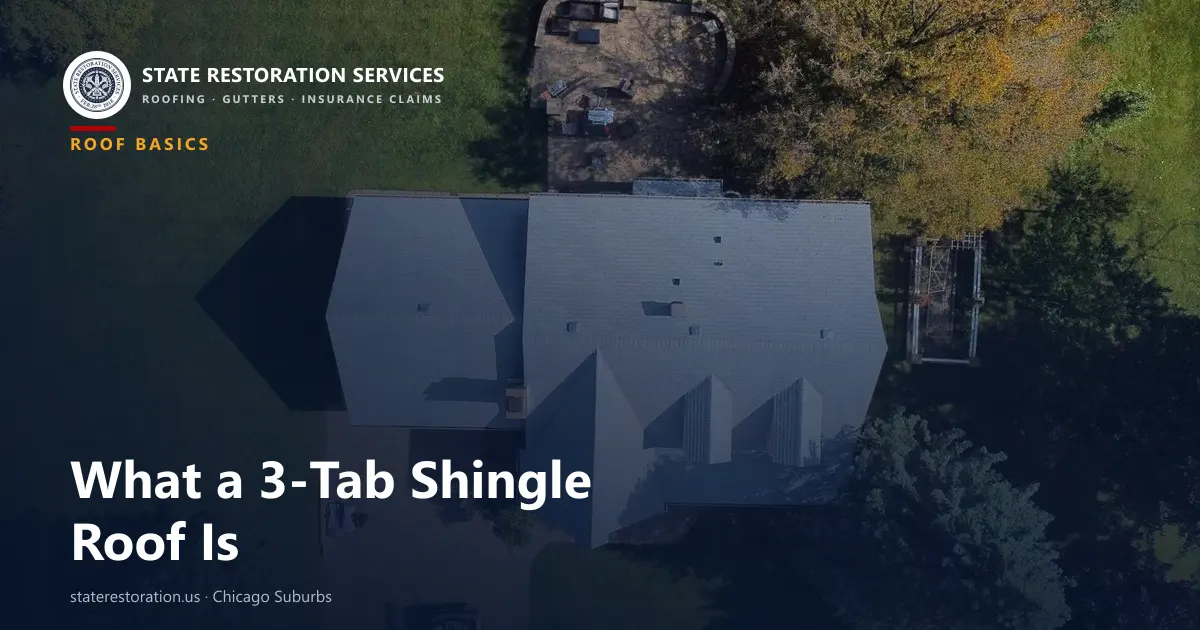
A 3-tab shingle roof is an asphalt roof covered with flat, single-layer strip shingles. Each strip has two slots cut into its lower edge, so once it is nailed down it looks like three separate shingles of the same size. Row after row, those tabs line up into an even, flat brick pattern. It is the plainest kind of asphalt shingle still sold, and you will find it on plenty of older homes in the north and northwest Chicago suburbs.
If an inspector, an insurance adjuster or a roofer just wrote "3-tab" on a report about your house, this page is for you. It shows what the shingle looks like up close, how to check your own roof from the yard, which of the two sizes you have, and what that means when something needs fixing. If you are choosing between 3-tab and architectural shingles for a new roof, we compared them side by side in architectural vs 3-tab shingles for Illinois weather, and we won't repeat that table here.
One 3-tab shingle, drawn to scale
Most of each strip is never seen. The next row up covers the top part, and only the bottom band, the exposure, faces the weather. Here is a standard 12 by 36 inch strip with the parts named.
- The nails go just above the cutouts, where the next row hides them: 4 per strip on a standard roof, 6 on steep slopes or in high wind, per IKO's data sheet.
- The sealant strip is a line of asphalt adhesive. It softens in the sun and glues down the tabs of the row above.
- The exposure is the 5 inch band (5 5/8 inch on the metric size), and it is all you ever see from the ground.
The strip is a fiberglass mat soaked and coated with asphalt, with colored mineral granules pressed into the top. That is the whole shingle: one layer. An architectural shingle glues a second layer under the first, which is where its thick, shadowed look comes from. A 3-tab roof has no second layer, so it reads as flat from the street.
Two parts in the drawing decide how a 3-tab roof behaves in wind. The sealant strip is a line of asphalt adhesive that the sun softens after installation, gluing each tab to the shingle below it. The nails sit just above the cutouts, where the next row hides them. When a tab lifts, it is almost always because the sealant never bonded or has let go, not because the nails pulled.
Is your roof 3-tab? Five things you can check from the yard
Four of the five checks below need nothing but your eyes, and the fifth needs a tape measure.
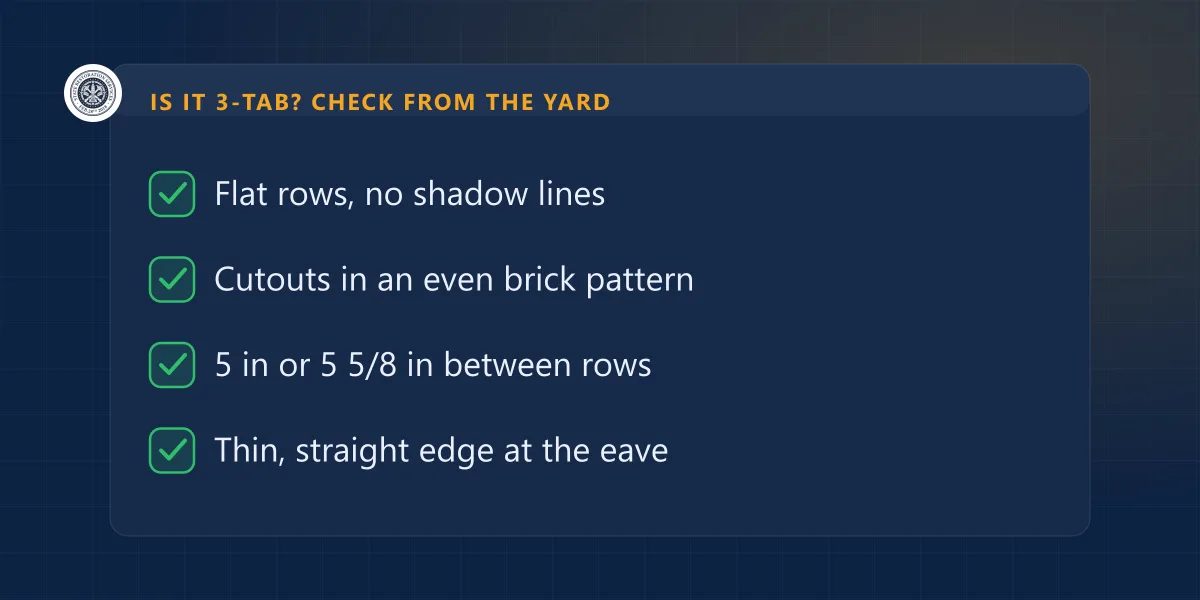
- Stand back far enough to see a whole slope. A 3-tab roof shows clean, straight horizontal lines with no darker shadow bands between them.
- Look at the slots. On 3-tab they line up in a regular pattern, each one halfway between the slots of the row below, like a brick wall laid by somebody very patient.
- Look at the eave edge from the side. A 3-tab edge is one thin layer, about the thickness of a coin stack. An architectural edge shows a thicker, uneven bottom.
- Check the ridge. Ridge caps on older roofs are often 3-tab strips cut into thirds and bent over the peak. That alone doesn't prove the field is 3-tab, but it is a hint.
- If a ladder is already against the house for gutter work, put a tape on the rows at the eave. The distance from the bottom of one row to the bottom of the next is the exposure, and it tells you the size (below).
Please don't climb onto the roof to look. An older 3-tab roof on a cold morning is brittle, and on a hot afternoon the granules roll under your shoes like ball bearings. Binoculars from the driveway, or the photos from our free roof inspection, will tell you the same thing without the fall.
The two sizes of 3-tab, and why the size matters to you
3-tab shingles are made in two sizes, and the size decides which shingles can be used to patch your roof. A shingle of the other size will not line up with your slots or your rows.
| Size | Strip | Exposure (row to row) | Example from the maker's own sheet |
|---|---|---|---|
| English (imperial) | 12 x 36 in | 5 in | GAF Royal Sovereign, English size |
| Metric | 13 1/4 x 39 3/8 in | 5 5/8 in | IKO Marathon Plus AR technical data sheet |
How to read your tape. Measure from the bottom edge of one row to the bottom edge of the row above, on three or four rows, and take the usual number. Close to 5 inches means the English size. Close to 5 5/8 inches means metric. Slot to slot along a row is the other giveaway: 12 inches on English, a little over 13 inches on metric.
Why this matters: say a summer storm takes a dozen tabs off your back slope. If your roof is metric and the only bundle on the truck is English, the new rows come up 5/8 of an inch short on every course and the slots wander out of line. A careful roofer checks the size before ordering anything for the repair.
What the "60 mph" on 3-tab actually means
You'll see 3-tab described as a 60 mph shingle. That number is a warranty limit, not a lab result. GAF's page for Royal Sovereign says the shingle passes the 110 mph and 150 mph wind tests in the lab, and in the footnote says it is warranted to withstand wind speeds up to 60 mph. The same page lists a 25-year limited warranty. So the shingle can hold more than 60 mph on a test rig when the sealant has bonded perfectly, but the manufacturer only stands behind it to 60.
That gap shows on real roofs. Straight-line wind and summer thunderstorms in Lake and Cook County can blow past 60 mph, and when they do, the flat single-layer tab is the first thing to flex. Our article on wind damage to roofs in Illinois goes through what we photograph after a wind event.
Is 3-tab discontinued?
No, not across the board, whatever a door-knocker tells you while pointing at your roof. GAF still lists Royal Sovereign today and calls it the number one selling 3-tab shingle in America. What has changed is how often it goes on a whole house. Builders and homeowners have moved to architectural shingles for full replacements, so many crews stock only architectural, and finding a 3-tab bundle in your exact size and color can take a call or two. For repairs that's usually solvable. For a full new roof we install architectural systems from GAF, Owens Corning and IKO, which you can see on our residential roofing page.
How a 3-tab roof shows its age here
These are the things we point to on 3-tab roofs in the north and northwest suburbs, and what each one usually means.
A straight crease across a tab
The tab was lifted by wind and folded back at the line where the shingle above holds it. The seal is broken even if the tab has dropped back flat. Creases are hard to see from the ground and easy to see in close-up photos.
Tabs missing in a row
The sealant let go along a run and a gust took the tabs off together. You may find them in the yard. The strip underneath is now open to the rain.
Corners turned up or tabs cupped
Usually age and heat from the attic below. We explain the causes in curling, cupping and clawing shingles.
Small bumps or a raised tab with a nail head under it
A nail working its way up through the shingle. See roof nail pops for why that happens and what we do about it.
Granules piling up in the gutters
Some loss is normal on a new roof. Heavy loss on an older 3-tab roof means the asphalt is getting bare. Our guide to shingle granules in the gutters covers how to tell.
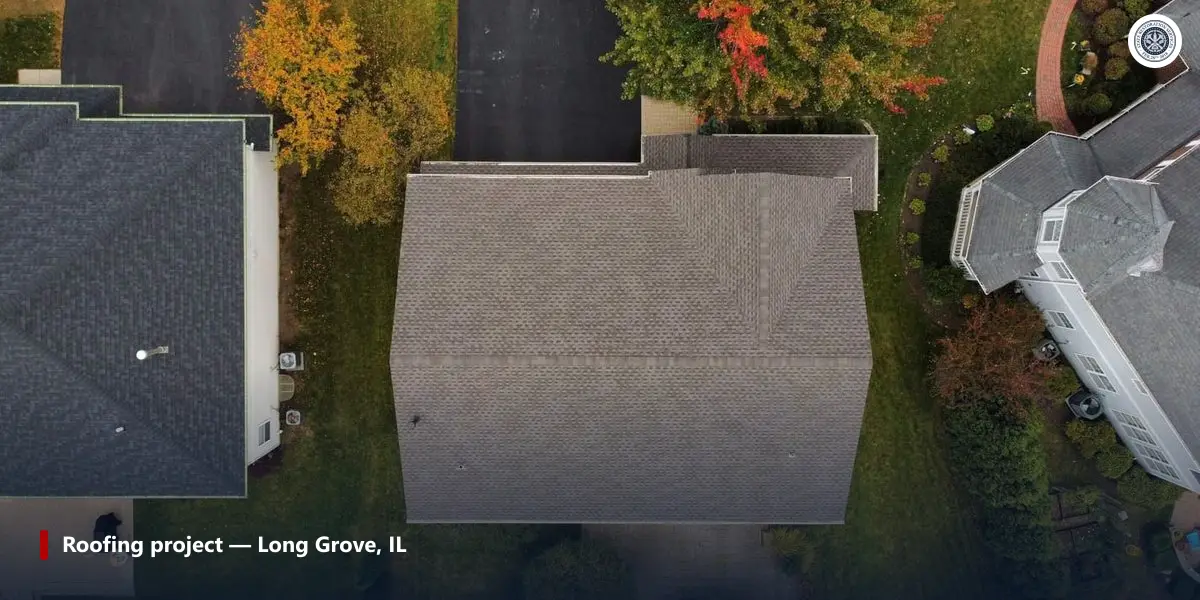
Compare the roof above with your own. A dimensional roof like this one, an aerial photo from one of our Long Grove jobs, has a speckled, uneven texture even from the air. A 3-tab roof photographed the same way shows tight, regular stripes.
Repair or replace when you own a 3-tab roof
A 3-tab roof can be repaired, and often should be. Whether a repair makes sense depends less on the word "3-tab" than on the condition of the shingles around the damage.
A repair usually works when
- the damage is a small area, a few tabs or a strip or two;
- the shingles around it still bend without cracking when the roofer lifts them to reach the nails;
- a shingle in your size, and a color close enough, can be found;
- the rest of the roof has years left in it.
It usually doesn't when
- the shingles crack as soon as they are lifted, so every fix breaks two more tabs;
- damage is spread across several slopes after a storm;
- the roof already has two layers, or the deck is soft under foot;
- the color has faded so far that new tabs would look like patches from the street.
We go through the full decision in how we decide between roof repair and replacement. The color question has its own article too: matching shingle color after storm damage. If storm damage is part of the story, we document it and write the estimate, and our partner, the licensed Illinois public adjuster State Adjusting Services, can represent you with the insurance company if you want help there. See how that works on our insurance claim page.
Questions owners of 3-tab roofs ask us
Can you put architectural shingles over a 3-tab roof?
Sometimes the code allows a second layer, but whether it is a good idea depends on the village and on the manufacturer's instructions for the new shingle. We walk through the rules in roofing over existing shingles in Illinois.
Are my ridge caps 3-tab even if the roof is not?
Possibly. For years crews made ridge caps by cutting 3-tab strips into thirds. Many newer systems use a dedicated thicker ridge cap shingle instead.
Can a 3-tab roof be part of an insurance claim?
Yes. The type of shingle doesn't stop a claim, though the age and condition of the roof matter to the carrier, and the carrier decides what it covers and pays. We photograph and document the damage and write the estimate.
How can I tell 3-tab from architectural in a photo?
Look at the slots and the shadow. 3-tab shows regular slots lined up in a pattern and no shadow bands. Architectural shows irregular dark bands and no repeating slot pattern.
Not sure what's on your roof? Book a free inspection or call (866) 992-2982, Monday through Friday, 7:00 AM to 7:00 PM, and Saturday and Sunday, 9:00 AM to 5:00 PM. We'll tell you which shingle you have, which size it is, and whether a repair is worth doing. We work across the north and northwest Chicago suburbs.