
 Volodymyr Lukaniuk
Quick answer: Roofing over existing shingles is allowed on most Chicago-area homes that carry only one layer, and the model residential code stops it at two. But the code hands the real decision to two other parties: your village, which sets the inspections, and the shingle manufacturer, whose printed instructions the code adopts by reference.
Roofing over existing shingles has a lot of names on a bid sheet. Layover. Overlay. Re-cover. Nest. Whatever it is called, it means the same thing: your old roof stays on the house and the new one goes on top of it. Somebody usually offers it because it knocks a four-figure line item off the price, and on the right house that is a legitimate thing to offer. On the wrong house it buries the one part of the roof nobody can price from the ground.
We are a family-owned roofing contractor in Lincolnshire, and most of the homes we work on sit in Lake and Cook County, where the freeze-thaw cycle punishes anything installed on an uneven surface. So this is the guide we wish homeowners had before they signed: what the code actually says, what your village actually inspects, what GAF and IKO put in writing, and what the second layer costs you in five years rather than this week.
Can you legally put a new roof over old shingles?
Usually yes, on a house with one existing layer. The model residential code permits a roof re-cover and then names three situations where it is banned outright: a wet or deteriorated existing roof, certain hard tile coverings, and a roof that already carries two or more layers. Everything else is a local and a manufacturer question.
The code calls it a roof re-cover, defined as "the process of installing an additional roof covering over a prepared existing roof covering without removing the existing roof covering." Section R908.3.1.1 of the International Residential Code then lists the exceptions verbatim:
A roof recover shall not be permitted where any of the following conditions occur: Where the existing roof or roof covering is water soaked or has deteriorated to the point that the existing roof or roof covering is not adequate as a base for additional roofing. Where the existing roof covering is slate, clay, cement or asbestos-cement tile. Where the existing roof has two or more applications of any type of roof covering.
Read the first condition again. A re-cover is banned where the existing roof "has deteriorated to the point that the existing roof or roof covering is not adequate as a base for additional roofing." That is a judgment call about the condition of what is already up there — and nobody can make it honestly from a driveway.
The permission side is just as important. The same code section allows a re-cover, among other cases, "where the new roof covering is installed in accordance with the roof covering manufacturer's approved instructions." That clause is why the rest of this guide leans on GAF and IKO documents. The code sets the outer limits and then adopts the manufacturer's printed instructions as the standard for the work itself.
Who actually decides in Illinois — the state, your village, or the manufacturer?
Your village, then the manufacturer. Illinois has no statewide code governing repairs to an existing single-family home, so the two-layer ceiling reaches your house only because your municipality adopted a code that contains it. The state's own building agency says so in plain language, and tells you to check the manufacturer as well.
The Capital Development Board answers this exact question in its Illinois Codes FAQ. Asked whether the Illinois Residential Building Code Act covers repairs to existing construction, CDB answers: "No. It only applies to new residential construction. Residential repairs may be regulated by local Authorities Having Jurisdiction (AHJ)." Asked directly about a storm-damaged roof and whether ice-and-water shield and drip edge are required, it answers:
The State has not adopted a building code for repairs to existing single family residences. However, both you and your insurance company should check with your unit of local government to verify if it has adopted any building code or ordinance regarding these... You should also verify if the roofing manufacturer requires these as a warranty condition.
So "is it up to code?" is not a question with one Illinois answer. It has a Wheeling answer and a Vernon Hills answer, and they are not the same. Both villages are in our service area, they are about seven miles apart, and their published re-roof requirements differ in a way that changes whether a layover is realistic at all.
| Published requirement | Wheeling | Vernon Hills |
|---|---|---|
| Layers allowed | Not stated on the handout | "The maximum number of layers of shingles allowed on a house is two" |
| Required inspections | Sheathing (plywood), Ice and Water, Final | Final inspection only |
| Ice-and-water shield | Inspected as its own stage | 24 in. inside the exterior wall line, plus 6 ft along every valley |
| Paperwork at application | Residential Reroofing Affidavit, contract on letterhead, driver's license, state roofing license | Application, signed contract, state roofers license, fee and refundable bond |
Sources: the Village of Wheeling residential roofing replacement page and the Village of Vernon Hills re-roof permit handout.
Look at what Wheeling inspects. A sheathing inspection and an ice-and-water inspection are two separate visits by an inspector, and neither one has anything to look at on a layover: the sheathing is under the old shingles and the membrane is not being installed. Vernon Hills goes the other way and allows two layers outright — while also requiring ice-and-water shield 24 inches inside the exterior wall line and six feet up every valley. Those two requirements sit awkwardly together on the same roof, which is exactly the question to put to the village in writing before you sign anything. Their permit application even has a field on it labeled "Overlays," so they are asking you to declare it up front.
We work in both towns — see our roofing work in Wheeling and in Vernon Hills — and the honest summary is that you cannot carry one answer across a village line here.
What do GAF and IKO actually say about it?
GAF publishes a re-roofing procedure and permits the work if you follow it. IKO permits it too, then says in its own words that removing the old layer is better practice. The gap between "permitted" and "recommended" is where most layover problems live, and both positions are worth reading before you decide.
GAF: allowed, with four conditions and a nail-length problem
The Timberline LayerLock installation instructions carry a section headed RE-ROOFING. It reads:
If old asphalt shingles are to remain in place, nail down or cut away all loose, curled, or lifted shingles and replace with new, and just before installing the new roofing, sweep the surface clean of all loose debris. Since any irregularities may show through the new shingles, be sure the underlying shingles provide a smooth surface. Fasteners must be long enough to penetrate the wood deck at least 3/4" (19 mm) or just through plywood.
Four separate obligations there: fix the loose shingles, sweep the surface, make sure it is smooth, and use a long enough nail. The last one is arithmetic a homeowner can check. GAF requires the nail to reach three-quarters of an inch into the wood deck, or all the way through the plywood. On a tear-off, a standard 1 1/4-inch roofing nail clears that easily. On a layover, that same nail has to pass through the new shingle and the old shingle first, and what is left over is what goes into the deck. Ask the bid what nail length is being used. If the answer is the same 1 1/4-inch nail used on a tear-off, the crew is short of the penetration GAF asks for, and that shows up in the first real wind rather than on the invoice.
IKO: allowed, and they still tell you to strip it
IKO explains the technique properly. When the old and new shingles have the same exposure, roofers "nest" the new course — the top edge of the new shingle butts against the bottom edge of the old one. Then IKO adds the caution, in its guidance on shingle exposure: "Because the old shingles may not have the same exposure as the new shingles, it is not good practice to simply install the new shingles over the older shingles," because "the bottom shingles may create an uneven surface for the top shingles, which may then deform, which can affect their ability to seal properly."
That is not an abstract worry on a north-suburban house, and the numbers show why. Exposure is the amount of each shingle left showing after the next course covers it, and it is not standard across the industry:
| Shingle | Exposure | What that means for a nest |
|---|---|---|
| Older "imperial" 3-tab | 5 in. | Nothing modern nests onto it — every course would land off the old butt line |
| Metric 3-tab and most laminates (GAF Timberline HDZ) | 5 5/8 in. | Nests onto another 5 5/8 in. roof, and only onto that |
| IKO "advantage" size (Cambridge, Nordic, Dynasty) | 5 7/8 in. | A quarter inch off GAF — cross-brand nesting does not line up |
Figures from GAF's own installation instructions and IKO's published exposure guidance. The practical upshot: if your house still has its original imperial-sized 3-tab roof, there is no modern architectural shingle that nests onto it. The crew is not nesting at that point, they are laying new courses across an old ridged surface and hoping the ridges do not telegraph through.
And IKO does not stop at exposure. On its tear-off guidance it lists why removing the old layer is worth the money, including this: "Some shingle properties (for example impact resistance) may have only been evaluated on shingles applied directly to the deck. An underlying old shingle layer may affect those roof performance properties." If you are buying a shingle partly for its impact rating — GAF Timberline HDZ carries a UL 2218 Class 3 rating — that sentence deserves a minute of your attention before you bury the deck.
What can a layover physically never include?
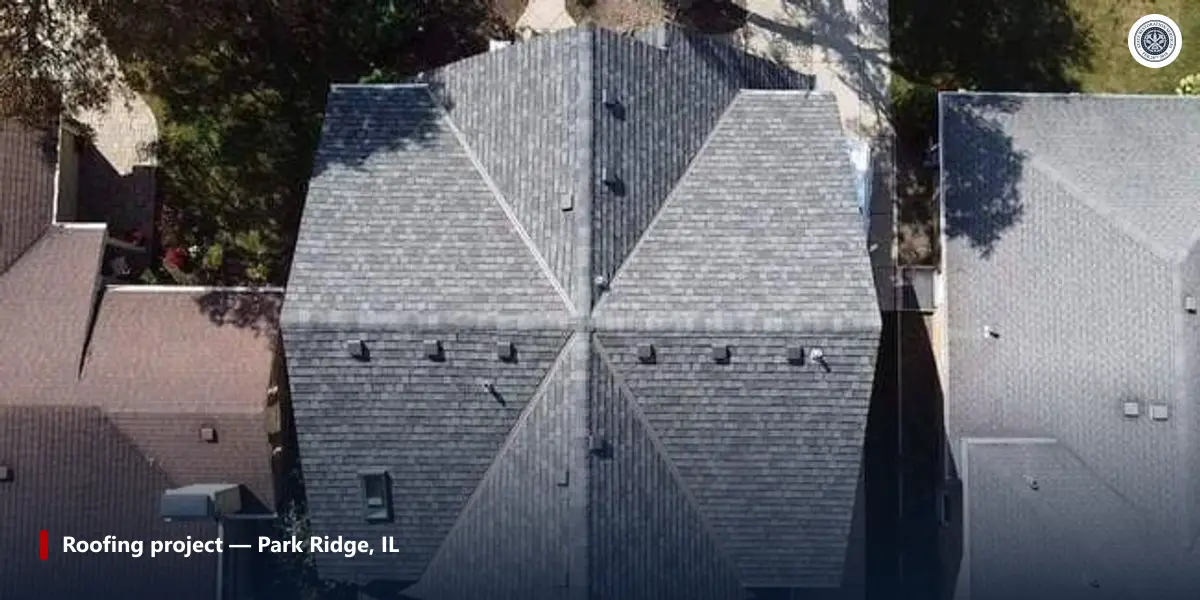
Four things, and they are the four that cost the most to fix later: an inspection of the deck, an ice-and-water membrane at the eaves, a flat nailing surface, and the two GAF accessory categories that live on the deck. None of these is a matter of the crew cutting corners. They are simply unreachable once the old roof stays on.
- The deck. Soft, delaminated or rotted sheathing is invisible until the old shingles come off, which is why we price it per sheet rather than guessing — see what roof decking replacement actually costs here. On a layover, a bad sheet stays bad and now has a second roof nailed into it.
- Ice-and-water shield. The self-adhering membrane at the eaves and in the valleys sticks to the deck. On an Illinois roof it is what stops meltwater backing up behind an ice dam from finding a nail hole. Read why ice dams form here and what actually fixes them if you want the mechanism.
- A flat nailing surface. GAF asks for one in writing. Old curled tabs and worn butt edges give you the opposite, and a shingle that sits over a ridge does not sit flat on its sealant strip.
- Deck-side accessories. GAF's covered accessory list is Ridge Cap Shingles, Starter Strip Shingles, Leak Barrier Products, Roof Deck Protection Products, Cobra Attic Ventilation Products and Seam Tape for Roof Decks. Two of those six — the leak barrier and the roof deck protection — go on the deck. A layover removes them from the board.
Compare that against everything a full replacement does include, line by line, in our guide to what a proper roof replacement covers.
Does a second layer void your shingle warranty?
Not automatically, and the blanket claim that it does is wrong. GAF publishes a re-roofing procedure, so a layover installed to that procedure is a compliant installation. What changes is where you sit if something fails, and which coverage tier you can still reach. Both are worth knowing before you treat a layover as free.
The GAF Shingle & Accessory Limited Warranty is "specifically conditioned on your shingles or ridge cap shingles being fastened and installed strictly in accordance with GAF's application instructions." The warranty then says it "remains in effect" even where the products were not properly installed — but GAF "will NOT be liable for" damage caused by "improper fastening of your shingles or accessories or application not in strict accordance with GAF's printed application instructions, if the improper installation was the cause of the damage."
Read that as a homeowner and it is a warning about causation, not about paperwork. A manufacturing defect is still covered. A blow-off traced to a nail that never reached three-quarters of an inch into the deck is not, and on a layover that argument is much easier for a manufacturer to make.
The tier question is simpler arithmetic. GAF's enhanced accessory coverage kicks in only "if you install 3 or more GAF Accessories and shingles that carry a Lifetime Limited Warranty." Below that, the term drops and coverage narrows to ridge cap and starter. A layover has already deleted two of the six qualifying accessory categories, so you are trying to reach three out of four rather than three out of six. Starter strip is one of the survivors, which is one more reason to insist on real starter strip at the eaves and rakes rather than field shingles cut on the roof. And IKO says the same thing from its side: "Some shingle manufacturers' limited warranty coverage may require the old layer be removed."
What does a layover actually save you, and what does it cost later?
It saves the tear-off and disposal line, which on an average roof in our service area runs roughly $1,000 to $2,500. What it buys you is a roof whose next replacement is a mandatory two-layer strip, because the code will not permit a third. The saving is real. It is also borrowed.
| Line | Full tear-off today | Layover today |
|---|---|---|
| Tear-off and disposal | $1,000 - $2,500 | $0 |
| Decking repair if rot is found | $75 - $120 per sheet, priced when we can see it | Not possible - the deck stays covered |
| Debris hauled off a 20-square roof | About 2.4 tons | Nothing now; about 4.8 tons next time |
| Next replacement | Single-layer strip | Two-layer strip, required by code |
Those first two figures come from our own guide to reading a roofing estimate, and the tonnage from our homeowner prep guide, where we publish what actually lands in the container on your driveway. A full replacement on a typical Chicago-suburb home runs about $9,000 to $18,000 installed. Take the tear-off line out and the saving is that $1,000 to $2,500, once, in exchange for a heavier and more expensive strip later and a deck nobody has looked at in the meantime. If the number is what is standing in your way, our financing options are usually a better answer than removing a line item from the scope.
When is a layover the right call, and when do we refuse it?
A layover is defensible on a house with exactly one flat, sound layer, a deck with no known history of leaks, matching exposure, a village that permits it, and an owner who understands they are trading a future strip for a present saving. It is not defensible on anything else, and there are four cases where we say no.
- Two layers are already up there. The code closes this one, and no bid should be arguing with it.
- The old surface is not flat. Curled tabs, cupped courses, a wavy plane. GAF asks for a smooth surface in its own instructions, and you cannot manufacture one out of a bad roof.
- There is any leak history, or the exposure does not match. A leak means the deck needs eyes on it. A mismatch means nesting is off the table and the courses will telegraph.
- It is a storm claim. If a carrier's scope is written and priced for a replacement, delivering a layover hands you a thinner roof than the settlement paid for. If you are working through a claim, read how we document storm damage first. Illinois law bars a roofing contractor from negotiating the claim itself, which is why our partner, the licensed public adjuster State Adjusting Services, is the one who can represent you on it.
We come down this way for one reason: stripping a roof is the only step that shows anyone the condition of the deck. Often the news is good and the sheathing is fine. Either way the homeowner ends up with a fact rather than an assumption, and on a layover that fact stays sealed under the new roof until the next replacement. You can see how we run a job from the first inspection onward on our process page, and the systems we install on our residential roofing page.
Related reading: how we decide between a repair and a replacement, and why starter strip belongs on your rakes as well as your eaves.
Frequently asked questions
Can you put a new roof over old shingles in Illinois?
On most one-layer homes, yes. The model residential code permits a roof re-cover and bans it on a wet or deteriorated roof, on slate and clay and cement tile, and where two or more layers are already installed. Illinois has no statewide code for repairs to existing single-family homes, so your village and your shingle manufacturer set the actual rules.
How many layers of shingles are allowed on a house?
Two is the ceiling in the model code. Vernon Hills, in our service area, publishes it plainly on its re-roof handout: the maximum number of layers of shingles allowed on a house is two. Once two layers are up, a further re-cover is not permitted and the next roof has to be a full strip to the deck.
Does roofing over existing shingles void the shingle warranty?
No, not by itself. GAF publishes a re-roofing procedure in its installation instructions, so a layover done to that procedure is compliant. The warranty stays in effect, but GAF is not liable for damage caused by an installation that departed from those instructions, and a layover deletes two of the six accessory categories that unlock enhanced coverage.
Is a layover cheaper than a tear-off?
Today, yes, by roughly the tear-off and disposal line, which runs about $1,000 to $2,500 on an average roof here. Later it is more expensive, because the next replacement has to remove both layers, which is about twice the debris weight and a bigger disposal cost.
Not sure how many layers are on your house? Book a free inspection or call (866) 992-2982 — we will tell you how many layers are up there and what each option honestly costs. We serve the north and northwest Chicago suburbs.