
 Volodymyr Lukaniuk
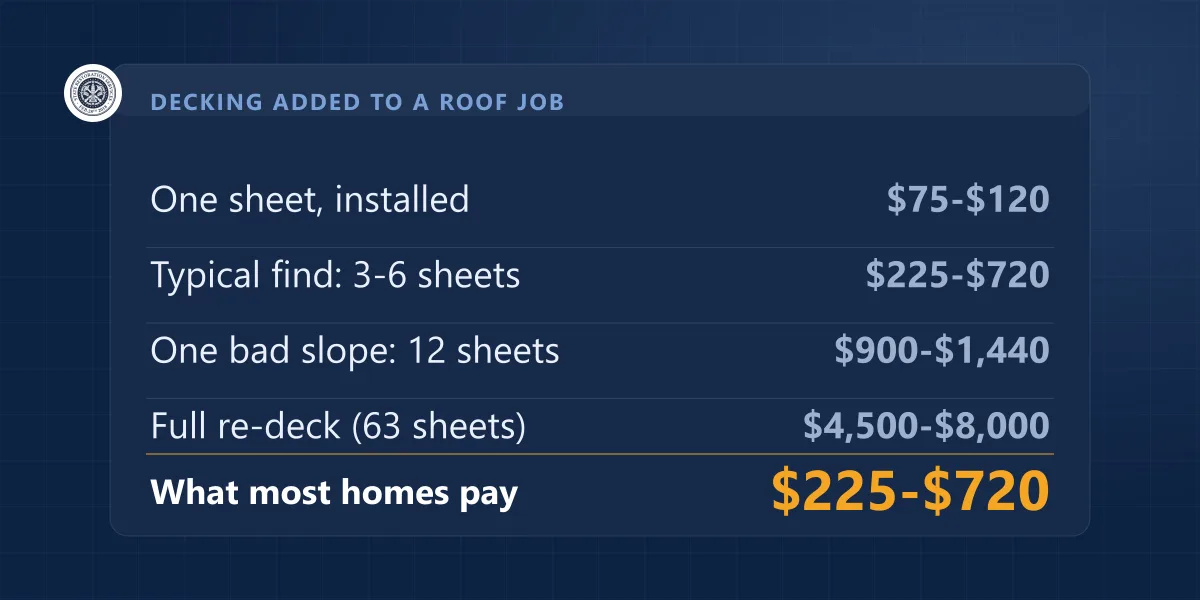
Quick answer: Roof decking replacement runs $75–$120 per installed sheet in the Chicago suburbs. Most twenty-year-old roofs need three to six sheets, so $225–$720 on top of the roof price. A full re-deck of an average home runs $4,500–$8,000 and is genuinely rare. Nobody can price it honestly before the tear-off.
Roof decking replacement cost is the one line on a roofing estimate that nobody can promise you up front, and that makes homeowners uneasy. Reasonably so. Every other number on the bid can be measured — the squares off a satellite image, the pitch off the eave, the linear feet of drip edge with a tape. The decking sits under the shingles and under the underlayment, and its condition stays genuinely unknown until a crew has the old roof stripped and is standing on bare wood.
So here is what that line actually costs in Lake and Cook County, what makes us call a sheet bad, and how to write the decking clause into a contract so it can never turn into a number somebody invents while your roof is open.
What is roof decking, and why can't it be priced before the tear-off?
Roof decking is the layer of wood nailed across your rafters or trusses — usually 7/16-inch OSB or half-inch plywood on anything built since the 1970s, and 1-inch boards on older suburban houses. Every other part of the roof fastens to it. It is buried under two layers of roofing, so its condition cannot be judged from a ladder or a drone.
People often assume we can tell from inside the attic. We do look, and it helps — daylight through a seam, a stained rafter, a soft patch near a chimney chase. But the attic shows only the underside, and only the parts not hidden by insulation, ductwork or a finished ceiling. Rot starts on the top face where the water sits, so by the time it shows through underneath it has been there a while.
That is why a decking number cannot be a fixed price. It can be a fixed rate, and that is what to insist on. A bid that says "decking replaced as needed" with no dollar figure is a blank the contractor gets to fill in later, when you have a stripped roof and the least leverage you will ever have. We cover that trap and the rest of them in how to read a roofing estimate.
How much does roof decking replacement cost in the Chicago suburbs?
Budget $75–$120 per installed 4x8 sheet. That covers the OSB or plywood itself, the labor to cut out the bad section back to the rafters, the new sheet nailed off to code, and hauling the rotted wood away. Most homes we open up need three to six sheets. A full re-deck of an average 2,000-square-foot roof lands at $4,500–$8,000.
| What we find under the shingles | Sheets | Added to the job |
|---|---|---|
| Soft spots around a pipe boot, vent or valley | 2–4 | $150–$480 |
| Typical find on a twenty-year-old roof | 3–6 | $225–$720 |
| One chronically wet slope (usually the north side) | 10–15 | $750–$1,800 |
| Full re-deck, average 2,000 sq ft roof | ~63 | $4,500–$8,000 |
Two honest notes on that table. First, a full re-deck is normally quoted by the square rather than per sheet, because a crew sheeting a whole slope works far faster than one cutting a patch into a live roof — so the whole-deck price per sheet comes out at or below the low end of the range, not the top. If a contractor multiplies their patch rate by sixty-three sheets, ask them to re-price it as a re-deck. Second, that ~63 is 2,000 square feet divided by the 32 square feet in a sheet, plus about 10% for waste. A cut-up hip roof with dormers wastes closer to 20%.
For context, a full architectural-shingle replacement on a typical single-family home here runs roughly $12,000–$20,000. Three to six sheets of decking is a rounding error against that. Sixty-three sheets is not, which is exactly why the difference is worth understanding before you sign anything.
What makes us call a sheet of decking bad?
A sheet comes out when it can no longer hold a nail or carry a person. That is the whole test. Discoloration on its own is not a reason — plenty of decking has old water stains from a leak that was fixed twenty years ago and is structurally perfect. What we are checking for is softness, delamination, sag between rafters, and fasteners that spin instead of biting.
| What we see | What it means | Replace? |
|---|---|---|
| Sheet flexes underfoot between the rafters | The wood has lost stiffness — it will telegraph through new shingles | Yes |
| OSB edges swollen and crumbling | Long-term wetting; the strands have separated and will not hold a nail | Yes |
| Plywood face peeling in layers | Delamination — the glue lines have failed | Yes |
| Nail shank spins in the hole with no grip | The wood is punky even if it looks fine on the surface | Yes |
| Dark staining, wood still firm and solid | An old leak that has since dried out | No |
| Visible dip between two rafters from the street | Either failed decking or a structural issue underneath | Inspect first |
That last row is worth a sentence. A sag you can see from the driveway is not always a decking problem — sometimes it is a rafter carrying a load it was never sized for, and new wood on top of it fixes nothing. We would rather say that on inspection day than nail over it. Either way, every sheet we pull gets photographed in place before it comes out and the photos go to the homeowner, so a bill for eleven sheets comes with eleven pictures.
OSB or plywood: what goes back down?
On a modern roof we replace like with like — 7/16-inch OSB into an OSB deck, half-inch plywood into a plywood deck — because a thickness mismatch leaves a ridge or a dip that shows through the finished shingles. Where there is a real choice, OSB is the cost-effective default and plywood is the better answer on a slope that has already proven it gets wet.
| 7/16 in. OSB | 15/32 in. CDX plywood | |
|---|---|---|
| Material, per 4x8 sheet | $14–$20 | $28–$52 |
| Behaviour after a soaking | Edges swell and largely stay swollen | Dries back closer to flat |
| Flatness out of the stack | Very consistent | Occasional cup or crown |
| Where we reach for it | The default on most re-roofs | Patching into board decking; slopes with a known moisture history |
Both are code-legal roof sheathing when the panel's span rating matches your rafter spacing — that rating is stamped on the face of every sheet, and it is the number the inspector reads, not the thickness. Kept dry under proper underlayment and a balanced attic, OSB will outlive the shingles on top of it. Most of the OSB horror stories we get asked about trace back to a roof that leaked for years, not to the panel.
What about board decking on older Chicago-area houses?
Plenty of homes here are decked in 1x6 or 1x8 boards rather than panels, and that is fine. Tight, sound board decking is a solid deck and does not need replacing because it is old. No code requires swapping sound boards for plywood, so "it has to come off because it is not plywood" is a sales pitch, and an expensive one to accept without a second opinion.
There is a real version of that conversation, though. Asphalt shingles have to be fastened to a solidly sheathed deck (IRC R905.2.1). Houses that once carried cedar shakes were often decked in spaced sheathing — boards with one- to two-inch gaps between them, deliberately, so the shakes could breathe. Shingle nails landing in those gaps hold nothing. On a spaced deck you either overlay the whole roof with panels or re-deck it, and that is the situation where the $4,500–$8,000 number stops being theoretical.
Which edition of the code your village enforces varies, and it matters for what an inspector will pass. Since 1 January 2025 an Illinois local code has to regulate structural design at least as stringently as the IRC, and jurisdictions without their own adopted code fall back to the current IRC edition — the Illinois Capital Development Board publishes the current position. We pull the permit and deal with your village's inspector either way; it is part of how we run a job.
Does homeowners insurance pay for new roof decking?
Usually not, and it is worth knowing why before you ask. Insurance covers sudden damage from a covered peril. Decking that rotted slowly under a leak nobody fixed is wear and deterioration, which every homeowners policy excludes. Decking broken by the storm itself, or required by code to complete a covered repair, is a different question with a much better answer.
Three situations come up on our claims work:
- Rot from a long-standing leak or poor attic ventilation. Not covered. This is maintenance, and no amount of arguing changes that.
- Decking physically damaged by the event. A limb through the roof, or wind that peeled shingles and lifted sheathing with them, is storm damage and belongs in the scope.
- Decking that has to change to satisfy code during a covered replacement. That is what ordinance-or-law coverage exists for — the classic case being a spaced-sheathing deck that cannot legally take new asphalt shingles. We walk through it in what code-upgrade coverage pays for on a roof claim.
One thing we cannot do is argue any of that with your carrier. Illinois law bars a roofing contractor from negotiating an insurance claim on a homeowner's behalf. What we do is document the deck with photographs, write a code-compliant estimate that cites the sections it relies on, and hand you something an adjuster can actually price. When a claim needs someone representing you, our affiliated licensed public adjuster, State Adjusting Services, can take that role. More on the split on our storm and insurance claim page.
How do you keep the decking line from becoming a surprise?
Get the rate in writing and get the evidence in photographs. Those two things remove essentially all of the risk from a line item nobody can pre-measure. It takes one conversation before you sign, and it is the same conversation we have with every homeowner we hand an estimate to.
- A per-sheet price on the contract, in dollars. Not "replaced as needed", not "at cost". A number.
- Ask what counts as a sheet. A 2x4 patch should not bill as a full 4x8 sheet. Ours are billed as what gets installed.
- Ask what the rate includes — material, labor, fasteners and disposal, or only some of those.
- Ask for a photo of every sheet replaced, taken before it comes out.
- Be wary of an exact decking figure. Anyone quoting precise decking through an intact roof is guessing, and the guess gets corrected in whichever direction suits them.
Our own answer, on every estimate we write: only decking that is rotted, delaminated or sagging gets replaced, we show it to you before it comes out, and the per-sheet price is agreed in the contract up front so there are no surprise line items. Decking sits inside the scope of a proper tear-off, which we break down line by line in what a roof replacement actually includes, and it is priced the same way on every residential roof replacement we quote.
Related reading: why ice dams form and what the real fix is — ice damming is the most common reason we find a whole slope of soft decking on an otherwise healthy roof.
Frequently asked questions
How much does roof decking replacement cost per sheet?
In the north and northwest Chicago suburbs, $75 to $120 per installed 4x8 sheet. That rate should include the panel, the labor to cut out the bad wood and nail in the new, and disposal. Ask for it in writing before you sign, because it is the one line nobody can pre-measure.
Will my whole roof need new decking?
Almost certainly not. Most homes need three to six sheets out of roughly sixty. A full re-deck is reserved for genuine cases — spaced sheathing left over from a cedar shake roof, or a deck soaked for years by an unrepaired leak. If a full re-deck is proposed on a roof that has been watertight, get a second opinion.
Does homeowners insurance pay for rotted roof decking?
Generally no. Rot is gradual deterioration, which policies exclude. Decking broken by the storm itself is covered, and decking that must be replaced to bring a roof up to code during a covered repair may be paid under ordinance-or-law coverage. Illinois law bars roofers from negotiating claims, so a public adjuster handles that side.
Can new shingles go over old board decking?
Yes, if the boards are tight, sound and hold a fastener. Board decking that meets those conditions is a solid deck and does not need replacing for age alone. Spaced sheathing with gaps between the boards is the exception: asphalt shingles require a solidly sheathed deck, so it needs an overlay or a re-deck.
Not sure what is under your shingles? Book a free inspection or call (866) 992-2982 — we are family-owned, based in Lincolnshire, rated 4.9 stars by 92 homeowners, and we work across the north and northwest Chicago suburbs Monday through Saturday.