
 Volodymyr Lukaniuk
Quick answer: Starter strip shingles are the hidden first row at the eaves and rakes. Their sealant sits at the very edge, so the bottom and outer ends of every field shingle are glued down. On a GAF roof, starter at the eaves and rakes is what moves your wind coverage from 110 mph to 130.
Every asphalt shingle roof has one row that nobody ever sees. It goes on first, along the eaves and up both rake edges, and the first visible course covers it completely. That hidden row is the starter, and because it is invisible, it is easy to leave off without anyone noticing for years. It is also, in writing from the manufacturers themselves, one of the conditions attached to your wind warranty.
We are a family-owned roofing company in Lincolnshire and we install GAF, Owens Corning and IKO across the north and northwest suburbs. All three publish their starter requirements openly, so this guide quotes them directly rather than paraphrasing.
What does a starter strip actually do up there?
Two things. At the eave it fills the gaps under the joints in the first visible course so water cannot reach the deck. At the eaves and the rakes it puts a band of factory sealant right at the edge, which bonds the bottom and the outer end of every shingle above it.
The second job is the one that gets forgotten. Every asphalt shingle carries a factory-applied adhesive band, and the Asphalt Roofing Manufacturers Association describes how it works: once each course is nailed down, every subsequent shingle course will bond with the previously installed course, with the asphalt-based sealant fusing the shingles together
, and heat and UV rays from the sun activates and softens the sealant to create the necessary bond
. That band is positioned to grab the course below it. The very first course has no course below it. Without a starter under it, the bottom edge of your roof is held on by nails alone.
At the rake the geometry changes but the logic does not. IKO puts it this way: at the rake edge the sealant strip will be positioned at the outer roof edge and once warmed by the sun, it will help seal the rake ends of all the finish roof shingles
. There is a practical bonus as well: a run of starter up the gable gives the crew a dead-straight line to cut every course against.
Why not just cut up regular shingles for the starter course?
Because the sealant ends up in the wrong place. A field shingle carries its adhesive band well up from the bottom edge, where it grabs the course below. Flip that shingle over and the adhesive sits too high to hold the first course down at all.
IKO describes the shortcut in their own words: the starter shingle is simply a three-tab shingle installed ‘upside down,’ with the tabs facing up the roof... while this shortcut did protect the roof deck at shingle joints and cutouts, it unfortunately left that first course of shingles unsealed and vulnerable to wind uplift. The sealant on an upside-down three-tab shingle ends up far too high up the roof to effectively seal the first course of the finished shingles.
There is a correct way to make starter out of 3-tab, and it is worth knowing because it tells you what the strip is supposed to look like. IKO again: The proper way to adapt three tabs as starters is to trim the tabs off the shingle along a line across the tops of the cutouts. This yields a strip with the sealant at the bottom.
Their 2012 residential bulletin describes the same era: traditionally either 3-tab strip shingles (with the tabs cutoff) or mineral surface roofing has been used
.
Two things have changed since then. Architectural shingles are now the popular choice, and you cannot make a proper starter out of one by cutting, because a laminated shingle is two layers thick and its adhesive is placed for a completely different job. And the warranty language has tightened. GAF does not say a starter strip; it says GAF Starter Strip Products
. If a bid quotes you a 130 mph wind warranty on a GAF roof and the starter is field-cut, those two statements do not go together.
Do starter strips really have to go on the rakes as well?
Yes, if you want the wind coverage that came with the shingle. GAF ties its higher wind speed to starter at the eaves and the rakes, and IKO says the same for its high-wind warranty. Leave the rakes bare and a GAF Lifetime shingle drops from 130 mph to 110.
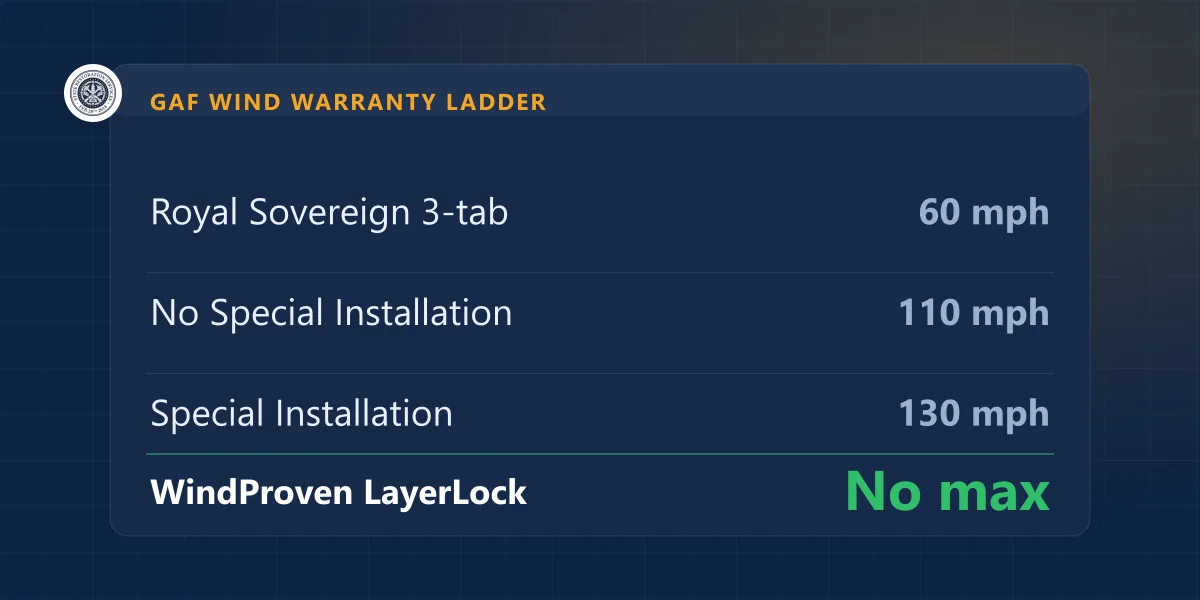
Here is the exact sentence from the GAF Shingle & Accessory Limited Warranty, under the heading Special Installation: Your GAF LayerLock-labeled Shingles will be covered up to the maximum wind speed above ONLY if installed using 4 nails per shingle and you have GAF Starter Strip Products installed at the eaves and rakes. Special Installation for all other GAF Shingles requires use of 6 nails per shingle and GAF Starter Strip Products installed at the eaves and rakes.
IKO prints its version right on the Leading Edge Plus application instructions: To ensure coverage under the High Wind Resistance Limited Warranty: Starter strip shingles must be used at all eaves and rakes.
Note the difference between those two, because it matters when brands get mixed on one roof. IKO asks for starter strip shingles. GAF asks for GAF starter strip products, by name, so another brand's starter does not satisfy that clause even though it is the same part doing the same job.
| What is on the roof | Wind speed covered | Wind warranty term |
|---|---|---|
| Royal Sovereign (GAF 3-tab) | 60 mph | 5 years |
| Marquis WeatherMax | 80 mph | 5 years |
| A GAF Lifetime shingle, without Special Installation | 110 mph | 15 years |
| A GAF Lifetime shingle, with Special Installation (correct nail count plus GAF starter at eaves and rakes) | 130 mph | 15 years |
| A LayerLock-labeled shingle plus at least four qualifying accessories, including starter at eaves and rakes | WindProven: no maximum wind speed | 15 years |
Those figures are GAF's own published warranty tables. The jump from 110 to 130 costs a few bundles of starter and, depending on the shingle, two extra nails each. The jump to WindProven needs the whole system: a LayerLock shingle, ridge cap, roof deck protection, starter at eaves and rakes, and either a leak barrier or attic ventilation. Nail count is the other half of that same clause, and we went through it in how many nails per shingle and why placement matters more.
What do GAF, Owens Corning and IKO actually specify?
All three sell a purpose-made starter, and all three publish different numbers for it. Coverage per bundle runs from 105 to about 120 linear feet, the fastener count and spacing differ, and each one tells you to cut a different amount off the very first strip.
That last one is worth a moment, because the reason for it is not obvious. If the starter strips and the field shingles are close to the same length and both start flush at the corner, their end joints stack on top of each other all the way along the eave, and a joint sitting over a joint is a path to the deck. So each manufacturer tells you to shorten the first strip, and each one names a different amount.
| GAF Pro-Start | Owens Corning Starter Strip Plus | IKO Leading Edge Plus | |
|---|---|---|---|
| Coverage per bundle | 120.33 linear ft (19 full sheets, split into 38 pieces) | 105 linear ft (16 shingles, two pieces each) | 109 linear ft (16 shingles, 32 strips) |
| Strip size once split | 6-1/2 in x 38 in | 7-3/4 in x 39-3/8 in | 7-7/8 in x 40-7/8 in |
| Overhang past the edge | 1/4 in to 3/4 in | Up to 3/4 in | 1/4 in to 3/4 in |
| Fastening | Nails every 10 to 12 in, set 1-1/2 to 3 in above the eave | 5 fasteners, 2 to 3 in from the eave edge | 4 nails per strip, 3 to 4 in from the edge and 1 in from each end |
| The first strip | Remove 3 in when the field shingle is 39-3/8 in | End joints at least 4 in from the joint in the shingle above | Remove about 20 in |
| At the rakes | Overlap the eave strip by at least 3 in and work up | Machine-cut straight edge at the eave and along the rake | Run vertically up the rake, sealant to the outer edge |
IKO's version of the offset rule does two jobs at once. Step 9 of their instructions has you remove about 20 inches from the first strip and set the rest along the eave; step 10 then has you take the leftover 20″ piece starter strip
, rotate it, and run it up the rake with the sealant facing the outside edge. The offcut is the first piece of the rake. Nothing goes in the dumpster and the joints never line up.
Owens Corning adds a limit worth knowing if you have chosen a heavier shingle. Starter Strip Plus can be used with shingles that have an exposure of no more than 6"; if the exposure is greater than 6", a full starter (15 3/4" x 39 3/8") would be required
, and it may not be used at all under their Berkshire, Woodmoor or Woodcrest lines, which call for Woodstart instead. If you are choosing a designer shingle, the starter is part of that decision. We go through the shingle lines themselves on our shingle roofing systems page.
None of this is optional guidance, either. The International Residential Code section that governs roof covering application is a single sentence: Roof coverings shall be applied in accordance with the applicable provisions of this section and the manufacturer's installation instructions.
Whatever is printed on the wrapper is what the inspector is entitled to hold the roof to.
Where does starter sit relative to the drip edge?
On top of the metal, and under everything else. Drip edge is fastened to the deck first, with the underlayment lapped over it at the eaves and tucked under it at the rakes. Starter then goes on top of the drip edge and overhangs the roof edge slightly, so water drips clear instead of curling back onto the fascia.
ARMA's technical bulletin on drip edge gives the tolerance and the exception in one place. With a plain 90-degree L-shaped drip edge, extending the starter course and field courses of shingles 1/4″ – 3/4″ (6-19 mm) beyond the drip edge at all eaves and rakes is recommended
. With a T-shaped or D-shaped profile, shingles at the rake edge may be trimmed flush with the drip edge, while shingles at the eaves may extend up to 3/4″
. GAF says the same about its own strips: where the drip edge extends out from the eaves and rakes, Pro-Start may be placed flush with it.
So if you stand at the corner of the house and look up at a finished roof, you should see a thin, even shadow line of shingle past the metal, straight for the whole run. A wavy line means the first row was not run to a straight line, and that is one of the few parts of the install a homeowner can check from the driveway. The full sequence of what goes down before the shingles is set out in what a full roof replacement actually includes.
How do you check an estimate for it?
Look for starter named as a product, and look for the words eaves and rakes. Starter is sold by the linear foot, so a complete line gives either a bundle count or a footage. A bid that only says shingles has not told you whether the edges are covered.
The arithmetic is easy enough to do yourself. Add up the length of every eave and every rake on the house, then divide by the bundle coverage in the table above. Whatever number that produces is the floor. A single bundle listed against a house whose edges total three hundred feet does not cover those edges, whatever else the bid says.
| What to look for on the bid | Why it matters |
|---|---|
| The starter named as a product: Pro-Start, WeatherBlocker, Starter Strip Plus, Leading Edge Plus | The word “starter” on its own can mean a field shingle cut on the roof |
| The words eaves and rakes, not just eaves | The rakes are the half that gets dropped, and both GAF and IKO tie wind coverage to both |
| A bundle count or a linear footage | Starter is bought by the foot, so a line with no quantity cannot be checked against the roof |
| The wind warranty tier, written down | 110 mph, 130 mph and WindProven are three different installations, not three different pieces of paper |
That is the same habit worth applying to every line on a roofing bid, including ours. If you want the longer version, how to read a roofing estimate goes through all of them. And a price that arrives before anyone has measured the eaves and rakes cannot contain a footage for edges nobody has measured, however confident the number on the clipboard looks.
Does missing starter matter on a storm claim?
It can. A wind claim turns on whether the shingles were sealed when the storm hit, and an adjuster who finds bare edges has an installation argument instead of a storm one. That is a workmanship question, and where it lands depends on which warranty you actually have.
Sealant failure is genuinely ambiguous on an older roof. Strips fail from cold-weather installation, from dust on the adhesive, and from years of expansion and contraction, all without a storm anywhere in the picture. We went through how carriers and their engineers argue that in wind damage on a roof claim in Illinois. A missing starter course adds a second explanation for the same lifted shingles, and it is one that points at the last roofer rather than at the weather.
The warranty side splits the same way. A manufacturer covers its product and your contractor covers the installation, while GAF's enhanced system warranties add some coverage for misapplication, but only where the roof went on as a full system through a certified contractor. That is exactly the difference we set out in manufacturer versus workmanship warranties.
One honest note about how the claim itself works in Illinois: a roofing contractor here is not allowed to negotiate your insurance claim. What we can do is document the roof properly and write a code-compliant estimate. When the claim needs somebody on your side of the table, our partner, the licensed public adjuster State Adjusting Services, can represent you on it. Our storm and insurance page explains where that line sits.
Related reading: how many nails per shingle — and why placement matters more covers the other half of GAF's Special Installation clause, and what is actually included in a full roof replacement puts starter in sequence with everything else that goes on before the first visible course.
Frequently asked questions
Do you need starter strips with architectural shingles?
Yes. IKO states plainly that you do need a starter course with architectural shingles, and GAF ties its higher wind speed coverage to starter strips at the eaves and rakes on its Lifetime shingles, which are all laminated. The starter is hidden under the first course, so it does not have to match the color of the roof. A few designer shingles are the exception and call for their own matching starter, so check the wrapper.
Can the roofer use leftover shingles from my roof as starter?
Only in the old-fashioned way, and only with 3-tab. The correct method is to trim the tabs off along a line across the tops of the cutouts, which leaves a strip with the sealant at the bottom edge where it can hold the first course down. A 3-tab simply flipped upside down puts the sealant far too high up the roof to seal anything. Neither version is what GAF means when its warranty says GAF Starter Strip Products.
Does starter go over or under the drip edge?
Over it. The drip edge goes on first, with the underlayment lapped over the drip edge at the eaves and the drip edge laid over the underlayment along the rakes. The starter then sits on top and overhangs the roof edge by a quarter inch to three quarters of an inch, though with a T-shaped or D-shaped drip edge profile the shingles at the rake may be trimmed flush instead.
How much starter does my roof need?
Measure the total length of every eave and every rake, then divide by the coverage of the product being used. A bundle of GAF Pro-Start covers about 120 linear feet, Owens Corning Starter Strip Plus covers 105, and IKO Leading Edge Plus covers 109. Your roof being 30 squares tells you nothing about that number, which is why starter is easy to leave off a bid priced by the square.
Thinking about your roof? The first step is a free, no-obligation look: we photograph anything worn or damaged, explain what we found in plain language, and give you an honest written assessment. Book a free inspection, see how we work, or call (866) 992-2982. We are a family-owned, licensed and insured Illinois roofing contractor in Lincolnshire, serving the north and northwest Chicago suburbs including Vernon Hills. Our office is open Monday to Friday, 7:00 AM to 7:00 PM, and Saturday and Sunday, 9:00 AM to 5:00 PM. For a full roof, siding, gutter or window project, start on our residential roofing page.