
 Volodymyr Lukaniuk
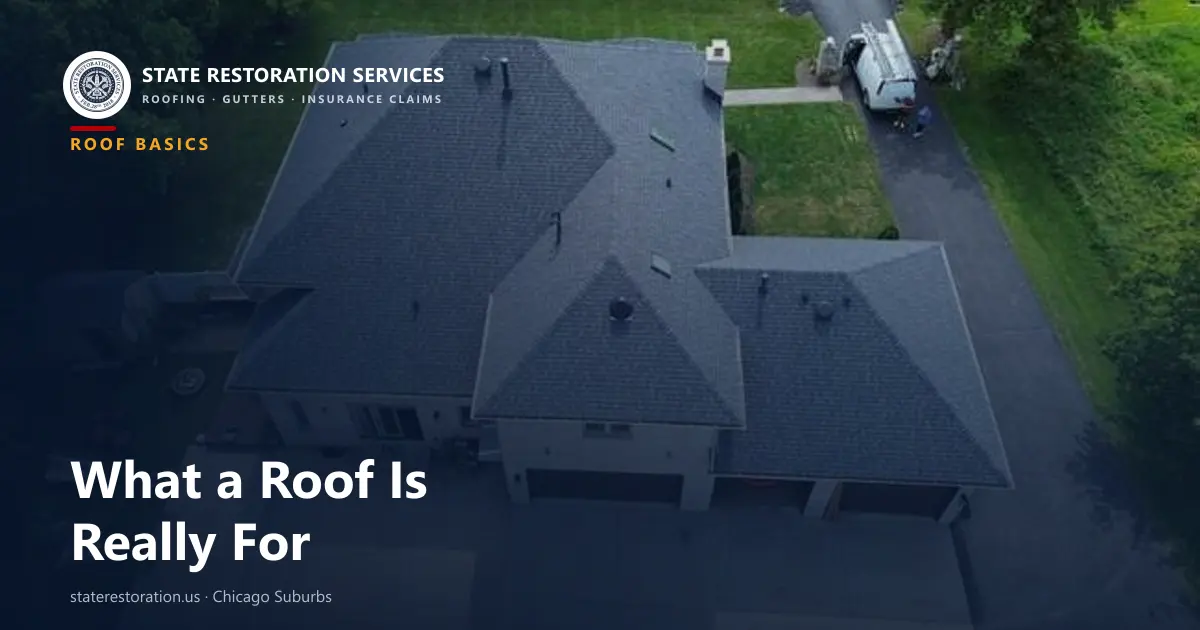
The primary function of a roof is to keep water out of the house by moving it somewhere else. Rain, snowmelt and the slush that sits on a roof after a January storm all have to travel from the ridge to the ground without finding a way in. Every other thing a roof does, from carrying snow to keeping the attic cool, either serves that job or comes second to it.
That sounds obvious, but it changes how you read a quote, a leak or an inspection report. A roof isn't a waterproof lid. Asphalt shingles are laid in overlapping courses, like the scales on a fish, and they work because gravity pulls water down and across them faster than it can work its way up and under. Slow the water down (a clogged gutter, an ice dam, a valley full of leaves, a roof pitched too low for shingles) and the same roof that was dry for fifteen years starts to leak.
Follow one raindrop from the ridge to the downspout
The easiest way to see what each part of a shingle roof is for is to follow a single drop of water down it. The drawing shows the edge of a typical roof in the north suburbs, where most of the trouble happens.
The shingle sheds it
The drop lands on a shingle and runs over the top of the course below. The granules on the surface keep the sun off the asphalt, and the sealant strip under each tab keeps wind from lifting it so water can't be blown up and under.
The underlayment catches what slips under
Wind-driven rain, a cracked tab or a nail that backed out can let water under a shingle. The underlayment, a synthetic sheet or felt over the whole deck, carries that water down to the edge instead of into the wood.
The ice barrier holds at the eaves
Over the overhang, the roof is cold while the part above the attic is warm. Snow melts up high, refreezes at the edge and pools behind the ice. A self-sealing membrane that grips the deck and seals around every nail stops that standing water. This is the strip our guide to ice dams in Illinois calls the backstop, because the real fix lives in the attic.
The drip edge throws it clear
A bent metal strip at the roof edge kicks the water out past the fascia board and into the gutter, so it doesn't wick back along the underside and rot the wood.
The gutter and downspout finish the job
The water is off the roof but not away from the house yet. The gutter carries it to a downspout, and the downspout has to put it on the ground far enough out that it doesn't soak the foundation. A roof that dumps water against the basement wall has done only half its work.
Notice that only the first step is the part you can see from the driveway. When homeowners say "the roof looks fine," they mean the shingles look fine. The other four layers are where a good roof and a cheap one differ, and they're the reason we list each of them on an estimate for a residential roof replacement instead of writing "new roof" and a number.
Where water usually gets past a roof
Water on the open field of shingles rarely gets in. It gets in where the roof stops being one smooth slope: where it meets a wall, a chimney, a pipe, another slope or the edge. These are the places we look first when someone calls about a stain.
| Where | What you usually see inside | What most often caused it |
|---|---|---|
| Chimney | A stain on the ceiling or wall right next to the chimney chase, worse in long rains | Step or counter flashing pulled loose from the brick, cracked sealant, no cricket behind a wide chimney |
| Plumbing vent pipe | A small round stain directly under the pipe, often in a bathroom ceiling | The rubber collar of the pipe boot dried and split in the sun |
| Valley | A wet line along the ceiling below where two slopes meet | Shingles cut too short or nailed too close to the centre, leaves damming the valley |
| Eaves | Water on the inside of an exterior wall or around a window head in late winter | An ice dam and no ice barrier, or a barrier that stops short of the wall line |
| Wall where a lower roof meets siding | A stain along the top of the wall of the room under the lower roof | Missing step flashing, or no kick-out flashing at the bottom so water runs behind the siding |
Four of those five are flashing, which is why we wrote a separate piece on why flashing causes most roof leaks. If the stain sits under a pipe, the cheap and common answer is replacing the pipe boot, not the roof.
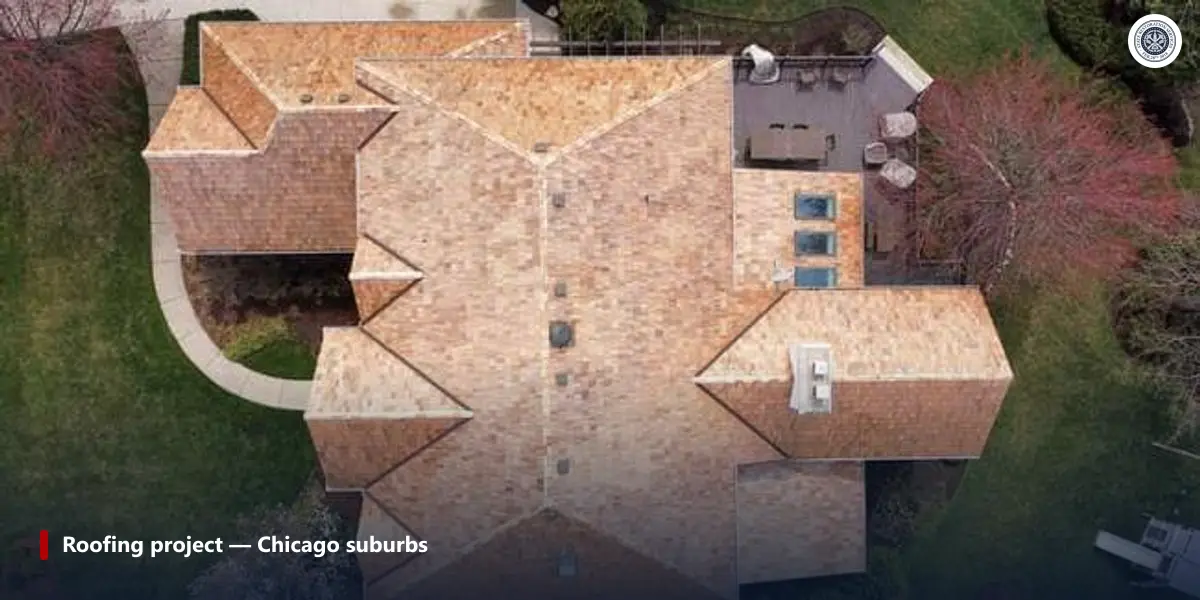
The other jobs a roof does, in the order they protect the first one
People list a roof's functions as if they were equal: weather, insulation, structure, looks. On a house in Lake or Cook County, they aren't. We rank the rest by how much each one helps the roof keep water out.
- 2
Letting the attic breathe
Air that comes in at the soffits and leaves at the ridge carries off the moisture a house puts into the attic every winter and the heat that bakes shingles every summer. When it's blocked, frost forms on the nails, the deck gets damp, and the snow on the roof melts unevenly, which is how ice dams start. If your attic is hot or wet, our attic ventilation work looks at intake and exhaust together.
- 3
Carrying the weight
Rafters or trusses and the deck carry the shingles, the crew walking on them and a wet, heavy snowpack after a big storm. A deck that sags between rafters holds water instead of shedding it, and soft spots are often old leaks the shingles hid.
- 4
Keeping heat where it belongs
The roof itself isn't much of an insulator; the insulation on the attic floor does that work. The roof's part is staying dry so that insulation stays dry, because wet insulation stops working and starts rotting the drywall under it.
- 5
Looking like it belongs on the house
A roof is the biggest single surface you see from the street, so colour and shingle style matter for resale. It's last on this list only because a handsome roof that leaks is worth less than a plain one that doesn't.
What an Illinois year throws at that job
A roof here doesn't face one kind of weather. It gets four, and each one tests a different part of the water path.
Winter
Snow load, freeze and thaw, ice dams at the eaves. The ice barrier and the attic ventilation earn their keep from December to March.
Spring
Hail and wind-driven rain from the storms that cross the area. Hail knocks granules loose and bruises shingles; wind lifts tabs that never sealed.
Summer
Sun and attic heat. Shingles age fastest in July, and rubber pipe boots crack after enough summers of it.
Fall
Leaves in the gutters and valleys. A clogged gutter is the reason a lot of "roof leaks" in November turn out to be water backing up under the first course. Clean or properly sized gutters keep that last step of the path open.
If you see any of the signs below, one part of that path has started to fail, and it's worth having someone look before the next season does more of it.
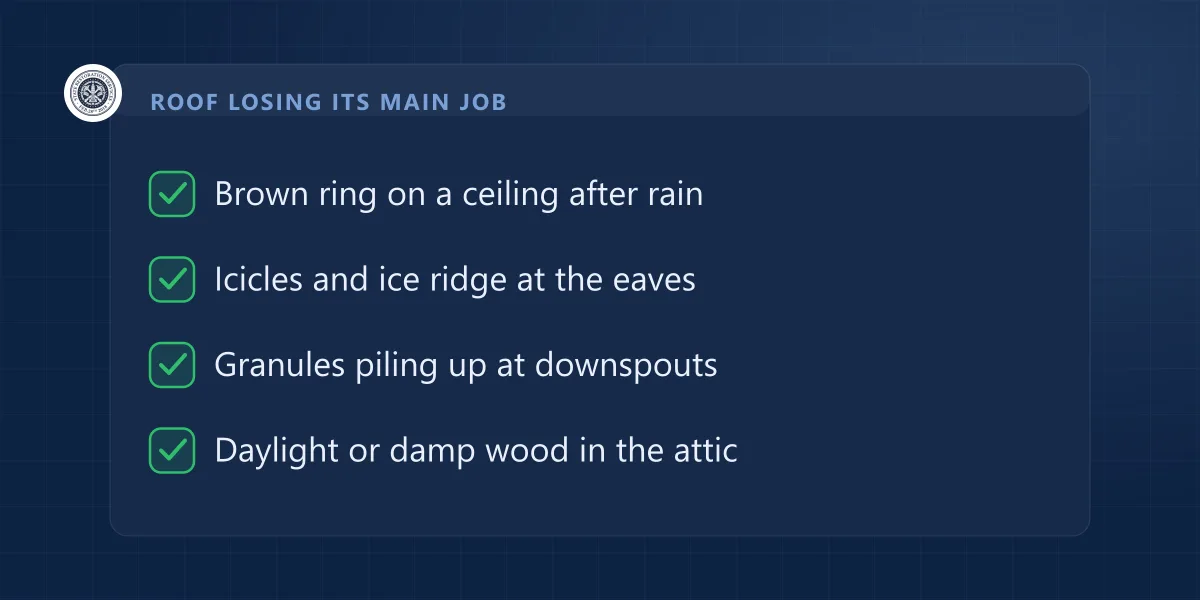
Storm chasers from out of state like to tell people that a roof with a few missing granules needs replacing tomorrow. Usually it doesn't. A roof that keeps the water moving and shows none of those signs is doing its main job, whatever its age, and it may only need a repair at one joint.
Questions people ask about what a roof is for
Does a flat roof have the same primary function?
Yes, it still has to keep water out, but it can't rely on overlap and gravity the way shingles do. A low-slope roof uses a continuous membrane that is sealed at every seam, and it still needs a slight slope to drains or scuppers so water doesn't stand on it.
Can a roof keep water out if the shingles look worn?
Often, yes. Faded colour and some granule loss are normal with age. What matters is whether water can still get under a course or through a joint, which is why an inspection looks at flashing, pipe boots, valleys and the attic as well as the shingles.
Is the roof what keeps my house warm?
Mostly no. Attic insulation keeps heat in. The roof protects that insulation from water and, with good ventilation, keeps the attic close to the outdoor temperature in winter so snow on the roof doesn't melt and refreeze.
Who can check whether my roof is still doing its job?
A licensed roofing contractor can inspect the roof and the attic. We do free inspections in the north and northwest Chicago suburbs and write down what we find, layer by layer.
If you'd like us to follow the water path on your own roof, call State Restoration Services at (866) 992-2982, Monday through Friday, 7:00 AM to 7:00 PM; Saturday and Sunday, 9:00 AM to 5:00 PM, or book a free roof inspection online.