
 Volodymyr Lukaniuk
Quick answer: A real free roof inspection covers four things: the ground around the house, every slope of the roof, every penetration and flashing point, and — when anything points inside — the attic from underneath. It usually takes under an hour and ends with photographs and a written estimate you keep. If somebody is off your roof in ten minutes holding a contract, you got a sales call.
Every roofing company in the north suburbs offers a free roof inspection, and that one phrase covers two completely different visits. One is an hour of work that leaves you holding photographs, a measurement and an honest answer. The other is a ladder leaned against your gutter for a few minutes so somebody can knock on the door and say the words "storm damage." Both are free. Only one of them is worth your morning.
So here is what actually happens on a thorough one — the order we work in, what we are looking at on each pass, and what should be in your hands when the truck pulls away. Use it on us. Then use it on the next company that knocks on your door after a hailstorm.
What does a free roof inspection actually include?
A complete inspection has four passes: a walk-around at ground level, the roof surface slope by slope, every penetration and flashing point, and a look from inside the attic when anything suggests water is getting in. On a typical suburban house that runs under an hour. Anything much shorter has skipped a pass.
The order matters more than people expect. Everything found at ground level tells us where to look hardest once we are up there, and everything found on the roof tells us what we are trying to confirm or rule out in the attic. Working the other way around — climbing straight up, taking a few pictures, coming down — is how a roof gets called "storm damaged" when it is simply old.
| Pass | What gets checked | Roughly how long |
|---|---|---|
| 1. Ground level | Gutter faces and downspouts, drip edge along the rakes, vent caps, siding and window wraps, AC condenser fins, what has washed out of the downspout elbows | 10–15 min |
| 2. Roof surface | Every slope walked or scoped separately, test squares, granule loss, mat exposure, nail pops, ridge and hip cap, the feel of the deck underfoot | 20–30 min |
| 3. Penetrations | Pipe boots, chimney and sidewall flashing, valleys, skylights, ridge and box vents, kickouts at the roof-to-siding transition | 10–15 min |
| 4. Inside | Decking from underneath, daylight at penetrations, staining on the sheathing, damp or matted insulation, blocked eave baffles | 10–20 min |
What we look at from the ground before the ladder comes off the truck
The ground tells us how hard the storm actually hit before anybody climbs. Soft metal around a house dents at hail sizes below the threshold that bruises a shingle, so the gutters, downspouts, vent caps and AC fins record a hail event that the roof itself may have shrugged off — or confirm one bad enough to matter.
We look at the gutter faces and the downspouts, the drip edge along the rakes, the caps on the vents, the siding and the aluminum wrap on the window trim, and the fins on the air conditioner. Then we check what has washed out of the downspout elbows, because a fresh pile of granules at the splash block is a different signal than a thin film of them.
Direction matters as much as the dents. Hail arrives on the wind, so damage clusters on one or two elevations, and a house with dents on all four sides at waist height is usually recording a decade of lawnmowers and ladders rather than a storm. This part you can do yourself before anybody arrives — our storm-damage walk-around checklist is the same ten minutes, written for someone standing in their own driveway.
What happens once we are on the roof
Each slope gets treated as its own roof, because that is how a claim gets scoped. A north slope can be nearly untouched while the west slope took the whole storm, and an inspection that reports "the roof" as one object cannot support either a repair decision or a claim.
On each slope we chalk a test square — ten feet by ten feet, one hundred square feet — and count actual hits inside it instead of eyeballing the whole plane. As we explain in our guide to what hail damage actually looks like on asphalt, eight or more hits per test square is the rough threshold insurers and adjusters use to call damage storm-related rather than age-related. Counting inside a marked square is what makes that number mean anything.
Then the rest of the surface: granule loss and where it is concentrated, mat exposure where the fiberglass shows through, nail pops lifting tabs, the condition of the ridge and hip cap, and the seal strip on the tabs themselves. We also pay attention to how the deck feels underfoot. A slope that gives underfoot is telling us about the sheathing, and that changes the price of any work more than the shingles do — the decking line is the one item nobody can quote before the tear-off.
Photographs are where inspections quietly go wrong. A close-up of a chalk circle could have been taken on any roof on any street in Illinois. A photograph that proves something has the slope in it, an edge of the house for orientation, and something in frame for scale.
Why the attic is the half most inspections skip
The attic answers questions the shingles cannot. From underneath you can see daylight at a penetration, dark staining on the sheathing, damp insulation under one specific spot, and frost or rust on the nail tips — and each of those points at a different problem with a different price attached.
The distinction that saves people the most money is old staining versus active staining. A dark ring on the underside of the decking that is dry and hard has already been fixed, or the leak that made it stopped years ago. Wet or soft sheathing means water is arriving now. A surface-only inspection cannot tell those apart, so it defaults to the expensive assumption.
Frost on the nail tips in January is a different animal again. That is warm indoor air condensing on cold metal, which points at attic ventilation rather than at a hole in your roof, and it is the same mechanism behind most ice dams in Illinois. A new roof installed over that problem will have the problem. Insulation packed tight against the sheathing at the eaves, blocking the intake baffles, is the usual cause and it is visible in thirty seconds with a flashlight.
If your house has a cathedral ceiling there is no attic to walk into, and the inspection has to lean harder on the exterior and on what the ceiling itself is telling you — we covered that case separately in our guide to ventilating a roof with no attic. Either way, ask whoever is on your roof whether they looked inside. It is a fair question and the answer is informative.
What you should be holding when we leave
The paperwork is the part you actually keep, because it is what you show to a second roofer or hand to your carrier. The output is a set of photographs organized by slope, a measurement, a finding list, and a written estimate — and on our free inspections you keep the photos and the estimate whether or not you decide to move forward.
| What the report should contain | Why it matters | What its absence tells you |
|---|---|---|
| Photos labeled by slope | A carrier scopes by slope; so does a repair | Nobody can tell which roof, or which side of it, you are looking at |
| A measurement in squares | Every price on the estimate is derived from it | The number was guessed from the driveway |
| Test square results | Turns "damage" into a count somebody else can check | The word "damage" is doing all the work |
| Findings split into storm, wear and maintenance | Only one of the three is an insurance matter | Everything has been bundled toward a claim |
| A decking rate, not a decking guess | $75–$120 per installed sheet is a rate you can hold them to | The one unknowable line is open-ended |
| An itemized written estimate | Lets you compare it against another bid line by line | You have a number, not a scope |
That last row is worth an evening of your time. Two bids that both say "roof replacement" can differ by thousands and still describe different jobs — our guide on how to read a roofing estimate walks through the line items where the difference usually hides.
How to tell a real inspection from a sales call
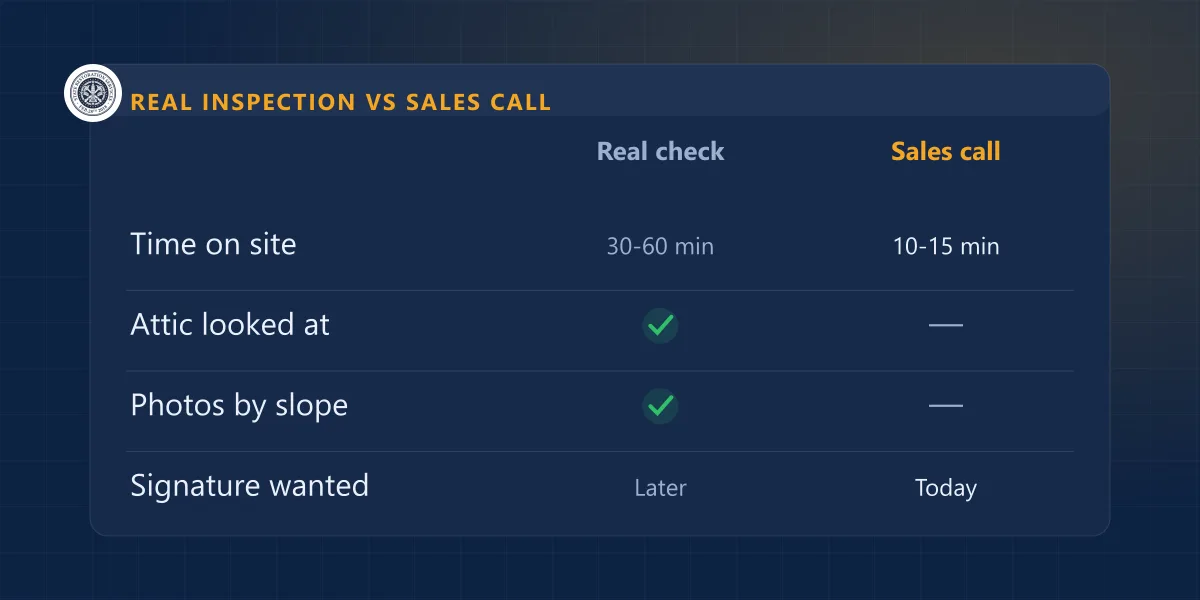
The clearest tell is what happens in the last five minutes. A real inspection ends with a report handed over and no pressure on your timeline. A sales call ends with a contract to sign before anyone leaves. If the urgency is arriving from the person in your driveway rather than from your roof, that is worth noticing.
A few specific things we would raise an eyebrow at, none of which require you to know anything about roofing:
- Under fifteen minutes on site, including setup. A ladder takes a few minutes to place safely. What is left after that is not four passes.
- No measurement offered. Somebody who has not measured cannot price the job, which means the number in front of you came from somewhere else.
- Damage photographed only in close-up. See the note above about chalk circles.
- An offer to handle your insurance claim. In Illinois a roofing contractor may not negotiate a claim on your behalf, so this is either a misunderstanding of the law or a company hoping you do not know it.
- Anything about covering, waiving, absorbing or "taking care of" your deductible. That one is illegal in Illinois, and we go through the statute in our guide to roof insurance deductibles.
- The price expires today. Materials pricing moves; it does not move at 5 p.m.
None of this means an out-of-town crew is automatically bad at roofing. It means that when the warranty call comes in three years, the phone number matters — which is the whole argument in our piece on storm chasers versus a local roofer.
What Illinois puts in your hands before you sign anything
Two documents are not optional. Under the Illinois Home Repair and Remodeling Act, work over $1,000 requires a written contract stating the total cost with parts and materials listed with reasonable particularity, and the contractor must give you the state's "Home Repair: Know Your Consumer Rights" pamphlet and collect your signed acknowledgment before that contract is executed. Both requirements sit in the same act, at 815 ILCS 513.
That gives you a clean, non-confrontational test at the kitchen table. Ask for the pamphlet. A company that does this work in Illinois every week has a stack of them in the truck. A company that has never heard of it has not been doing home repair work in Illinois for long.
The same act requires the contractor to carry insurance, and licensing is separate — Illinois licenses roofing contractors through the Department of Financial and Professional Regulation, and the license number is searchable in about a minute. Our guide to hiring a roofer in Illinois covers the license tiers, the insurance minimums and the two separate cancellation rights that apply after storm damage.
On the claim itself: we document damage and build a code-compliant estimate, and that is where our authority stops. Illinois law bars a roofing contractor from negotiating an insurance claim, so if you want somebody representing you on the claim rather than on the roof, our affiliated licensed public adjuster, State Adjusting Services, can take that part.
What if there is nothing wrong with your roof?
Then we say so, and that is a normal outcome. Plenty of inspections after a Chicago-area storm end with a roof that is fine, a couple of lifted shingles worth ten minutes of somebody's time, and a suggestion to look again in two or three years. Nobody enjoys driving back to Lincolnshire with no work booked, but inventing a reason to be on your roof is a much more expensive habit than an empty afternoon.
A useful "no damage" answer still contains something. It should name the age of the system, the parts with the shortest remaining life — usually the pipe boots and the sealant at the flashings, which give out long before the field of shingles does — and a date to look again. Our climate does the arithmetic here: shingles in the north suburbs go through freeze-thaw cycles roughly 40 to 50 times a season, and the small rubber and sealant parts age faster than the shingles themselves.
For reference, a full architectural shingle replacement in our service area generally runs $9,000 to $18,000 depending on size, pitch, layers and access. If the honest answer today is that your roof has several good years left, knowing that is worth an hour of somebody's Saturday. If you would like that hour, book a free inspection — we confirm the appointment usually within one business hour, and we work normal business hours, Monday through Saturday.
Frequently asked questions
How long should a free roof inspection take?
Usually under an hour on a typical suburban house, longer on a large or cut-up roof with many valleys, dormers and penetrations. Under fifteen minutes means somebody looked at one slope. The time is not the point on its own, but it is a reliable proxy for how many of the four passes actually happened.
Does a free roof inspection include the attic?
It should whenever anything suggests water is getting inside — a ceiling stain, a suspected leak, frost on the nail heads, or a ventilation question. The attic separates an old dry stain from active water, which is the difference between a repair and a replacement. If it is not offered, ask, and treat the answer as information.
Do I have to sign anything at a free roof inspection?
No. You should leave with photos, a measurement and a written estimate, and you should be able to think about it, get a second bid and sign later. In Illinois, work over $1,000 requires a written contract and the state's consumer rights pamphlet with your signed acknowledgment before that contract is executed, so a signature is a step with paperwork attached to it, not a formality on a clipboard.
Can my roofer deal with my insurance company after the inspection?
Not on the negotiation. Illinois law bars a roofing contractor from negotiating a claim for a homeowner. We can document the damage thoroughly, photograph it by slope and write a code-compliant estimate you hand to your carrier, and our affiliated licensed public adjuster, State Adjusting Services, can represent you on the claim itself. Anyone promising to "handle the whole claim" for you as a roofer is describing something they cannot legally do.
Thinking about your roof? Book a free inspection or call (866) 992-2982 — we are a family-owned roofing contractor based in Lincolnshire, and we serve the north and northwest Chicago suburbs for roofing, gutters, siding and windows.