
 Volodymyr Lukaniuk
To find a roof leak, start at the stain on your ceiling and work up and back toward the high side of the roof, never straight up. Water gets in at one spot, runs down the underside of the roof deck or along a rafter, and drops where the wood finally lets it go, which can be several feet away. Two clues narrow it down before anyone climbs anything: when the water shows up (which kind of weather) and where the stain sits under the roof (what part of the roof is above it). Then a flashlight trip into the attic, and if that comes up dry, a hose test run from the bottom of the roof upward.
We repair leaks on homes across the north and northwest Chicago suburbs, and November is when the calls start: the first long cold rains, the first wet snow, the first frosty mornings. Below is the order we work in, written so you can do the safe parts yourself and hand us a much shorter list.
First rule out the leaks that are not the roof
A brown ring on the ceiling looks like a roof problem, and often it is. But a fair number of the "roof leaks" we get called to turn out to be something else, and nobody wants to pay a roofer to find a plumber's job.
Look at these before you blame the shingles:
- A bathroom, laundry or kitchen sits right above the stain. If the stain grows on a dry week, it is almost certainly a pipe, a drain or a toilet seal.
- The furnace or air conditioner lives in the attic. Its condensate drain line or pan can overflow on its own, in any weather.
- The stain is directly under a bathroom fan. Warm, wet shower air cools in the duct on its way through a cold attic and runs back down as water.
- Drips show up on clear, cold mornings with no rain or snow at all. That is frost from the house melting off the attic side of the roof, covered further down.
If none of those fits, it is time to look at the weather.
When it drips tells you what is leaking
The timing of a leak is the cheapest clue you have, and most people never write it down. Next time, note the date, whether it rained hard or just steadily, which way the wind blew, and whether there was snow on the roof. Then match it here:
| When you see water | Usually points to |
|---|---|
| Only in long, heavy rain, even with no wind | A valley packed with leaves or grit, a cracked rubber collar on a plumbing vent, or an old shingle field that has simply worn through. |
| Only when rain is blown in from one direction | Whatever faces that wind: flashing where a roof meets a wall or chimney, the ridge vent, gable louvers, or shingles that a gust unsealed without tearing off. |
| On a sunny day after snow, or during a thaw | An ice dam at the eave pushing meltwater back under the shingles, or snow melting around a skylight or chimney. |
| Cold, clear mornings with no weather at all | Attic condensation: moist house air freezing on the nail tips and deck overnight, then dripping when the sun warms the roof. |
| Any time, including dry weeks | Not the roof. Plumbing, a fan duct or an attic HVAC drain. |
The wind row deserves a second look. When a leak only appears in some storms, we treat it as a sign that the problem may be a whole edge or a whole slope, not a single nail hole. Our roof repair page explains why that changes the repair-or-replace conversation.
Where the stain sits points to what is above it
Stand under the stain and picture the roof directly overhead and a little uphill of it. On most homes around here, one of these is up there:
The roof edge and gutter
Water that shows up a foot or two in from an outside wall in winter is the classic sign of ice dams backing water under the shingles. In summer the same spot points to the drip edge or an overflowing gutter.
The chimney
Step and counter flashing around the brick, the mortar joint it is let into, and the crown on top. Our article on chimney flashing and crickets shows each piece.
A plumbing vent pipe
The rubber collar around a vent stack hardens and splits long before the shingles are done. It is one of the cheapest fixes on a roof, and our page on pipe boot leaks covers it.
A valley
Two slopes empty into one channel. When it clogs, water runs sideways under the shingle edge and lands in the room below, not at the valley.
The skylight flashing or the glass
Drips down the shaft walls in rain mean flashing. Beads on the inside of the glass on a cold morning mean condensation, which no roofer can fix with shingles.
The roof-to-wall corner
Where a porch or garage roof meets a two-story wall, water rides the step flashing down to the bottom corner. Without a kickout flashing there, it goes into the wall.
Reading the attic, from the stain upward
If you have an attic you can get into, this is where most leaks are found. Go during or right after a rain if you can, because wet wood shines under a flashlight and dry wood does not. Take a bright light, a phone, a tape measure and a marker, and step only on the joists, never on the drywall between them.
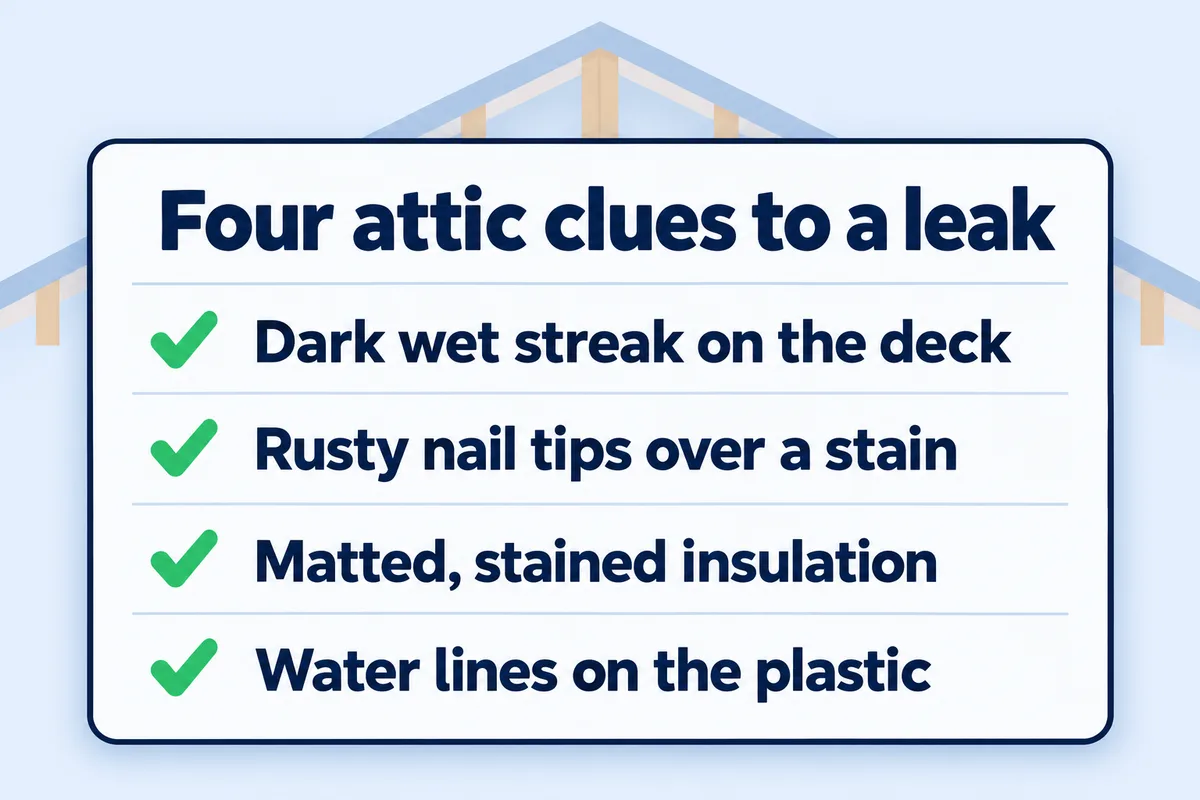
- Find the top of the stain from above. Pull back the insulation over the spot you marked on the ceiling. Wet, matted or brown-edged insulation shows the drop point.
- Check the plastic, if there is any. Some older homes have a plastic sheet between the insulation and the ceiling, and it can carry water sideways for a long way. Follow any water lines on it.
- Look up and uphill. Shine the light on the underside of the roof deck above the drop point and follow any dark streak or water line toward the peak. Water runs downhill along the wood, so the entry point is higher up the slope.
- Check the nails. Rusty or dark nail tips poking through the deck, especially with a ring of stain around each one, often mean frost, not rain. A whole field of frosty nails on a cold morning is a ventilation problem; see our page on attic ventilation.
- Check everything that goes through the roof. Vent pipes, the bath fan duct, the chimney chase, the skylight shaft. A wet ring on the wood around any of these is a strong lead.
- Measure from something that goes through the roof. Once you find the wet spot, measure its distance from the nearest vent pipe or the chimney. That pipe is visible from outside, so your measurement lets a roofer go straight to the spot.
Vaulted and cathedral ceilings have no attic to crawl into. For those, the timing table and the stain position are your best clues, and the rest is a job for someone on the roof.
The hose test, in the order roofers run it
When the attic is dry and the weather will not cooperate, you can make your own rain. It takes two people, a garden hose and patience, and it needs a day above freezing. One person stays inside under the suspected area with a light and a phone. The other works the hose on the roof, which on anything steep, wet or high should be a roofer, not a relative.
- Start low. Soak the roof below the suspected area first, then move up only when that section stays dry inside.
- Do one small area at a time: one side of a chimney, one vent pipe, one part of a valley. Soaking everything at once tells you nothing.
- Run water down the roof the way rain falls. Spraying upward under the shingles forces water where rain never goes and creates a leak that is not real.
- Give each area several minutes before moving on. Water may take a while to travel along the deck and show up inside.
- When the person inside calls out, stop, mark that area outside, and do not keep soaking it. You found it.
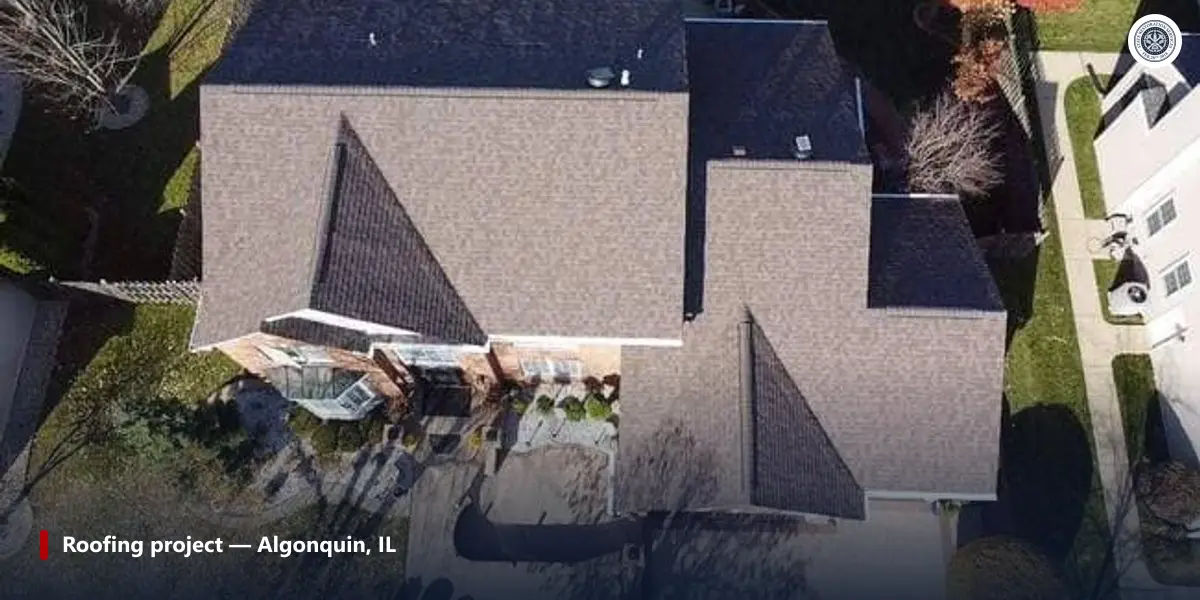
Seen from above, a roof is a map of likely suspects: every pipe, valley and spot where a lower roof meets a wall is a joint, and joints are where water gets in.
What we do when you call about a leak
Our visit follows the same order you just read. Where there is attic access we start there, because the underside of the deck shows the path. Then we walk the whole roof, not only the area over the stain, since a roof that produced one failure often has a second one starting. You get a written scope with photos before any work, and on flashing we replace the metal instead of smearing caulk over it. If the roof is open and rain is coming, our crew puts on an emergency roof tarp during the same visit.
We work Monday to Friday, 7:00 AM to 7:00 PM, and Saturday and Sunday, 9:00 AM to 5:00 PM, and an active leak gets priority during those hours. If the leak started with a storm, our article on whether homeowners insurance covers a roof leak explains which leaks a policy treats as sudden damage and which as wear.
Frequently asked questions
Is a roof leak always directly above the ceiling stain?
No. Water usually enters higher up the slope and runs along the roof deck or a rafter before it drops. Look uphill of the stain, toward the peak, and around anything that goes through the roof.
How can I tell attic condensation from a roof leak?
Condensation shows up on cold, clear mornings with no rain, as frost or droplets on many nail tips across the roof. A rain leak shows up during or after rain, in one area, usually with a streak on the deck leading to it.
Why does my roof leak in some storms and not others?
Rain driven by wind from one direction reaches flashing and vents that straight-down rain never touches. Note the wind direction each time it leaks; the side of the house facing that wind is where to look.
Can I do a hose test in November?
Only on a day above freezing, with the roof dry enough to work on safely. Water left on a cold roof can freeze, and a wet roof in fall is slippery. If the weather will not allow it, a roofer can usually find the leak from the attic and a close look at the roof.
If you have found the stain but not the source, book a roof inspection or call us at (866) 992-2982. Tell us when it drips and where the stain is, and we will start from there.