
 Volodymyr Lukaniuk
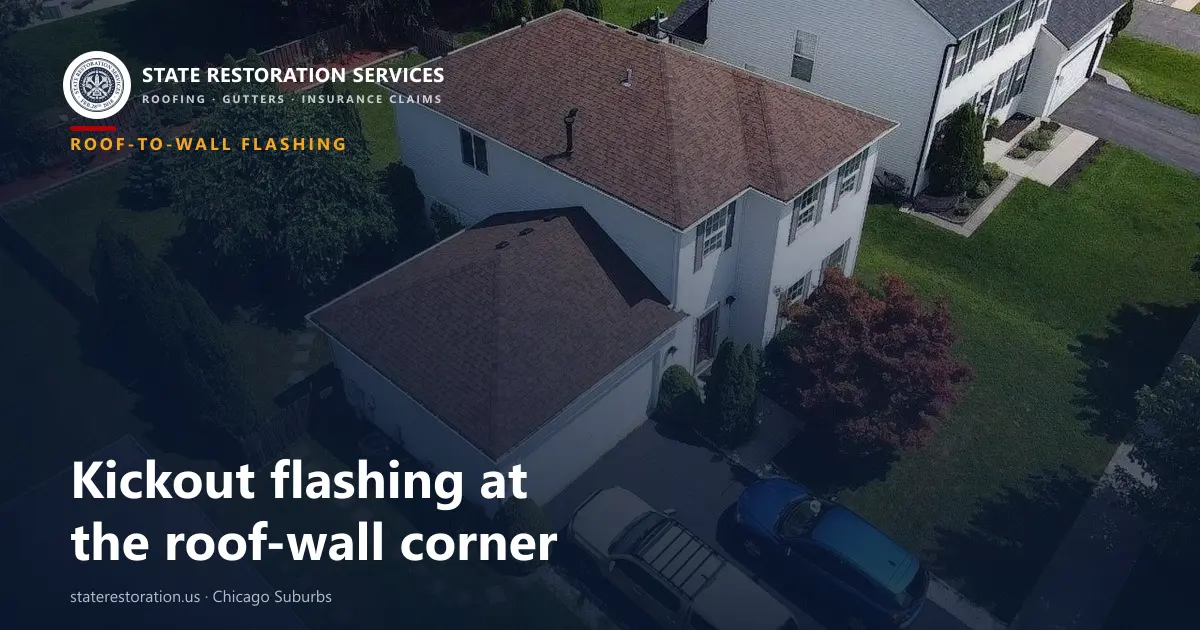
Kickout flashing is the short, bent piece of metal at the bottom of a roof-to-wall joint that throws the water running along the wall out into the gutter instead of down the siding. You need one anywhere a lower roof ends against a taller wall that keeps going past the gutter: an attached garage tucked against a two-story house, a front porch roof, a one-story bump-out. When it is missing, every rain sends a concentrated stream behind the siding at the same spot, and the wall can rot for years before anything shows on the outside.
It costs a few dollars in metal. Leaving it out is a small mistake with a big bill, mostly because nobody looks at that corner until the trim goes soft.
Where on your house the kickout belongs
Stand on the driveway and look for any spot where a roof edge with a gutter stops against a wall that keeps going down below it. That is the corner, and plenty of houses have more than one.
| The spot | What you see from the ground | Where the water goes without a kickout |
|---|---|---|
| Attached garage against a two-story wall | The garage roof slopes toward the street and its gutter dead-ends at the side of the house | Down the face of the two-story wall, right beside the garage door trim |
| Front porch roof | A shallow roof over the entry, gutter ending where the porch meets the house wall | Behind the siding next to the front door, often into the door frame |
| One-story bump-out or addition | A family room or kitchen addition with its own small roof running into the main house | Into the wall at the joint between old and new framing, the weakest spot on the house |
| Split-level step | The lower wing's eave meets the upper level's wall halfway along the house | Down the upper wall and onto the lower roof's fascia board |
| Gutter ending at a chimney | A gutter that runs into the side of a brick or sided chimney chase | Against the chimney base, where it soaks the brick or the chase framing |
InterNACHI, the home inspectors' association, names the same two situations as the places a kickout is critical: a roof-wall joint where the wall continues past the lower eave, and a gutter that stops at a chimney (InterNACHI on kickout flashing).
What a missing kickout looks like from the driveway
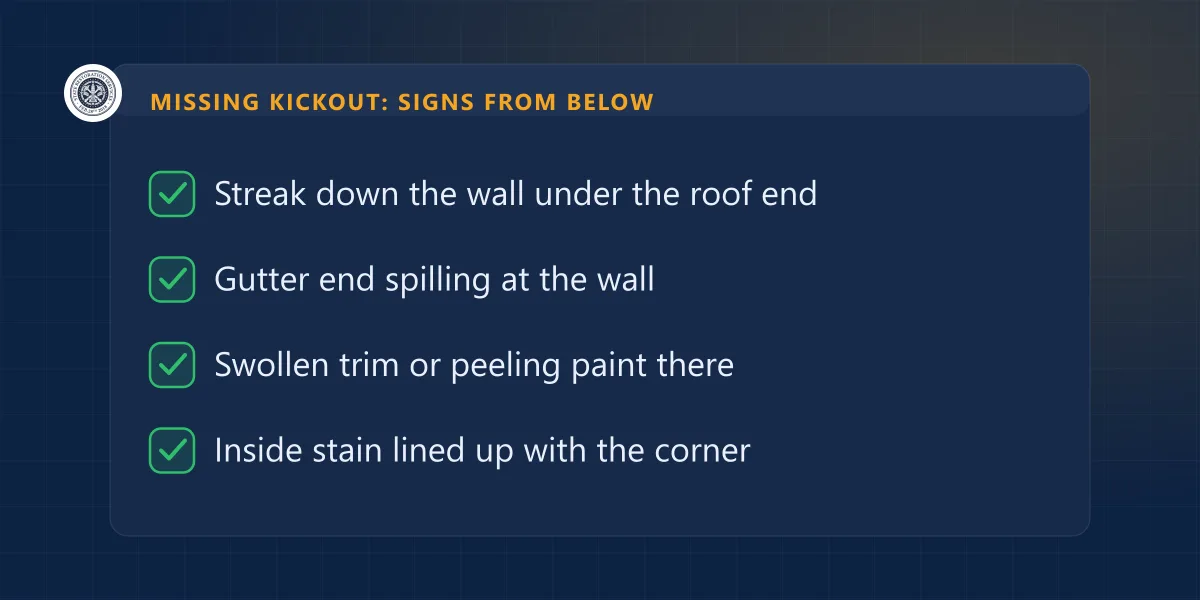
Sometimes it looks like nothing at all. Vinyl, manufactured stone and fiber cement hide water very well, so a dry-looking wall proves little. When there are signs, they sit in a narrow band directly below the end of the lower roof:
- a dark vertical streak or a clean-washed stripe running down the wall under the roof end
- the gutter end overflowing against the wall in a hard rain, while the rest of the gutter keeps up
- a swollen, split or soft piece of trim, or paint that keeps peeling at the same spot
- siding that bows out or feels spongy when you press it
- a ceiling or wall stain inside the house that lines up with that outside corner
That last one fooled a remodeler writing in the Journal of Light Construction. A pale stain on one interior wall of an Iowa house lined up with a roof-wall corner that had no kickout. Once the stone and vinyl came off, the sheathing behind the whole section was rotten, and the repair ran to about $6,000 (JLC, "How to Destroy a Wall in Two Easy Steps"). We are not quoting that as a price for your house. We are quoting it because the outside of that wall looked fine.
Why that one corner takes so much water
Along a roof-to-wall joint, every shingle course gets its own L-shaped piece of step flashing, one leg on the roof and one up the wall behind the siding. Water that runs down the wall, plus whatever the roof pushes sideways, rides down that staircase of metal like a channel. At the bottom the channel just ends. With a kickout there, the bent lip turns that stream outward into the gutter. Without one, the stream pours off the last step flashing behind the siding, onto the corner of the wall sheathing, every single rain.
A gutter cannot fix this from below. Its end cap sits on the fascia of the lower roof, a few inches away from the wall, and the water is already behind the siding by the time it gets there.
What the code text says about it
Kickouts are not new or optional on new work. The International Residential Code has required them since the 2009 edition, and the Journal of Light Construction quotes the clearer 2012 wording:
"A flashing shall be installed to divert the water away from where the eave of a sloped roof intersects a vertical sidewall."2012 IRC wording, as quoted in JLC, "Kickout Flashing: Required by Code, Yet Often Overlooked"
The details around it come from other sections and from the federal Building America program at Pacific Northwest National Laboratory:
- Step flashing size
- At least 4 inches up the wall and 4 inches onto the roof, continuous or in steps (PNNL, citing the IRC).
- Metal thickness
- Corrosion-resistant, not less than 0.019 inch, which is No. 26 galvanized sheet.
- Siding above the roof
- Siding stops short of the shingles: at least 1 inch on new work, at least 1.5 inches in the PNNL retrofit guide.
- Size of the kickout
- Big enough for real storm flow. PNNL warns that kickouts bent on site are often too small for the water a roof sends down.
Local rules can add to this. Minnesota, for example, writes a 2 1/2-inch minimum length into its state version of the code and requires a kickout when a house is re-sided, but not on a reroof alone (City of Hopkins, Minnesota). In our area the village that issues your permit decides which edition and which local changes apply, so ask the building department when you pull a permit for a roof or siding job.
How we add a kickout to a house that never had one
You cannot slide a proper kickout in from outside and call it done. It has to sit under the step flashing and under the house wrap, so the corner gets opened up. On a typical garage-to-house corner the work goes in this order:
- Take off the shingles along the bottom few feet of the roof-wall joint and remove enough siding to see the house wrap. PNNL's existing-home guide calls for opening at least 8 inches of wall.
- Look at the sheathing and the framing at the corner. Soft or black wood comes out now, because new flashing over rot only hides it.
- Run a self-adhered membrane from the roof deck onto the wall, and lap the roof underlayment up the wall about 8 inches.
- Set the starter strip, then the kickout as the very first piece of step flashing, fastened to the roof deck and not to the wall.
- Weave new step flashing with each shingle course up the joint, then lap the house wrap down over the top of the flashing so water on the wrap lands on the metal and not behind it.
- Put the siding back with its bottom edge held up off the shingles, and check that the kickout's lip sends water past the front of the gutter end.
Because this job is half roof and half siding, it goes best when one crew does both. That is why we would rather add a kickout while the roof is being replaced or the siding is being redone than as a separate trip.
Fixes that do not hold
A bead of caulk where the gutter end meets the wall is the most common one. It may stop a drip for a season, but the water is coming from behind the siding, above the caulk, so the sealant never sees it.
A scrap of aluminum bent on the tailgate and pushed under the last shingle is the next. If it is not lapped under the house wrap, the water simply runs behind it. PNNL's guide makes the same point about site-made diverters being too small.
Then there is the kickout someone shortened because it looked ugly. InterNACHI notes that owners sometimes cut them down below the usual six inches of height or trim them flush with the wall, which takes away most of what they do. If yours looks stubby, it may have been trimmed.
What it costs and when to do it
Done during a reroof or re-siding, a kickout adds a small amount of metal and labor to work that is already open. As a separate repair, it falls under the flashing work we price at roughly $300 to $1,200 for new step, valley or counter flashing, as laid out in our guide to roof flashing leaks. What moves the number is what we find behind the siding. Rotten sheathing at the corner is quoted after it is opened and photographed, never guessed at beforehand.
If the gutter at that corner is undersized or pitched toward the wall, it is worth fixing in the same visit, since a kickout only works if the gutter can take what it sends. Our seamless gutter installation crew can size it for that end.
A kickout that was there and got torn loose or crushed in a windstorm or hail is a different matter from one that was never installed. Storm damage can be part of a claim. We document it and write the estimate, and because Illinois law does not let a roofer negotiate a claim, our partner, the licensed Illinois public adjuster State Adjusting Services, can represent you on the claim itself. More on that on our storm and insurance page.
Questions homeowners ask about kickout flashing
Does every roof-to-wall joint need a kickout?
No. It is needed where the wall keeps going past the bottom of the roof edge and the gutter. A dormer side wall that ends on the roof, or a joint where the wall stops at the eave, has nowhere for the stream to go behind the siding.
Can a kickout be added without replacing the roof?
Yes. The bottom few feet of shingles and some siding come off, the corner is flashed properly, and both go back. Matching the shingles is easiest when the roof is not too old, which is one more reason to do it alongside a roof or siding project if one is coming up.
Is a missing kickout covered by homeowners insurance?
A kickout that was never installed is a construction detail, not a storm loss. Water damage from it built up slowly, and policies usually treat that differently from sudden damage. A kickout bent or torn off by wind or hail is storm damage and can be documented as part of a claim.
Related reading: chimney flashing and crickets, and why gutters overflow in heavy rain.
If there is a streak under one of your roof corners, book a free inspection or call (866) 992-2982. We are open Monday to Friday 7:00 AM to 7:00 PM and Saturday and Sunday 9:00 AM to 5:00 PM, and we work across the north and northwest Chicago suburbs.