
 Volodymyr Lukaniuk
Quick answer: Chimney flashing is a two-part metal system where the roof meets the brick: step flashing woven into the shingle courses, and counter-flashing let into a saw cut in the mortar joint above it. Installed that way it runs 15–25 years. Sealed to the face of the brick instead, it starts leaking in about three winters.
If there is a water stain on your ceiling near the fireplace, chimney flashing is the first thing we look at — and most of the time it is also the last thing we have to look at. We are a family-owned roofing company based in Lincolnshire, and after eight years on roofs across the north and northwest Chicago suburbs, the chimney is still one of the handful of spots we check first on any leak call. Here is what a proper chimney flashing job actually involves, when code says your chimney needs a cricket behind it, and what the work really costs around here.
What is chimney flashing, and why does it fail before the shingles do?
Chimney flashing is two separate layers of metal doing one job. Step flashing sits under the shingles and turns up against the brick. Counter-flashing is let into a cut in the mortar joint and laps down over the top of it. Water that sneaks past the first layer gets caught by the second and sent back out onto the roof.
Around a full chimney there are actually four pieces. An apron on the down-slope face, where the roof runs into the brick. Step flashing up both sides, one L-shaped piece per shingle course, woven in rather than laid on top. A back pan or a cricket on the up-slope face. And counter-flashing over all of it, tucked into the mortar.
That mortar cut is the part that gets skipped. A proper reglet is a shallow saw cut about an inch into the horizontal mortar joint; the metal is bent, driven into the cut, and locked in with polyurethane sealant. The alternative — running the counter-flashing flat against the brick face and caulking the top edge — puts the entire roof-to-chimney joint on a bead of sealant. Brick and metal move at different rates, and our freeze-thaw cycle swings roughly 40–50 times a season. Nothing that depends on caulk survives that for long. For the wider picture on why metal outlasts sealant everywhere on a roof, we wrote a full guide to how roof flashing fails and where leaks start.
Three ways a chimney gets flashed
| Method | How long it holds | Typical cost | Our honest take |
|---|---|---|---|
| Roof cement or caulk smeared over the old metal | 1–3 years | $50–$150 | A stop-gap to get you through a season, nothing more |
| Counter-flashing surface-mounted and sealed to the brick face | 5–10 years | $400–$700 | Works, but it becomes a maintenance item you have to remember |
| Step flashing woven in, counter-flashing cut into a mortar reglet | 15–25+ years | $650–$1,200 | The actual fix — it lasts as long as the shingles beside it |
When does a chimney need a cricket?
A cricket is required when the chimney measures more than 30 inches across parallel to the ridgeline and does not intersect the ridge itself. That is IRC section R1003.20, and it is the language your village inspector is reading. A narrow chimney, or one sitting up on the ridge, is normally flashed with a simple back pan instead.
The reason is drainage. The up-slope face of a chimney blocks everything coming down that roof plane — rain, granules, maple seeds, and in February a wedge of snow and ice — so all of it piles against the brick and has to find its way around. A flat back pan holds it in one place. A cricket is a small peaked saddle framed behind the chimney that splits the flow and sends it down both sides. On a wide chimney it is also the difference between a spot that dries out after a thaw and a spot that stays wet all winter, which is the same mechanism behind ice dams on Illinois roofs.
Code also sets how tall the cricket has to be, based on how steep your roof is. W is the chimney width parallel to the ridge; H is the height of the cricket where it meets the brick.
| Roof slope | Cricket height (H) | On a 48-inch-wide chimney |
|---|---|---|
| 12:12 | 1/2 of W | 24 inches |
| 8:12 | 1/3 of W | 16 inches |
| 6:12 | 1/4 of W | 12 inches |
| 4:12 | 1/6 of W | 8 inches |
| 3:12 | 1/8 of W | 6 inches |
Read the middle row, because 6:12 is the pitch on a great many suburban houses here. A 48-inch chimney on that roof needs a cricket a foot tall at the brick. That gets framed, sheathed, covered in ice-and-water shield and flashed like a small roof of its own, which is why it carries its own line on the estimate.
Which edition of the code your village enforces varies. Since 1 January 2025 an Illinois local code has to be at least as stringent as the IRC, and jurisdictions without their own adopted code fall back to the current IRC edition — the Illinois Capital Development Board publishes the current position. We pull the permit and deal with your village's inspector either way — it is part of how we run a job.
What if your chimney is a sided box instead of brick?
Plenty of houses built here from the 1980s onward have a framed chimney chase: plywood and siding wrapped around a metal flue, capped with a sheet-metal chase cover. The flashing logic is identical, except the counter-flashing tucks up behind the siding and housewrap rather than into a mortar joint. Chases add two failure points a brick chimney does not have.
The first is the chase cover itself. Builders often capped these with a flat galvanized pan, and a flat pan holds a puddle in the middle until it rusts through from the inside. You usually find out when the stain appears on the ceiling directly under the flue. A proper replacement is stainless or heavy aluminum with a cross-break — a slight peak so water runs off — and turned-down edges with a drip so water leaves the cover instead of tracking back under it.
The second is the bottom corner, where the chase meets the roof and the wall keeps going down past it. That corner needs a kickout flashing: a small angled piece that throws water out into the gutter instead of letting it run behind the siding. It is a cheap piece of metal and an easy one to leave off, and when it is missing the damage shows up as rotted sheathing behind the siding long before anyone sees a drip inside.
What does chimney flashing work cost in the north suburbs?
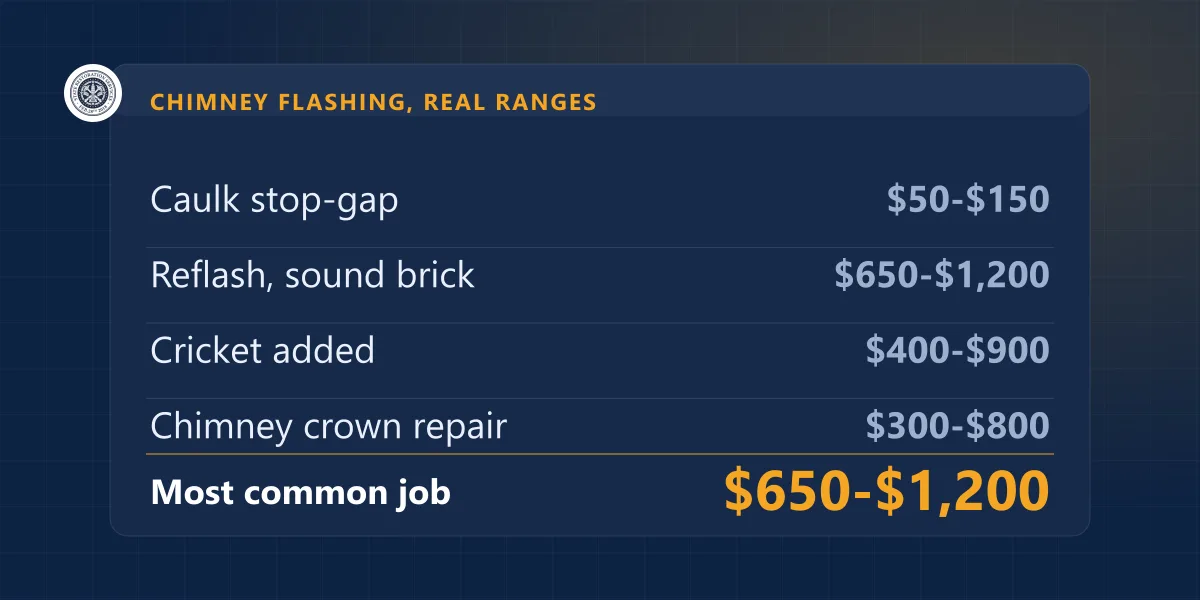
A standalone chimney reflash on a sound masonry chimney runs about $650 to $1,200 in our area. Adding a cricket where code calls for one is another $400 to $900. Those are ranges, not quotes — the real number depends on chimney size, roof pitch, and whether the crew is working off a one-story eave or a second-story slope.
| Scope of work | Typical range | What moves the number |
|---|---|---|
| Caulk or roof-cement stop-gap | $50–$150 | One visit; buys you a season, not a fix |
| Reflash a sound masonry chimney | $650–$1,200 | Chimney size, roof pitch, one story vs two |
| Add a cricket where code requires it | $400–$900 | Chimney width and roof slope set the size |
| Chimney crown repair or top-course rebuild | $300–$800 | Mason's work, priced separately from flashing |
| New chase cover on a framed chase | $500–$1,100 | Size, and stainless vs aluminum |
Almost none of that is material. Flashing metal costs a few dollars a foot. What you are paying for is the setup, the reglet cut, the shingle courses that have to come up and go back down properly, and the fact that somebody has to be comfortable working against a brick wall on a slope. That is also why the same work costs far less folded into a full roof replacement than it does as a standalone service call — the ladders, the tear-off and the crew are already there.
One honest note on the crown, the concrete cap on top of the chimney. If it is cracked and letting water down into the brick, that is a mason's job. We will tell you that rather than price it as flashing and hope the leak was ours to fix.
The corner that gets cut on a re-roof
Some of the chimney leaks we get called out to are on roofs only a few years old. A cheap bid leaves the existing counter-flashing in place, tucks fresh step flashing behind twenty-year-old metal, and runs a bead of sealant along the top. Everything below the mortar line is brand new, the joint itself is still twenty years old, and the callback arrives around the third spring.
Your estimate should say what happens at the chimney. Three questions settle it before you sign, and they take about a minute:
- Is the counter-flashing being replaced, or reused from the old roof?
- Is the new counter-flashing going into a fresh cut in the mortar joint, or sealed to the face of the brick?
- If the chimney is wider than 30 inches, is a cricket included in this price?
A roofer who does it properly will answer all three without hesitating, because it is what they priced. If the chimney is not itemized at all, ask for it in writing — the same principle applies to every other line in what a full roof replacement should include.
Does homeowners insurance pay for chimney flashing?
Usually not, and it helps to know why before you call. Insurance covers sudden damage from a covered peril. Mortar that eroded over 30 winters and a sealant bead that finally gave up are wear and deterioration, which every homeowners policy excludes. Flashing that hail dented or wind tore loose is a different question with a much better answer.
The practical version: a $700 repair sits under almost every deductible, so filing gains you nothing — worth checking against your own numbers in our guide to roof insurance deductibles in Illinois. Where the chimney genuinely belongs in a claim is as part of a storm-damaged roof, because the flashing has to come off to replace the shingles around it and it should be scoped and paid for on that basis.
One thing we cannot do: Illinois law bars a roofing contractor from negotiating your insurance claim. What we do is inspect, document the damage, and build an estimate that meets code. If you want somebody representing you on the claim itself, our affiliated licensed public adjuster, State Adjusting Services, can do that. More on how the two roles fit together on our storm and insurance claims page.
Frequently asked questions
How do I know a leak is the chimney and not the roof itself?
Look at where the stain sits and when it shows up. A stain on the ceiling beside the chimney chase that appears in ordinary rain points at the chimney flashing. It can land several feet down-slope of the brick, because water runs along the deck and then a rafter before it finally drops through the drywall.
Can chimney flashing be replaced without replacing the whole roof?
Usually yes. If the shingle field still has years left, we lift the courses beside the chimney, weave in new step flashing, cut a fresh reglet and set new counter-flashing. Past roughly 20 years the shingles get brittle and crack when they are lifted, which is the honest mechanical reason a roofer may decline the repair.
Does every chimney need a cricket?
No. A cricket is required when the chimney measures more than 30 inches across parallel to the ridgeline and does not intersect the ridge itself, under IRC section R1003.20. A narrow chimney, or one sitting on the ridge, is normally flashed with a back pan instead.
How long should new chimney flashing last?
Step and counter-flashing cut into the mortar joint should run 15 to 25 years or more, which matches the life of the shingle system around it. Counter-flashing that is only sealed to the face of the brick depends on a bead of sealant and becomes a maintenance item every five to ten years.
Related reading: Roof flashing 101 and the five spots leaks start and how your roof insurance deductible works in Illinois.
Got a stain near the fireplace? Book a free inspection or call (866) 992-2982 — we serve the north and northwest Chicago suburbs, and we will tell you plainly whether it is a $150 stop-gap or a $900 job.