
 Volodymyr Lukaniuk
Quick answer: Ice dams form when heat leaking into your attic melts snow on the upper roof while the eaves stay below freezing. The meltwater runs down under the snowpack, refreezes at the cold edge, and backs up under your shingles. The real fix is sealing and insulating the attic floor and balancing ridge-and-soffit ventilation so the whole roof deck stays one temperature — heat cables and chipping ice only treat the symptom, not the cause.
Every winter the calls start the same way: a thick ridge of ice hanging off the eave, icicles the length of a broom handle, or a homeowner in Buffalo Grove or Mundelein staring at a wet stain spreading across a bedroom ceiling in the middle of a January thaw. Ice dams in Illinois aren't rare — they're what happens when a snow-covered roof, a warm attic, and a hard freeze all show up in the same week, which around here is most of the winter. The good news: ice dams are almost entirely preventable, and the fix has almost nothing to do with the roof surface itself. It's about what's happening underneath it.
What causes ice dams on an Illinois roof?
An ice dam forms when heat escaping your living space warms the underside of the roof deck enough to melt snow on the upper slopes, even while the outside air sits well below freezing. That meltwater runs down under the snowpack until it hits the unheated eave, refreezes, and builds a ridge of ice that backs water up under your shingles.
It isn't the cold that causes ice dams — it's the mismatch. A roof that's one uniform temperature, cold from ridge to eave, just holds its snow until it melts off the whole surface at once, the way it's supposed to. The problem shows up when part of the roof runs warmer than the rest, almost always because heat is leaking out of the attic below it. Illinois supplies the other two ingredients for free: enough snow cover to hold meltwater in place for days, and eave temperatures that sit below freezing for weeks at a stretch. Put a warm patch on the upper roof next to a cold eave and you've built the machine.
What are the three ingredients it takes to build an ice dam?
It takes snow cover, a warm spot in the attic leaking heat upward, and a cold eave for the meltwater to refreeze against. Illinois hands you two of those three every winter without you doing anything — the only variable you actually control is how much heat your attic is losing.
| Ingredient | Why Illinois has it covered |
|---|---|
| Snow cover | Chicago-area winters bring repeated snow events that sit on the roof for days, giving meltwater somewhere to pool |
| Attic heat loss | Recessed lights, bath fans, and gaps around the attic hatch leak warm air straight into the underside of the deck |
| Freezing eave temps | The overhang past your exterior wall gets no heat from below, so it stays at outdoor temperature no matter how warm the attic runs |
Quick fixes vs. the real fix — what actually stops an ice dam?
Heat cables, chipping, and roof rakes all treat the ice that's already there; none of them touch the attic heat loss that built it. The only fix that stops ice dams from coming back is sealing and insulating the attic so the roof deck runs one temperature, with ice-and-water shield at the eaves as a backstop.
| Fix | Stops it long-term? | Rough cost |
|---|---|---|
| Heat cables along the eave | No | $300–$700 installed, plus electricity every time it snows |
| Chipping or salting the ice | No | Cheap up front, real risk of cracked shingles and voided warranties |
| Roof rake after every snow | Partial | $30–$60 for the tool, plus your time after every storm |
| Attic air sealing, insulation & balanced ventilation | Yes | $1,500–$4,000 depending on attic size and current insulation |
How do you actually stop ice dams for good?
You stop ice dams by closing the attic air leaks, bringing insulation up to depth, and balancing ridge-and-soffit ventilation so the attic stays close to outdoor temperature — then backing it up with ice-and-water shield at the eaves for the storm that beats even a well-sealed attic.
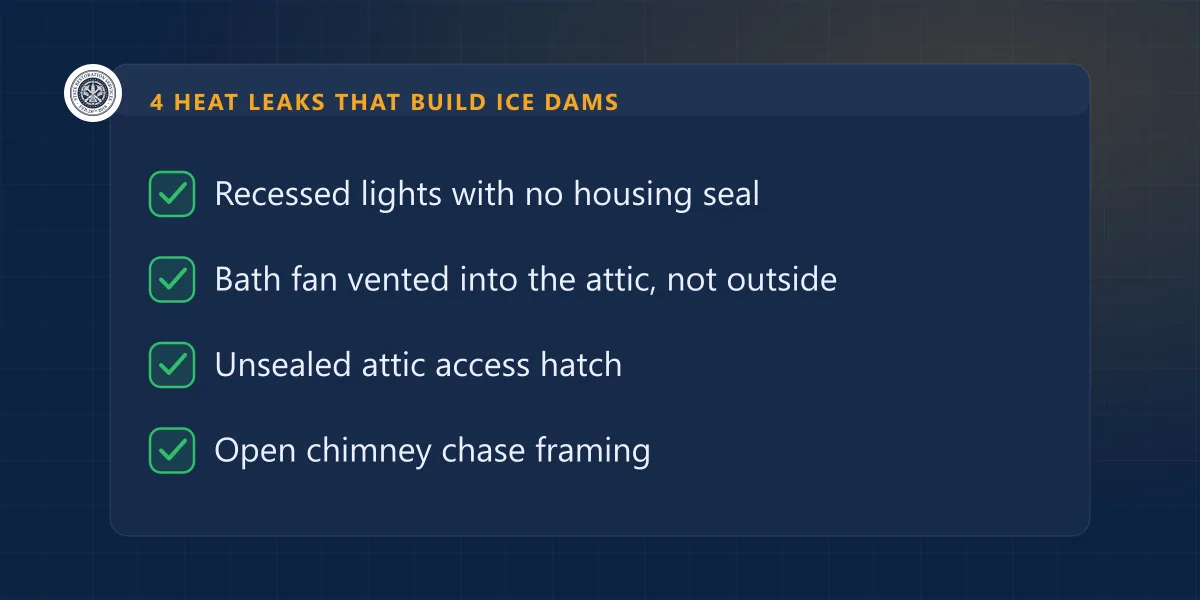
We start at the attic floor, not the roof. Recessed lights without airtight housings, bath fans that dead-end into the attic instead of venting outside, an unsealed attic hatch, and open framing around a chimney chase are the usual suspects — each one is a direct pipe for warm household air to reach the underside of your deck. Sealing those, then bringing insulation up to Illinois's recommended attic R-value, does more to stop an ice dam than anything you can do to the roof itself. From there, ridge and soffit ventilation need to work together, not against each other — soffit intake pulling in cold outside air and a ridge vent letting it exhaust, so the whole attic runs close to outdoor temperature instead of turning into a warm box under your insulation.
Even a well-sealed, well-vented attic can still lose the fight during an extended thaw-freeze stretch, which is why ice-and-water shield at the eaves and valleys is code-required on a reroof here and is exactly what we install as the backstop on every job — you can see the full line-by-line breakdown in what's included in a roof replacement. Think of it as two layers of defense: attic work stops the dam from forming in the first place, and the membrane under your shingles keeps you dry on the winter it forms anyway.
When does an ice dam turn into an insurance claim?
An ice dam becomes a claim once trapped water gets past the shingles and shows up as a stain on a ceiling, peeling paint, or soaked attic insulation. Illinois law doesn't let a roofing contractor negotiate that claim on your behalf, which is exactly why we work alongside a licensed public adjuster on the insurance side.
Watch for a brownish ring on a ceiling or upper wall, paint that's bubbling or peeling in a corner near an exterior wall, or a musty smell in a closet under the eave — those show up days after the ice dam itself, once meltwater has had time to soak through drywall. If you catch it, document it with photos and call us before you start tearing into drywall. Under Illinois law, a roofing contractor isn't allowed to negotiate your claim, so when an ice dam turns into real interior damage, our partner licensed public adjuster handles the claim side while we document the roof damage and put together a code-compliant repair scope.
Frequently asked questions
What causes ice dams on a roof in Illinois?
Ice dams form when heat leaking from your living space into the attic melts snow on the upper roof while the eaves stay below freezing. The meltwater runs down under the snowpack, refreezes at the cold eave, and builds a ridge of ice that backs water up under the shingles.
How do you get rid of an ice dam safely?
The safest short-term fix is professional steam removal, which melts the ice without chipping at shingles or granules. Don't use a hammer, axe, or rock salt on your roof edge — they crack shingles and can damage gutters. Steam removal buys you time; sealing and insulating the attic is what stops the dam from coming back.
Does homeowners insurance cover ice dam damage in Illinois?
Many Illinois homeowners policies cover sudden interior water damage caused by an ice dam, though coverage and deductibles vary by carrier and policy. Ongoing damage from a chronic, unaddressed dam is more likely to be disputed, which is another reason to fix the attic instead of just treating the symptom every winter.
Will heat cables stop ice dams for good?
Heat cables melt a channel through an existing ice dam, but they don't address the attic heat loss that built the dam in the first place. They're a reasonable stopgap for one bad winter, not a permanent fix, and they add an electric bill every time it snows.
Dealing with ice dams on your roof this winter? Book a free inspection and we'll check both your attic and your roof edge, not just the ice you can see. Browse the residential roofing systems we install, see how the claims side works on our insurance claim page, or reach out with questions. We serve homeowners across the north and northwest Chicago suburbs, including Vernon Hills. Related reading: our storm-damage walk-around checklist and how we decide between roof repair and replacement.