
 Volodymyr Lukaniuk
Quick answer: After a storm, walk the yard and gutters before you look at the roof itself. Real storm damage shows up as granules in the downspouts, dented gutters and soft metal, torn window screens, and shingles that look bruised, curled, or missing — not just "a little worn." If you see two or more of those signs, it's worth a free inspection. Don't get on the roof yourself, and don't sign anything with the crew that knocks on your door the same afternoon.
Every time a storm rolls through the north and northwest Chicago suburbs, we get the same two calls the next morning: homeowners who saw nothing and are worried they're missing something, and homeowners who climbed up a ladder, found a few dinged shingles, and are convinced their whole roof needs replacing. Both are guessing. This storm damage checklist is the same ground-level walk-around our crews do before we ever touch a ladder, so you can tell the difference between normal wear and something that belongs on an insurance claim.
What actually counts as storm damage on a roof?
Storm damage means measurable impact from a specific weather event — hail bruising the mat under the granules, wind lifting or tearing shingles, or debris puncturing the surface — not the slow granule loss and curling that comes from a roof simply getting old. The distinction matters because only the first kind is something an insurance policy is built to cover.
The confusing part is that both can look similar from the ground. A 16-year-old roof with worn, curling shingles can look "beat up" after a windy night even if the wind did nothing new to it. That's exactly why we walk the yard first — the yard tells you whether anything actually happened, before you start reading tea leaves on the shingles themselves.
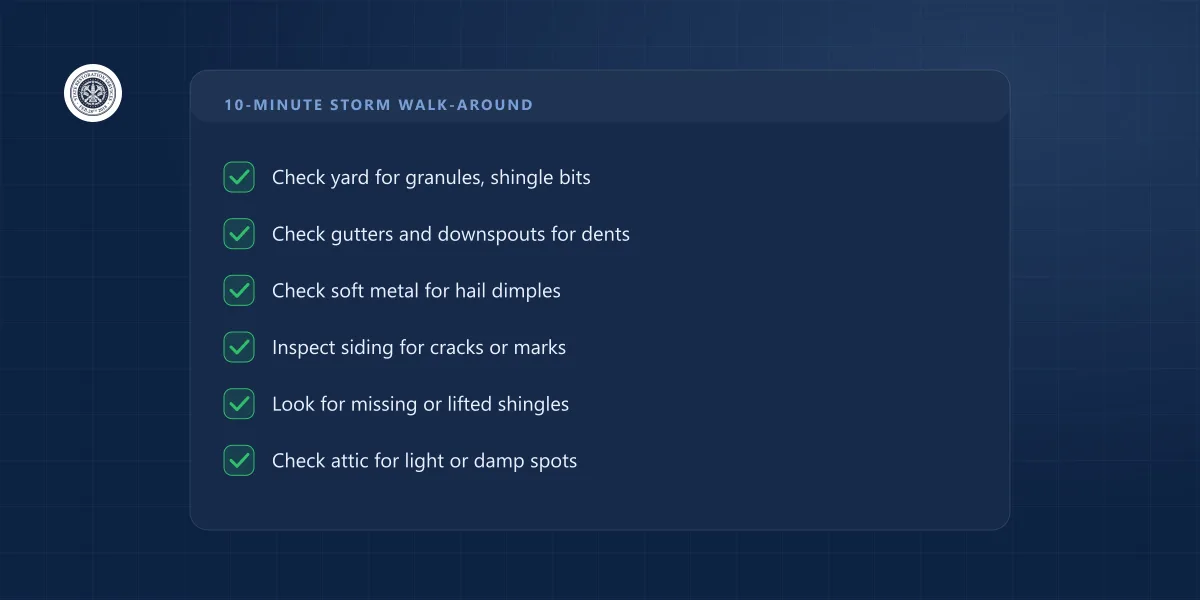
Start on the ground: the 10-minute walk-around
Do this the day after a storm, in daylight, with your feet on the ground. You're not diagnosing anything yet — you're gathering evidence.
- Downspout output. Pop the bottom elbow off a downspout or just look at where water exits. A handful of granules after any storm is normal. A noticeable pile, especially on a roof under 12 years old, is a flag.
- Gutters and downspouts. Hail dents aluminum before it dents most shingles. Dimples, especially clustered on one slope facing the storm, are a real data point.
- Window screens and soft metal. Torn screens, dented mailbox tops, dinged AC fins, and dented roof vent caps all take hail damage more visibly than shingles do. If your neighbor's AC unit or your own mailbox has fresh dimples, that's the same hail that hit your roof.
- Siding. Cracks, small punctures, or chalky-looking impact marks (the surface coating knocks loose and shows a lighter color) mean the same hail reached siding height.
- The yard itself. Torn leaves, stripped bark on one side of small branches, and dented patio furniture all corroborate hail size and direction.
What can you safely check without getting on the roof?
Stand back from the house — across the street or from an upstairs window — with binoculars if you have them. You're looking for missing shingles, shingles that are visibly curled or lifted at the edges, exposed nail heads (little silver dots where a shingle has slid), and bent or missing ridge cap pieces along the roof's peak. Any of these from a safe distance is worth documenting with a photo and a date.
We know the temptation after a storm is to grab a ladder and go look yourself. Please don't. We've replaced more roofs damaged by a homeowner's fall than we've replaced roofs actually destroyed by hail — that's not a joke, that's just what fifteen years on Chicago-area roofs teaches you. A roof is safe for a trained crew with the right footwear and fall protection. It is not a safe place for a homeowner in tennis shoes the morning after a storm, especially if the deck is even slightly wet.
Ground-safe checks vs. what needs a trained eye
| You can check yourself | Needs a roofer or inspector |
|---|---|
| Downspout granule buildup | Mat exposure and bruising under granules |
| Gutter and vent-cap dents | Soft spots or give underfoot on the deck |
| Torn window screens | Damage on the back slope you can't see from the ground |
| Missing shingles visible from the street | Flashing separation around chimneys and vents |
| Siding cracks or impact marks | Whether the damage is old wear or storm-fresh |
The right-hand column is where an eight-minute free inspection earns its keep. We carry a chalk marker and photograph every hit we find, on every slope, so you have documentation either way — even if the answer turns out to be "this is cosmetic, you don't need a claim." We'd rather tell you that for free than have you file a claim you didn't need.
What NOT to do in the days right after a storm
Don't sign a contract with the crew that knocks on your door the same afternoon, before you've even called your insurance company. After a bad hailstorm, out-of-town crews follow the storm track from state to state, canvas neighborhoods for a few weeks, and are gone long before a warranty claim would ever come due. That's not us being petty about competition — it's a pattern insurers and state licensing boards both track every storm season. A local company with a Lincolnshire address and Google reviews going back years isn't going anywhere; that accountability is worth something.
Also don't let anyone push you to file a claim before you know whether there's real damage. Filing and withdrawing claims can affect future premiums, and a legitimate roofer will tell you honestly when the damage is cosmetic. We do — it costs us a job sometimes, and we're fine with that.
When is it worth filing an insurance claim?
File when a qualified inspection finds functional damage — mat exposure, bruising that's compromised the shingle's ability to shed water, or wind damage that's torn or lifted shingles — not just cosmetic marks. In Illinois, most policies give you roughly one year from the date of loss to file, but insurers get suspicious of claims filed months after a storm with no documentation, so don't sit on it if you find something real.
One more Illinois-specific detail worth knowing: a roofing contractor is not legally allowed to negotiate your insurance claim for you. We can document damage, build a code-compliant estimate, and hand you a clear picture of the scope of work — but if your insurer's estimate comes in low and you want someone licensed to advocate on the claim itself, that's the job of a public adjuster. Our sister company, State Adjusting Services, does exactly that and only gets paid if you do.
What happens when we come out for a free inspection?
One of our crew members walks the same ground-level checklist above with you first, then gets on the roof (safely, with the right gear) and photographs every slope, including the back of the house you can't see from the street. You get a written summary either way: documented storm damage with photos you can hand to your adjuster, or an honest "this roof is fine, here's what we found and why it's not claim-worthy." No pressure to sign anything on the spot. If you're in Arlington Heights, Buffalo Grove, Northbrook, or anywhere across Lake and Cook County, we can usually get someone out within a day or two of a storm.
If the inspection does turn up real damage, our process page walks through what a full roof replacement looks like from tear-off to final cleanup, and how we scope siding and gutter damage from the same storm event if it applies.
Frequently asked questions
How long after a storm can I still find damage?
Physically, the damage doesn't heal or disappear — a hail bruise or torn shingle looks the same a month later as it does the next morning. What changes is your ability to prove the timing. Photograph what you find as soon as you can and note the date, even if you don't inspect the roof itself right away.
Do small hail dents always mean I need a new roof?
No. Small cosmetic dimples on soft metal without matching mat exposure or bruising on the shingles themselves usually don't add up to a functional claim. Size and pattern matter more than the fact that dents exist somewhere on the property — that's exactly what a proper inspection sorts out.
Is it safe to check my own roof after a storm?
We'd rather you didn't climb up yourself. Roofs are more slippery than they look, especially with any residual moisture, and a fall is a far more expensive and painful outcome than waiting a day or two for a trained inspection. Everything worth checking safely can be seen from the ground or a window.
Who do I call first — my insurance company or a roofer?
Either order works, but we'd suggest getting a free roofing inspection first so you know whether you actually have damage worth reporting. That way, if you do call your insurer, you're calling with photos and a documented scope instead of a guess.
Think your roof took a hit in the last storm? Book a free inspection or call (866) 992-2982 — we serve the north and northwest Chicago suburbs. Related reading: what real hail damage looks like on asphalt shingles and how we decide between repair and replacement.