
 Volodymyr Lukaniuk
Quick answer: Repair when the roof is under about 15 years old, the damage is isolated to one or two spots, and the decking underneath is still solid. Replace when granule loss is heavy across multiple slopes, the decking has gone soft, or a storm hit 25% or more of the roof's total area — at that point patching just delays the inevitable and costs you twice.
Every week somebody calls us after getting two wildly different answers from two different roofers: one says "patch it, you're fine for years," the other says "this whole thing needs to come off today." The honest answer is that roof replacement vs repair isn't a coin flip and it isn't a sales pitch — it's a handful of specific, checkable facts about your roof. We'll walk you through exactly what we look at on the ladder, when a repair is genuinely the smart move, when it's a band-aid you'll pay for twice, and how to spot a contractor pushing you toward the more expensive answer because it's the more expensive answer.
What's the real difference between a roof repair and a full replacement?
A repair fixes a specific, localized problem — a cracked pipe boot, a run of lifted shingles along one valley, a section of flashing that pulled away from a chimney — while the rest of the roof stays in place. A full replacement means tear-off down to the decking and a new roofing system installed from the deck up. The line between them is condition, not preference: a repair only makes sense if the rest of the roof still has real life left in it.
What do we actually check before telling you "repair" or "replace"?
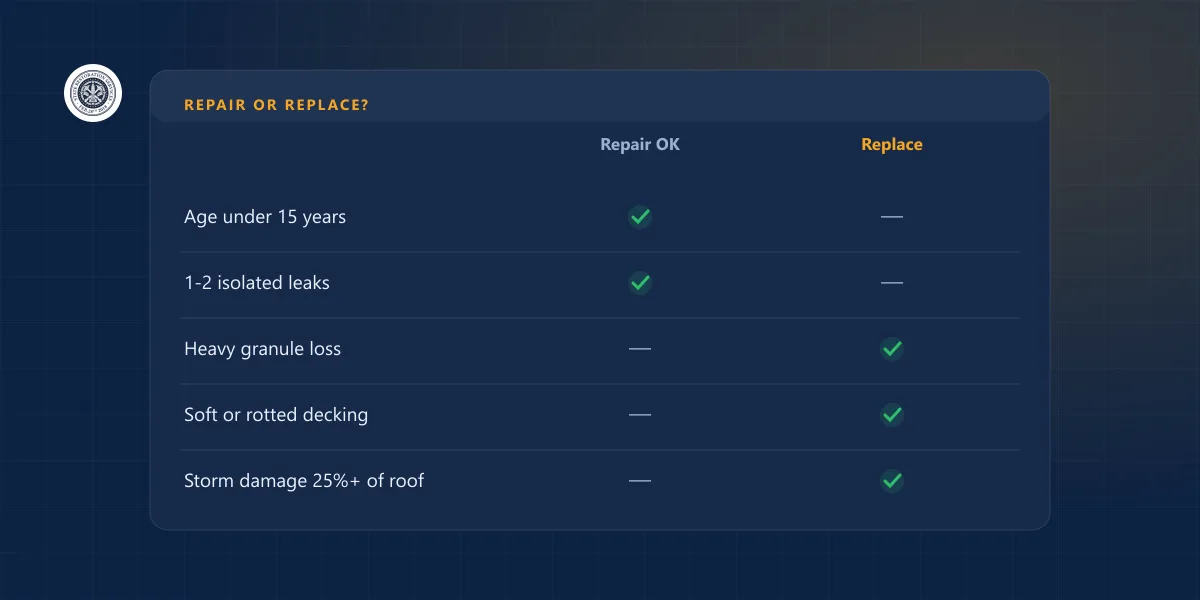
We climb the roof and check five things: age, how many separate problem areas there are, how much granule loss has happened, whether the decking is still solid when we press on it, and what percentage of the total roof area storm damage covers. Those five answers almost always point to the same conclusion independently — when they don't agree, we tell you that too instead of picking the number that sounds better.
| What we find | Usually means |
|---|---|
| Roof under 15 years old, one or two leak points | Repair |
| Granule loss heavy on multiple slopes, mat showing through | Replace |
| Decking soft or spongy underfoot | Replace — a repair can't fix rotted plywood underneath it |
| Storm damage covers 25%+ of the roof | Replace, and most insurers agree at that threshold |
| Two or more layers of shingles already on the roof | Replace — Illinois building code caps re-roofing at two layers, and a third layer isn't legal to add |
When is a repair genuinely the right call?
A repair is the right call when a roof under roughly 15 years old has one clearly identifiable problem — a flashing failure, a single storm-torn section, a vent boot that dried out and cracked — and the shingles everywhere else are still gripping tight with normal granule coverage. We've repaired plenty of roofs for customers and told them flat out not to spend money on a full tear-off, because the numbers didn't support it. If your roof is 8 years old and a branch put a 3-foot gash in one slope, that's a repair, full stop.
The catch is matching. Shingle colors fade with UV exposure over years, so a repair on an older roof sometimes leaves a visibly different patch. That's a cosmetic tradeoff worth knowing about upfront, not a reason to talk yourself into a replacement you don't structurally need.
When does a repair just delay a replacement you're going to need anyway?
A repair is a temporary fix, not a real solution, when the shingles around the damaged area are already brittle, curling, or shedding granules on their own — you're not fixing a roof at that point, you're buying a few more years on a roof that's failing everywhere, one patch at a time. We've seen homeowners spend $600 on a repair in spring and $600 again in October on the same roof, when a full replacement at that stage would have cost less than the two repairs combined plus the water damage from the leak that opened up in between.
The tell is usually the decking. If we pull back shingles near a leak and the plywood underneath is soft, discolored, or delaminating, no shingle repair sitting on top of it is going to hold. Rotted decking has to be replaced regardless of what's happening with the shingles, and once we're opening up that much of the roof, doing the whole thing at once is almost always the better value than doing it in sections over two or three service calls.
How can you tell you're being upsold to a replacement you don't need?
The biggest tell is a contractor who recommends full tear-off after a single leak, without ever getting on the roof to look at the rest of it, and without showing you photos of the shingle condition elsewhere. A legitimate assessment documents what's wrong and shows you the areas that are fine, not just the areas that need work.
- Full replacement recommended off a single leak with no roof-wide inspection
- No photos or written notes on shingle condition away from the damaged area
- "Code upgrade" charges that are never itemized or explained
- Heavy pressure to sign a contract same-day, especially right after a storm
- No written scope of work — just a total price and a signature line
This is where out-of-town storm chasers earn their reputation — a crew that showed up in a truck with a magnetic sign two days after a hailstorm has every incentive to write the biggest job possible before they leave town again, and no incentive to still be answering your calls in three years if that work doesn't hold up. A local contractor who's still going to be here for your next roof, and the one after that, doesn't have the same reason to oversell you.
Is it ever the other way — someone selling you a repair when you actually need a replacement?
Yes, and it's less talked about but just as common. A rock-bottom "repair" bid on a roof that clearly needs replacing is usually a contractor racing to win the job on price, planning to either come back for change orders once they're already on your roof, or doing a patch that's designed to look fine for the length of a one-year workmanship warranty and not much longer. If a bid seems too cheap for the condition we'd expect based on the roof's age and damage, that's worth a second opinion just as much as a bid that seems inflated.
Frequently asked questions
How much does a roof repair typically cost versus a full replacement?
In the Chicago suburbs, a straightforward repair usually runs a few hundred to around $1,500 depending on the scope, while a full asphalt shingle replacement on an average home runs into the five figures. That gap is exactly why the repair-vs-replace call matters, and why it's worth getting a real inspection instead of taking either number at face value.
Can I get a second opinion without paying for another full inspection?
Most reputable roofers, us included, will do a free on-roof assessment. If a contractor wants to charge you just to look and give an opinion, or won't get on the roof at all, that's worth noting on its own.
Does insurance treat repair and replacement claims differently?
Yes. Insurers generally cover storm-caused damage regardless of whether the fix ends up being a repair or a replacement, but the threshold for approving a full replacement (commonly around that 25% damaged-area mark) varies by carrier and policy. Because Illinois law doesn't allow a roofing contractor to negotiate your claim, our documentation goes to you and, if you want it, to our partner licensed public adjuster at State Adjusting Services to handle that conversation with your insurer directly.
How many roof repairs is too many before I should just replace it?
There's no fixed number, but if you've paid for two separate repairs on the same roof within about 18 months, that's a strong signal the roof is failing broadly rather than in one spot, and the math usually favors replacing it before a third repair and the water damage that can come with a leak you didn't catch in time.
Not sure which side of that line your roof is on? Book a free inspection and we'll climb up, tell you honestly what we find, and put it in writing — whether that's a repair or a full roof replacement. If a storm is behind the damage, we can also walk you through the insurance claim process and what financing options are available either way. We serve homeowners across the north and northwest Chicago suburbs, including Arlington Heights, Buffalo Grove, and Northbrook — or just reach out with questions. For more on what drives roof costs in this market, see our guide on what a new roof really costs in the Chicago suburbs, and if you're dealing with recent storm damage, check out how to spot real hail damage on an asphalt roof. To see exactly how we run a full replacement job when that's the right call, read about our process.