
 Volodymyr Lukaniuk
A square on a roof is 100 square feet of roof surface, the same as a patch 10 feet by 10 feet laid on the slope. Roofers, suppliers and insurance estimates all count a shingle roof in squares, so a "24 square" roof has about 2,400 square feet of shingles on it. A square of a standard architectural shingle such as GAF Timberline HDZ comes in three bundles, according to GAF's own explanation of the roofing square.
The definition is the easy part. The part people get wrong is turning a house into squares: the roof is bigger than the floor under it, some squares on a quote are roof and some are waste, and a few pieces of the roof are not counted in squares at all. Below we work one ordinary house from the tape measure to the bundle count, the same way we do it before we write an estimate in the north and northwest Chicago suburbs.
Why the roof is bigger than the house under it
A square is measured on the slope, not on the ground. Lay a 10 by 10 square on a sloped roof face and look at it from above: it covers less ground than 100 square feet, because part of each foot goes up instead of out. That is why a roof always has more squares than a floor plan of the same outline.
Turning the pitch into a number you can check
The pitch on a quote reads like 6/12: the roof rises 6 inches for every 12 inches it runs. The pitch factor is how much longer the slope is than the run, and it comes from plain geometry, so you can check any factor a roofer or a calculator gives you:
pitch factor = square root of (12 x 12 + rise x rise), divided by 12. For 6/12: square root of 180 = 13.42, and 13.42 / 12 = 1.118.
Take a house whose roof outline, seen from above with the overhangs, covers 1,500 square feet. Keep the outline and change only the pitch, and the square count moves like this:
Factors rounded to three decimals, squares to one. The red bar is the pitch used in the worked house below.
Two things are worth noticing. Between a gentle 4/12 and a common 6/12 the difference is only one square on this house. Going from 6/12 to a steep 12/12 adds more than four. And a hip roof with the same pitch on every face has the same area as a gable roof over the same outline. The hips change the waste, not the squares, which is the next step.
One house, from the tape measure to the bundle count
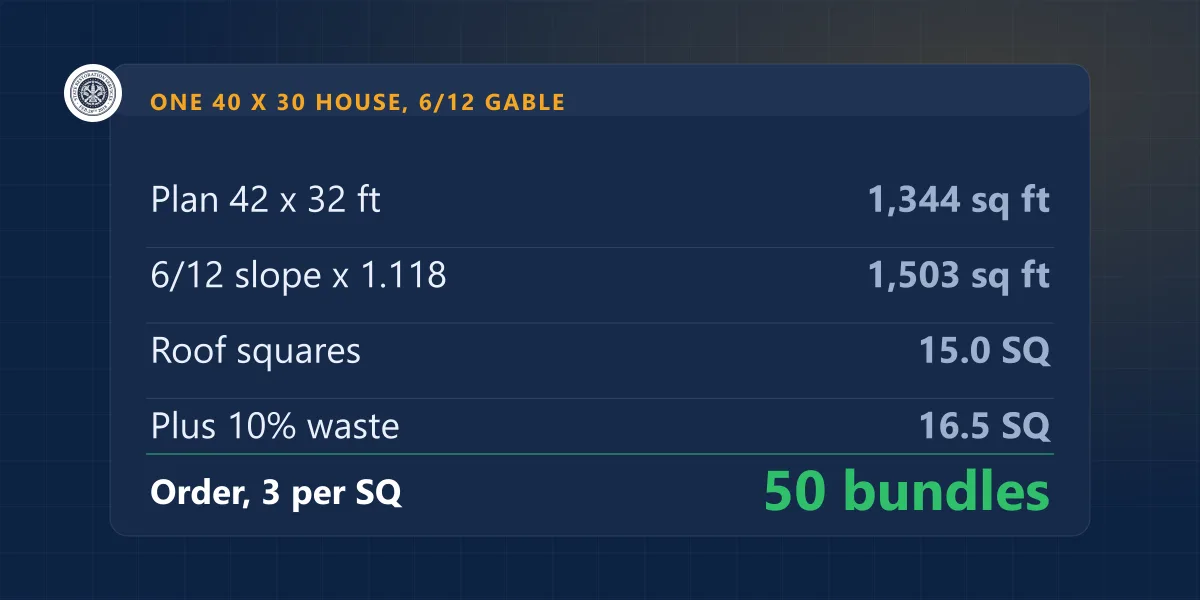
Take a plain two-story house with walls 40 by 30 feet, a gable roof at 6/12, and a 1-foot overhang on every side. This is the arithmetic, step by step:
- 1
Add the overhangs to the walls: 42 by 32 feet. That is the roof outline seen from above.
1,344 sq ft - 2
Multiply by the 6/12 pitch factor, 1.118. Check it another way: each face runs 16 feet from the eave to the ridge, which is 17.9 feet on the slope, and 2 faces x 42 x 17.9 lands in the same place.
1,503 sq ft - 3
Divide by 100. These are the squares that are actually on the roof.
15.0 squares - 4
Add waste for cuts at the rakes, the ridge and the starter course. A simple gable takes about 10%. Valleys, hips and dormers push it toward 15%.
16.5 squares - 5
Three bundles per square for a shingle like Timberline HDZ, rounded up to whole bundles, because nobody sells half a bundle.
50 bundles
Put a hip roof on the same house and step 3 stays at 15.0 squares, while waste near 15% takes the order to about 17.3 squares, or 52 bundles. Two extra bundles for the same roof area is a fair example of why quotes on one house rarely match to the square.
Two counts of squares can sit on the same quote
The worked house carries two numbers, and both are honest. Trouble starts when they are mixed up, or when one quote shows one and the next quote shows the other.
Squares on the roof
15.0 SQ
The measured surface. Tear-off, disposal and installation labour are usually priced on this number, because that is how much roof the crew strips and covers.
Squares ordered
16.5 SQ
Roof squares plus waste. Shingles are bought on this number. If a quote charges labour on it too, you are paying a crew to install the offcuts that went in the dumpster.
One more mix-up we see on calculators and in printed guides: someone measures the roof on the slope, then multiplies by the pitch factor anyway. The slope gets counted twice and the roof grows by 12% on paper. If a number on your quote looks high, ask which of the two counts it is and whether the measurement was taken on the slope or from above.
What a square of shingles leaves out
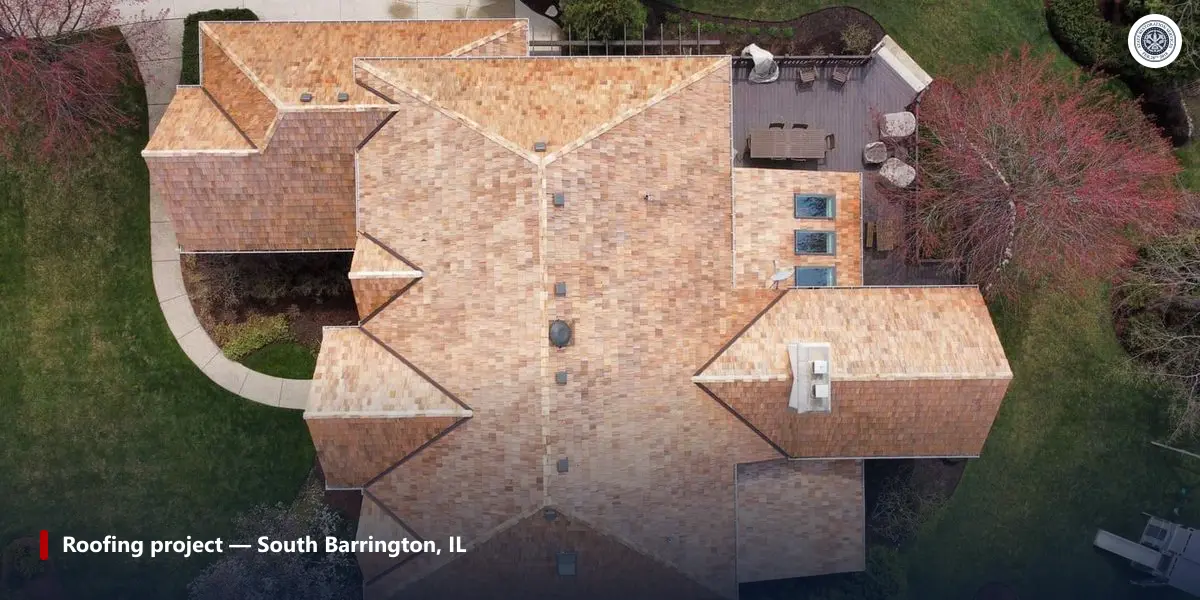
- Starter strip along the eaves, and on many systems along the rakes as well, is ordered in linear feet. On the worked house that is 84 feet of eave plus about 72 feet of rake.
- Hip and ridge cap shingles are linear feet too: 42 feet of ridge on the gable, a good deal more once hips are added.
- Flashing at walls, chimneys and skylights is counted by the piece or by the foot.
- Underlayment is sold in rolls rated by how many squares they cover, so it follows the square count, but it is its own line.
So a quote that lists only squares and bundles is missing pieces of the job. You'll find what a complete scope should hold in what's included in a roof replacement, and how the lines read on paper in how to read a roofing estimate.
Squares on an insurance estimate
An insurance estimate for hail or wind damage prices the roof per square too, usually written as SQ next to each roofing line. Every line priced that way rises and falls with the same square count, so a measurement that comes up a square or two short, or a pitch entered lower than the roof really is, shrinks the whole roof section of the estimate.
What we do on a storm job: we measure every face and its pitch, photograph the damage, and write a code-compliant estimate with the squares, the waste and the linear items shown separately. If your carrier's estimate shows a different count, put the two side by side and you'll see where it differs.
The carrier decides what it covers and pays. If you want someone to represent you on the claim itself, our partner, the licensed Illinois public adjuster State Adjusting Services, can do that. Steep and two-story roofs carry their own per-square lines, explained in steep and high roof charges on an estimate.
Five numbers to ask any roofer for
A roofer who measured your roof has these numbers already. Asking for them costs nothing and lets you compare two quotes line for line instead of total against total.
- The squares on the roof, before waste.
- The pitch of each face, because a house can have a 6/12 main roof and a 4/12 porch.
- The waste percentage, and why that figure for your roof.
- The squares ordered, and the bundle count it gives for the shingle you picked.
- The measurement itself: an aerial report or a hand-measured sketch with each face on it.
If you're also trying to understand the total, our roof replacement cost guide for the Chicago suburbs shows what moves the price, and our residential roofing page lists the GAF, Owens Corning and IKO systems we install.
Questions we get about squares
How many squares is a 2,000 square foot house?
It depends on the roof outline and the pitch, not on the floor area. A two-story house of 2,000 square feet sits on about 1,000 square feet of ground, so its roof can be a dozen squares or so, while a 2,000 square foot ranch can need well over 20. Measure the outline with the overhangs and use the pitch table above.
Is a square of shingles always three bundles?
No. Three is common for standard architectural shingles such as GAF Timberline HDZ. Heavier designer shingles often take more bundles per square. The wrapper and the manufacturer's sheet print the exact coverage for each product.
Does a square include the underlayment and the ridge cap?
No. A square counts roof area. Underlayment, starter strip, ridge cap and flashing are separate lines, and the caps and the starter are counted in linear feet.
Can I measure squares from the ground?
Roughly. Measure the house outline, add the overhangs, multiply by the pitch factor and divide by 100. For a quote you need every face measured, which an aerial report or a roofer on the roof gives you. Please don't walk the roof yourself to get it.
Want the real numbers for your roof? Book a free inspection or call (866) 992-2982, Monday through Friday, 7:00 AM to 7:00 PM, and Saturday and Sunday, 9:00 AM to 5:00 PM. We'll give you the squares, the pitch of each face and the waste we'd use, in writing, across the north and northwest Chicago suburbs.