
 Volodymyr Lukaniuk
Quick answer: Four nails per shingle is the code minimum and the everyday standard. Six are required on slopes over 21:12, in a manufacturer's high-wind application, and for certain wind warranty tiers. Where the nail lands matters more than how many there are — a nail driven an inch too high leaves the bottom half of the shingle held on by adhesive alone.
How many nails per shingle has three answers, not one: the number in the building code, the number in the manufacturer's installation instructions, and the number the wind coverage you were sold assumes. They do not always match. And in Illinois, the one you would assume carries the most weight — the building code — may not apply to a re-roof at all.
Fasteners are the part of a roof you pay for and never see, and by the time they matter the shingles are already in the yard. So here is what the rules actually say, what goes wrong on a roof, and the three moments when a homeowner can check the work without ever going up a ladder.
How many nails per shingle does the building code require?
Four. Section R905.2.6 of the 2021 International Residential Code requires that asphalt shingles "have the minimum number of fasteners required by the manufacturer's approved installation instructions, but not less than four fasteners per strip shingle or two fasteners per individual shingle." Read the first half again: the code's real number is whatever the wrapper says.
The code sets a floor of four and then adopts the manufacturer's instructions by reference, which turns the printed instruction sheet inside the bundle into an enforceable document rather than a suggestion. If GAF, Owens Corning or IKO calls for six nails in your situation, four is a code violation even though the code says four.
The Asphalt Roofing Manufacturers Association puts the same rule in plainer words — "for most asphalt shingles, a minimum of four nails is required per full-size strip shingle" — and adds the fastener specification that almost nobody asks about at the estimate stage.
| What the rule says | Why it is there |
|---|---|
| Nails at least 12 gauge (0.105") with a head at least 3/8" across | A thin shank or a small head pulls through the shingle mat instead of holding it |
| Galvanized steel, stainless steel, aluminum or copper | A fastener that corrodes stops holding long before the shingles wear out |
| Long enough to penetrate at least 3/4" into the deck, or all the way through sheathing thinner than 3/4" | Holding power comes from the wood, not the shingle |
| Four per full-size strip shingle, or more if the instructions say so | The code floor; the instructions set the real number |
| Roofing nails only — not staples, not screws | ARMA states the codes require roofing nails; IKO says screws leave gaps that can leak |
Shank type is the other line worth asking about. Ring-shank nails have rings down the shaft that bite into the deck, they cost a little more than smooth shank, and one IKO test found they hold roughly 300 percent better. On an exposed lot with nothing upwind of it, that is the cheapest upgrade on the whole job.
When do you actually need six nails instead of four?
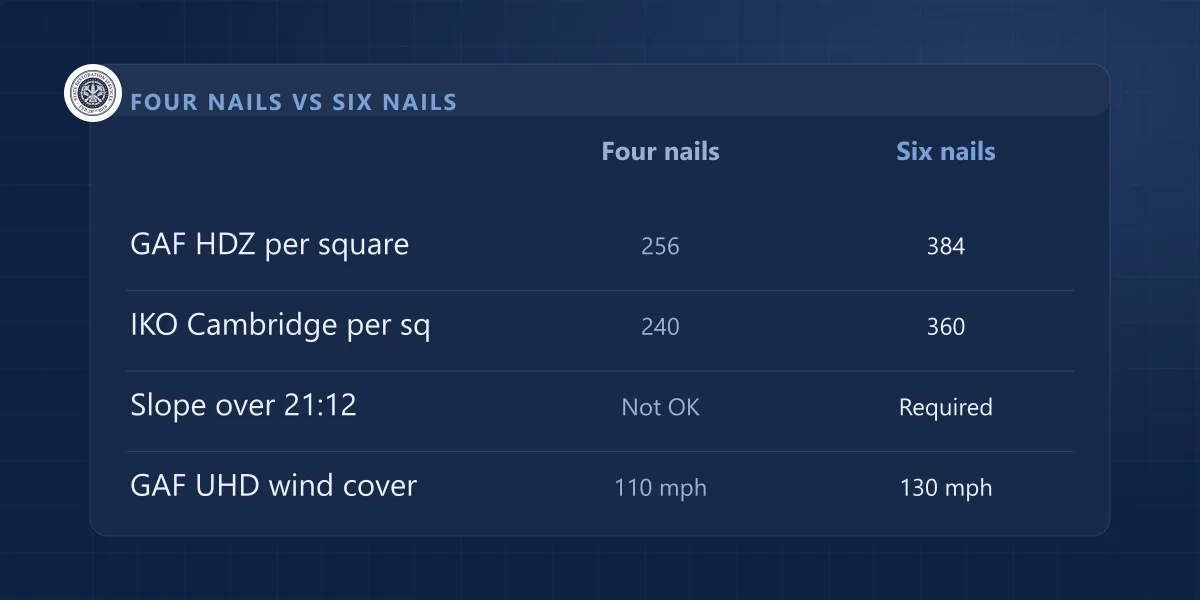
In three situations: on a slope steeper than 21:12, in a manufacturer's high-wind application, and whenever the wind coverage you were sold is written around six. GAF rates Timberline UHD for 110 mph with four nails and 130 mph with six, while Timberline HDZ reaches 130 mph on four. Six is often a warranty decision rather than a code one.
ARMA treats 21:12 — 21 inches of rise per foot, which works out to about 60 degrees, so mansard lower slopes and turret faces rather than an ordinary suburban gable — as the limit for normal application, because that angle "reduce[s] the effectiveness of factory-applied self-sealing adhesives, especially in colder climates and shaded areas." Past it the shingles need more fasteners plus hand-sealing: quarter-sized spots of ASTM D4586 roof cement under every shingle, four spots per laminated shingle near the lower edge, applied as the shingle goes down.
The arithmetic on the count is small enough to say out loud. GAF publishes 64 pieces and 256 nails per square for Timberline HDZ, which is exactly four each. IKO publishes roughly 240 nails per square for Cambridge, and 360 under its High Wind Application — "two more nails a shingle." So going to six adds somewhere around 120 nails per square. Nails run about ten dollars for a five-pound box. Against the $450 to $1,150 per square a Chicago-suburb tear-off costs, the material is a rounding error, and what you are really buying is the extra minutes on the roof.
One more thing to know before you compare bids. GAF's WindProven limited wind warranty carries no maximum wind speed at all, and extra nails alone do not earn it. It requires a LayerLock shingle plus four categories of GAF accessories: starter strips, roof deck protection, ridge cap shingles, and a leak barrier or attic ventilation. That is a whole-system specification, and a bid that promises the warranty without those line items has not priced it.
Why nail placement matters more than nail count
Because an architectural shingle is two bonded layers, and only a nail in the correct band catches both. Placed too high, ARMA warns, "the bottom layer, which will be held in place only by the factory-applied adhesive, may delaminate and slide off the roof." Four nails in the right band hold better than six in the wrong one.
The target band sits below the sealant strip and above the part of the shingle that will still be showing when the course above is laid. ARMA's placement rules are short enough to memorize: never put a nail where it will be visible when the roof is finished, keep every nail head at least an inch from either end of the shingle, keep nails at least two inches away from a cutout or end joint in the course underneath, and never drive into a knot hole, crack or gap in the deck.
How wide is that band? Narrower than most homeowners picture. GAF's StrikeZone nailing area on Timberline HDZ measures 1.81 inches, and GAF calls that the widest in the industry. Owens Corning solves the same problem with a woven fabric strip across the nailing zone on its Duration line and rates those shingles for 130 mph on four nails. IKO prints nail lines on the shingle face.
Three competing manufacturers have each spent research money on making that target easier to hit, which tells you something on its own. GAF's headline number is that in a lab test a roofer placed 999 out of 1,000 nails correctly. It is a marketing figure, and it is also an admission: hitting a band under two inches wide, hundreds of times an hour, on a hot roof, is hard enough to be worth engineering around.
| Placement fault | What it does |
|---|---|
| Nail above the band ("high nail") | Misses the lower lamination; that layer is left on adhesive alone and can delaminate |
| Nail low, in the exposed area | Head sits in the weather; a visible nail head is a leak path from day one |
| Nail within an inch of the shingle end | Too little material around the head; the corner tears loose in wind |
| Nail within two inches of a cutout below | Fastener lands in the gap between shingles instead of solid material |
| Nail into a gap or knot hole in the deck | No wood to grip; the nail is decorative |
What does a badly driven nail look like?
There are three ways to get the driving wrong, and all three come from the same source — a nail gun that has not been set for the shingle. Underdriven leaves the head standing proud. Overdriven cuts the head into or through the mat. Crooked nails do a bit of both. ARMA's rule is that the entire head must bear tightly against the shingle.
The association is blunt about the consequences: failure to use a properly adjusted pneumatic system leads to "sealing failures, raised tabs, distortions, and blow-offs of shingles." It also gives the fix, which is worth quoting to any contractor who shrugs at it. Underdriven nails get tapped down. Overdriven or crooked nails get pulled, the hole gets patched with ASTM D4586 roof cement, and a new nail goes in nearby — or the whole shingle gets replaced.
The setting that was right at 7 a.m. is not automatically right at 2 p.m. Tank pressure cycles, hose length changes as the crew moves across the roof, and warm asphalt takes a nail deeper than cold asphalt does, so the depth gets re-checked through the day rather than dialled in once. In the cold months there is a second issue stacked on top, because the sealant strips need warmth to bond at all — which is part of choosing when to replace a roof in this climate.
Does any of this apply if my Illinois village has no building code?
On a re-roof, possibly not — and this surprises people. The Illinois Capital Development Board's own FAQ states that "the State has not adopted a building code for repairs to existing single family residences." The Illinois Residential Building Code Act applies to new residential construction, and stripping the shingles off a house that already exists is a repair.
What the state tells homeowners to do instead is the useful part. Answering a question about a storm-damaged roof and whether ice-and-water shield and drip edge are required, the CDB says to check with your unit of local government, and that "if neither have adopted a code or ordinance addressing this, it is not required even though it is clearly good practice to do so. You should also verify if the roofing manufacturer requires these as a warranty condition."
That last sentence is the State of Illinois pointing you at the manufacturer's instructions. It is worth finding out what your own town has adopted before you sign anything: CDB keeps an Illinois Municipal Code Directory listing the model code and edition each municipality reported, and the CDB also states that whatever a jurisdiction adopts "must meet the minimum structural requirements of the IRC." Where local enforcement is thin, the documents that actually bind your roofer are your written contract and the warranty conditions — so the nailing spec belongs in the contract, in writing, before anyone climbs a ladder.
It is a fair question to put to every bidder, and the answers separate people quickly. Ask it the same way you would ask about licensing and insurance: which shingle, how many nails per shingle, what shank, what length, and who registers the warranty.
How can a homeowner check the nailing without getting on the roof?
There are three moments. Before you sign, get the nail count, shank type and length written into the contract. During the job, ask the foreman for a phone photo of one nailed course before the next one covers it. After the job, go into the attic on a bright day and look up at the deck.
The attic check works because a correctly sized nail comes through. ARMA says as much: where the underside of the deck is visible, nails of the recommended length "will result in the nail points penetrating through the deck and being exposed to view." On the half-inch plywood or OSB most suburban homes are sheathed with, that is exactly what you should see. Homeowners call us worried about it every year, and it is the roof working as designed.
What the attic can tell you is roughly how many nails went into each shingle. A standard laminated shingle is 39-3/8 inches wide, so four nails puts a point about every foot along a course, and six puts one about every seven or eight inches. Scan along a rafter bay and see which pattern you are looking at.
What the attic cannot tell you is high versus low placement — from below, a nail is a nail. For that you need eyes on the shingle face, which is why the mid-job photo is worth asking for and why a proper roof inspection includes lifting shingles rather than looking from the driveway.
| When | What to check | What a good answer sounds like |
|---|---|---|
| Before signing | Nail count, shank type, length, and the shingle product by name | "Six ring-shank, 1-1/4 inch, HDZ — it's on line 4 of the contract" |
| Day of install | A photo of one nailed course before it gets covered | The foreman takes the photo without being talked into it |
| Week after | Attic: nail points through the deck, spacing along a course | Tidy rows, consistent spacing, no wandering strays |
| After the first real windstorm | Lifted corners or raised tabs, visible from the ground | Nothing lifting; a flat, quiet roof |
What bad nailing costs you later
Two things, and neither shows up for years. The first is blow-off: shingles that let go in a gust well under what the wrapper is rated for, usually along one exposed slope. The second is a warranty argument, because a manufacturer's wind coverage is written around installation to its instructions, which is the whole point of the difference between a manufacturer warranty and a workmanship warranty.
It also shows up in claims. When an adjuster or an engineer lifts shingles on a wind damage claim, nail placement gets recorded, because what is being decided is whether the shingles left because of the storm or because of how they were fastened. If a five-year-old roof loses shingles in a 55 mph gust, expect that question.
Illinois law does not allow a roofing contractor to negotiate an insurance claim, so what we do is document the roof and build a code-compliant estimate; our partner, the licensed public adjuster State Adjusting Services, can represent you on the claim itself. If your roof is losing shingles and you are not sure whether you are looking at a storm or an install, that distinction is worth getting right early — our storm and insurance page walks through it.
Related reading: what's actually included in a full roof replacement and what roof decking replacement really costs, since the deck is what your nails are holding on to.
Frequently asked questions
How many nails per shingle is standard?
Four per full-size strip shingle is the minimum in the International Residential Code and the standard most manufacturers print on the wrapper. Six are used on slopes steeper than 21:12, in a high-wind application, and where a specific wind warranty tier requires them. The manufacturer instructions for your exact shingle are the number that counts.
Can a roofer use staples or screws on asphalt shingles?
No. The Asphalt Roofing Manufacturers Association states that the building codes require roofing nails to fasten asphalt shingles, and IKO says plainly that screws are not an approved fastener because they leave gaps that can leak. Nails must be corrosion-resistant, at least 12 gauge, with a head of at least three-eighths of an inch.
Should I be able to see roofing nail points in my attic?
Usually yes, and it is not a defect. A nail long enough to hold the shingle has to reach at least three quarters of an inch into the deck, or all the way through sheathing thinner than that, so on a typical half-inch plywood or OSB deck the points come through and are visible from below.
Does using six nails instead of four improve my roof warranty?
It can, depending on the shingle. GAF rates Timberline UHD for 110 mph wind coverage with four nails and 130 mph with six, while Timberline HDZ reaches 130 mph on four. Ask which product you are being quoted and what nailing pattern its wind coverage assumes, then have that written on the contract.
Thinking about your roof? Book a free inspection or call (866) 992-2982 — we are a family-owned residential roofing company in Lincolnshire serving the north and northwest Chicago suburbs. Office hours are Monday to Friday, 7:00 AM to 7:00 PM, and Saturday and Sunday, 9:00 AM to 5:00 PM.