
 Volodymyr Lukaniuk
Quick answer: The best time of year to replace a roof in the Chicago suburbs is late spring through early fall — roughly May to mid-October — when the deck stays above 40°F and asphalt shingles seal themselves within days. Winter roofs go on here every year and hold up fine, but only with hand-sealing and a short list of extra rules.
Most homeowners treat the best time of year to replace a roof as a scheduling problem. It is decided by temperature, and specifically by the temperature at the surface of the shingle on the day it goes down. Asphalt shingles bond to each other with a strip of thermally activated sealant that only works within a temperature range, and every other seasonal argument about roofing traces back to that strip. This guide explains it, then puts the National Weather Service’s own Chicago numbers against it so you can see where the window opens and closes on your street.
When is the best time of year to replace a roof in Illinois?
Late spring through early fall — roughly May through mid-October in the north and northwest suburbs. In that stretch the roof deck is warm enough for shingles to seal on their own, crews get full working days, and the new roof is sealed and tested by weather before the first hard freeze. September is the single best month we get.
The reason September wins is that it stacks three things at once: daytime temperatures still well above the sealing threshold, less of the rain that eats spring start dates, and enough runway before winter that the roof has bonded completely by the time snow loads it. That is also why September books out first. If you are reading this in late summer and thinking about a full roof replacement before winter, the thing in short supply is calendar, so start the conversation earlier than feels necessary.
Why 40°F is the number that decides your install
Nails hold a shingle to the deck. The sealant strip holds shingles to each other, and that is what resists wind uplift. The Asphalt Roofing Manufacturers Association describes it as a “thermally activated asphalt sealant, which bonds the shingles together after they are applied to the roof,” with sealing time varying by slope, orientation and sun exposure. Around 40°F that bonding stops happening on its own.
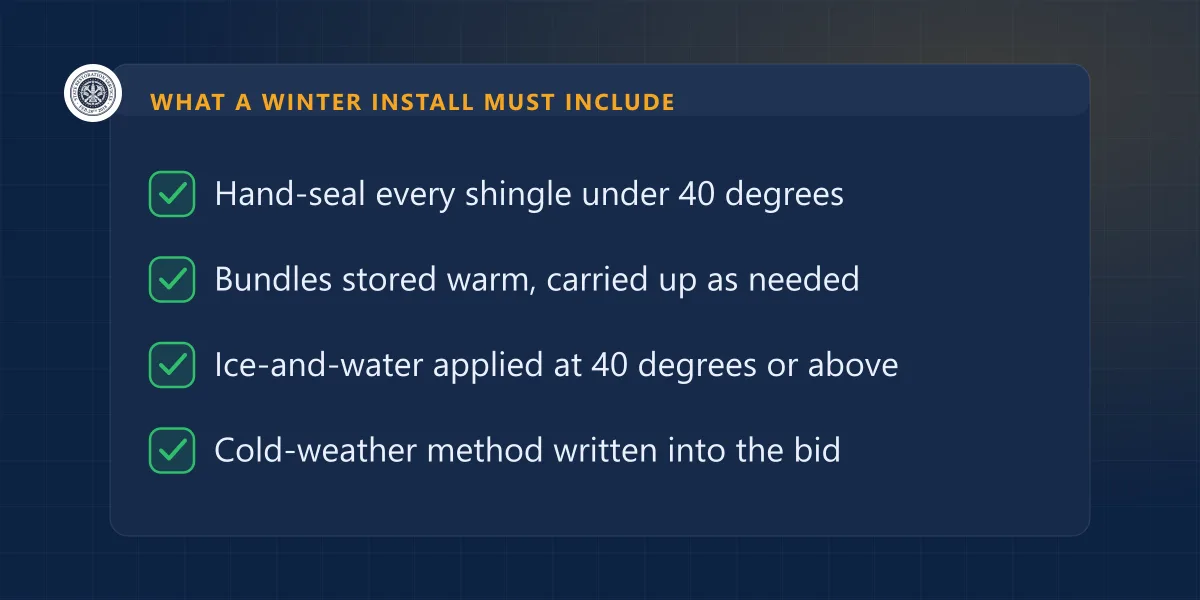
So manufacturers write a separate set of instructions for cold weather. Owens Corning’s cold-weather shingle installation bulletin applies at or below 40°F and calls for hand-sealing laminate shingles with four spots of ASTM D4586 asphalt roof cement about an inch back from the leading edge, two spots under each tab on three-tab shingles, and nails placed in the common bond area. IKO’s cold-weather guidance asks for six nails instead of four and three quarter-sized spots of cement per shingle, and says to store bundles “preferably in temperatures higher than 10 degrees Celsius or 50 degrees Fahrenheit.”
Notice that those two sets of instructions do not match each other. Four spots or three, four nails or six — the pattern is dictated by whichever shingle is going on your house, and following the wrong one can put the wind coverage in question. So the useful question to ask a roofer quoting a November job is not “do you hand-seal?” but “what does the manufacturer of the shingle you are putting on my house require in cold weather?” Anyone who regularly installs GAF, Owens Corning and IKO systems can answer that in one sentence.
| On the roof | Above about 40°F | At or below 40°F |
|---|---|---|
| Shingle sealant | Strip activates in the sun and bonds on its own | Strip stays inert — every shingle hand-sealed with roof cement to the manufacturer’s pattern |
| Handling | Shingles flex and cut clean | ARMA warns shingles “may crack, or in severe cases, break apart” if bent, thrown or dropped |
| Storage | Anywhere dry | Kept warm indoors and carried up as they are used, rather than left stacked cold on the driveway |
| Ice-and-water shield | Bonds to a clean, dry deck | Product minimums apply — CertainTeed’s Vycor HT calls for air, deck and membrane at 40°F or higher |
| Nailing | Standard four-nail pattern | Owens Corning: nails in the common bond area. IKO: six nails per shingle |
When does the Chicago-area roofing window actually close?
It closes later than most homeowners expect, and then it closes hard. On the National Weather Service 1991–2020 normals for Chicago O’Hare, normal daily highs stay above the 40°F sealing threshold from March through November. December is where it breaks: the normal high for the whole month is 36.6°F, already below the point at which a shingle seals itself.
That figure is worth reading twice. Through a normal Chicago December, January and February, an average day never reaches sealing temperature at all, so a roof installed in those months waits for the first warm stretch of spring before its sealant does anything. Until that happens, the hand-applied cement is what holds the shingles to each other, which is why the cold-weather procedure carries so much weight in an Illinois winter.
| Month | Normal high / low at O’Hare | What it means for a shingle roof |
|---|---|---|
| March | 47.0°F / 31.0°F | Warm afternoons only; nights still below freezing. Marginal. |
| April | 59.0°F / 40.3°F | Season opens. Rain, not cold, is what moves your start date. |
| May–August | 70.5–84.5°F / 50.6–66.4°F | Full sealing weather. Shingles bond within days of install. |
| September | 75.5°F / 57.1°F | The best month of the year here. Warm, drier, sealed before winter. |
| October | 62.7°F / 45.4°F | Still good. Normal first freeze at O’Hare is October 19. |
| November | 48.4°F / 34.1°F | Afternoons work, mornings often do not. Frost has to burn off first. |
| December | 36.6°F / 24.4°F | Normal high sits below the sealing threshold all month. |
| January–February | 31.6–35.7°F / 18.8–21.8°F | Cold-weather procedures apply to the entire job. |
Source: NWS Chicago 1991–2020 monthly normals and the NWS normal first-freeze dates. Your roof is not the airport, either: a shaded north slope runs colder than a south slope on the same house, so one calendar day can be a sealing day on one side and not the other.
Can you replace a roof in winter in the Chicago suburbs?
Yes. Roofs go on in January here every year, and a correctly built winter roof performs exactly like a summer one. What changes is the method, the pace and the amount of the day that is actually usable. Frost has to come off the deck before underlayment goes down, snow has to be cleared rather than roofed over, and the sealing work is done by hand instead of by the sun.
What you actually give up in winter is predictability. A December job can lose a day to a squall with no warning, so a two-day roof turns into a four-day roof spread across a week and your house sits under underlayment in between. That is normal and it is watertight, but it is worth hearing before you sign rather than on day three.
What to have in writing before a cold-weather install starts:
- The shingle manufacturer and product line by name — the cold-weather instructions are specific to it.
- The hand-sealing method: cement type (ASTM D4586), number of spots per shingle, and the nail count and placement.
- Where materials are stored overnight, and that bundles come up as they are used.
- How frost, snow and ice come off the deck before anything is fastened to it.
- What happens to the schedule on a weather day, and who calls whom.
- The same line items you would expect in any season — a per-sheet decking price is worth even more in winter, when rot is harder to spot from the ground.
If you want the rest of that list, our guide on how to read a roofing estimate walks through every line a complete bid should carry.
So what is the catch with spring and summer?
Nothing is wrong with them — they are simply not free of trade-offs either. Spring gives you sealing temperatures and rain in the same week. Summer gives you the longest dry stretches of the year and the busiest schedule, because hail season and roofing season are the same season in northern Illinois.
| Season | What is genuinely better | What it costs you |
|---|---|---|
| Spring (April–May) | Warm enough to seal; winter damage is fresh and easy to document | Rain days push start dates around, sometimes repeatedly |
| Summer (June–August) | Longest dry runs; shingles seal fastest | Hail season is the same season, so storm work fills the calendar first |
| Early fall (September–mid-October) | Mild, drier, and sealed well before winter | Everyone wants it, so it books out first |
| Late fall and winter | Availability, and no waiting behind a storm queue | Hand-sealing, weather days, snow clearing, shorter usable days |
Does the time of year change what a roof costs?
Less than people hope. Shingles are priced off manufacturer price sheets, and tear-off, disposal, permits and labor do not fall because it is February. A standard architectural asphalt replacement in the Chicago suburbs runs roughly $9,000–$18,000 installed whatever month you sign, and the things that genuinely move that number are pitch, layers, decking and access.
What the season does change is your position in the queue and how much weather risk sits inside the start date. Some contractors do offer off-season incentives to keep crews working; it is a fair thing to ask about, and a fair thing to be told no about. What should never happen is a price that expires this afternoon. If money rather than weather is what is holding the project, look at the financing options before you look at the calendar — the in-house plan is 0% interest for up to 24 months with a small one-time origination fee and a soft-pull pre-qualification. Our full breakdown of what a new roof really costs here covers the rest.
When you should not wait for better weather
The calendar stops being the deciding factor in four situations: water actively coming into the house, storm damage with a live insurance claim, an exposed or missing section of roof heading into winter, and a roof an inspection has already condemned. In each of those, the damage keeps growing while you wait for spring, and the growth is what costs money.
The freeze-thaw cycle is what makes an Illinois winter unforgiving to a compromised roof. Water gets into a gap, freezes, expands, thaws and does it again — roughly 40–50 times a season around here. A small opening in October is a larger one by March, and the ceiling below it usually tells the story first. If you already have an active leak, we respond fast during business hours, Monday to Saturday, including temporary tarping to stop the water until a full repair can be scheduled.
If a storm caused the damage, the clock is your insurer’s, not the weather’s: your policy carries a notice requirement and it does not pause for winter. We document the damage and build a code-compliant estimate, and because Illinois law does not allow a roofing contractor to negotiate a claim, our affiliated licensed public adjuster, State Adjusting Services, can represent you with the carrier. The storm and insurance page explains how that split works, and our step-by-step on filing a storm-damage claim in Illinois covers the sequence in detail. We work across Lake and Cook County, from Mundelein and Vernon Hills down through Arlington Heights and Norridge.
Related reading: why ice dams form on Illinois roofs and the fix that actually works and what is actually included in a full roof replacement.
Frequently asked questions
Is it bad to replace a roof in the winter?
No, as long as the crew follows the manufacturer’s cold-weather instructions. The real risk is a roof installed in January exactly the way it would be installed in July: no hand-sealing, cold bundles cracking on the ground, and ice-and-water membrane pressed onto a deck too cold to bond to it.
What is the cheapest month to get a new roof?
There is no cheap month. Shingles are priced from manufacturer price sheets, and tear-off, disposal and permit fees do not fall in January. What changes with the season is availability and lead time, not the cost of the materials on your roof.
How cold is too cold to install shingles?
Around 40°F is where the shingle sealant stops activating on its own, which is why manufacturers set their cold-weather procedures at that point. Below it the job is still possible, but every shingle has to be hand-sealed with roofing cement and the materials have to be kept warm until they go up.
Will a roof installed in cold weather still be under warranty?
Yes, if the cold-weather instructions for that specific shingle were followed. Manufacturer warranties are written against the installation instructions, so hand-sealing pattern, nail placement and material handling are what keep the wind coverage intact. Ask for the cold-weather method in writing before the job starts. Our guide to roof warranties explains which coverage is whose.
Not sure whether your roof makes it through another winter? Book a free inspection or call (866) 992-2982 — most inspections take under an hour, and you keep the photos and the estimate whether or not you decide to move forward. We serve the north and northwest Chicago suburbs across Lake and Cook County.