
 Volodymyr Lukaniuk
Quick answer: A roof carries two separate warranties, not one. The manufacturer's warranty (GAF, Owens Corning, IKO) covers defective shingles — never the installation. Your roofer's own workmanship warranty covers installation mistakes — never a bad batch of material. Enhanced manufacturer tiers require a certified installer and can add labor coverage, but every tier can be voided by ordinary things: unlicensed repairs, blocked ventilation, or simply never registering it. Neither warranty covers storm damage — that's what your insurance policy is for.
Ask ten homeowners what their roof warranty covers and eight will tell you "everything, it's lifetime." We wish it worked that way. A roof warranty is actually two separate promises, made by two separate companies, and almost nobody explains the difference before the crew packs up the trailer. We've had a homeowner call us in a panic about a ceiling stain, certain their "50-year warranty" would cover it — only to learn the shingles themselves were fine. The leak was a flashing failure around the chimney, which was never the shingle manufacturer's problem to begin with. Here's how roof warranties actually work, in plain English, and the ordinary things that quietly cancel them.
What does a "roof warranty" actually cover?
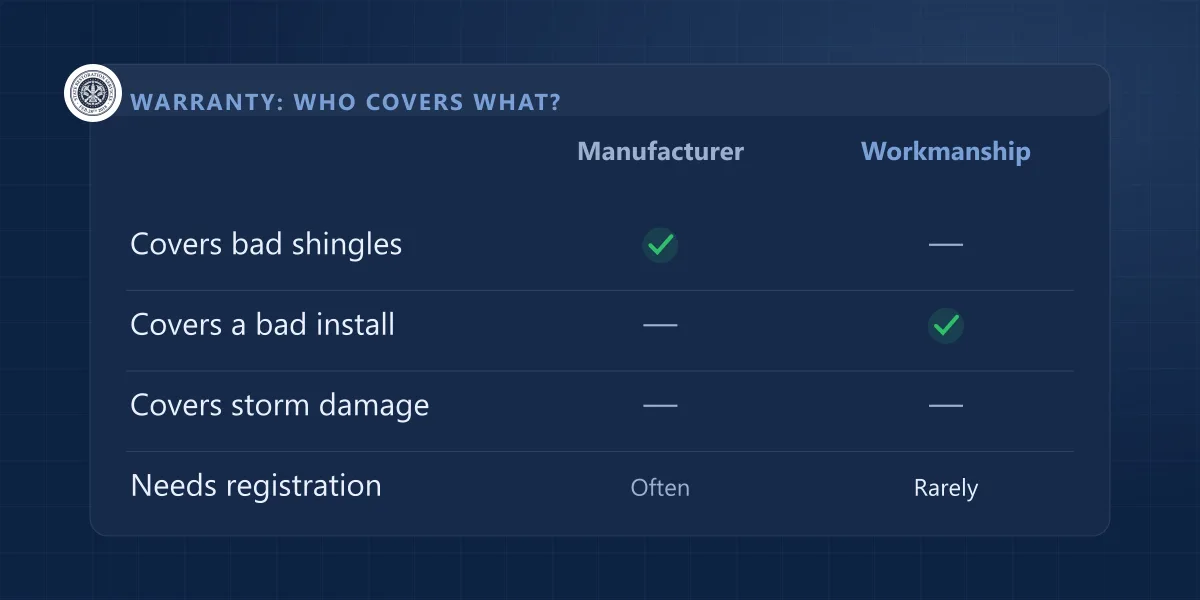
A roof warranty is really two warranties stacked on top of each other. The manufacturer — GAF, Owens Corning, or IKO — warranties the shingles themselves against a manufacturing defect. Your roofer separately warranties their own labor: the tear-off, flashing, ventilation, and nailing pattern. Mix the two up and you'll call the wrong company when something goes wrong.
Think of it like a new car. The manufacturer warranties the engine against a factory defect. The shop that installed your aftermarket stereo warranties its own wiring job. If the stereo's static is bad because of a wiring mistake, the manufacturer doesn't want to hear about it — and if there's a factory engine defect, the stereo shop can't fix that either. A roof works the same way. Most of the leaks we get called out for after year one aren't a shingle defect at all — they're a flashing detail, a nail pattern, or a vent boot, which is workmanship territory, not manufacturer territory.
The manufacturer's warranty: what "lifetime" really means
Every major shingle brand calls its base coverage some version of a "limited lifetime warranty." In practice that means full replacement value only for a set number of years — commonly the first decade — after which the payout shrinks (prorates) based on the shingle's age. The enhanced tiers that fix that require your roofer to hold the manufacturer's own certification.
GAF's standard Shingle & Accessory Limited Warranty covers material defects and doesn't require you to register anything — just keep your invoice. Above that sits the GAF Roofing System Limited Warranty, which needs the shingle plus qualifying GAF accessories (starter strip, ridge cap, underlayment) installed together. Above that, GAF's Certified and Master Elite contractor tiers unlock enhanced pledges that add workmanship coverage on top of the material coverage — the Golden Pledge, GAF's top tier, extends labor coverage out to 25 years, but only through a Master Elite contractor. Owens Corning runs a similar ladder: its standard warranty needs to be registered online within a set window after installation, and its Preferred and Platinum Protection tiers — sold only through Owens Corning's own certified network — add a workmanship warranty most standard installs never get. IKO's structure follows the same shape under different names. The pattern across all three brands is the same: the base material warranty is automatic, and the good stuff — labor coverage, a longer non-prorated period — is locked behind using a contractor the manufacturer has actually certified. Which is also why it's worth asking your roofer directly which tier they're enrolled in, not just which brand of shingle they're selling you.
| What you get | Standard material warranty | Enhanced tier |
|---|---|---|
| Covers a defective shingle | Yes | Yes |
| Covers your roofer's install mistakes | No | Often, for a set number of years |
| Requires a certified/preferred installer | No | Yes |
| Requires registration | Varies by brand | Usually, within a set window |
The workmanship warranty: your roofer's own promise
The workmanship warranty has nothing to do with the shingle brand — it's your roofer personally standing behind their own labor: flashing, nailing pattern, ventilation, and tear-off quality. It only means something if the company is still around to honor it, so ask how long they've actually been in business, not just how many years the paperwork claims.
We back every roof our own crews install with a written workmanship warranty on the installation, which is a separate document from whatever GAF, Owens Corning, or IKO paperwork comes with the shingles — see how the two fit together in our process. We don't sub the tear-off out to a day-labor crew we've never met, because the workmanship warranty is only as good as the people who did the work. Whoever you hire, get the exact term in writing before you sign — "lifetime workmanship" from a company that's been open for two years is a promise on paper, not in practice.
The everyday things that void a roof warranty
Most voided roof warranties aren't caused by a storm or a bad shingle — they're caused by ordinary maintenance done the wrong way. The most common: letting anyone other than a licensed roofer patch, vent, or walk your roof, blocking the attic ventilation the warranty requires, layering new shingles over old instead of a proper tear-off, and never registering the warranty when the brand requires it.
- Any repair, patch, or new penetration by someone other than a licensed roofer — a handyman adding a satellite mount or a solar contractor drilling mounting brackets without notifying you can void coverage on the whole section, even though your original roofer did nothing wrong.
- Blocked or unbalanced attic ventilation — several manufacturer warranties are explicitly tied to code-compliant intake and exhaust; see our breakdown of why attic ventilation matters for how that plays out on real roofs.
- Never registering the warranty — a brand like Owens Corning has a standard-warranty registration step; skip the window and you can lose the extended terms even though the shingles were installed correctly.
- Installing over an existing layer when the manufacturer's terms require bare decking for full coverage.
- Walking on the roof for something unrelated — holiday lights, a DIY gutter cleaning, a dish install — and cracking or lifting shingles in the process.
- Selling the house without transferring the warranty — most material warranties transfer once, within a limited window; miss the paperwork and the new owner starts from zero.
Does a roof warranty cover storm or hail damage?
No. Neither the manufacturer's warranty nor your roofer's workmanship warranty covers hail, wind, or storm damage — that's an insurance claim, not a warranty claim. A warranty only covers a defect or a mistake; a storm is neither.
That distinction matters because it changes who you call first. If a hailstorm dents your shingles, that's a conversation with your homeowners insurance, not the shingle manufacturer. We walk homeowners through filing a storm-damage roof claim in Illinois regularly, and under Illinois law a roofing contractor can't negotiate that claim on your behalf — our affiliated licensed public adjuster, State Adjusting Services, is who actually represents you with the carrier while we document the damage and build the estimate.
How to actually keep your roof warranty alive
Keep your invoice and contract, register the warranty within the window if your brand requires it, and never let anyone but a licensed roofer touch the roof again — including for something as small as a new vent or a satellite dish. Those three habits prevent nearly every warranty denial we see.
Beyond that: if you add gutters, siding, or windows later through a different company, ask them in writing to confirm their work won't disturb anything the roof warranty depends on (drip edge, flashing, soffit ventilation). And if an enhanced tier requires periodic maintenance, keep a simple record — a photo and a date is enough. Ready for a full roof replacement done with the paperwork handled correctly from day one? That's exactly what we walk through on a free inspection.
Frequently asked questions
Does a roof warranty cover storm or hail damage?
No. A warranty covers a manufacturing defect or an installation mistake. Storm and hail damage is an insurance matter, handled through your homeowners policy, not through the shingle manufacturer or your roofer's workmanship warranty.
What happens to my roof warranty if I sell my house?
Many manufacturer material warranties transfer once to a new owner, within a limited window after the sale. Workmanship warranties are tied to the original contract and don't always transfer automatically, so ask your roofer directly and get any transfer confirmed in writing before closing.
Does having another company do a repair void my warranty?
It can. An unlicensed patch, a non-approved material, or a repair the original manufacturer never signed off on is one of the most common reasons a warranty claim gets denied. Call your original installer first, even for something that looks minor.
Do I need to register my roof warranty?
It depends on the brand and the tier. Some standard material warranties don't require registration, but Owens Corning's standard warranty includes a registration step, and every enhanced, certified-installer tier requires registration within a set window. Ask your roofer to confirm it was actually done — don't assume it happens automatically.
Not sure what warranty your current roof actually has? Book a free inspection and we'll walk you through exactly what's covered, or if you're due for a full roof replacement, we'll make sure the paperwork protects you from the day the crew leaves.