
 Volodymyr Lukaniuk
Quick answer: After a storm, document the damage, call your insurer within a few days (not weeks), and get an independent roof inspection before the adjuster shows up — don't rely on the insurance company's estimate alone. A licensed roofing contractor can document damage and build the estimate, but under Illinois law we can't negotiate your claim for you; that's the job of a licensed public adjuster like our affiliate, State Adjusting Services.
Filing a storm-damage roof claim in Illinois isn't complicated, but the order you do things in matters more than most homeowners realize. We've walked hundreds of Lake and Cook County homeowners through this after wind and hail events, and the claims that go smoothly almost always have the same pattern: fast documentation, an independent inspection before the adjuster's visit, and someone on the homeowner's side who understands how the estimate gets built. The ones that go sideways usually skipped one of those three things.
How soon do you actually need to file after a storm?
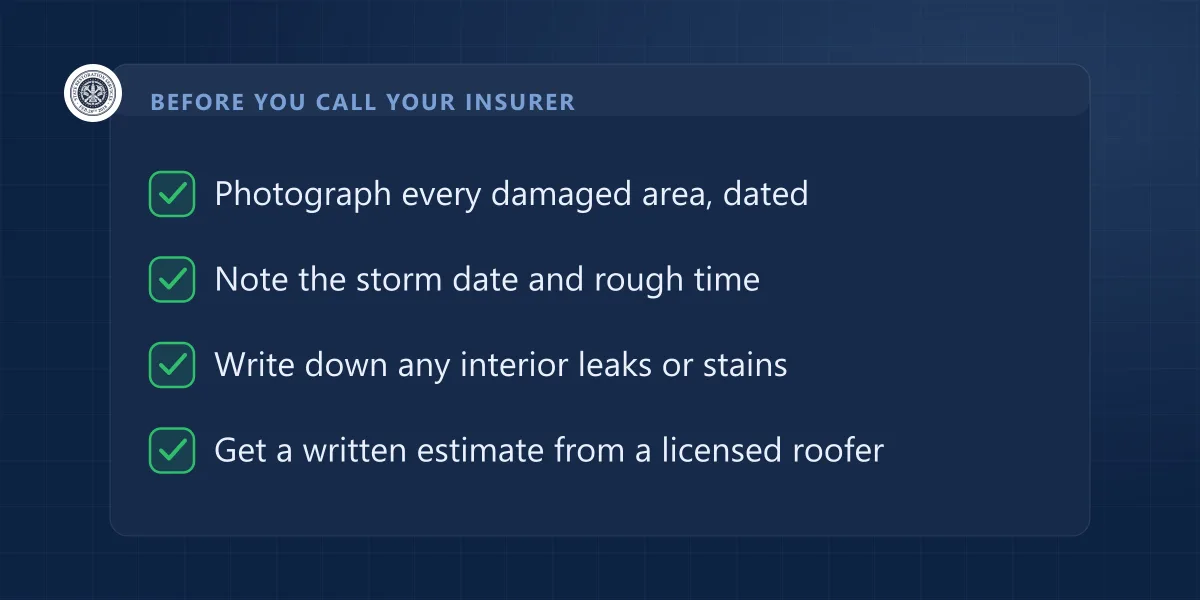
Call your insurer within a few days of the storm, not weeks. Most homeowner policies require "prompt notice," and while that's rarely a hard day-count, waiting too long gives the insurer room to question whether the damage happened in the storm you're claiming or sometime after. Document the date immediately even if you file the actual claim a day or two later.
We get it — right after a storm, you're dealing with fences down, trees on the driveway, maybe water in the basement. The roof isn't always the first thing on your mind, especially if there's no obvious leak yet. That's exactly how claims get weaker than they should be: three weeks pass, someone finally looks at the roof from the ground, and by the time the adjuster shows up, nobody can say with confidence which storm caused which damage. Note the storm date the day it happens, even if you don't call the insurance company until the next business morning. Your own phone's photo timestamps do a lot of the proving for you — which is more than we can say for the door-knocker who shows up the next morning with a clipboard and a contract ready to sign before you've even called your insurer. If someone's rushing you to sign anything before you've filed the claim yourself, slow down.
The filing process, step by step
Every claim moves through roughly the same sequence. Here's the order we walk homeowners through, and why skipping a step tends to cost you money later.
| Step | What happens | Why it matters |
|---|---|---|
| 1. Report the claim | Call your insurer, get a claim number and adjuster contact | Starts the clock; without a claim number nothing else moves |
| 2. Document it yourself | Dated photos of the roof, gutters, siding, and any interior leaks | Your own record — the adjuster's photos aren't the only evidence that exists |
| 3. Get an independent roof inspection | A licensed local roofer walks the roof before or alongside the adjuster | Adjusters often work from the ground or a drone; a contractor on the roof catches things a photo from 40 feet up misses |
| 4. Adjuster's on-site inspection | The insurance company's adjuster measures and scopes the damage | This produces their first estimate — it's a starting point, not the final word |
| 5. Compare estimates | Your contractor's scope vs. the adjuster's scope, line by line | This is where most of the real money in a claim gets found or lost |
| 6. Reconcile and approve scope | Supplement requests get submitted for anything the adjuster missed | Insurers expect supplements — asking isn't adversarial, it's normal |
| 7. Repairs and final payment | Work is completed, final inspection releases the depreciation holdback | The last check (recoverable depreciation) only comes after the job is done |
What is the adjuster actually looking for, and where do estimates go sideways?
Insurance adjusters are looking to confirm the damage exists, tie it to a covered event, and scope a repair — but their estimate is a starting offer, not gospel. The most common gaps: not counting every damaged slope, skipping code-required items like ice-and-water shield or proper ventilation, and leaving out collateral damage to gutters, screens, or siding that got hit by the same hail.
Adjusters aren't villains — most are doing a genuinely hard job, covering a large territory, working from a standardized software estimate (usually Xactimate) that prices by line item. The problem is the software only prices what someone tells it to price. If the scope entered is short, the number comes out short, no matter how fair the underlying pricing is. We've seen adjuster estimates miss an entire back slope because it wasn't visible from the front yard, skip the ice-and-water shield replacement Illinois building code requires along the eaves, and leave storm-dented gutters off the estimate entirely because the adjuster was focused on the shingles. None of that is fraud on anyone's part — it's what happens when the scope gets built fast. A second set of eyes, specifically a roofer who does this for a living in this climate, is what catches it.
This is also where RCV vs. ACV comes in, and it trips up almost every first-time claimant. RCV (replacement cost value) is what it actually costs to replace your roof today. ACV (actual cash value) is RCV minus depreciation for the roof's age and condition. Most policies pay ACV first, hold back the depreciation, and release the rest — the "recoverable depreciation" — once the work is done and you show proof of completion. If your policy is RCV-based (most are for roofs under a certain age), you're not losing that money forever, but you do have to finish the job and submit the paperwork to get it. Skip that step and that check just sits with the insurance company.
Repair or replace: does that decision change how you file?
The filing process is the same either way — document, inspect, compare estimates — but the scope conversation differs. A repair claim usually resolves faster since there's less to reconcile. A full replacement claim takes longer because there's more to itemize (tear-off, decking, underlayment, ventilation, flashing) and more room for the adjuster's first estimate to miss something. We've written a full breakdown of how we decide repair vs. replace if you want the mechanics of that call.
Where a public adjuster fits in — and why we can't negotiate your claim ourselves
A licensed public adjuster represents you in negotiations with the insurance company; a roofing contractor can document damage and build an estimate but, under Illinois law, cannot negotiate your claim on your behalf. That split exists to keep contractors from having a financial stake in claim outcomes — which is a reasonable rule, but it does mean you need someone else in your corner if a claim gets contested.
Here's the honest version of when you need that extra layer and when you probably don't:
| Situation | DIY / contractor documentation usually enough | Public adjuster worth it |
|---|---|---|
| Claim was approved close to your contractor's estimate | Yes | No |
| Adjuster's scope is missing items your roofer flagged | Sometimes (a supplement request may fix it) | Yes, if the insurer pushes back on the supplement |
| Claim was partially or fully denied | No | Yes |
| Damage involves multiple trades (roof, siding, gutters, interior) | No | Yes |
| You just want a second opinion the estimate is fair | Yes | Not necessary |
We work alongside State Adjusting Services, a licensed public adjuster, precisely for the situations in that right-hand column. We document the roof, build the honest scope, and hand you to someone who's licensed to argue that scope with your insurer when it needs arguing. That's not us passing the buck — it's the legal line Illinois draws, and honestly, it's a better system than one company doing both jobs.
Common reasons a storm claim gets denied or lowballed
The recurring culprits: damage that reads as cosmetic rather than functional, the "wear and tear" excuse on an aging roof, thin documentation, and estimates built from a lowball or unlicensed contractor bid that undersells the real scope.
- "Cosmetic, not functional" damage. Some hail marks genuinely don't break the shingle's waterproofing — but plenty of legitimate functional damage gets waved off with this line anyway. This is exactly why a trained eye on the roof, not just a drone photo, matters.
- The age card. If your roof is 18 years old, expect the insurer to point at wear and tear before they point at hail. A dated, storm-specific claim (documented the week of the event) is much harder to wave off than one filed months later on a roof that's clearly near end of life anyway.
- Thin documentation. No photos, no date, no independent inspection report — just a homeowner's word against a standardized estimate. This is the single most preventable reason claims come in low.
- A lowball estimate becomes the ceiling. If the first estimate submitted (from any contractor) undersells the scope, the insurer's number tends to anchor to it. This is why we build the real scope from day one rather than a number designed to win the job cheap and pad it later.
Frequently asked questions
Do I have to use the contractor my insurance company recommends?
No. In Illinois, you have the right to choose your own licensed contractor for a storm-damage repair or replacement. Insurance company "preferred vendor" lists exist for convenience, not obligation — the money follows the approved scope, not a specific contractor's name.
What's the real difference between RCV and ACV on my claim?
RCV is today's full replacement cost; ACV is RCV minus depreciation for your roof's age. Most policies pay ACV up front and release the depreciation ("recoverable depreciation") after the repair is finished and you submit proof — so finishing the job and doing the paperwork is what unlocks the rest of the money.
How long does a storm claim take from filing to finished roof?
A straightforward, undisputed claim can go from report to completed repair in a few weeks. A contested or supplemented claim, or one that needs a public adjuster, commonly runs six to ten weeks once you count negotiation time, material lead time, and weather delays.
Can State Restoration Services negotiate my insurance claim for me?
No — Illinois law doesn't allow a roofing contractor to negotiate your claim. We document the damage and build the honest estimate. For negotiation, we work alongside our partner, the licensed public adjuster State Adjusting Services, who is legally authorized to represent you with the insurer.
Filing a claim after a storm and not sure where you stand? Schedule a free roof inspection and we'll document the damage and walk you through the next step, whether that's a straightforward insurance claim or bringing in a public adjuster. We serve Arlington Heights, Buffalo Grove, Northbrook, and the rest of the north and northwest Chicago suburbs, and our residential roofing and process pages cover what happens after the claim is approved. Related reading: what real hail damage looks like and how to read a roofing estimate.
Want a licensed professional on your side of the claim? Volodymyr Lukaniuk of our team is a licensed public adjuster (IL & IN) and HAAG-certified inspector who represents property owners directly on storm-damage claims — from documentation to the final settlement. Learn how he works at Volodya Adjuster.