
 Volodymyr Lukaniuk
Quick answer: Curling shingles on a roof that went on last fall are usually cold curl, which ARMA says fixes itself once the sun warms the roof. On an older roof, cupped edges or clawed tabs come from the asphalt shrinking with age. That is wear, so it points to repair or replacement, not to an insurance claim.
Curling shingles can be seen from the driveway, because a lifted edge throws a shadow on an otherwise flat slope. The same curl can mean three different things. On a new roof in January it is usually nothing. On a roof that is twenty years old it usually means the shingles are near the end of their life. In between, it can point to a hot attic, a sealing problem, or something underneath the shingle that is not curling at all.
We are a family-owned roofing company in Lincolnshire, working across the north and northwest Chicago suburbs since 2018. Below, we sort the three kinds of curl apart, separate them from look-alikes, and explain what a repair, a warranty and an insurance policy can each do about them. Where we quote, the source is the Asphalt Roofing Manufacturers Association (ARMA), a hail-damage paper by Haag Engineering, or the GAF shingle warranty.
Which way are your shingles curling?
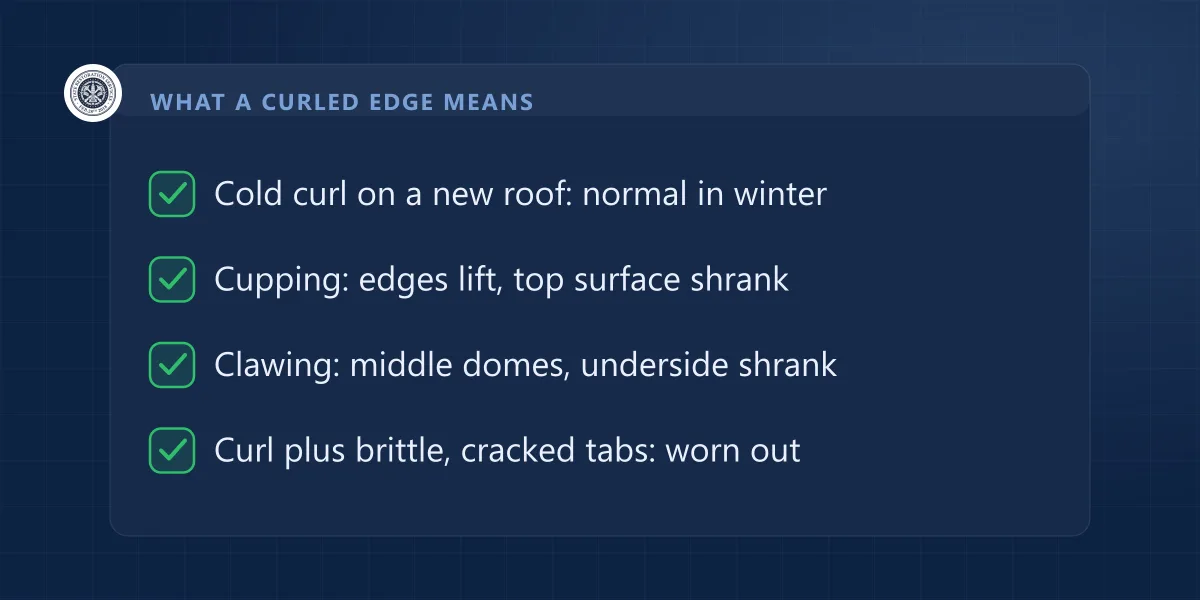
Look at the shape first. If the edges lift on a roof installed during the last cold season, that is cold curl. If the tab edges turn up into a shallow dish on an older roof, that is cupping. If the edges turn down and the middle of the tab rises, that is clawing. Only cold curl goes away.
| What you see | Name | Roof age | What is going on | What to do |
|---|---|---|---|---|
| Edges lifted, shingles otherwise look new | Cold curl | Installed in the last few months, seen in cold weather | The asphalt coating contracts in the cold, before the strips have fully sealed | Wait for warm, sunny weather and look again |
| Corners and edges of the tab turned up, like a shallow dish | Cupping | Older roof | The top surface of the shingle has shrunk | Have the roof inspected; plan for replacement if it is widespread |
| Edges turned down, middle of the tab humped up | Clawing | Older roof | The bottom surface of the shingle has shrunk | Same as cupping |
| Raised ridges running across several courses in a line | Buckling, not curling | New or old | Movement in the deck or wrinkled underlayment under the shingles | Find the cause underneath first (see below) |
The clearest description we have found is in a 2004 paper by three Haag Engineering engineers, Hail Damage to Asphalt Roof Shingles, published by the American Meteorological Society. Haag investigates roof damage for a living. On these two shapes it says:
"Cupping and clawing results from asphalt shrinkage on the top and bottom surfaces of the shingles, respectively. The corners and edges of the shingles are prone to curling or cupping as the mat shrinks."
Contractor websites use these two words inconsistently, and some swap them. The names matter less than what they share: both come from the shingle itself changing with age, and neither is caused by an impact.
Is curling on a brand-new roof a problem?
Usually not, if it shows up in the first cold months after installation. ARMA's Residential Asphalt Roofing Manual calls it cold curl and says it should correct itself when the roof warms up. The sealant strips that hold each course down are activated by the sun's heat, so a roof finished in late fall may not fully bond until spring.
The full passage from the ARMA manual:
"During the colder months following installation, it is not uncommon for asphalt shingles to have a tendency to curl at the edges. This phenomenon, known as "cold curl," is due to contraction of the asphalt coating that causes the edges of the shingles to lift. Cold curl is a normal occurrence and should correct itself when the roof warms up either by sunlight or by an increase in the ambient temperature."
Two lines a little earlier in the same chapter explain why a late-season roof behaves this way: "The factory-applied adhesive on self-sealing shingles is activated by heat from the sun. In winter when it is cold, bonding can take longer than during warmer seasons of the year depending upon the geographic location, weather, roof slope and direction that the structure faces." On a roof finished in November, the north-facing slope can stay unsealed longer than the south-facing one. We cover the cold-weather side of installation, including hand-sealing, in the best time of year to replace a roof.
Cold curl stops being the explanation when:
- the edges are still lifted after several weeks of warm, sunny weather;
- a tab lifts and drops in the wind, which means it has not bonded;
- the curl is concentrated in one area, such as along a rake edge or at the eaves, rather than spread over the slope;
- shingles are torn, creased or missing.
In any of those cases, call the company that installed the roof. A shingle that did not seal is an installation question for the workmanship warranty, and it is better raised in the first season than after a windstorm.
What makes an older roof cup or claw?
Age, heat and the quality of the asphalt. As a shingle weathers, its asphalt shrinks and stiffens, and the tab pulls out of shape. Haag lists the things that set the pace: asphalt quality, shingle color, roof pitch, which way the slope faces, and attic ventilation. Ventilation is the one a homeowner can change.
Haag places cupping and clawing in the same family as blistering and splitting: "Common deficiencies inherent with aged asphalt shingles are blistering, splitting, cupping, clawing, crazing, and flaking." It describes what happens next on a roof that keeps aging: "Eventually, chunks of granules flake away from the mat leaving the asphaltcoated mat exposed to the weather." Splitting, the diagonal or horizontal cracks that sometimes show up on the same roof, it attributes to "a combination of asphalt shrinkage, deck movement, and low tensile strength in the mat."
The factors Haag names, in the order a homeowner can act on them:
- Attic ventilation. ARMA's manual warns that overlooking proper ventilation may result in "Premature failure of the roofing." An attic that holds heat warms the deck and shingles from below while the sun heats them from above. Our guide to attic heat and shingle life explains how intake and exhaust are balanced.
- Slope direction. Haag names slope direction as an aging factor, which is why curling can be heavier on one face of a house than on another.
- Shingle color and pitch. Both are fixed for the life of the roof. They are worth weighing when you choose the next one.
- Asphalt quality. This is a manufacturing question. It is the only factor that can make curling a warranty matter, and even then the ventilation will be checked first.
If you see curling on a roof in its late teens or older, read it alongside the other signs of age: granules in the gutters, bare spots, cracked tabs. Our article on how long a roof lasts in our freeze-thaw climate gives realistic lifespans by material.
Is it curling, buckling or a nail pop?
A curled shingle changes shape at its own edges. Buckling is a raised wave that runs across several shingles, because something underneath moved. A nail pop is a single bump where a fastener has backed up into the shingle above it. All three look like uneven shingles from the ground, and each one has a different fix.
| Check | Curling (cupping or clawing) | Buckling | Nail pop |
|---|---|---|---|
| Shape | The edges or corners of individual tabs bend | Ridges or waves across several courses | A small, round bump at a nail line |
| Pattern on the roof | Spread over a slope; can differ from one face of the house to another | Lines that follow deck joints, or random if the underlayment wrinkled | Scattered single spots |
| Cause | The shingle itself shrinking with age | Deck movement or wrinkled underlayment | A fastener backing out of the deck |
| Fix | Repair if isolated; replacement if it is the whole roof | Fix what is underneath, then reinstall or replace the shingles | New fastener next to the old one, hand-seal the shingle above |
ARMA's note on buckled shingles says buckling "is most often the result of wrinkles in the roofing underlayment or movement of the wood decking," and that distortions from wrinkled underlayment "will be random throughout the roof area and not coincidental with joints in the roof deck." It also names look-alikes caused by "nails not driven flush with the shingle surface" and "shingles deformed prior to installation due to poor storage conditions." Our guide to roof nail pops covers the fastener side in detail.
Why does a curled edge matter in a windstorm?
Because the strip of sealant along the bottom of each course is what holds the shingle down in wind. A tab whose edge has lifted away from the course below is no longer bonded at that spot, so wind can get under it. A roof with widespread curling has more unbonded edges for the wind to lift.
ARMA's manual is direct about where wind resistance comes from: "Most wind resistant shingles depend upon the bonding action of a factory-applied self-sealing adhesive for the majority of their wind resistant strength." A cupped or clawed tab has pulled its edge away from that bond.
That has an insurance consequence. If a storm takes shingles off a roof that was already curling, expect the carrier to ask whether the damage came from the wind or from the roof's condition before the wind. Haag's authors make the point about aged shingles in general: these conditions are often "not discovered until after a hailstorm; however, this does not mean they were created or aggravated by the storm." The flip side is that a curled roof can still take real wind or hail damage, and that damage should be assessed on its own. We go through how wind damage is proven in wind damage on a roof claim in Illinois.
Can curled shingles be repaired?
Yes, when the curling is limited to a few tabs on a roof that is otherwise sound. A roofer can hand-seal lifted tabs with asphalt roofing cement, or replace individual shingles. When the shingles are curled and brittle across whole slopes, sealing them buys time but does not stop the rest from aging.
ARMA makes the general case in Asphalt Shingle Roofs are Repairable, which lists "resealing shingles that have been damaged by high winds" among repairs that can be done quickly. For hand-sealing, its manual specifies asphalt roofing cement conforming to ASTM D4586: "Two spots of this cement about the size of a quarter are placed under each tab on three tab shingles," and "four spots of asphalt roofing cement on laminated shingles."
Three cautions from our side of the ladder:
- More cement is not better. ARMA warns that "Excessive use of asphalt roofing cement may cause blistering." Use the few spots ARMA describes, not a bead across the whole tab.
- Old shingles are stiff. A tab that has cupped for years has lost its flexibility, and forcing it flat can crack it. On an old roof, replacing the shingle is often the better repair.
- Fix the heat, too. If the attic is the reason the shingles cupped, sealing the tabs treats the symptom. The ventilation needs to be corrected before the next roof goes on.
Stay off the roof yourself; a ladder and a pitched surface are where homeowners get hurt. From the ground, binoculars show curl clearly, especially in low morning or evening light. When the honest answer is replacement, we explain how we make that call in roof replacement vs. repair: how we decide. Anyone who wants to replace a five-year-old roof over a little cold curl in February deserves a second opinion, and probably a cup of coffee and a calendar.
Will insurance or the shingle warranty pay for curling?
Insurance, generally no: homeowners policies exclude wear and tear and deterioration, and cupping and clawing are aging. A shingle warranty covers manufacturing defects, so premature curling from a bad batch could qualify. But manufacturers exclude damage from inadequate ventilation, and they will check the attic before agreeing it is the shingle.
The GAF Shingle & Accessory Limited Warranty is a good example of how this reads. It promises the shingles "will remain free from manufacturing defects that adversely affect their performance," and lists damage from "inadequate ventilation" among the exclusions. If you think the curling on a young roof is a defect, the same document sets the procedure: "You must notify GAF about any claim within 30 days after you notice a problem," and "Notice to your contractor, dealer, or home builder is NOT notice to GAF." And hold off on repairs: "If you repair or replace your GAF Products before you notify GAF about your claim or before GAF has completed its evaluation of your claim, your claim may be denied." Check the paper for your own brand, since Owens Corning and IKO publish their own terms. The difference between the manufacturer's coverage and the installer's is explained in roof warranties: manufacturer vs. workmanship.
When there has been a real storm, we inspect, photograph and document the damage the storm caused, separately from the roof's age, and write a code-compliant estimate. A roofer in Illinois is not permitted to negotiate the claim with your insurer. That job belongs to a licensed public adjuster, and ours is an affiliate, State Adjusting Services. Details are on our storm and insurance claim page, and the GAF, Owens Corning and IKO systems we install are on the residential roofing page.
Related reading: Shingle blisters vs hail damage · Architectural vs 3-tab shingles for Illinois weather
Frequently asked questions
Why are the shingles on my new roof curling in winter?
The Asphalt Roofing Manufacturers Association calls this cold curl. In cold months after installation, the asphalt coating contracts and the shingle edges lift. ARMA says it is a normal occurrence that should correct itself when the roof warms up. If the edges are still lifted after a stretch of warm, sunny weather, ask your installer to look at the sealing.
What is the difference between cupping and clawing shingles?
Both come from asphalt shrinking as the shingle ages. In cupping, the top surface shrinks and the edges of the tab turn up. In clawing, the bottom surface shrinks, so the edges turn down and the middle of the tab rises. The Haag Engineering paper on hail damage describes both and lists them among conditions of aged shingles, not storm damage.
Can you glue curled shingles back down?
On a roof that is otherwise sound, a roofer can hand-seal a lifted tab with asphalt roofing cement that meets ASTM D4586, using a few quarter-size spots as the ARMA manual describes. ARMA also warns that too much cement can cause blistering. If the shingles are brittle and curled across whole slopes, gluing them is a short-term measure.
Does homeowners insurance cover curling shingles?
Not for the curling itself. Standard homeowners policies exclude wear and tear and deterioration, and cupping and clawing come from aging. If a windstorm or hail then damages the roof, that damage is judged on its own. Expect the carrier to look closely at which shingles were already curled before the storm.
Seeing curled edges from the driveway? Schedule a free inspection, or call us at (866) 992-2982 on weekdays from 8:00 AM to 5:00 PM. Our crews work across Lake and Cook County in the north and northwest suburbs.