
 Volodymyr Lukaniuk
Yes, you can often put new shingles over old shingles, once, if the roof has a single flat layer on a sound deck and your village allows it. A second layer already up there, old shingles that are wet or falling apart, or a soft deck all mean the old roof comes off first. That is the whole legal question. The money question takes a little longer, because the layover price is lower for a reason you can only see once you know what stays hidden under it.
Roofers call this a layover, an overlay or a roof-over. The code calls it a recover, and it calls stripping the old shingles a replacement. You will see all of those words on bids around here, sometimes from the same salesman in the same driveway.
Count your layers before anyone quotes you
Every rule below starts with one number, so get it yourself. Stand a ladder at a gable end where the shingles run past the wall and look at the cut edge from the side. One layer looks like one thin line of asphalt on top of the drip edge. Two layers look thick and a little lumpy, and on an older house you may see the old shingles stick out past the new ones. Do this from the ladder and stay off the roof itself. If you can't see the edge, ask for the count in writing on the bid.
When does the old roof have to come off?
The old shingles have to come off when any one of the five conditions below is true. The first three are the stops in section R908.3.1.1 of the 2018 residential code, as printed in this government re-roof guide. The last two come from the Asphalt Roofing Manufacturers Association bulletin on replacement and recover, the trade group of the companies that make the shingles.
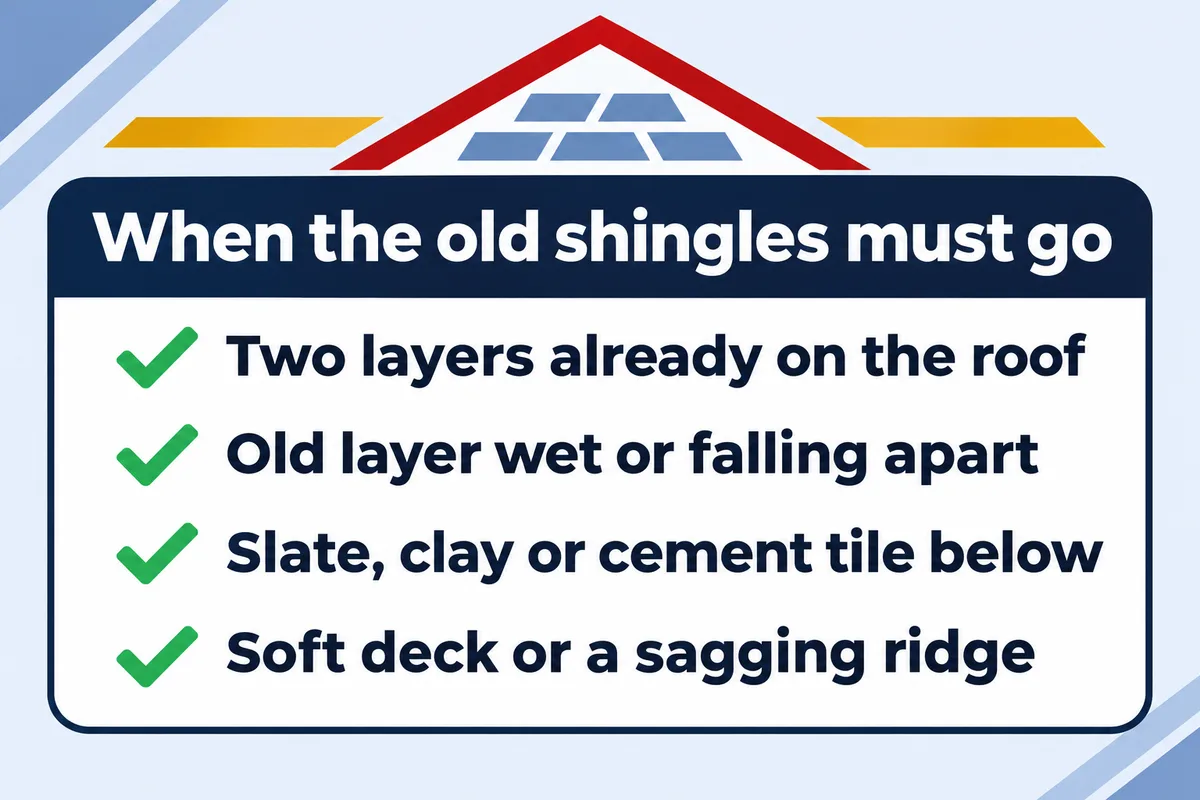
- The roof already has two or more coverings of any kind.A layer of roll roofing under one layer of shingles counts.
- The old covering is water-soaked or so worn it can't serve as a base.Shingles that come apart in your hand are the plain version of this.
- The old covering is slate, clay tile, cement tile or asbestos-cement tile.If a house has old asbestos-cement shingles, that removal needs its own plan, so ask before anyone starts.
- The deck shows rotted or warped wood, or wide gaps between deck boards.You can often spot this from the attic with a flashlight on a bright day.
- The ridge or the truss lines sag, or the old shingles are too curled to lie flat.The bulletin sends a sagging roof to a licensed structural engineer before any roofer.
Clear all five and the bulletin itself says a tear-off may not be needed. We say that plainly because some pages on this subject read as if a layover were against the law everywhere. On a flat, dry, single layer it's a legal way to shingle a roof, and the old layer even acts as a backup under the new one.
Your village has its own sheet, and it can be stricter
Illinois towns write this down in their permit handouts. We read two of them for this article, one from each of the counties we work in.
Hawthorn Woods, Lake County
Its roofing requirements sheet says: "Maximum of two layers of asphalt or fiberglass shingles is permitted." With two already up, everything comes off. It also wants new flashing at re-roofing and an ice and water shield inspection.
La Grange Park, Cook County
The 2025 roof permit packet caps a roof at two layers and asks for a permit for a new layer the same as for a tear-off. Ice and water shield has to reach at least 2 feet past the inside of the exterior walls, and it gets inspected.
Yours may say something else, and the same bulletin warns that some local codes require removing more than one layer. One phone call to the building department settles it. If a door-knocker tells you no permit is needed because "we're only going over the top," that call gets more useful still.
What stays hidden under a layover
The deck nobody gets to see
A layover leaves the wood covered for another couple of decades. On a tear-off, bad boards turn up the morning the shingles come off, and the crew swaps them. Our roof decking replacement cost guide puts that at $75 to $120 per installed sheet here, and most twenty-year-old roofs need three to six sheets. That comes to $225 to $720, a small line on the bid. Skipping the look doesn't make the soft spots go away; they just stay under new shingles with the nails going into them.
The ice barrier at the eaves
This is the part that matters most in a Chicago winter. The membrane that stops ice dam water from backing up normally sticks straight to the deck. IKO's re-roofing bulletin R-23 does allow its membrane over one existing layer at the eave, as long as those shingles are in fair shape and lie flat, with curled edges nailed down first. So it can be done on an IKO roof. Ask whether your bid includes it, and whether it runs the distance your village requires. If your house has a history of ice dams along the eaves, that history is a good reason to get the old layer off and see what the water has been doing.
Flashing, vents and the drip edge
Old step flashing and pipe boots sit at the height of the old roof. Reusing them is how a new roof ends up with an old leak, which is why Hawthorn Woods asks for new flashing either way. Our guide on why flashing causes most leaks shows where to look. Any bid for a layover should name each one: chimney, walls, vents, pipes. The same sheet wants a drip edge on all rakes and eaves, so ask how it fits over the old edge.
Nail length
The code guide linked above wants each nail through the full thickness of the roofing and at least 3/4 inch into the deck. Two layers make that thickness bigger, so the nail that works on a clean deck may barely reach wood on a layover. Ask what length is on the truck. If you want the rest of the nailing rules, we covered them in how many nails each shingle needs.
Will a second layer overload the roof? Do the arithmetic
A second layer adds about 2.3 pounds per square foot, which is real weight but small next to what a sound roof is built for. Some pages talk about roofs collapsing under a second layer without showing a number, so here are the numbers, using the 230 pounds per square Consumer Reports lists for IKO Cambridge laminated shingles on a sample 22-square roof.
| What sits on the roof | Pounds per square foot |
|---|---|
| Second layer of laminated shingles (230 lb per 100 sq ft) | About 2.3 |
| 18 inches of old, settled snow, from our guide to snow on a roof | 18 to 30 |
| Roof load on the Hawthorn Woods requirements sheet | 30 |
Across those 22 squares the second layer comes to about 5,060 pounds, spread over the whole roof. On straight, sound framing that rarely decides the question by itself. A roof that already sags is another matter, and that goes back to stop five.
The bill you are moving, and when it comes due
A layover moves the tear-off to the next roof, and the next tear-off has twice as much to remove. Our roof replacement cost guide for the Chicago suburbs has the installed ranges, and those are tear-off prices.
Tear off now
You pay for labor and dump fees on one layer today.
The crew sees the whole deck and fixes it, and the ice barrier goes straight onto wood.
The next roofer starts from one layer, with the same choice you have today.
Go over now
You skip the stripping labor and the dump fees today.
The deck stays unseen until the next roof.
At that next roof both layers must come off under the rules above, with extra labor and dump fees for the second one.
How long do you plan to stay in the house? That's the question that usually decides it. Selling in a few years, with one flat layer and a sound deck, is the case where a layover has its best argument. If you want the shingles to last as long as they are rated for, start from the deck. Before you decide, a roof inspection will tell you which of the stops apply. We also explain how we weigh a roof's age and condition in how we decide between repair and replacement.
What a bid for a layover should say in writing
- How many layers are on the roof now, and how the roofer knows.
- Whether a permit is included, and which inspections the village requires.
- The ice barrier: which product, and how far past the exterior wall it runs.
- Each piece of flashing, vent and pipe boot, and whether it's new or reused.
- Nail length, and the shingle maker's written instructions for going over old shingles.
- What the shingle maker's warranty says about a roof installed over an old layer. Ask for the document, since a salesman's memory doesn't count.
- A second price for a tear-off with the same shingle, so you can see the gap.
A low number with none of that on the page tells you very little. The same goes for the fellow who shows up after a storm with a truck full of shingles and a price he came up with before he saw your attic.
Frequently asked questions
Is a second layer of shingles illegal in Illinois?
A second layer is allowed in many places, as long as the roof has only one layer now and the old shingles are a sound base. A third layer is the one the village sheets we read rule out. The rule is written village by village, so the building department that issues your permit has the last word.
How much cheaper is a layover than a tear-off?
You save the labor of stripping the roof and the dump fees for the old shingles. Ask for both prices on the same bid, with the same shingle, so you can see the real difference on your roof. Then compare it with the decking and the flashing the cheaper option leaves unchecked.
Can I put a metal roof over my old shingles?
Sometimes. The 2018 residential code lets a complete, separate system such as standing seam stay on top of old roofing when it carries its load straight to the framing and does not lean on the old roof. Your village and the metal maker still have to agree with the plan, so ask before anyone orders panels.
My old shingles have hail damage. Can new ones go on top?
Hail-bruised shingles are a poor base, because the code stops a recover when the old covering can no longer serve as one. Have the damage documented before anything covers it. Once a new layer is on, nobody can photograph what the storm did to the old one.
Related reading: what counts as an old roof and how to get the house ready for a roof replacement.
Not sure how many layers you have? Call (866) 992-2982, seven days a week (weekdays 7:00 AM to 7:00 PM, weekends 9:00 AM to 5:00 PM), or book a free roof inspection online. Our residential roofing crews work across the north and northwest Chicago suburbs.