
 Volodymyr Lukaniuk
Quick answer: To prepare for a roof replacement, move both cars out of the garage and driveway the night before, clear fifteen feet around the house, take art and mirrors off top-floor walls, tarp anything stored in the attic, and call your satellite provider the week you sign. Plan on one to two loud days.
Nobody hands you a prep list when you sign a roofing contract. You get a start date, a shingle color and a handshake, and then the week goes by and you start wondering whether the car should be out of the garage. So here is how to prepare for a roof replacement, written from your side of the driveway instead of ours.
We are a family-owned roofing company in Lincolnshire and we work across the north and northwest Chicago suburbs. The same four things go wrong on unprepared houses: a car boxed in behind the dumpster, an attic full of boxes that come out gray, a satellite dish nobody planned for, and a patio set that spends the day under shingle grit. All four are about twenty minutes of work the night before.
What actually happens at your house on tear-off day?
A crew arrives between 7 and 8 AM, stages a dumpster or dump trailer, tarps the ground and the shrubs, and strips the old roof before lunch. Then underlayment, then shingles, then cleanup. Most Chicago-suburb roofs finish in one to two days, and you do not need to be home for any of it.
What you will notice from inside is the sequence. Tear-off is the loud half: steel shovels dragged across decking, directly over your ceiling, for three or four hours. After that the noise changes to compressors and nail guns, which is quieter and much easier to talk over. If you want the full scope of the work itself, we wrote that out line by line in what a full roof replacement actually includes. This article is about the half of the day that happens on your side of the ceiling.
| Roughly when | On the roof | What it means for you |
|---|---|---|
| 7–8 AM | Crew arrives, ground tarps go down, container is set | The driveway is gone for the day |
| 8 AM – midday | Tear-off — the loudest stretch | Constant scraping; dust falls into the attic |
| Around midday | Decking inspected, soft sheets swapped out | You may get a phone call about extra decking |
| Midday – late afternoon | Ice-and-water shield, underlayment, shingles | Steady nail-gun noise, far less vibration |
| Last hour | Magnetic nail sweep and walkthrough | Walk the driveway yourself before you park on it |
What do you need to move outside before the crew arrives?
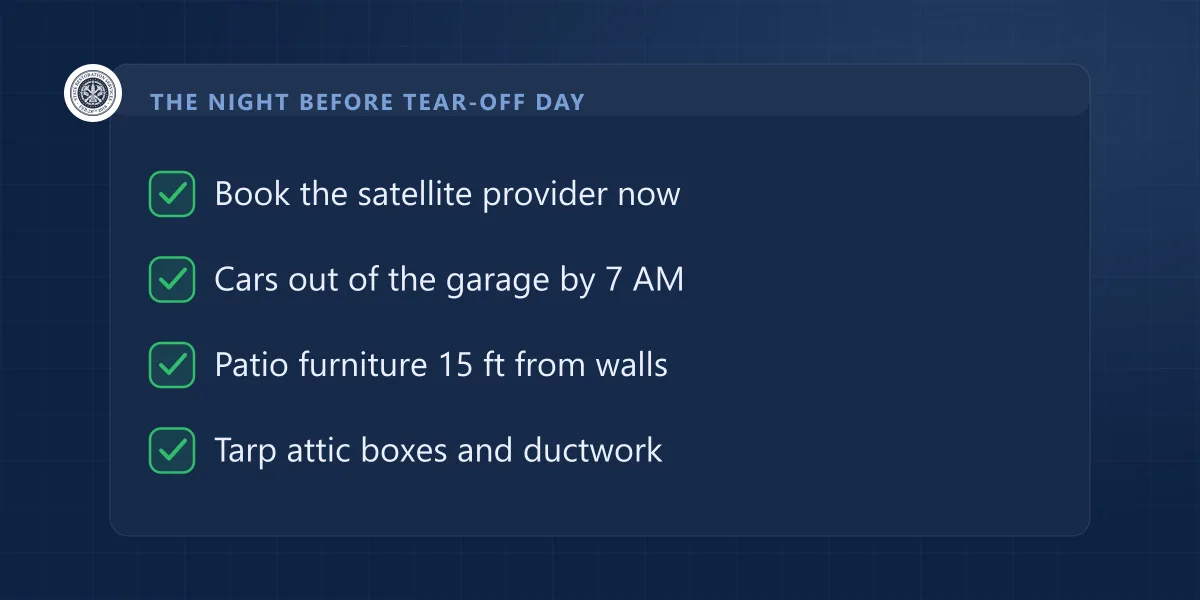
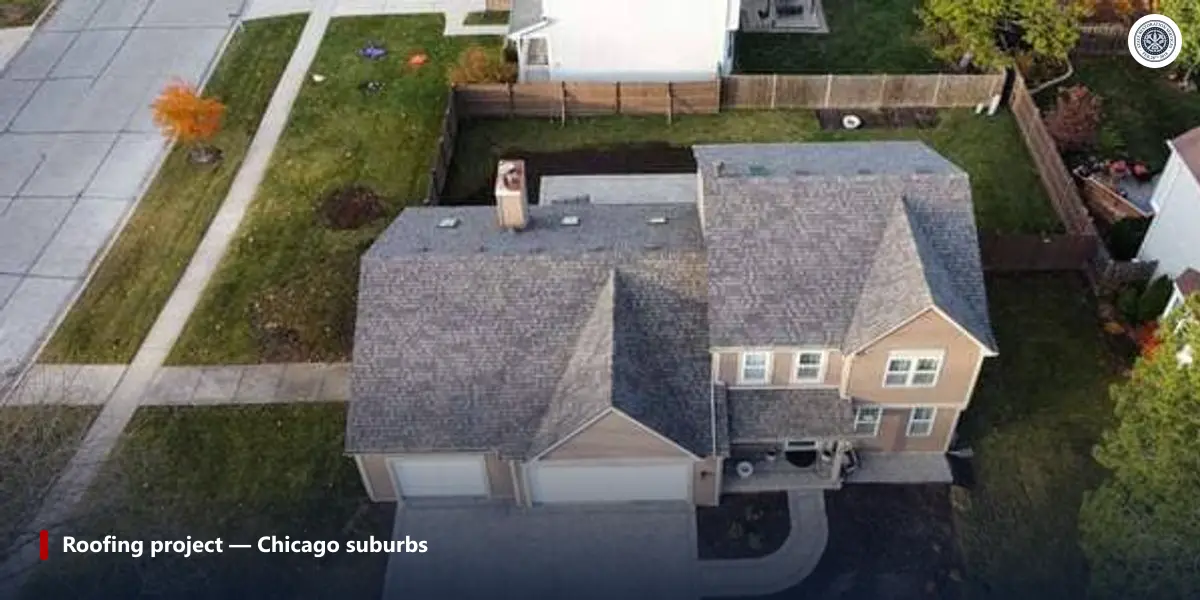
Both cars, everything within about fifteen feet of the walls, and anything you would be upset to find a shingle granule on. Shingles come off the roof edge and land in a wide band around the house, and tarps catch most of it but never all of it. Fifteen feet is a useful working number because that is roughly the band a shingle bundle scatters into when it comes off a two-story eave. Here is the whole outside list, in the order it takes the least time:
- Cars, out the night before. The garage door ends up behind the container or under the drop zone, and even if it does not, you do not want to drive across a driveway that has been collecting nails since eight in the morning.
- Patio furniture, grill, potted plants, toys, the trampoline. Move them, do not just cover them. A tarp over a glass table still transmits a falling bundle.
- Point out the fragile things. The AC condenser, sprinkler heads, low-voltage lighting, a new paver patio, a septic lid if you have one. Walk the crew leader past them in the morning and ask for the condenser to be covered, so nothing has to be guessed from a ladder.
- Unlock the gate if the crew needs the back yard, and say so if a dog uses that run.
- Check the garbage collection day. If it lands on tear-off day, put the bins at the far end of the parkway the night before, or the truck will not be able to reach them.
Where does the dumpster go, and will it wreck the driveway?
It usually goes on the driveway, because that is the shortest carry from the roof edge, and yes there is real weight involved. An architectural shingle bundle runs roughly 70 to 80 pounds and it takes three bundles to cover a square (100 square feet), so figure about 210 to 240 pounds of shingle per square before you add felt, nails and drip edge. The totals below are our own arithmetic off those published bundle weights, not a quote.
| Roof size | One layer of architectural shingle | Two layers |
|---|---|---|
| 20 squares | about 2.4 tons | about 4.8 tons |
| 25 squares | about 3.0 tons | about 6.0 tons |
| 30 squares | about 3.6 tons | about 7.2 tons |
That is the load sitting in a steel box on your driveway, and the roll-off truck that drops and collects it weighs more than the box does. The standard protection is plywood under the container rails and along the truck's wheel path, and it takes two minutes to lay down if you ask for it. If your driveway is newer asphalt in July heat, or if it is pavers, ask for street placement or a dump trailer instead. If it does go in the street, ask who is handling the right-of-way permit — village rules on that differ, and it is not something you want discovered on the morning of.
One more thing homeowners forget: on a lot of jobs a conveyor or a boom truck also needs driveway space to get bundles onto the roof. If both cars are still there at 7 AM, something gets parked on the lawn instead.
Why does work on the roof make a mess inside the house?
Because tear-off is a percussive job and your house is one connected frame. Vibration carries down to the top-floor ceilings, and decking boards have gaps between them, so decades of dust, granules and crumbled felt sift straight through into the attic. Nothing is being damaged. Things stored up there just come out gray.
The fix is twenty minutes with a roll of plastic sheeting or a stack of old bedsheets, done the evening before rather than the morning of:
- Drape the attic. Cardboard boxes, stored electronics, exposed flex duct, and the top of the furnace or air handler if it lives up there.
- Take art and mirrors off top-floor walls. Leave the hooks in the wall. Four hours of hammering is what walks a frame off a hook.
- Clear top shelves of anything that can walk to the edge, and expect ceiling fans to wobble and light fixtures to rattle. That is normal and it stops when the tear-off does.
- Photograph your top-floor ceilings the day before. On an older house, hairline drywall nail pops are possible, and a dated photo means nobody has to argue about what was already there.
Afterwards, if you go up and see nail points coming through the decking, that is not a mistake. On plank or spaced sheathing — common on the older housing stock around here — and on any sheet that got replaced, the fastener has to pass through the deck to hold the shingle down. What you should not see is daylight.
Who handles the satellite dish and the solar panels?
Your satellite provider takes the dish down and re-aims it, and your solar installer detaches and resets the panels. Neither job belongs to a roofer, ours included. We will pull a dish off if you ask us to, but it comes off and stays off until their technician gets here, so make that call the week you sign rather than the week after the roof is finished.
| Item | Who does it | What to know before the roof date |
|---|---|---|
| Satellite dish | Your TV provider | Roughly $50–$100 for a service call, and they book out. Re-aiming needs a signal meter, so the same four holes do not give you back your signal. |
| Solar panels | A licensed solar contractor | Detach and reset is commonly quoted around $200–$300 per panel. Using anyone else is how people put a panel warranty at risk. |
| Antenna or mount you no longer use | Us, on request | Say so before the crew arrives and the penetration gets patched into the new roof instead of reused. |
There is a detail about dishes worth knowing in advance, because it surprises people: most provider technicians will not step onto a roof and will only mount where they can reach from a ladder. So your dish may come back on an eave, a gable end or a yard pole instead of the slope it was on. That is a better outcome anyway — a dish on the roof means somebody drilled holes in a roof you just paid for. The trade press has been telling roofers to leave dishes alone for years, for the same reasons (Roofing Contractor, "The Do's and Don'ts of Satellite Dish Removal").
On solar: we do not install or service panels, so we schedule around your solar contractor rather than promising to handle it. If a covered storm is what put you on this list in the first place, ask whether the detach and reset belongs on the claim — it often does, and that is the kind of line item our storm and insurance claim team looks for.
What do you do about pets, kids and working from home?
Get the pets out of the house if you can, and move any call you cannot afford to lose to before 8 AM or after tear-off ends. Dogs and cats do badly with four hours of scraping directly overhead, and a crated dog in the basement is a distant second to a dog at a friend's house.
- Find the cat before the garage door goes up and stays up. Cats hide in exactly the place you are about to open.
- Turn off motion alerts on doorbell cameras and glass-break sensors for the day, or your phone will buzz two hundred times.
- Reroute deliveries. The front porch may be under a tarp, and nobody wants a package under a debris chute.
- Keep kids and pets off the lawn until after the magnetic sweep, not just until the noise stops.
What might we call you about in the middle of the job?
Usually decking. Soft or rotted sheets only become visible once the shingles are off, which is why they are priced per sheet rather than counted in advance. The other call is anything we find that the estimate did not cover — a failed vent boot, a chimney flashing that was caulked instead of flashed.
Two things make that call painless. First, have the per-sheet decking rate in writing before the job starts; reading a roofing estimate properly covers where that line hides, and we put real numbers on it in our guide to roof decking replacement cost. Second, decide who is authorized to say yes. If one spouse signed the contract and the other is home, tell us that at the morning walkthrough.
You should also know your permit is our job, not yours. We pull it and post it where the inspector can see it. Villages here take that seriously — Arlington Heights brought its roof permit requirement back in 2021 specifically because the permit creates a paper trail on workmanship. Skipping the permit to save the fee also removes that paper trail, and the homeowner is the one who then has to prove the work was done right.
What should you check after the crew leaves?
Walk the property with the crew leader before they pull out, then do your own pass the next morning in daylight. Low morning sun across the driveway shows up nails and granules that a walkthrough at six in the evening hides.
- Nails. Ask for a second magnetic pass down the driveway and along the drip line. Nails ride down with the tarps at the end, after the first sweep.
- Your tires. Look at them in the morning. A nail in a tire shows up as a slow leak days later, when nobody connects it to the roof.
- Gutters. Shingle grit and cut-offs end up in them. Ask whether they were flushed. If yours are old enough that the answer is "why bother", that is a conversation about seamless gutter installation, not about cleaning.
- The attic. Pull your tarps out and look for daylight. You will not have a reason to go up there again for years.
- Top-floor ceilings, against the photos you took the day before.
- Landscaping. A crushed shrub is easy to sort out that week and awkward to raise in October.
- Paperwork. Warranty registration, the final inspection, and an invoice that matches the contract you signed.
Related reading: what a full roof replacement includes, line by line and what a real free roof inspection covers. If you are still choosing a date, our residential roofing page and our process lay out how a job runs from the first call.
Frequently asked questions
Do I need to be home when my roof is replaced?
No. Almost all of the work happens outside, so you do not need to be home for the installation. We walk the property with you at the start and at the end, and we are reachable all day. What matters more than being home is that someone with authority to approve extra decking can answer the phone.
How long will my driveway be unusable?
Plan on the whole working day, and both days if the roof runs two days. The dumpster or dump trailer sits there, the material gets staged there, and nails end up there until the magnetic sweep. Park both cars on the street the night before rather than the morning of.
Will a roofing dumpster crack my driveway?
It can, and the risk is highest on newer asphalt in hot weather or on pavers. A loaded container of shingle debris is several tons, and the truck that sets it down is heavier. Ask for plywood under the container rails and the wheel path, or ask for street placement instead.
Do I have to empty my attic before a roof replacement?
No. Cover it instead. Dust, granules and old felt crumbs fall through the gaps between decking boards during tear-off, so drape plastic or old sheets over cardboard boxes, stored electronics and exposed ductwork the night before. Nothing needs to be carried out.
Thinking about your roof? Book a free inspection or call (866) 992-2982 — we are a family-owned, licensed and insured Illinois roofing contractor rated 4.9 stars from 92 Google reviews, serving the north and northwest Chicago suburbs from Arlington Heights to Lincolnshire.