
 Volodymyr Lukaniuk
Quick answer: A home equity loan for a roof works, and for a roof that is simply worn out it is often the cleanest money there is. Two things surprise people. Nearly half of these loans are approved without anybody looking at the house. And federal law stops your roofer from starting for three business days after you sign.
Every autumn we get the same phone call. The roof is twenty-two years old, it is not leaking yet, the insurance company has started asking pointed questions about it, and the homeowner wants to know whether borrowing against the house is a sensible way to pay for a replacement. Usually it is. But there are two or three moving parts nobody explains at the bank, and one of them will quietly move your start date.
We are a family-owned roofing contractor based in Lincolnshire, working across the north and northwest Chicago suburbs. We are roofers, not lenders, and none of this is financial advice. What we have is a lot of hours at kitchen tables while this decision gets made. Here is what actually happens between the day you sign and the morning the dumpster shows up.
Can you use a home equity loan or HELOC to pay for a new roof?
Yes, and both work. They are secured by your house, both can fund a whole roof, and the difference between them is shape rather than substance: a home equity loan is one lump sum at a fixed rate, and a HELOC is a revolving line you draw against during a draw period, usually at a variable rate.
For a single roof at a known price, the lump sum is normally the simpler tool. A roof is not an open-ended project. You get an itemised number, you accept it, the number does not change unless we open the deck and find rot, in which case you approve that separately. The flexibility of a line of credit mostly buys you the option to spend the rest of it on something that is not your roof, which is a fine thing to want and a bad thing to do by accident.
A cash-out refinance is the third option and, in our experience, the one people talk themselves into and then regret. Resetting the rate on your entire mortgage balance to fund one exterior project only makes sense if you were refinancing anyway.
| How you pay | What secures it | What it actually costs you | When it makes sense |
|---|---|---|---|
| Insurance claim | Nothing — it is your policy | Your deductible | The damage came from a storm, not from age |
| Home equity loan or HELOC | Your house | Interest, valuation and closing costs, and a lien on your home | The roof is worn out rather than damaged, and you have equity |
| Cash-out refinance | Your house, as a new first mortgage | A new rate applied to the entire balance | Only if you were refinancing for other reasons anyway |
| Contractor financing | Depends on the product — ask | 0% in house for up to 24 months, or a 10 to 30 year term with a lending partner | You want to start now, or you are covering a deductible |
Will the lender actually look at your roof?
Often nobody does. The Mortgage Bankers Association’s 2025 Home Equity Lending Study, which covers 2024 originations, found that “47% of total originations were subject to an Automated Valuation Model (AVM) and 26% had a Desktop Valuation (DV), with most entailing either an exterior/drive-by inspection or no inspection at all. Conversely, 24% of originations required a full appraisal with the majority entailing both interior and exterior inspection.”
Read that again with a roof in mind. An automated valuation model is software. It reads public records, tax data and recent comparable sales, and it assumes your house is in roughly the same condition as the houses around it. It has never seen your roof and never will. That cuts both ways, and homeowners usually only notice one side of it: the model will not penalise you for a twenty-two-year-old roof, but it will not give you credit for the new one you put on last spring either.
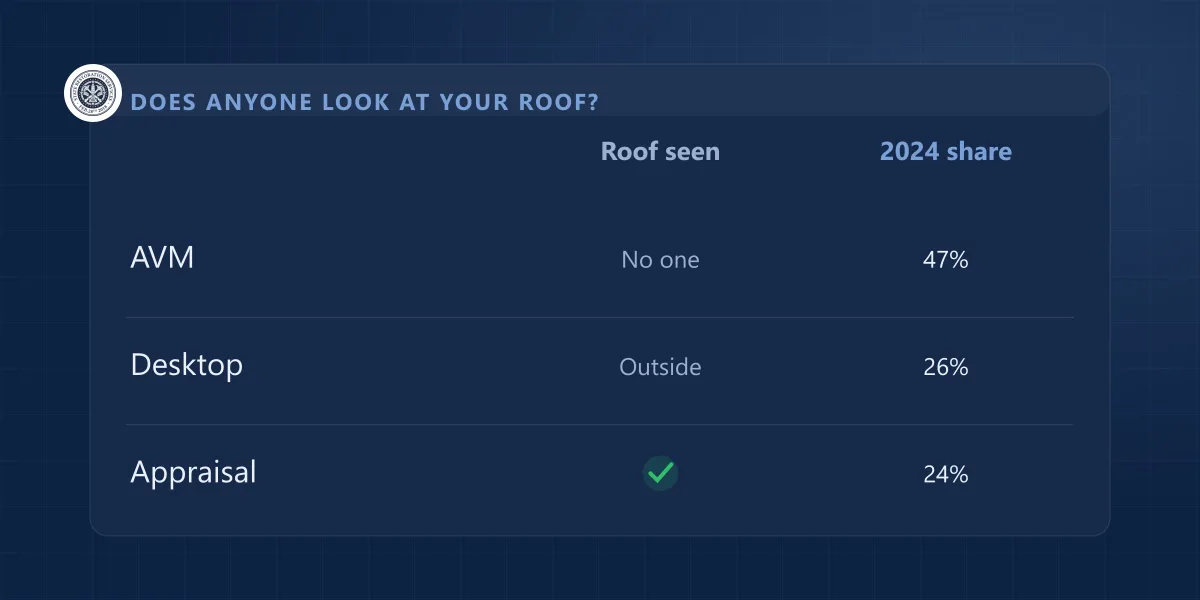
The desktop valuations in that middle 26% are a half measure. Read the wording carefully: an exterior drive-by, or nothing. That means a tarp, a sagging ridge line or a roof that is visibly bald will register, and everything else — the granule loss, the split boots, the deck that flexes underfoot — will not. Nobody gets on the ladder for a desktop valuation.
The 24% is the one where somebody gets close enough to have an opinion. Chase, describing its own process, says the appraiser evaluates “major structural components, including the roof, foundation, siding and lot characteristics.” That is a person standing in your driveway forming a judgement about shingles, and there is no national rulebook governing what they must conclude the way FHA and VA publish theirs for a purchase loan. Each lender writes its own condition standard, which is exactly why the split above looks the way it does.
If you are buying or selling rather than borrowing against a house you already own, the rules are different and stricter, and we wrote that one up separately: what a lender’s appraiser does with the roof on a purchase.
What happens if the appraiser does flag the roof?
The lender does one of two things. It lowers the value, which lowers what you can borrow. Or it approves the loan subject to the repair being completed, which is the catch-22 of this whole exercise: you wanted the money in order to fix the roof, and the roof is the reason you cannot have the money.
There are three ways out of that loop, and only one of them involves arguing.
- Put a real contract in front of the underwriter. A signed, itemised scope with a firm price from a licensed and insured roofer is a very different document from “the roof looks tired.” Some lenders will fund on the strength of it. Others will fund into escrow and release on completion — the same mechanism a mortgage servicer uses with insurance money on a roof claim.
- Check whether it is a claim first. If a storm did this, the loan is the wrong instrument entirely. More on that below.
- Use financing that prices the job instead of the equity. Contractor financing looks at your credit and the work, not at what an appraiser thinks of your shingles.
We cannot tell you what your particular lender will decide. We can tell you which paperwork makes that conversation short. Before the valuation, have this ready:
- The roof’s actual age, and the permit or invoice that proves it if you have one.
- A written, itemised estimate — tear-off, underlayment, ice-and-water shield, ventilation, flashing, the lot — not a one-line number. Our guide to reading a roofing estimate shows what a complete one contains.
- Photographs of anything that is obviously wrong, taken from the ground.
- Your contractor’s licence and certificate of insurance. Lenders holding funds in escrow ask for both.
- Whether an insurance claim is open on the property. Do not let the lender find that out on its own.
The three-day rule that stops your roofer from starting
If the loan is secured by your principal home, federal law hands you three business days to cancel it, and during those three days your roofer legally cannot begin. Not the tear-off, not the delivery. Regulation Z, section 1026.23(c) is unusually blunt about it:
“Unless a consumer waives the right of rescission under paragraph (e) of this section, no money shall be disbursed other than in escrow, no services shall be performed and no materials delivered until the rescission period has expired and the creditor is reasonably satisfied that the consumer has not rescinded.”
The clock runs until midnight of the third business day after the last of three events: the transaction being completed, delivery of the cancellation notice, and delivery of all material disclosures. If the lender never handed you that notice, the right does not quietly expire in three days — it can stretch to three years.
Two exemptions are worth knowing. The mortgage you used to buy the house is not rescindable, and neither is a refinance with your original creditor except as to new money. So if you are purchasing a home and the roof is part of the negotiation, this is not your rule; the appraisal one is.
What this means in practice is simple and mildly annoying. When somebody promises a dumpster on your driveway tomorrow morning on money you signed for this afternoon, one of two things is true: the job is not being paid out of that loan, or nobody has read the paperwork. We have been the roofer who had to explain the delay to a homeowner who was irritated with us about it. We would still rather be that roofer than the one who drops a pallet of shingles into a transaction the customer then cancels.
One caveat: if your contractor financing is an unsecured personal loan with no lien on the house, this rule does not apply to it, because the rule attaches to credit secured by your dwelling. Ask which product you actually signed. And note that your roofing contract carries its own separate cancellation terms under Illinois law, which we cover in the licensing and contract checklist.
Does a new roof actually add value to the house?
Not the way a kitchen does, and anyone who tells you otherwise is selling. Remodeling’s 2025 Cost vs. Value Report puts asphalt shingle roof replacement at roughly two thirds of cost recouped, and about 66% when the figures are broken out for Illinois. A roof does not add a premium. It removes a deduction.
Treat that percentage as a market model, not a quote. The report prices one standardised specification and assumes a resale within about a year. It is not your house, your roof size, or our estimate. Do not budget from it.
The honest framing is this: nobody has ever paid more for a house because the roof was new. Plenty of people have paid less, or walked away entirely, because it was not. That shows up in three places — the appraiser’s condition rating, the buyer’s inspection report, and the insurance carrier who decides whether to keep writing the policy at all. We have written about the second one in what “five years left” on an inspection report really means, and about the third in non-renewal because of your roof. For a lot of homeowners in our area, the insurance letter is what finally starts this whole process.
Before you borrow, make sure this is not an insurance claim
A loan is 100% your money. A storm claim is your deductible. Those two things get confused constantly, because from the driveway a worn-out roof and a hail-damaged roof can look identical, and the difference between them is worth five figures.
We are in Lake and Cook County, where hail and straight-line wind are ordinary facts of life rather than rare events. Before you put a lien on your house to pay for shingles, have somebody get on the roof who knows what storm damage looks like as opposed to age. Our free inspection exists for exactly this, and it is genuinely free — including the times we come down the ladder and tell you it is wear, not a claim, and that a loan is your honest option. That happens, and we say it.
If it is storm damage, understand the division of labour, because Illinois law is specific about it. A roofing contractor may not negotiate your insurance claim. We document the damage and build a code-compliant estimate. Our partner, the licensed public adjuster State Adjusting Services, can represent you on the claim itself. The step-by-step is in filing a storm-damage roof claim in Illinois, and the wider picture is on our storm and insurance page.
One warning about waiting. Damage left long enough stops looking like a sudden loss and starts looking like maintenance you skipped, and a carrier that reaches that conclusion has an exclusion ready for it. We laid the policy language out in does homeowners insurance cover a roof leak in Illinois. Borrowing money is a much worse outcome than filing on time.
What we tell people at their own kitchen tables
Get the roof looked at before you get the money. It is the cheaper order of operations, and it changes the question you take to the lender from “how much can I borrow” to “here is a priced, scoped job, will you fund it.” That second conversation is much shorter.
Then compare the loan against what your roofer can already do. We offer 0% in house for up to 24 months, or terms of 10 to 30 years through home-improvement lending partners, with no money down and the option of combining financing with an insurance claim so the claim pays the roof replacement and the financing covers your deductible. The details are on our financing page. If a 24-month interest-free plan clears the balance, a second lien on your house is a lot of machinery to solve a problem you did not have.
And if you would rather just talk it through with a person, that works too. We are on the phones during normal business hours, Monday to Friday, 7 AM to 7 PM, and Saturday and Sunday, 9 AM to 5 PM — no call centre, no script.
Related reading: what a new roof really costs in the Chicago suburbs and roof replacement versus repair, and how we decide.
Frequently asked questions
Do I need an appraisal to get a home equity loan for a roof?
Often no. In 2024, 47% of home-equity originations were valued by an automated model and 26% by a desktop valuation, most of those with an exterior drive-by or no inspection at all. Only 24% got a full appraisal. Ask your lender which method it plans to use, because that answer decides whether the condition of your roof is part of the decision at all.
Can a lender turn down a home equity loan because of the roof?
It can, when a person actually looks. An appraiser rates the property’s condition, and the roof is one of the major components examined. A weak rating usually shows up as a lower value, a smaller loan, or an approval made subject to the repair. A signed, itemised contract from a licensed roofer with a firm price and scope gives the underwriter something concrete to work with.
Is a home equity loan or contractor financing better for a roof?
The real difference is the lien. A home equity loan or HELOC is secured by your house and usually carries the lower rate. Contractor financing is faster and, in our case, can be 0% for up to 24 months in house, or a 10 to 30 year term through a lending partner with no money down. If you can clear the balance inside two years, the 0% option is hard to beat.
Does the three-day cancellation right apply to my roofing contract too?
No, they are two separate rights. Regulation Z gives you three business days to cancel a loan secured by your principal home, and during that window no money may be disbursed and no work performed. Your roofing contract has its own cancellation terms under Illinois law. Read both, because the dates on them will not match.
Thinking about your roof? Book a free inspection or call (866) 992-2982 — we are a family-owned roofing contractor serving the north and northwest Chicago suburbs, and we will tell you honestly whether this is a claim, a loan, or a roof that has a few more winters in it.