
 Volodymyr Lukaniuk
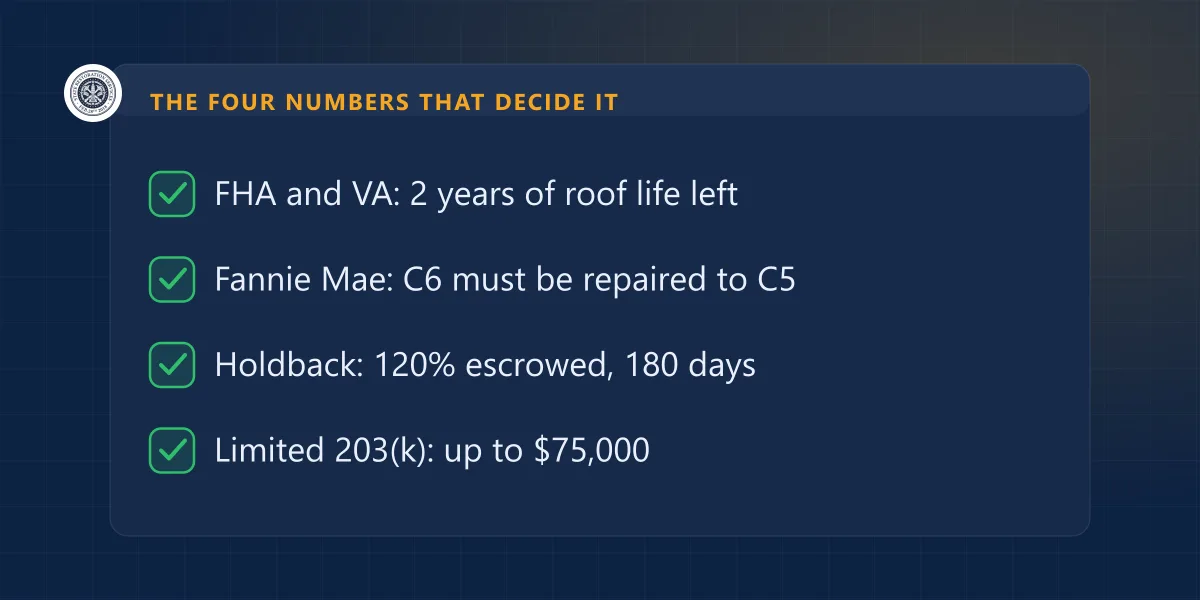
Quick answer: A lender's appraiser rates the whole property C1 through C6. A C6 has to be repaired to at least C5 before a conventional loan can be sold to Fannie Mae. FHA and VA add a harder test: the roof covering must have at least two years of remaining physical life, or the appraisal goes "subject to" inspection by a professional roofer.
Roof appraisal requirements come up late in a sale, when there is the least room to react. The home inspection is done, attorney review is over, everybody has picked a moving date — and then somebody hired by the lender visits the property and writes one sentence about your roof that puts the file on hold.
Here is the whole thing in plain English: who the appraiser works for, what they are actually required to write about your roof, which rule belongs to which loan program, and what your choices are once a report comes back "subject to."
What does a lender's appraiser actually do with your roof?
Physically, very little. The appraiser is hired by the lender, sees the property once, and rates the entire house on a six-point condition scale. Fannie Mae requires the report to identify "items that require immediate repair" and "items where maintenance may have been deferred." Nobody is walking your slopes or lifting a shingle.
That distinction matters, because the appraiser and the home inspector answer different questions. The appraiser's job is value and eligibility — is this house worth the money, and is it acceptable security for a loan somebody else is going to buy. Anything wrong with the house registers only insofar as it affects those two answers.
What they do observe, they have to write down. Fannie Mae's Selling Guide is blunt about it: "Appraisal reports must reflect adverse conditions that were apparent during the inspection," and — the line that catches whole subdivisions built the same year — "Detrimental conditions of the improvements must be reported in the appraisal even if the conditions are typical for competing properties." So the fact that every roof on your block is the same age carries no weight in the report.
The view itself is usually from the ground, sometimes from a ladder at the eave, and increasingly from aerial imagery the lender already holds. For the other half of this picture, we wrote about what a home inspector's "five years of roof left" actually means, which is a separate person working from a separate rulebook.
What do the C1 to C6 condition ratings mean?
They are Fannie Mae's standardized description of the property's condition, C1 being brand new and C6 being damaged enough to affect safety or structure. The rating covers the whole house, not the roof on its own — but a roof is one of the few components visible from the driveway that can drag the rating down by itself.
| Rating | Fannie Mae's definition | What that usually looks like on a roof |
|---|---|---|
| C1 | "very recently constructed and have not previously been occupied" | New build, first owner |
| C2 | "no deferred maintenance, little or no physical depreciation, and require no repairs" | Recent replacement, everything sealed |
| C3 | "well-maintained and feature limited physical depreciation due to normal wear and tear" | Mid-life roof, flashings intact |
| C4 | "some minor deferred maintenance and physical deterioration due to normal wear and tear" | Granule loss, a few curled tabs, no leaks |
| C5 | "obvious deferred maintenance and are in need of some significant repairs" | Bare patches, a lifted section, an obvious repair pending |
| C6 | "substantial damage or deferred maintenance with deficiencies or defects that are severe enough to affect the safety, soundness, or structural integrity" | Open decking, a stripped slope, visible sag |
Most tired suburban roofs land at C4. A twenty-year-old roof losing granules on an otherwise well-kept house is ordinary wear, and ordinary wear does not stop a loan. What produces a C6 is a roof that has stopped doing the job — daylight through the deck, a slope with the shingles gone, a soft spot the appraiser can see dipping from the street.
The consequence is written into the guide: "Loans secured by properties with a condition rating of C6 are not eligible for sale to Fannie Mae. Any deficiencies impacting the safety, soundness, or structural integrity of the property must be repaired with a resulting minimum condition rating of C5 prior to sale of the loan." Your bank almost certainly does not intend to keep your mortgage. "Not eligible for sale to Fannie Mae" therefore reaches you as "we cannot fund this."
What are the FHA and VA roof rules?
Both government programs apply a remaining-life test that conventional lending does not. HUD Handbook 4000.1 requires the appraiser to notify the lender "if the roof covering does not prevent entrance of moisture or provide reasonable future utility, durability and economy of maintenance and does not have a remaining physical life of at least two years."
The handbook then tells the appraiser exactly what to do about it: "The Appraiser must report if the roof has less than two years of remaining life, and make the appraisal subject to inspection by a professional roofer." Read that carefully, because it is better news than it sounds. That instruction sends the question to a roofer, and a roofer's written finding that the covering has years of life left clears the condition without a dollar of work being done.
There is a winter clause worth knowing too: "When the Appraiser is unable to view the roof, the Appraiser must explain why the roof is unobservable and report the results of the assessment of the underside of the roof, the attic, and the ceilings." Between December and March around here, that is how a snow-covered roof becomes an attic inspection.
VA Pamphlet 26-7 sets the same two prongs — the roof covering must "prevent entrance of moisture" and "provide reasonable future utility, durability, and economy of maintenance" — and adds one construction rule: "When a defective roof with three or more layers of shingles must be replaced, all old shingles must first be removed."
The "three layers" rule everybody quotes, and where it really comes from
You will read everywhere that "FHA allows a maximum of three layers of roofing." That sentence comes from HUD's HOC Reference Guide, which now sits in HUD's archive. The current Handbook 4000.1 carries no general layer limit in the appraisal chapter at all. The closest thing in the live handbook is in the 203(k) rehabilitation instructions: "Roofs that already have two layers of shingles should not be roofed again. Remove the existing shingles, then roof with new shingles."
What genuinely binds a homeowner in Illinois is the building code the village enforces. Public Act 103-0510 set a statewide baseline from 1 January 2025: any municipal or county building code must meet an International Residential Code edition "published in the current year or preceding nine calendar years." Every recent IRC edition contains R908.3.1.1, which bars a roof re-cover "where the existing roof has two or more applications of any type of roof covering."
So the third-layer question gets settled at the permit desk long before an appraiser has an opinion about it. If your house already carries two layers, the next roof is a tear-off, and a bid priced as a re-cover will not pass the permit inspection. That is one of the line items worth checking when you read a roofing estimate properly.
What happens when the appraisal comes back "subject to repairs"?
The loan cannot close on that report. The condition has to be cleared and then re-verified, normally on Fannie Mae Form 1004D, the Appraisal Update and/or Completion Report, which an appraiser may complete from an "on-site visual inspection" or from photos and video provided there are "visually verifiable exhibits."
Between the condition and the 1004D sits the part that actually takes the time: somebody has to agree to pay. There are three routes, and each one carries a different catch.
| Route | How it works | The catch |
|---|---|---|
| Seller does the work | Roof is replaced or repaired before closing, appraiser signs the 1004D | Needs a crew, a permit and weather; the closing date moves to the roof's schedule |
| Price reduction | Sales price drops, buyer handles the roof after closing | The appraised value still has to support the loan — and on FHA or VA the condition follows the property, so a lower price does not remove it |
| Seller credit | Seller contributes at closing | Capped, and restricted to closing costs — see below |
The credit route carries a restriction that is easy to miss: a seller credit cannot be handed over as roof money. Fannie Mae caps interested party contributions at 3 percent of the price above 90 percent LTV, 6 percent from 75.01 to 90 percent, and 9 percent at 75 percent or below — and permits them only for "Borrower closing costs, including prepaids" and HOA assessments. FHA is the same shape with a different number: interested parties "may contribute up to 6 percent of the sales price toward the Borrower's origination fees, other closing costs, prepaid items and discount points." In both programs the money is confined to closing costs, and construction work is not a closing cost.
A price reduction sits outside the contribution rules entirely, because it changes the sales price rather than adding a payment. That is usually the cleanest route when the buyer plans to do the roof themselves — with the caveat above, that an FHA or VA condition is attached to the house and survives the discount.
For scale while you negotiate: our published Chicago-suburb range for an architectural asphalt roof on an average home is $9,000 to $18,000 installed, or roughly $450 to $1,150 per square, and we break down what moves a number inside that band in what a new roof really costs in the Chicago suburbs. Repairs sufficient to clear a condition often run a fraction of that, which is why the roofer's inspection is worth getting before anybody agrees to a full replacement.
Timing deserves its own warning in Illinois. Asphalt shingles need warmth to seal down, so from late November through March an install date set three weeks out can slip with the forecast. We laid out the temperature limits in the best time of year to replace a roof around here.
Can you close first and put the roof on later?
Sometimes. Fannie Mae calls it a postponed improvement, and lenders call it an escrow holdback: the loan funds, the work money is held back, and the roof goes on afterwards. It is deliberately narrow, and the four constraints are all in the Selling Guide.
- The work must be "completed within 180 days of the note date."
- "The cost of completing improvements must not represent more than 10% of the 'as completed' appraised value."
- The lender withholds "funds equal to 120% of the estimated cost" — or the full contract price where there is a "guaranteed fixed-price contract."
- It exists for a "valid reason, such as inclement weather or a shortage of building materials," which is exactly the January problem in Lake and Cook County.
Two honest caveats. First, plenty of lenders will not do holdbacks at all, and government loans are tighter still — so ask your loan officer whether their investor permits one before you build a closing date around the idea. Second, that 120 percent cushion exists because an estimate can move. Ask your roofer for a written guaranteed fixed price rather than an estimate, and the escrow is calculated on the real number instead of a padded one.
What if the roof is the reason the house is cheap?
Then the roof can be financed into the purchase instead of fought over. FHA's Limited 203(k) folds the rehabilitation cost into the mortgage, and it has been loosened twice since 2024. Mortgagee Letter 2024-13 raised the total rehabilitation cost cap from $35,000 to $75,000 and extended the rehabilitation period from six months to nine, for case numbers assigned on or after 4 November 2024.
Mortgagee Letter 2026-06, issued 23 June 2026, then raised the Limited 203(k) to a maximum of four draws per contractor, explicitly because a two-draw structure "disrupts contractor cash flow" on the larger projects the higher cap now allows. If the work is structural or larger, the Standard 203(k) exists; on the conventional side, Fannie Mae's HomeStyle Renovation does a comparable job.
One practical caveat sits on the contractor's side: a renovation loan means draw schedules, consultant sign-offs and paperwork, and not every roofing company will work inside that. Ask before you sign anything, on both ends.
What should you actually do about it?
The job is different depending on which side of the transaction you are on. Neither list takes long.
Selling — before you list
- Get a measured written assessment of the roof, not an opinion. Age alone does not fail an appraisal. Condition does, and condition is a thing somebody can actually document. Here is what a real free roof inspection covers.
- Clear the things that read as deferred maintenance from the driveway — a missing ridge cap, a lifted section, a tarp that has been up since spring, a bent run of gutter. Left alone, those are the details that push a rating from C4 down to C5, and most of them are a few hundred dollars of work.
- If there was a storm, deal with it as a storm claim now, not during attorney review. Illinois law does not allow a roofing contractor to negotiate your insurance claim; we document the damage and build a code-compliant estimate, and our affiliated licensed public adjuster, State Adjusting Services, can represent you on the claim itself. Start at storm and insurance claims.
- Find the permit history and any warranty paperwork. Manufacturer coverage often transfers to the new owner only inside a short window after the sale, and the window starts running at closing whether anybody has looked for the paperwork or not.
Buying — after the report comes back
- Read the exact wording of the condition. "Subject to inspection by a professional roofer" and "subject to repair" are different instructions with different price tags. The first one is frequently cleared by a report.
- Get the roofer's inspection the appraiser asked for before anybody negotiates a number. A written finding that the covering has well over two years of life left resolves an FHA condition on its own.
- Price the work properly before you counter. Against our published ranges, the gap between a repair that clears a condition and a full replacement runs from a few hundred dollars to well over ten thousand.
- Ask your loan officer in writing whether a holdback is allowed on your loan product, and what their turnaround is on a 1004D. Those two answers decide whether you are moving the closing date.
Related reading: Home inspection roof report: what "5 years left" actually means and selling a house with an open roof insurance claim in Illinois. Our process page walks through what happens after you call us.
Frequently asked questions
Does an old roof automatically fail an appraisal?
No. Fannie Mae’s condition ratings describe condition, not age, and the FHA test is remaining physical life rather than a birthday. A well-maintained twenty-year-old roof with no leaks and no missing shingles routinely appraises without a condition. A neglected twelve-year-old roof with an open slope does not.
What is the difference between the home inspector’s roof report and the appraiser’s?
The home inspector works for the buyer and describes what they found. The appraiser works for the lender and decides whether the property is acceptable security for the loan. An inspector can call a roof serviceable and an appraiser can still condition the report on repairs, because they are answering different questions for different people.
Can a seller credit pay for the new roof?
Not directly. Fannie Mae limits interested party contributions to closing costs, prepaids and HOA assessments, capped at 3 percent of the price above 90 percent LTV, 6 percent from 75.01 to 90 percent and 9 percent at or below 75 percent. FHA allows up to 6 percent toward origination fees, closing costs, prepaid items and discount points. A price reduction sits outside those rules, but it does not erase an FHA or VA condition.
What happens if the appraiser cannot see the roof?
HUD Handbook 4000.1 tells the appraiser to explain why the roof is unobservable and to report the results of an assessment of the underside of the roof, the attic and the ceilings. In an Illinois January that usually means the question moves indoors, and stains or daylight in the attic become the evidence the file turns on.
Sources
- Fannie Mae Selling Guide B4-1.3-06 — property condition ratings C1–C6 and C6 eligibility
- Fannie Mae Selling Guide B4-1.2-05 — Form 1004D, postponed improvements and completion escrows
- Fannie Mae Selling Guide B3-4.1-02 — interested party contribution limits
- HUD Handbook 4000.1 — appraiser minimum property requirements, "Roof Covering"
- HUD HOC Reference Guide, Roofs & Attics (archived) — the source of the "three layers" line
- HUD Mortgagee Letter 2026-06 — Limited 203(k) draw changes, and the 2024 cap history
- Illinois Municipal League fact sheet on Public Act 103-0510 — statewide building code baseline
Thinking about your roof before a closing? Book a free inspection or call (866) 992-2982 — we serve the north and northwest Chicago suburbs, and we will get on the roof and put a measured price in writing.