
 Volodymyr Lukaniuk
Quick answer: A home inspection roof note like “approximately five years of remaining life” is an estimate offered outside the standards the inspector works to. Illinois rules do not require a home inspector to determine service life expectancy, and the standard purchase contract says a roof near the end of its useful life is not a defect. You have five business days to do something useful with it.
Your home inspection roof section comes back and it reads something like this: asphalt shingles, granule loss noted, approximately five years of remaining life. Then everyone argues about it. The buyer hears a countdown. The seller hears an insult. Almost nobody asks the question that actually matters, which is what that sentence was allowed to be in the first place.
We are a family-owned roofing company in Lincolnshire and we look at roofs for buyers across the north and northwest Chicago suburbs. So here is the plain version: that line is an estimate offered outside the standard the inspector works to, the contract you just signed has already decided what it is worth in a negotiation, and the same contract gives you a way to use it — if you move inside five business days.
Can a home inspector tell you how many years your roof has left?
No, and in Illinois they are not required to try. The state’s Standards of Practice for licensed home inspectors say the inspector is not required to determine “the service life expectancy of any component or system,” and is not required to “report on future conditions.” A remaining-life number is a courtesy, offered above and beyond the rules.
Illinois licenses home inspectors, and the rules they work to are published in the administrative code. On roofs, Section 1410.200 asks for two things: inspect “the roof covering, roof drainage systems, flashings, skylights, chimneys, and roof penetrations,” and “describe the roof covering and report the methods used to inspect the roof.” That second half is the most useful sentence in the whole report, and it is easy to read past.
Go find the “methods used” line before you read anything else. If it says the roof was viewed from ground level with binoculars, or from a ladder at the eave, then nobody has seen the field of your roof, the valleys, or the back slope. That is not a criticism of the inspector — the standards genuinely do not require anyone to climb up there, and a wet November roof is a real hazard. It just tells you how much weight that five-year estimate can carry.
The national standard reads the same way. The InterNACHI Standards of Practice say the inspector is not required to walk on any roof surface, not required to perform a water test, and not required to “warrant or certify the roof.” They also state outright that the inspection “is based on the observations made on the date of the inspection, and not a prediction of future conditions” — and, in the line that decides most of these arguments, that “the fact that a system or component is near, at, or beyond the end of its normal, useful life is not, in itself, a material defect.”
A home inspector has a few hours to survey every system in the house. The roof is one line item among dozens. The standards are written narrowly on purpose, and a good inspector will tell you the same thing we just did: get a roofer up there if the roof matters to your decision.
So where does the “five years left” number come from?
Usually from a published life-expectancy table minus the roof’s age. InterNACHI’s life expectancy chart puts 3-tab asphalt at 20 years and architectural at 30, with a printed warning that the list “should be used only as a general guideline and not as a guarantee or warranty.” Subtract a 15-year-old roof and you get five.
Arithmetic is not the problem. The problem is that the subtraction assumes a set of conditions nobody checked, and in our climate those conditions are exactly what decides whether a roof reaches its rated age or gives up years early. The chart itself says so: “the life of a roof depends on local weather conditions, building and design, material quality, and adequate maintenance.”
| What the subtraction assumes | What actually moves the number on a Chicago-area roof |
|---|---|
| The shingle performs to its rated life | Attic ventilation. A hot attic cooks the shingles from underneath, and that is invisible from the driveway — see why attic temperature ages shingles |
| One layer over sound decking | A second layer laid over the first, which runs hotter and hides whatever the deck is doing |
| A correct installation | Nail line and nail depth. Shingles nailed above the common bond area release in the first strong wind, at any age |
| No storm history | Hail bruising, which shortens the life without changing what the roof looks like from the ground — see what hail damage actually looks like |
| Average exposure | Slope orientation. A south-facing slope on a freeze-thaw climate roof does not age at the same rate as the north one |
Most of that is invisible from the ground, which is why two roofs of identical age honestly deserve different answers.
Does an aging roof count as a defect the seller has to fix?
Under the Multi-Board 7.0 contract that most Illinois residential deals run on, no. The roof is named as a major component, and a major component “shall be deemed to be in operating condition, and therefore not defective… if it does not constitute a current threat to health or safety, and performs the function for which it is intended, regardless of age or if it is near or at the end of its useful life.”
Read that last clause twice, because it is the whole ballgame. A dry 22-year-old roof that is still keeping water out is, by the contract’s own definition, not defective, and the test the contract applies is leaks and safety rather than remaining years. The form itself then adds a consequence people miss: a request for credits or repairs in violation of that subparagraph “shall allow Seller to declare this Contract terminated and direct the return of Buyer’s Earnest Money.”
Your money comes back to you in that scenario. The house does not. That is the real exposure on a repair demand built around roof age.
What you do have is paragraph 12(c): if the condition of the property is unacceptable to you and you serve notice within five business days after the Date of Acceptance, the contract is null and void. That is a blunt instrument, and it is why buyers negotiate a credit instead. But the leverage comes from a number, and a number is exactly what a home inspection is not required to give you.
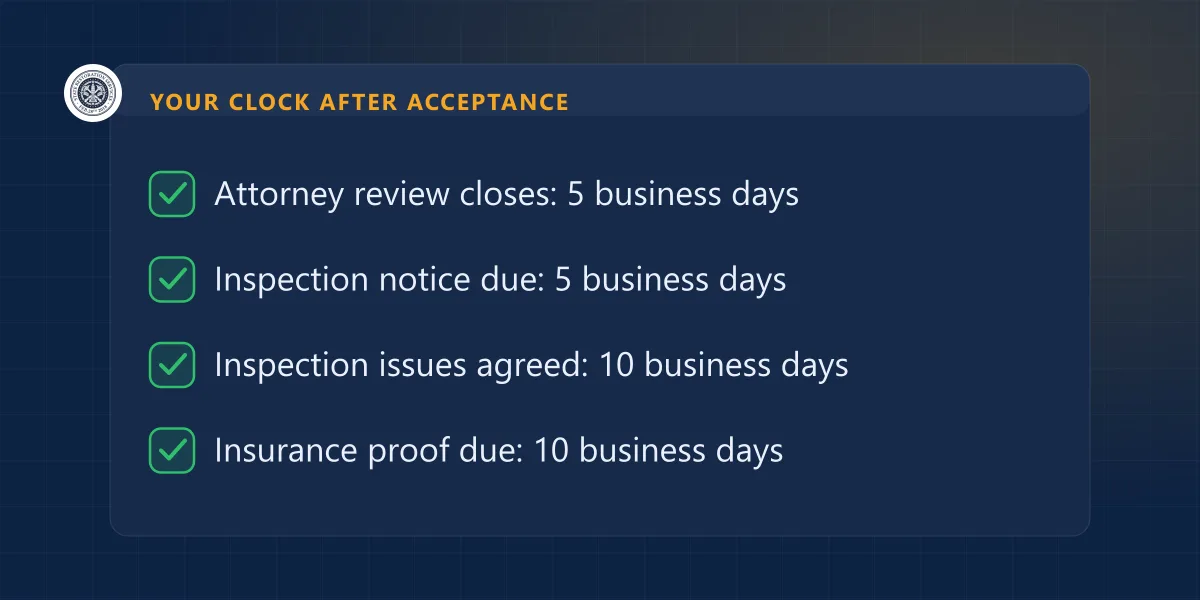
Those dates are the reason we are writing about a roof in a piece full of contract language. On the standard form, attorney review runs five business days after the Date of Acceptance. Your inspection notice on major component defects is due in the same five. If written agreement on all inspection issues has not been reached after ten business days, either party may terminate. And paragraph 12(d) is the quiet one: failure to inspect and notify within the time specified “operates as a waiver of Buyer’s rights to terminate this Contract under this Paragraph 12.”
Check the dates in your own contract rather than ours — they are negotiable, riders move them, and some deals do not use this form at all. Your attorney owns that timeline. We are roofers; we own the part where somebody actually gets on the roof.
What does a roofer’s inspection add that a home inspection is not built to give?
A different job with a different output. A home inspection is a visual survey of every system in the house on one morning. A roof inspection is one system, measured, walked when it is safe to walk, checked from the attic side, and priced. You end up holding a written replacement price your attorney can put into a request.
| What you get | Home inspection | Roof-only inspection |
|---|---|---|
| Scope | Every system in the house, in a few hours | Roof covering, flashings, valleys, gutters, attic |
| Roof access | Whatever the “methods used” line says; walking it is not required | On the roof whenever pitch, footing and weather allow |
| Measurement | Not part of the standard | Roof measured in squares, slope by slope |
| Output | Condition observed on the day, with photos | A written price for replacement, and for repair where repair is honest |
| Life estimate | Not required, and offered as a courtesy | Still not a guarantee — but tied to what we saw on the deck, in the attic, and at the flashings |
We walk through the whole sequence in what a real free roof inspection covers, so we will not repeat it here. The short version for a buyer: the attic half is the part that tells you whether the roof is aging normally or being cooked, and it is the half a rushed look skips. If you are going to end up replacing it, our residential roofing work is GAF, Owens Corning and IKO systems, and a new roof resets the warranty clock in a way a credit toward a patch does not.
The deadline that really decides an old roof is the insurance one
Paragraph 13 of the same contract makes your purchase contingent on obtaining “evidence of insurability for an Insurance Service Organization HO-3 or equivalent policy at standard premium rates” within ten business days after the Date of Acceptance. Roof age and roof condition are among the first things an underwriter asks about.
It is easy to spend all ten of those days on the inspection argument and none of them on the insurance one, which is how a roof that nobody thought was a problem ends up ending a deal. Two questions are worth asking your agent in the same phone call: whether the carrier will write the policy at standard rates with a roof of this age and material, and whether a future roof loss would be settled at replacement cost or actual cash value. The second question is money. An actual-cash-value roof settlement pays the depreciated value, which on a roof of that age is a fraction of the job — the difference is laid out in RCV versus ACV on a roof claim.
If a carrier balks at the roof age, Illinois gives homeowners specific rights and timelines on that front, and we covered them in insurance non-renewal because of your roof. Worth reading before you assume the answer is no.
What if it is storm damage rather than wear?
Then it may be an insurance claim rather than a price negotiation, and while the seller still owns the house, it is the seller’s claim to file. Hail bruising and wind creasing do not read as “age” from the ground, and a report that says “worn shingles” may be describing a storm loss that nobody has looked at properly.
That distinction changes who pays for the roof, so it is worth settling before the five days run out. If a storm caused it, the seller may have a claim; how that gets handled between the parties, and what happens to the money at closing, is the subject of selling a house with an open roof claim in Illinois. Illinois law does not let a roofing contractor negotiate an insurance claim, so we document the damage and build a code-compliant estimate; our affiliated licensed public adjuster, State Adjusting Services, is who can represent a homeowner on the claim itself. More on how we handle storm and insurance work.
One more document deserves a careful read here. On the Illinois Residential Real Property Disclosure Report the seller responds to the statement “I am aware of leaks or material defects in the roof, ceilings, or chimney.” In that form, “aware” means “to have actual notice or actual knowledge without any specific investigation or inquiry” — the seller is not required to go looking. The form says so itself, in capitals: “THE FACT THAT THE SELLER IS NOT AWARE OF A PARTICULAR CONDITION OR PROBLEM IS NO GUARANTEE THAT IT DOES NOT EXIST.” An unticked box tells you what the seller knows, and nothing about what is on the roof.
What to actually do with your five business days
Move in this order, and start the day the inspection report lands rather than the day you finish reading it. The two clocks that matter run from the Date of Acceptance, not from your inspection, so a slow start eats the window before you have anything to negotiate with.
- Read the “methods used to inspect the roof” line first. It tells you how much of the roof was actually seen, and therefore how much the estimate is worth.
- Book the roof-only look the same day. Five business days is one week, and part of it belongs to the attorneys.
- Ask for the roof in squares plus a written price — full replacement, and repair where repair is genuinely an option. A range is fine for planning; a request to the seller needs one figure.
- Ask directly whether anything looks like storm damage rather than wear. The answer decides whether this is a credit conversation or a claim conversation.
- Hand your attorney the written price. They can put a figure into a request; “the roof is getting on” gives them nothing to ask for.
- Run the insurance quote in parallel. That contingency has its own ten-day clock and it does not wait for the roof discussion to finish.
For what the number is likely to look like, here are the installed ranges we quote across the north and northwest suburbs. Your roof lands where it lands based on size, pitch, layers and access — the full breakdown is in what a new roof really costs in the Chicago suburbs.
| Roof | Installed range |
|---|---|
| Architectural asphalt shingles, typical suburban home | $9,000 – $18,000 |
| Premium or designer shingle systems | $18,000 – $28,000 |
| Standing-seam metal | from about $20,000 |
| Priced by the square (100 sq. ft. of roof) | $450 – $1,150 |
Whether a seller credits any part of that is a negotiation between attorneys, and we have no business predicting it. Our job is to make sure the figure on the table was measured off the roof you are buying.
Related reading: what a real free roof inspection covers and how long a roof actually lasts in our freeze-thaw climate.
Frequently asked questions
Can a home inspector say my roof needs to be replaced?
They can report what they observed and recommend evaluation by a roofing contractor. Under the Illinois Standards of Practice a licensed home inspector is not required to determine the service life expectancy of any component, so a replacement recommendation is a referral rather than a finding you can take to the bank.
Is a 20-year-old roof a defect I can ask the seller to fix?
Not under the standard Multi-Board 7.0 language. A major component is deemed to be in operating condition, and therefore not defective, if it does not constitute a current threat to health or safety and performs the function for which it is intended, regardless of age or if it is near or at the end of its useful life.
How long do I have to get a roofer out after the home inspection?
On the standard Illinois form, notice of major component defects is due within five business days after the Date of Acceptance, and the parties have ten business days to reach written agreement on inspection issues. Read the dates in your own contract, because they are negotiable and riders change them.
Should I get a roof inspection if the home inspector did not flag the roof?
If the roof is somewhere past fifteen years old, or the report says it was viewed from the ground, it is worth a look. A roof-only inspection is free with us, and it produces a measured replacement price, which is the thing your attorney can actually put into a request.
Buying a house and the roof line worries you? Book a free roof inspection or call (866) 992-2982 — we serve the north and northwest Chicago suburbs, and we will get on the roof and put a measured price in writing for you.