
 Volodymyr Lukaniuk
Quick answer: A roof insurance non-renewal in Illinois comes with rights most homeowners never hear about: written notice 30 or 60 days out with a specific reason, up to 90 days to repair the defect under 215 ILCS 5/143.27, a licensed contractor's certificate as the proof of that repair, a 20-day window to appeal to the Director of Insurance, and the FAIR Plan if nobody else will write you.
The letter turns up in a plain envelope from your own insurance company, and it says your policy will not be renewed. Somewhere in the second paragraph is the reason: the roof. These are among the calls we take every year, and the homeowner on the other end almost always believes there are two choices — buy a roof this month, or go without coverage. There is considerably more room than that, and most of it is written into Illinois law.
We are a family-owned roofing company based in Lincolnshire, working across Lake and Cook County since 2018. We do not sell insurance and we have no say in your carrier's underwriting. What we can do is explain what the roof half of that letter means, what the state requires your insurer to do before and after sending it, and what the repairs on that list actually cost in this market.
Why would an insurance company drop a policy over the roof?
Because the roof is the part of a house most likely to turn into a five-figure claim, and it is the only part a carrier can assess without knocking on your door. Age, granule loss, patched sections, lifted tabs, tree overhang and dark streaking all feed a risk score. Most non-renewal letters we are shown cite condition, age, or both.
The numbers behind that decision are company underwriting guidelines, not law, and they are not published. Broadly, carriers get cautious about asphalt shingle roofs somewhere past 15 years and much more cautious past 20. Plenty of insurers do not drop those homes at all — they move them onto a scheduled roof settlement endorsement, which pays a fixed percentage of replacement cost by roof age instead of the full amount. If you were offered a renewal with a new roof endorsement rather than a non-renewal, that is what happened, and it is worth reading before you sign.
| What the letter says | What the underwriter is usually looking at |
|---|---|
| "Condition of the roof covering" | Lifted, curled or missing shingles, exposed underlayment, a visible patch or tarp |
| "Age of the roof covering" | The install year on file, or an estimate from imagery — often wrong if the roof was replaced and never reported |
| "Deferred maintenance" | Debris in the gutters, moss, overhanging limbs, an unrepaired flashing detail |
| "Prior loss history" | Two or more paid claims in a short window, roof-related or not |
| "Underwriting guidelines" | The vaguest and the most appealable — Illinois requires the specific fact behind it |
Can an Illinois insurer non-renew because my roof is old?
In practice, yes. Illinois bars a carrier from non-renewing over the age or location of the property itself, along with the age, gender, race, color, ancestry, marital status or occupation of the occupants. The condition of a roof covering is treated as a separate underwriting question, and no Illinois statute sets a maximum roof age. What the state does control is how much warning you get and what the letter has to tell you.
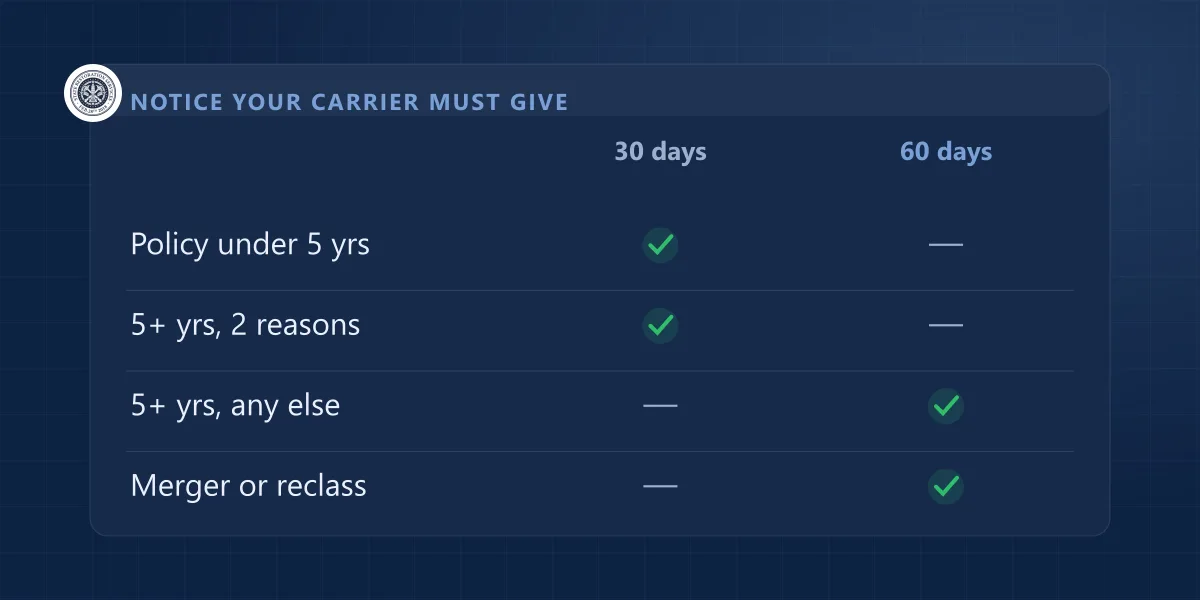
The deadline depends on how long the policy has been continuously in force. Under five years, the carrier owes you at least 30 days. At five years or more, it gets 30 days only for two narrow reasons — that you obtained the policy by giving misleading or incorrect information, or that a significant change has occurred such that there is a measurably greater chance of a loss — and 60 days for anything else, which is where "the roof is 21 years old" lands. A merger, restructure or reclassification of your policy is also a 60-day notice, and non-payment of premium is 10 days.
Those rules come from 215 ILCS 5/143.17 and the Illinois Department of Insurance's own consumer fact sheet on non-renewed homeowners policies. Check the postmark against the expiration date before you do anything else. A short notice on a policy you have held for a decade is worth a phone call on its own.
What does the non-renewal notice actually have to tell you?
It has to give a specific reason with a factual basis behind it, not a one-word label. It has to tell you that you can appeal, and that you may be eligible for the Illinois FAIR Plan. It also goes to your agent or broker and to your mortgage holder, which is why the bank sometimes calls you before you have opened the envelope.
The Department is blunt about the reason: a company "may not simply state 'fraud' or 'misrepresentation'" without providing a factual basis. The same logic applies to the roof. "Underwriting guidelines" is a label. Illinois requires the fact behind it. If that is all your letter says, call the carrier and ask, in writing, what specifically about the roof failed, on what date it was observed, and what evidence it is relying on. You are entitled to an answer, and you will need it for every step that follows.
Two more things live in that notice. The statute requires the company to keep proof of mailing, though not proof that you received it. And if you believe the carrier skipped a required step, you can ask the Director of Insurance for a hearing — but the written request has to reach the Department at least 20 days before the expiration date. That deadline arrives faster than the non-renewal does, so put it on the calendar the day the letter lands.
The 90-day repair window most homeowners never hear about
This is the part that surprises people. Under 215 ILCS 5/143.27, an insurer may not issue a cancellation or non-renewal notice on property "capable of being rehabilitated" without first allowing the insured a reasonable period to repair the defects. The statute caps that period at 90 days, and it names how the repair gets proved: "a certificate from a licensed contractor or architect", with the work "in compliance with local municipal building codes".
The clock is started by the insurance company's notice of the need for repair, which it may send at any time during the policy term — not automatically by the non-renewal letter itself. If a repair notice never arrived and your roof is fixable, that is exactly the question to put to your carrier in writing: is it treating this as a repairable defect, what does it need repaired, and what will it accept as proof.
Be clear-eyed about what the section does and does not do. It does not force a carrier to renew you, and it does not apply to a roof that is genuinely past rehabilitation. What it does is give you a defined window to fix a roof that can be fixed. What we can supply for that window is documentation: a dated written roof inspection report with photographs and an itemized scope of the repair, so that what you send the underwriter matches what was actually done. If your carrier has its own form, send it over with the estimate request rather than after the work.
When an algorithm scored your roof from an airplane
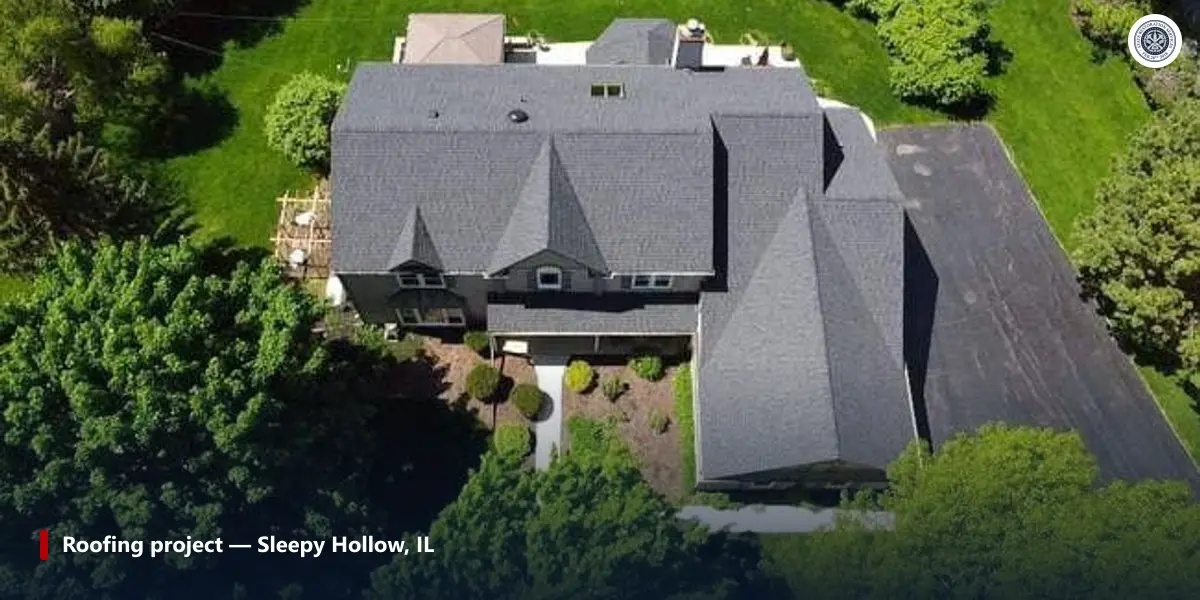
A growing share of these decisions start in the air. Vendors fly fixed-wing aircraft and drones or pull satellite imagery, and a model scores roof condition, tree overhang, debris and outbuildings without anyone setting foot on the property. It is legal, homeowners are rarely told it happened, and it is regularly wrong about what it is looking at.
NPR reported on the practice in 2025, and the consumer non-profit United Policyholders has been collecting these cases and advising homeowners to contact the insurer, request the detailed reasons, ask to see the photos, correct outright errors — their example is a skylight mistaken for damaged tile — ask what steps would reverse the decision, and shop for replacement coverage immediately. A few states have started writing rules about how recent those images must be and whether you get to see them; Illinois has not.
On a north-suburban roof, the things we most often see misread from above are the dark algae streaking that is cosmetic on an otherwise sound roof, a valley sitting in deep shade, a section still under repair on the day of the flyover, and a roof that was replaced two years ago with the carrier's records never updated. Every one of those is answerable with a date-stamped photograph taken from the roof rather than from an aircraft. We can put a person up there and document what is actually on your house. We cannot make your carrier look at it, and we will not pretend otherwise.
What if nobody will write the policy?
That is what the Illinois FAIR Plan Association exists for. It is the state's residual market — basic property insurance for owners who have been turned down in the standard market. It is narrower and more expensive than a normal homeowners policy, and most homeowners carry it for a year or two while the roof gets dealt with.
To qualify, the property has to be in Illinois, occupied, safe and structurally sound, and you have to have been unable to get coverage elsewhere. Vacant homes are not eligible. You apply through a licensed insurance agent, not directly; if you do not have one, the Plan will give you a list. It writes homeowners and dwelling fire policies, and its statewide average rate rose 11.6% for new and renewal policies effective April 1, 2026. You can reach their office at (312) 861-0385.
The FAIR Plan keeps your mortgage lender satisfied while the roof gets sorted out, and a documented new or repaired roof usually reopens the standard market at the next renewal. Do not let the letter panic you into treating the FAIR Plan as permanent.
Is it worth replacing the roof just to keep the policy?
Sometimes, and often not yet. If the underwriter flagged three lifted tabs and a cracked pipe boot, that is a few hundred dollars of work rather than a roof. If the roof is 22 years old, shedding granules into the downspouts, and this is the second carrier in three years to say no, the replacement was already due and the letter has only set the date.
| What the carrier flagged | Typical Chicago-suburb range | Usually enough for an underwriter? |
|---|---|---|
| Cracked pipe boot collar | $250–$450 for the first, $100–$200 each after | Yes, with photos of the finished work |
| A handful of lifted or missing shingles | A few hundred up to about $1,500 | Usually, if the rest of the roof is sound |
| Heavy algae streaking or moss | $350–$700 soft wash; $150–$400 for a zinc strip | Often, and it removes the visual trigger |
| Debris, overhanging limbs, clogged gutters | Quoted per home — we price it before we start | Yes, and it is the cheapest item on the list |
| End-of-life asphalt roof, 20+ years | $9,000–$18,000 installed, roughly $450–$1,150 per square | Yes, and it resets the age field for good |
If the honest answer is a full replacement, take a real look at the timing rather than the deadline in the letter — our guide to how we decide between repair and replacement walks through the five things we check on the roof itself. Residential roofing work of this size does not have to be paid in one lump either; we offer financing options for exactly this situation, where the calendar is set by someone else.
One warning, because a non-renewal letter is a magnet for it. The out-of-town crew that shows up the week after a storm and offers to "handle the insurance company for you" is not the answer to this problem — a non-renewal is an underwriting decision, and there is nothing to negotiate. If your roof does have real storm damage, that is a separate matter and a genuine storm and insurance claim; Illinois law does not permit a roofing contractor to negotiate a claim on your behalf, which is why that work belongs to our affiliated licensed public adjuster, State Adjusting Services. Anyone offering to do both has told you something useful about themselves.
Related reading: Scheduled roof settlement in insurance explains the endorsement carriers offer instead of dropping an older roof, and hiring a roofer in the Chicago suburbs covers the licensing and insurance paperwork to check before anyone touches your house.
Frequently asked questions
Can my insurance company drop me just because my roof is old?
In practice yes, because roof age and condition are underwriting questions rather than protected characteristics. Illinois bars a carrier from non-renewing over the age or location of the property itself, but it does not set a maximum roof age. What the state controls is the notice period, the reason it must give you, and your chance to repair first.
How much notice does an Illinois insurer have to give before non-renewal?
At least 30 days if the policy has been in force under five years. If it has been in force five years or more, the carrier gets 30 days only for two narrow reasons, and needs 60 days for anything else. Non-payment of premium is a 10-day notice. The notice also goes to your agent and your mortgage holder.
Do I really get 90 days to repair my roof before the policy ends?
Section 143.27 of the Illinois Insurance Code says an insurer may not send a cancellation or non-renewal notice on property capable of being repaired without allowing a reasonable time, capped at 90 days, to fix the defect. The clock starts from the company notice of needed repair, so ask your carrier in writing what it wants fixed.
Can a public adjuster stop a non-renewal?
No. A public adjuster represents you on an insurance claim, which is a different process from underwriting. If your roof has genuine storm damage, that is a claim and Illinois law bars a roofing contractor from negotiating it, which is where a licensed public adjuster belongs. A non-renewal decision is handled with your carrier, your agent, and the Department of Insurance.
Got a letter about your roof? Book a free inspection or call (866) 992-2982 and we will document what is actually up there — we serve the north and northwest Chicago suburbs, from Arlington Heights to Lake County, Monday through Saturday. Send us the letter with your request so we know exactly what the underwriter asked for.