
 Volodymyr Lukaniuk
Quick answer: Illinois has no law forcing your insurer to pay for a shingle color match. Matching comes out of your own policy wording and out of case law — most notably a 2019 Seventh Circuit decision applying Illinois law. If your shingle is genuinely discontinued and you can document that, a full roof is a reasonable ask.
The call usually comes about ten days after the hailstorm. The adjuster has been out, the estimate has landed, and it pays for the back slope only. Nobody has said it out loud yet, but the homeowner has already done the math: the shingle color match they need has not been manufactured since 2016, so half the roof is about to be a different color from the other half. That is the argument, and it is worth having.
Here is what Illinois actually requires, what we can document for you, and what we legally cannot do about it.
Does my insurance company have to match my shingles in Illinois?
There is no Illinois statute or insurance regulation that requires matching. What you have instead is your policy’s own loss-settlement wording — usually the phrase “like kind and quality” — and Illinois case law. When the original shingle is genuinely unavailable, that combination has been read to require replacing undamaged material too.
The case people cite is Windridge of Naperville Condominium Association v. Philadelphia Indemnity Insurance Co., decided by the Seventh Circuit in 2019. A 2014 hail and wind storm damaged the aluminum siding on the south and west sides of the buildings. The insurer wanted to pay for those two sides. Siding that matched the untouched north and east sides was no longer made. The court held that each building had suffered a direct physical loss, that the policy was ambiguous about whether the covered property was a single panel, one elevation, or the whole building, and that under Illinois law an ambiguity gets read in favor of coverage. The insurer had to put matching siding on all four sides.
Two honest caveats before you print that out and wave it at your adjuster. It was siding on condominium buildings under a commercial policy, not asphalt shingles on a single-family home. And a federal appellate decision is not a statute — your carrier is free to take a different view and make you argue for it. What the case does establish is that in Illinois, whether matching material is still available is a question a carrier has to answer rather than wave off.
Why won’t the new shingles match if I order the same color?
Three things move at once. The product line gets discontinued or reformulated, the granule blend drifts between production runs, and your existing roof has been bleaching in the sun for a decade. Order the same color name today and the repair will still read as a patch from the driveway.
| What changed | What you see from the driveway |
|---|---|
| The line was discontinued or reformulated | The nearest current product has a different tab shape and shadow line, so the seam shows even within the same color family |
| Granule blend varies between production runs | Same color name, visibly different mix of light and dark granules — normal enough that manufacturers tell installers to blend bundles from more than one pallet |
| 8–15 years of UV exposure and granule loss | The old field has faded a shade or two and lost surface granules; the new slope reads darker and glossier beside it |
That last row catches people out. Even where the exact product is still on the shelf, which does happen, a brand-new bundle laid beside a twelve-year-old field will not blend for a couple of seasons, and on a shaded north-facing slope it takes longer still. Worth knowing before you spend three weeks fighting for something the carrier would actually have granted.
How do you prove a shingle match isn’t available?
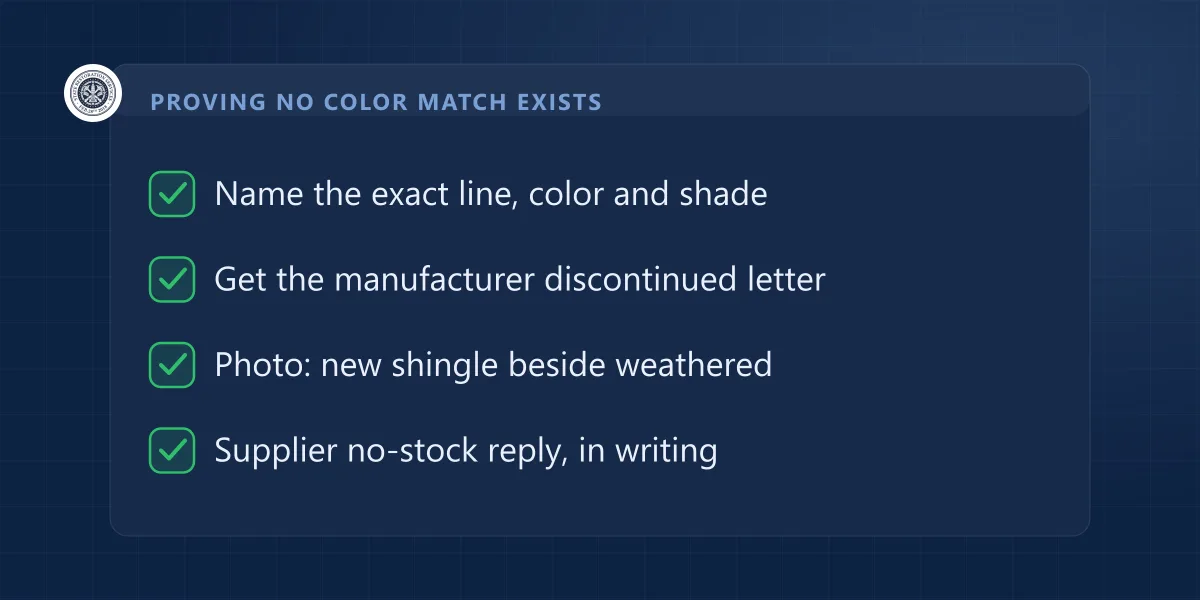
You prove it with documents. We identify the exact product line and color, ask the manufacturer for written confirmation that it has been discontinued, get a no-stock reply in writing from the distributor, and photograph a new shingle laid on the existing field in the same light. That is four pieces of paper in one packet.
- Identify the exact product. Color names travel: “Weathered Wood” exists at more than one manufacturer and has been reformulated more than once. The reliable sources are a leftover bundle wrapper in the garage or attic, the original roofing contract, the permit file at your village, or a sample shingle carried to the supply house counter.
- Get the manufacturer’s discontinuation confirmation. GAF, Owens Corning and IKO all keep records of retired lines and colors. A written confirmation that your product is no longer produced is the strongest single document in the file.
- Get the distributor’s no-stock reply in writing. “We called around and nobody has it” is worth nothing in a claim file. A dated email from the supply house saying the color is not available in this market is worth a great deal.
- Photograph the comparison. A new shingle laid on the existing field, on the same slope, in the same light, framed wide enough to show both. An adjuster reviewing the file from a desk sixty miles away cannot see your roof; they can see that photo.
Here is the part that surprises people: we hand that packet to you, not to your insurer. Illinois does not allow a roofing contractor to negotiate an insurance claim on a homeowner’s behalf. We inspect, we document, and we write a code-compliant estimate for the roofing work itself. Anyone knocking on your door after a storm promising to handle your whole claim is either unaware of that rule or hoping you are. If you want somebody representing you on the claim, that role belongs to a licensed public adjuster — our affiliated firm, State Adjusting Services, does that work, and you can read how the rest of the process fits together in our guide to filing a storm-damage roof claim in Illinois.
Will they replace the whole roof, or only the damaged slope?
It depends on how your carrier defines the covered property. Three scopes are common: the damaged slope alone, every slope visible from one standpoint, or the entire roof. Which one you get turns mostly on whether replacement material is still available, and on how much of the roof actually got hit.
| Scope the adjuster writes | What usually triggers it | What it means for you |
|---|---|---|
| Damaged slope only | Impact confined to one elevation and the original shingle still in production | One new slope; the rest of the roof keeps aging on its original clock |
| Slopes in one line of sight | Two or more slopes that read as a single surface from a normal viewing point | The visible group gets replaced; slopes around the back may not |
| Full roof replacement | The shingle is discontinued or unavailable, or damage is spread across most slopes | Everything comes off; you end up with one roof of one age and one warranty start date |
“Line of sight” deserves a word of caution. It is a carrier practice rather than an Illinois rule — you will not find it in Illinois insurance regulation, because Illinois does not regulate matching at all. Some adjusters apply it generously, and some have never used the phrase in their careers. Ask which standard is being applied to your roof and get the answer written into the scope. The same question is worth asking about siding if the storm hit your walls too, where matching disputes are even more common.
What does a slope-only settlement actually cost you?
On a typical north-suburban roof, a slope-only scope tends to land somewhere around $3,000–$6,000, while a full architectural asphalt replacement runs $9,000–$18,000 installed. Then the deductible comes off once regardless of scope, which on a small settlement can swallow a quarter of it or more.
| Slope only | Full architectural replacement | |
|---|---|---|
| Typical installed range, our service area | $3,000 – $6,000 | $9,000 – $18,000 |
| Deductible applied | Once, per claim | Once, per claim |
| What you own when the trucks leave | One new slope, the rest at its original age | One roof, one age, one warranty start date |
A main slope on a 25–30 square suburban roof is usually 8–12 squares, roughly a third of the job, which is where that $3,000–$6,000 comes from. It is a range from our service area rather than a quote — nobody can price your roof from a blog post, ours included.
Two things make the smaller number worse than it looks. The deductible comes off once per claim whatever the scope, so a flat $1,000 deductible is more than a quarter of a $3,800 slope — and if your policy carries a percentage wind-and-hail deductible, which is now common on Illinois homeowner policies, the entire slope can disappear underneath it. We walk through that math in detail in the guide to your roof insurance deductible in Illinois. The second thing is simpler: the untouched slopes keep aging while the new one starts over, so a partial roof often means buying the rest of it out of pocket a few years later.
What do I do if the carrier says no to matching?
Ask for the decision in writing and for the specific policy provision it rests on. Then send the unavailability packet and request a re-inspection with your roofer on the roof. If it stays denied and the gap is large, that is the point where a licensed public adjuster earns their fee — not before.
- Get the scope and the denial in writing, with the policy provision named. A verbal “we don’t do matching” from an adjuster on a phone call is not something anyone can review.
- Send the four-document packet and ask for a re-inspection. Ask to have your roofer present so the same shingle is being looked at by both parties.
- Call your agent and ask whether your policy carries any endorsement addressing matching or uniform appearance. Most Illinois homeowner policies do not, but one phone call settles it.
- Check whether anything else got missed while the scope was being narrowed — missing drip edge, ice-and-water shield, ventilation. Those belong in the estimate on their own footing; see what code-upgrade coverage pays for on a roof claim.
- Then decide whether the remaining gap is worth escalating. A public adjuster works on a percentage of the settlement, so the size of the disagreement decides whether the math works.
One thing to refuse outright: any contractor offering to cover your deductible, rebate it, or quietly build it into the price so the matching argument goes away. That is illegal in Illinois, and a company willing to break that rule in the first conversation is telling you exactly how the rest of the job will go. Straightforward storm and insurance claim documentation is the honest route, and if the timing is awkward, financing exists for the gap.
Related reading: siding storm damage and when it becomes an insurance claim and what hail damage on an asphalt roof actually looks like.
Frequently asked questions
Does Illinois law require insurance to match my shingles?
No Illinois statute or insurance regulation requires matching. It comes down to your policy’s loss-settlement wording and to case law, including a 2019 Seventh Circuit decision applying Illinois law that required an insurer to replace undamaged siding once a match was no longer available.
What happens if my shingle color has been discontinued?
Document it. Get written confirmation from the manufacturer that the line or color is no longer produced, plus a dated no-stock reply from the distributor. Proven unavailability is what moves a partial-roof scope toward a full replacement.
Can my roofer argue the matching issue with my insurance company?
No. Illinois does not allow a roofing contractor to negotiate a claim for a homeowner. We inspect, document and write a code-compliant estimate. Representation on the claim itself is the job of a licensed public adjuster, such as our affiliated firm State Adjusting Services.
Will new shingles eventually blend in with the old ones?
Partly, over a few seasons, as the new shingles weather and lose their factory sheen. They rarely blend completely, and on a shaded slope the difference lasts longer. If the original product was discontinued, the tab shape and shadow line will not blend at all.
Got an estimate that pays for one slope? Book a free inspection or call (866) 992-2982 — we will document what is actually up there. We are family-owned, based in Lincolnshire, and rated 4.9 stars from 92 Google reviews across the north and northwest Chicago suburbs.