
 Volodymyr Lukaniuk
Quick answer: Your mortgage company is on the roof insurance check because the Mortgage Clause in your policy makes any dwelling loss payable to the mortgagee and you together. On most conventional loans the servicer endorses the check straight back to you when the claim is under $40,000. Above that it deposits the money and releases it in draws as the repairs are inspected.
The hail comes through, the adjuster writes the estimate, the envelope finally shows up — and there is a name on the check that you did not expect. Finding your mortgage company on the insurance check is not a mistake and it is not your carrier being difficult. It is the paperwork you signed at closing doing exactly what it says it does. What follows is where that name comes from, what your servicer is actually allowed to do with your roof money, the dollar line that decides whether you get the check back in a week or wait through inspections, and what to do when the money sits there and nobody calls you back.
Why is your mortgage company’s name on the roof insurance check?
Because your lender is a named mortgagee on the policy, and the policy’s Mortgage Clause makes dwelling losses payable to both of you. The standard homeowners form reads: “If a mortgagee is named in this policy, any loss payable under Coverage A or B will be paid to the mortgagee and you, as interests appear.” Coverage A is your roof.
That condition is lettered L in the newer editions of the form and K in the 2000 edition published by the Insurance Information Institute, but the sentence itself has not changed. Your carrier has no discretion here. It pays the way the policy tells it to pay.
The reason the mortgagee is named at all sits one document over, in the mortgage itself. Section 5(c) of the Illinois single-family mortgage (Fannie Mae/Freddie Mac Form 3014) requires that every policy the lender requires “must include a standard mortgage clause” and “must name Lender as mortgagee and/or as an additional loss payee.” It reaches coverage the lender never asked for, too: buy extra property insurance on your own, and that policy has to carry the same clause.
So the check has two or three names on it because the house securing a loan got damaged, and the party holding that loan has a contractual say in how the damage gets repaired.
Can the bank keep the money, or does it have to pay for the roof?
It has to put the money toward the roof in almost every ordinary case. Section 5(d) of the same mortgage says insurance proceeds “will be applied to restoration or repair of the Property, if Lender deems the restoration or repair to be economically feasible and determines that Lender’s security will not be lessened by such restoration or repair.” Fixing a hail-damaged roof is the textbook version of both.
The next sentence is the one worth writing down: “If the Property is to be repaired or restored, Lender will disburse from the insurance proceeds any initial amounts that are necessary to begin the repair or restoration.” Your servicer is not entitled to sit on the whole balance until the job is finished. Money is supposed to come out to start the work.
The escape hatch runs the other way. If the lender decides repair is not economically feasible, or that its security would be lessened, the proceeds go to the loan balance instead, “with the excess, if any, paid to Borrower.” That clause does real work after a fire that takes the whole house. On an ordinary shingle claim against a mortgage many times its size, it almost never comes up.
| What happens to the check | What triggers it | Where the rule lives |
|---|---|---|
| Endorsed and mailed back to you | Claim below the servicer’s threshold and the loan is current | Servicer policy, following investor guidelines |
| Deposited and released in draws | Claim above the threshold, or the loan is delinquent | Mortgage Section 5(d); Fannie Mae B-5-01 |
| Applied to your loan balance | Lender decides repair is not economically feasible | Mortgage Section 5(d) |
At what dollar amount does the servicer just endorse the check back?
On a conventional loan that is current, the common line is $40,000. Fannie Mae’s Servicing Guide B-5-01 authorizes an initial release “up to the greater of $40,000; 33% of the insurance loss proceeds” and adds that “receipts are not necessary if the loss proceeds are less than or equal to $40,000.” Servicers publish that same figure to borrowers.
Freedom Mortgage, for one, tells its customers it endorses and returns checks under $40,000 in about six to eight business days, and deposits anything larger into a restricted account while it monitors repairs. Yours may draw the line somewhere else, so the first phone call is worth making before the check arrives.
Run that against real numbers. A full architectural shingle replacement in the north and northwest suburbs lands at roughly $9,000 to $18,000, and premium designer shingles at $18,000 to $28,000. A roof-only claim therefore sits under the threshold most of the time, and the file that goes to the loss-draft department is a formality rather than a project. Where homeowners get surprised is the multi-trade hailstorm: roof plus siding plus gutters plus a few windows on the same date of loss is one claim, one check, and it crosses $40,000 without anybody planning for it.
| Loan status when the loss is reported | Initial release | How the rest comes out |
|---|---|---|
| Current, or 31 days or less delinquent | The greater of $40,000 or 33% of the proceeds | Approved repair plan, then draws as work is inspected |
| More than 31 days delinquent, proceeds $5,000 or less | The whole amount, in one payment | Nothing further to schedule |
| More than 31 days delinquent, proceeds above $5,000 | 25% of the proceeds, capped at $10,000 | Increments of up to 25% after each inspection, then a final inspection |
Those are Fannie Mae’s numbers for loans it owns. Freddie Mac, FHA, VA and USDA loans each run their own version, and a servicer is free to be more generous than its investor requires. FHA’s published direction is the most borrower-friendly on its face: HUD tells servicers to “expedite the release of insurance proceeds for needed home repairs after approving a Viable Repair Plan,” and to release personal-property and temporary-housing money to the borrower promptly without netting it against an arrearage. Ask which investor owns your loan before you assume which rulebook applies.
What does the loss-draft department actually want from you?
Four things, in most packets: the check signed by every payee on it, the adjuster’s estimate or worksheet, a signed contract with the contractor doing the work, and that contractor’s W-9, license and certificate of insurance. Larger files add lien waivers and a completion affidavit at the end.
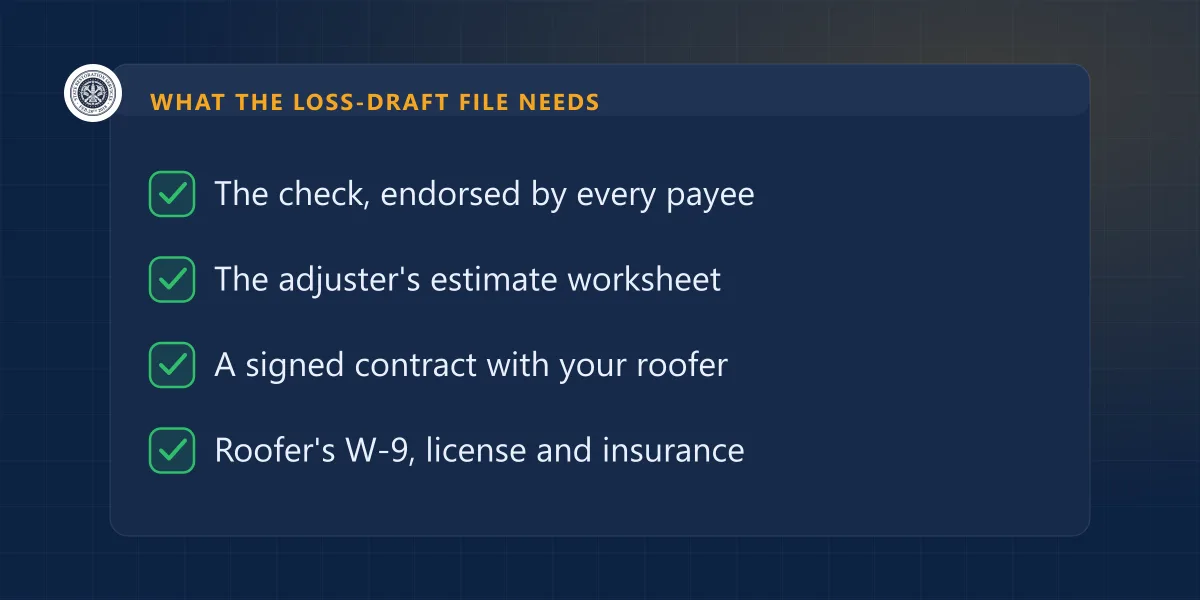
The contractor paperwork is not busywork. Section 5(d) lets the lender hold proceeds until it has inspected the property and is satisfied the work meets its standards, and it spells out that this “may include satisfying Lender’s minimum eligibility requirements for persons repairing the Property, including, but not limited to, licensing, bond, and insurance requirements.” Your servicer can decline to release your money to a crew that cannot produce a license and a certificate of insurance.
This is usually where the out-of-town door-knocker stops returning calls. We hand over our license, our certificate of insurance and a W-9 as a matter of course — the same documents are on our licensed and insured page. The licensing checks worth running on any Illinois roofer exist to protect you, and it turns out your bank runs a version of them as well.
How do staged draws work when a roof only takes two days?
They work badly unless somebody plans around them. The draw model was built for fires and floods, where a house is rebuilt over months and an inspector can meaningfully look at 30%, 60% and 90% of the work. A roof is torn off and finished before the first inspection could even be scheduled, so the sequencing has to be handled up front rather than discovered halfway through.
Two things in the rules help. The mortgage requires that the lender’s inspection “must be undertaken promptly,” and Fannie’s initial release of the greater of $40,000 or 33% is available before a single shingle comes off. On a claim that clears the threshold, the workable order is: open the loss-draft file the week the estimate is approved, get the initial disbursement scheduled, book the tear-off after that money moves, and let the final inspection release the balance once the job is done and photographed. On a delinquent loan the increments are 25% at a time with a final inspection at the end, so the balance sits until an inspector has been out.
The alternative — finish the roof first and ask for the money afterwards — is legal and common, and it means somebody carries the full cost until the servicer releases the funds. That is a decision worth making deliberately at the start, not discovering at the end.
Who pays for the roof while the servicer is holding the money?
You do, at least at the start, and three separate amounts are involved. Your deductible never comes from the carrier at all. Your recoverable depreciation is held back until the work is finished and invoiced. And on a claim over the threshold, the actual cash value payment is sitting in the servicer’s account rather than yours.
One line in the mortgage catches people who hired help on the claim, and we will say it plainly because we have a partner public adjuster: “Fees for public adjusters, or other third parties, retained by Borrower will not be paid out of the insurance proceeds and will be the sole obligation of Borrower.” If you retain a public adjuster, that fee is yours to pay and your servicer will not release proceeds to cover it. That is worth knowing before you sign the fee agreement.
The workable answer is to line up how the deposit and the gap get funded before the crew is scheduled — savings, our 0% in-house plan or a longer-term lender, or a start date that waits on the initial disbursement. Then recover the depreciation once the final invoice goes in, which is the piece homeowners most often leave on the table.
Is there an Illinois law that makes your servicer move?
No, and it is better to know that than to wait for one. Illinois has a Mortgage Escrow Account Act, but it defines an escrow account as one “into which the borrower is required to make regular periodic payments and out of which the lender pays the taxes on the property.” Claim proceeds appear nowhere in it. Your leverage here is federal and contractual.
The tool with actual teeth is a written notice of error under the federal mortgage servicing rules. 12 CFR 1024.35 lists ten specific servicing errors and then adds a catch-all — “any other error relating to the servicing of a borrower’s mortgage loan” — which is wide enough to cover a loss-draft file that has gone quiet.
Put your name, your loan number and a plain description of what went wrong into a letter, and the clocks below start running. Send it to the address the servicer designates for notices of error. It is allowed to require a specific one, and a letter that lands in the wrong department starts nothing at all.
| Step | Deadline | Counted in |
|---|---|---|
| Servicer acknowledges your notice of error in writing | 5 days | Business days, excluding weekends and federal holidays |
| Servicer investigates and responds | 30 days | Business days, excluding weekends and federal holidays |
| Response on a payoff-balance error | 7 days | Business days, excluding weekends and federal holidays |
Two calls to the loss-draft line will usually beat a letter, and a letter is what you have when the calls stop working.
If the carrier denied your claim, can your lender still get paid?
Yes. The Mortgage Clause protects the lender’s interest separately from yours, and it says so directly: “If we deny your claim, that denial will not apply to a valid claim of the mortgagee,” provided the mortgagee meets three conditions of its own.
Those conditions are that it notifies the carrier of any change in ownership, occupancy or risk it knows about, pays any premium you neglected to pay, and submits a signed, sworn statement of loss within 60 days of being told you failed to.
The mortgagee’s interest survives your denial, in other words, and it has its own path to appraisal, its own suit-against-us clock and its own loss-payment rights. And if the carrier pays the mortgagee while denying you, it is subrogated to the mortgagee’s rights under the mortgage. This is not a shortcut for a homeowner whose claim was denied, but it explains why a servicer sometimes engages with a carrier that has stopped engaging with you.
Related reading: the documents your insurer must send you on an Illinois roof claim covers the paperwork moving the other direction, and selling a house with an open roof claim deals with what happens to a loss draft when the loan is paid off at closing.
Frequently asked questions
Can I just sign the insurance check myself and deposit it?
No. A check that names your mortgage servicer as a payee needs that servicer’s endorsement before any bank will take it, and signing on their behalf is check fraud. Send it to the loss-draft address on their claim packet and let them endorse it properly.
What if my mortgage is paid off?
Then no mortgagee is named on the policy and the check comes to you alone, with no draw schedule and no inspections. It is worth checking your declarations page anyway, because a lender that was paid off years ago sometimes stays listed and ends up printed on the check.
Does the servicer pay me interest while it holds my roof money?
Usually not. The Illinois mortgage form says the lender is not required to pay interest or earnings on insurance proceeds unless the lender and borrower agree in writing or applicable law requires it. Fannie Mae does require the servicer to hold undisbursed proceeds in an interest-bearing custodial account, which is a different thing from paying that interest to you.
Can the servicer pay my roofer directly instead of paying me?
Yes. Section 5(d) of the standard Illinois mortgage lets the lender make disbursements directly to the borrower, to the person repairing the property, or payable jointly to both. Which one your servicer chooses is its call, and it is worth asking before the crew starts so everyone knows who is getting the draw.
Storm damage on your roof and a check you cannot cash? We build the estimate, hand your servicer the license, insurance and W-9 it needs, and work the draw schedule with you. Book a free inspection or call (866) 992-2982 — we are a family-owned roofer in Lincolnshire serving the north and northwest Chicago suburbs, and you can reach us during normal business hours. More on how claims work on our storm and insurance page.