
 Volodymyr Lukaniuk
Quick answer: The roof claim documents an Illinois insurer owes you are fixed by state regulation, not by an adjuster’s goodwill. A denial or a low offer needs a written explanation naming the policy language, within 30 days of the decision. A claim open past 75 days needs a delay letter. And on request, the company must hand over the estimate behind its number and the worksheet showing how it depreciated your roof.
When a homeowner calls us about a claim, the problem is usually the same one: a number they do not understand, and nothing in writing that explains it. The documents an Illinois insurer owes you are not a courtesy and they are not something you have to negotiate for. They sit in a state regulation called 50 Ill. Adm. Code Part 919, the Department of Insurance rule on improper claims practice, most recently amended effective January 17, 2025.
We are a family-owned roofing contractor in Lincolnshire, and Illinois law bars a roofer from negotiating your claim, so nothing below is us offering to argue with your adjuster. It is a list of paper you are entitled to, the deadline attached to each piece, and the words to use when you ask. Knowing what is supposed to arrive, and when, costs you nothing.
What is your insurance company actually required to send you?
Eight things, roughly. Some arrive on their own clock and some only arrive if you ask for them, which is the part the letters themselves never mention. Part 919 sets minimum standards for how claims are investigated and settled in Illinois, and a homeowners policy on a one-to-four-family home falls squarely inside it.
That last point matters more than it looks. Several of the strongest rules live in a subsection headed Fire and Extended Coverage Claims, which sounds like it belongs to house fires. It does not. 215 ILCS 5/143.13(b) defines a policy of fire and extended coverage insurance as one that “includes but is not limited to, the perils of fire and extended coverage, and covers real property used principally for residential purposes up to and including a 4 family dwelling.” Your homeowners policy is that policy. Hail and wind on your roof are that claim.
| Document | When it is due | Rule |
|---|---|---|
| Payment of the parts of the claim that are not in dispute | Within 30 days of the carrier affirming liability | 919.50(a) |
| Written explanation of a denial or an offer lower than you claimed | Within 30 days after the investigation and liability decision are finished | 919.50(a)(1) |
| Notice of Availability of the Department of Insurance | Attached to that same explanation | 919.50(a)(1) |
| Written explanation for a delay | 75 calendar days from the date you reported it, or 25 calendar days after your proof of loss — whichever is less | 919.80(d)(7)(B) |
| A copy of the estimate the settlement is based on | On request | 919.80(d)(7)(C) |
| A written response to your own higher estimate, naming a contractor | Promptly, in writing | 919.80(d)(7)(C) |
| The worksheets showing every depreciation deduction | On request | 919.80(d)(8)(A) |
| How many days your time to sue was paused, and how many are left | At the time of a denial in whole or in part | 919.80(d)(8)(C) |
Five of those eight arrive on their own. The other three exist only if you ask for them, and asking is a two-line email.
What has to be in a denial or short-payment letter?
The policy language the decision rests on. Section 919.50(a)(1) requires the written explanation to “clearly set forth the policy definition, limitation, exclusion or condition upon which denial was based.” A letter that says your claim does not meet policy requirements, without naming which requirement, has not done what the rule asks.
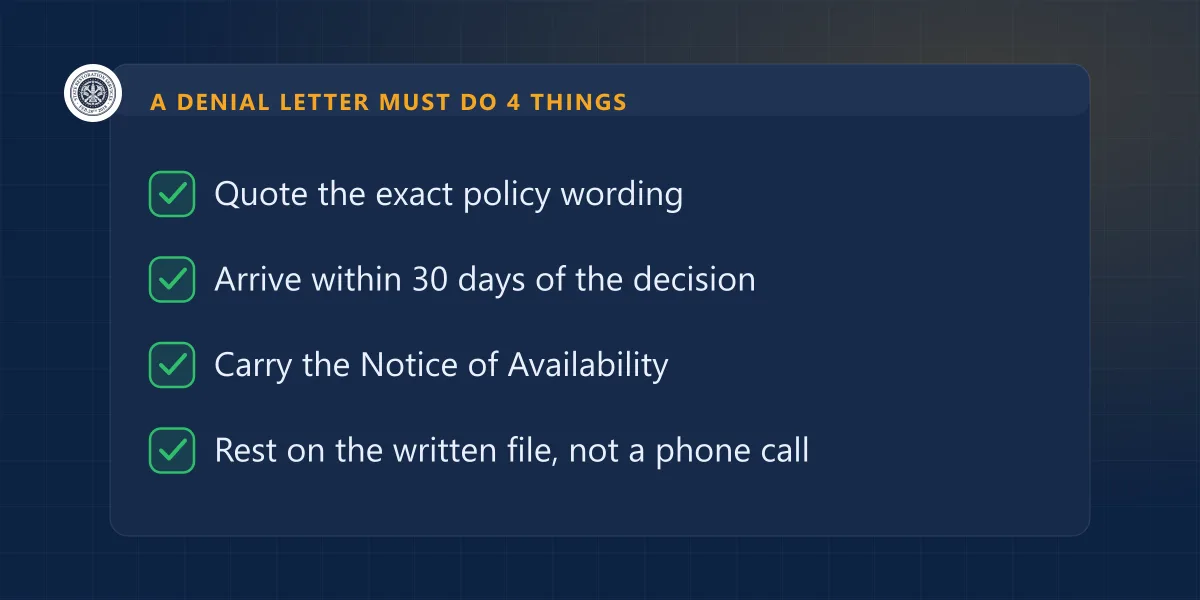
The same section sets the clock: 30 days after the investigation and the determination of liability are completed. Note the wording, because it is not 30 days from the storm and it is not 30 days from your phone call. It runs from the point the carrier finished deciding, which is why a file that never seems to finish deciding also never seems to produce a letter.
Then there is a rule about phone calls that is worth knowing. Under 919.50(b), “No company shall deny a claim upon information obtained in a telephone conversation or personal interview with any source unless such telephone conversation or personal interview is documented in the claim file.” If a decision traces back to what somebody said on a call, that call has to be written down in the file. Section 919.30(c) backs it up by requiring detailed documentation in every claim file “in order to permit reconstruction of the company’s activities.”
| What carries weight in a denial letter | What does not |
|---|---|
| Names the exact policy definition, limitation, exclusion or condition | “The damage does not meet policy requirements” |
| Points at something recorded in the claim file | An adjuster’s recollection of a call that is not in the file |
| Arrives in writing within 30 days of the decision | A voicemail saying the claim has been closed |
| Comes with the Notice of Availability attached | A letter that never mentions the Department at all |
One more, from 919.90(a): a claim “shall not be denied on the basis of failure to exhibit property unless there is documentation of breach of the policy provisions in the claim file.” If you are told the claim died because nobody could get on the roof, the file has to show that you actually refused.
What is the Notice of Availability, and why does it matter?
It is a fixed paragraph, defined word for word in 919.40, telling you the Department of Insurance exists and where to find it. It has to accompany a denial, a lower-than-claimed offer, and a delay letter. Its absence is easy to spot, and easy to raise.
The rule says the notice “shall be no less informative than the following: Part 919 of the Rules of the Illinois Department of Insurance requires that our company advise you that, if you wish to take this matter up with the Illinois Department of Insurance, it maintains a Consumer Division in Chicago at 115 S. LaSalle Street, 13th Floor, Chicago, Illinois 60603 and in Springfield at 320 West Washington Street, Springfield, Illinois 62767.”
Two details worth carrying away. First, the Chicago address in the current rule is 115 S. LaSalle Street; the older version of the same paragraph gave 122 S. Michigan Ave., 19th Floor. A 2026 letter still printing the Michigan Avenue address is running on an old template. That alone is not a violation of anything, but it is a reasonable prompt to read the rest of the letter closely.
Second, the Department has complained about this in public. In a July 2016 bulletin to all insurers doing business in Illinois, it wrote that “frequent errors either inadvertent or otherwise persist in providing accurate Notice of Availability information to Illinois insureds and claimants,” and said its complaints sections and market conduct unit would be “paying particular attention to this issue going forward and issuing corrective actions and penalties as necessary.”
While we are here, one piece of tidying. Part 919 does have an Exhibit A, and it is not the Notice of Availability — Exhibit A is a consumer brochure titled Total Loss Automobile Claims, which has nothing to do with your roof. The Notice of Availability is a definition in 919.40. If you go looking for it under Exhibit A you will end up reading about salvage vehicles instead.
How long can a roof claim go quiet before they owe you a letter?
Seventy-five calendar days from the date you reported it, or 25 calendar days after the company received your proof of loss, whichever comes first. At that point 919.80(d)(7)(B) requires a reasonable written explanation for the delay, with the Notice of Availability attached. The letter is owed automatically; you do not have to request it.
The same subsection sets a benchmark the Department watches across a whole book of business rather than on your file alone: an unreasonable delay on fire and extended coverage claims “exists when a median payment period exceeds 40 calendar days.” That is a market-conduct yardstick, not a promise about your claim, and it is worth being clear about the difference.
Two definitions in 919.40 fill in the earlier part of the timeline. “Reasonable Promptness” means a maximum of 15 working days to respond to a communication from you. “Prompt Investigation” requires a genuine effort to contact you within 21 working days of the notification of loss where liability is reasonably clear. If a month has gone by with nothing, those are the two phrases to put in your email.
We have written separately about what to do when the file has gone quiet for months rather than weeks — that is a different problem with a different remedy, and it is covered in our guide to an insurance company delaying a roof claim in Illinois. The broader question of what a homeowners policy covers when water is already coming through the ceiling is in does homeowners insurance cover a roof leak.
Can you make them show how they calculated depreciation?
Yes, and it is written down as an entitlement rather than a courtesy. On an actual cash value settlement, Section 919.80(d)(8)(A) requires the company to provide, upon your request, a copy of the claim file worksheets detailing every deduction for depreciation, including the age, condition and expected life it used.
The rule’s own words: “Upon the insured’s request, the company shall provide a copy of the claim file worksheet(s) detailing any and all deductions for depreciation, including, but not necessarily limited to, the age, condition, and expected life of the property.” The same subsection defines the calculation itself as replacement cost of the property at the time of loss, less depreciation.
Depreciation is the deduction that separates the first check from the cost of the work, and that gap is the number homeowners call us about. The worksheet turns it from a mystery into an arithmetic problem, because it has to state the age, the condition and the expected life the carrier used.
Expected life is the row to read first. If a fifteen-year-old architectural shingle roof has been depreciated against a twenty-year expected life, that is a shorter service life than the 25 to 30 years we give architectural asphalt in our Chicago-suburbs roof cost guide — and now the assumption is written down where you can point at it. What you do with the answer is covered in how to recover depreciation on an insurance claim, and the underlying vocabulary is in the difference between RCV and ACV.
Your roofer’s estimate is higher than the adjuster’s. Now what?
Then the carrier owes you a written answer and a name. Under 919.80(d)(7)(C), if you produce your own written estimate showing the repairs will cost more, the company “shall review and respond promptly in writing” and “provide the insured with the name of a repair shop or contractor that will make the repairs in a workmanlike manner” for its figure.
The second half is the part that does the work. “Failure of the company to so inform the insured of the name of a contractor shall require the company to provide written notice to the insured that any and all reasonable costs incurred for repair or replacement related to the partial loss in excess of the company’s estimate will be reimbursed by the company.” Name a contractor who will do it for that price, or agree in writing to cover the reasonable overage.
The same subsection entitles you, on request, to a copy of the estimate the settlement was built on. Ask for it before you argue with the number. When we lay the two estimates side by side, the difference is usually scope rather than price: a missing layer of ice-and-water shield, no drip edge, a ridge vent that never made it onto the line items. Our guide to reading a roofing estimate walks through the line items that hide the real price on both sides of that comparison.
| Ask for this | Words that work | Rule behind it |
|---|---|---|
| The depreciation worksheet | “Please send a copy of the claim file worksheets detailing all deductions for depreciation, including age, condition and expected life.” | 919.80(d)(8)(A) |
| The estimate behind the offer | “Please send a copy of the estimate this settlement is based on.” | 919.80(d)(7)(C) |
| A response to a higher estimate | “Attached is a written estimate showing a higher cost. Please respond in writing and name a contractor who will do this work in a workmanlike manner for your figure.” | 919.80(d)(7)(C) |
| The reason, in policy words | “Please identify the policy definition, limitation, exclusion or condition this decision is based on.” | 919.50(a)(1) |
| The delay letter | “This claim has been open past 75 days. Please send the written explanation for the delay.” | 919.80(d)(7)(B) |
What if the check is labeled final payment?
Read the label before you deposit it. Section 919.60(a) says no company shall indicate on a draft, check or accompanying letter that a payment is “final” or “a release” of any claim unless the policy limit has been paid or there is a genuine dispute over coverage or the amount owed.
A first actual cash value check on an open roof claim is generally none of those three things: the limit has not been paid, and at that stage there is often no stated dispute at all. The companion rule is 919.60(b): no company shall make any statement, written or oral, requiring you to complete a proof of loss in less time than the policy itself allows. If a letter gives you two weeks for something your policy gives you sixty days to do, the policy wins.
None of this is what the out-of-town crew that knocked on your door after the hail will be telling you, partly because the rules are dull, and partly because a business built on following storms is not built on being here when your claim closes. Keeping every letter and answering in writing costs nothing and builds the record everything above depends on. If a storm has just been through, our storm and insurance claim page explains where a roofing contractor’s job ends and where our partner, the licensed public adjuster State Adjusting Services, can step in, because Illinois law does not let a roofer negotiate your claim.
What Part 919 will not do for you
It will not decide what your roof is worth, and a single missed letter is not a lawsuit. Part 919 sets minimum standards and gives the Director of Insurance something to measure companies against. Knowing that limit keeps you from reading too much into one paperwork slip, and from ignoring a run of them.
The regulation is candid about its own purpose. Section 919.20(b) says its provisions are intended to define procedures and practices that, “committed with such frequency as to indicate a general practice,” will be the basis for a regulatory finding of unfair claims practices. Frequency is the operative idea. One late letter on your file is a fact you record; the same omission across a book of business is what a market conduct examination is for.
Two places that fact still has value. A complaint to the Illinois Department of Insurance is free, and a missing required letter is a concrete thing for it to look at, unlike a disagreement about roof condition. And if a claim ever reaches court, the paper trail is already built — 919.80(a) even requires companies to report a court’s finding of vexatious or unreasonable delay to the Director within 30 days. What that court route actually involves is in our guide to the Illinois options when a carrier stalls.
One last item that belongs on the pile. Under 919.80(d)(8)(C), where your time to sue has been paused, the company must tell you in writing, at the time it denies the claim in whole or in part, how many days the period was tolled and how many days are left. That is a deadline that quietly expires; get it in writing.
Frequently asked questions
Does my insurance company have to put a roof claim denial in writing in Illinois?
Yes. On a first-party claim, if the settlement is less than you claimed or the claim is denied, 50 Ill. Adm. Code 919.50(a)(1) requires a reasonable written explanation within 30 days after the investigation and determination of liability is completed, and it must set out the policy language the decision rests on.
Can I ask my insurer for the depreciation worksheet on a roof claim?
Yes, and it is a written rule rather than a courtesy. Section 919.80(d)(8)(A) says that upon the insured’s request the company shall provide a copy of the claim file worksheets detailing any and all deductions for depreciation, including the age, condition and expected life of the property. Ask in writing and keep the reply.
How long can an Illinois roof claim stay open before the insurer owes me an explanation?
On a homeowners policy, once the claim has been open more than 75 calendar days from the date you reported it, or 25 calendar days after your proof of loss, whichever comes first, the company owes you a written explanation for the delay under 919.80(d)(7)(B), with the Notice of Availability attached.
What is the Notice of Availability of the Department of Insurance?
It is a short paragraph, defined in 919.40, telling you that you can take the matter up with the Illinois Department of Insurance and giving its Chicago and Springfield consumer offices. It has to accompany a denial, a lower offer, and a delay letter. If it never arrived, that omission is worth raising.
Thinking about your roof? We document the damage and build a code-compliant estimate you can put in front of your carrier — book a free inspection or call (866) 992-2982. We are based in Lincolnshire and work across the north and northwest Chicago suburbs, from Arlington Heights to Northbrook. You can see how we work on our inspection and installation process page, or browse residential roofing for the systems we install.