
 Volodymyr Lukaniuk
Quick answer: In an Illinois condominium your balcony, terrace, patio or roof deck is almost always one of the limited common elements — part of the common elements, reserved for your unit alone. The association owns it. Whether the association also has to maintain it, insure it and pay for it are three separate questions, and your declaration answers all three.
A ceiling stain in the unit below a balcony sets off the same argument in building after building. The owner upstairs says the balcony belongs to the association. The board says the balcony belongs to the owner. Both are half right, which is the worst available outcome for the person watching their drywall turn brown.
We are a family-owned roofing company based in Lincolnshire, and we survey association buildings across the north and northwest Chicago suburbs alongside our house work. On multi-unit jobs this is the question we field more than any other. The confusion is structural rather than personal: the Illinois Condominium Property Act settles ownership in a single sentence, then hands maintenance, money and insurance to documents that were drafted when the building went up or was converted and are rarely opened again after closing.
This guide walks all four questions, with a link to the statute at each step so you can read the sentence rather than our summary of it. It is about condominiums specifically — if you are in a townhome association, our guide on who pays for a condo or townhome roof in Illinois covers that split. None of this is legal advice. For a live dispute, an hour with a community association attorney reading your actual declaration is money well spent.
Is your balcony actually a limited common element?
Only if the declaration says so. Section 2(s) of the Condominium Property Act defines limited common elements as a portion of the common elements "so designated in the declaration" as reserved for the use of certain units. The Act does name balconies as an example, but naming an example is not the same as designating your balcony. That has to happen in your own document.
Here is the definition in full, from Section 2 of the Act:
"Limited Common Elements" means a portion of the common elements so designated in the declaration as being reserved for the use of a certain unit or units to the exclusion of other units, including but not limited to balconies, terraces, patios and parking spaces or facilities.
Two things in that sentence get missed. First, exclusive use is not the test. A landing, a crawl space or a strip of roof that only your unit can reach is not a limited common element unless the declaration designated it as one — and plenty of buildings have spaces like that which were never designated at all. Second, and more importantly for the money question, a limited common element is a portion of the common elements. The same section defines common elements as "all portions of the property except the units, including limited common elements unless otherwise specified."
So you do not own your balcony. What you own is a unit, an undivided percentage of everything else, and an exclusive right to stand on one particular piece of the everything else. That distinction sounds academic until it decides who is allowed to sign the repair contract.
To settle it for your building, open the declaration and search it for balcony, terrace, deck and limited common, then look at the plat of survey. On most plats the unit boundary stops at the inside face of the exterior wall and the balcony is drawn outside it.
Who has to fix it, and who has to pay for it?
Those are two questions, not one, and they have two different answers. Section 18.4(a) puts the duty to maintain and replace the common elements on the board, and limited common elements are common elements. Section 9(e) then allows the declaration to charge the cost to only the units the balcony serves. The duty can sit with the board while the bill sits with you.
The board's duty comes first, in Section 18.4(a), which lists among the board's powers and duties: "To provide for the operation, care, upkeep, maintenance, replacement and improvement of the common elements." Read together with the definition above, that is the default for your balcony — the board's job, not yours, unless the declaration moves it.
The money runs on a separate track. Section 9(e) is one sentence long:
The condominium instruments may provide for the assessment, in connection with expenditures for the limited common elements, of only those units to which the limited common elements are assigned.
The word carrying the whole provision is may. It is an option the drafters could take, and plenty of older declarations never took it. Where the instruments did take it, the owners with balconies pay for all of the balconies and the rest of the building pays nothing. Where the instruments are silent, a balcony repair is an ordinary common expense, split under Section 9(a) in proportion to each owner's percentage of ownership. That means the ground-floor owners with no balcony pay their share of the balconies above them. It is entirely legal, and it is the reason an owner who has never set foot on a balcony can end up funding one.
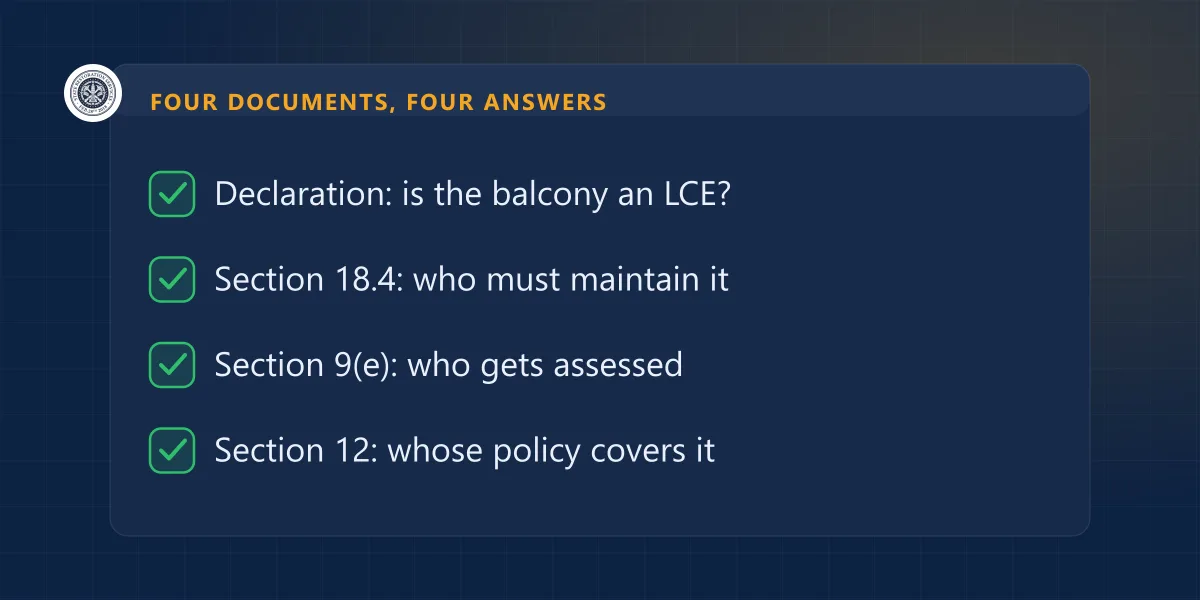
Set out side by side, the four questions look like this.
| The question | Where the answer lives | The default under the Act |
|---|---|---|
| Who owns the balcony? | Section 2(s) and your plat of survey | Owned in common by every unit; reserved for yours |
| Who must maintain and repair it? | Section 18.4(a), read with Section 2(e) | The board, unless the declaration moves the duty |
| Who gets assessed for the work? | Section 9(e) and the declaration | Everyone, unless the instruments allocate it |
| Whose insurance responds? | Sections 12(a)(1) and 12(b) | The association's master policy, subject to the board |
The reason to lay them out this way is that they are genuinely independent. It is normal, and not a drafting error, for the board to owe the repair while your unit alone owes the assessment for it.
Whose insurance covers a balcony or a roof deck?
The association's master policy, by default. Section 12(a)(1) requires property insurance "on the common elements and the units, including the limited common elements and except as otherwise determined by the board of managers." That clause carries its own escape hatch, and it is the part to check before you assume you are covered.
The same phrase appears again in Section 12(b): the insurance "must include the units, the limited common elements except as otherwise determined by the board of managers, and the common elements." Twice in one section, the Act tells the board it may determine otherwise. So the honest answer to "is my balcony on the master policy" is that it is unless your board decided it is not, and that decision would sit in a resolution or in the minutes rather than in the statute.
Two more provisions matter when a loss actually happens. Section 12(f) makes the association's policy primary where a unit owner also carries coverage on the same property, so this is not a race to file. And Section 12(c) gives the board three ways to handle the deductible: pay it as a common expense, assess it after notice and a hearing against the owners the damage originated from, or require the owners of the affected units to pay it. Which of the three your board chose is worth asking about in writing — the arithmetic behind those numbers is in our guide to your roof insurance deductible in Illinois.
One thing to raise before you improve a balcony rather than after. Section 12(b) defines improvements and betterments as additions and upgrades "installed or added to and located within the boundaries of the unit." A balcony generally sits outside the unit boundary, so composite decking or tile you lay over the association's concrete does not fit that definition neatly. Ask the board and your own agent how it is treated in your building before you buy the material, not after a hailstorm.
Where the balcony stops and the roof starts
At the waterproofing. On any balcony or roof deck built over living space, the walking surface — pavers, deck boards, tile — is not what keeps water out of the ceiling below. A membrane underneath it does that, and on a deck over living space that membrane is the roof. When the unit below stains, the walking surface is usually the last place to look rather than the first.
A deck over living space is a stack, and it helps to know the order:
| Layer | What it does | How it fails |
|---|---|---|
| Walking surface | Traffic, drainage gaps, appearance | Cracked pavers, loose boards, debris packed underneath |
| Protection and drainage layer | Moves water to the drain, shields the membrane | Silts up with leaf litter no one can see |
| Waterproofing membrane | The only layer actually keeping water out | Open or lifted seams, punctures, shrinkage at corners |
| Wall and threshold flashing | Seals the deck to the building and the door sill | Failed sealant, membrane never turned up high enough |
| Drains and scuppers | Remove standing water | Blocked, so water ponds and finds the weakest seam |
| Structural deck | Carries the load | Rot or corrosion, and it is normally found late |
The failure list above is the same one we work from on low-slope buildings generally, and it is on our commercial roofing page for a reason: ponding water still standing 48 hours after rain, open seams, cracked flashing at curbs and parapets, and blocked drains account for most of what we find. On service life, the figures we publish are 20 to 30 years for TPO and EPDM single-ply and 15 to 20 for modified bitumen. If your building went up in the 1990s and the deck membranes have not been touched since, they are already past the service life we would quote for them.
There is also a document worth asking for when balconies are being rebuilt. The 2021 International Building Code, adopted in Illinois, says at section 107.2.5 that where balconies or other elevated walking surfaces have weather-exposed surfaces and the structural framing is protected by an impervious moisture barrier, "the construction documents shall include details for all elements of the impervious moisture barrier system" along with the manufacturer's installation instructions. A board can ask a bidder for that detail sheet before signing anything, and it is a fair test of whether the bidder has built one of these assemblies before.
Nobody in Illinois is required to inspect your balcony
There is no statewide Illinois law setting an inspection interval for condominium balconies or structural elements. California requires associations to inspect elevated wood-framed elements on a nine-year cycle; the Illinois Condominium Property Act contains no inspection requirement of any kind, for a building of any size. Whether anyone ever looks at your balconies is a board decision and only a board decision.
The nearest thing in our region is a City of Chicago requirement, and it does not reach the suburbs. Chicago's facade ordinance obliges owners of buildings over 80 feet tall to have written condition assessment reports prepared by a licensed architect or structural engineer, as CooperatorNews Chicagoland sets out — but that covers facades, in the city, on high-rises. In Buffalo Grove, Northbrook or Palatine, the interval is whatever your board writes down.
The cheap version of a policy here is to put a balcony and deck walk on the same cycle as the reserve study, so the condition of the membranes gets written down and dated. When we survey an association property we walk every building, photograph the penetrations, drains and seams, and hand the board a written scope it can put in front of owners and a carrier. If you are at the stage of collecting numbers, our guide on roofing bids for an association board covers how to make three bids comparable.
What to do this week if water is coming in
Move on the record first and the repair second. These disputes drag when the early weeks of a leak exist only as phone calls nobody wrote down. Six steps, in order:
- Report it to the board in writing and keep the date. Email or a letter, not a voicemail. This is the document everything else hangs off.
- Photograph it the same day — the ceiling, the wall under the door threshold above, and the deck surface itself. Water stains grow, and a dated first photo settles arguments about how long this went on.
- Ask which document assigns the balcony, by article and section number of the declaration, rather than accepting a description of how the association has always done it.
- Ask which Section 12(c) deductible option the board is using and where the decision is recorded in the minutes.
- Expect to let people in. Section 18.4(j) gives the board access to each unit "as may be necessary for the maintenance, repair or replacement of any common elements" — on a deck leak, opening the ceiling below is often the only way to find where the water actually travels.
- Do not hire your own roofer for the deck above you. It is not your property to authorize work on, and being right about the leak does not make the invoice reimbursable.
What we tell boards is simpler. We will survey the property, tell you honestly whether a deck needs a repair, a targeted flashing rebuild or a new membrane, and put it in writing. Illinois law does not permit a roofing contractor to negotiate an insurance claim, which is why our partner, the licensed public adjuster State Adjusting Services, handles the claim side while we handle the roof — the rest of that arrangement is on our storm and insurance page, and how a job runs from survey to final walk is on our process. Houses, as opposed to association buildings, are covered under residential roofing.
We answer the phone Monday through Friday, 7:00 AM to 7:00 PM, and Saturday and Sunday, 9:00 AM to 5:00 PM. For an active leak, call during those hours and we will prioritize getting out to stop the water.
Related reading: Who pays for a condo or townhome roof in Illinois and roofing bids for an association board.
Frequently asked questions
Only my unit can reach the balcony. Does that make it a limited common element?
Not by itself. Section 2(s) of the Condominium Property Act defines a limited common element as a portion of the common elements so designated in the declaration. Exclusive use is what a limited common element looks like in practice, but the designation in the declaration is what creates one. If your declaration and plat never designate the balcony, it is an ordinary common element that you happen to be the only one standing on.
My declaration says nothing about who pays for balconies. What happens then?
The cost is an ordinary common expense and every owner pays a share of it. Section 9(e) lets the condominium instruments assess limited common element expenditures against only the units those elements are assigned to, but it says the instruments may provide for that. If yours do not, Section 9(a) applies instead and the bill is split in proportion to each percentage of ownership, balcony or no balcony.
Can the association charge only the owners with balconies for balcony repairs?
Yes, if the declaration or bylaws say so. That is exactly what Section 9(e) permits. Ask the board to point at the article and section of the declaration it is relying on rather than describing the practice, because an allocation that is not in the instruments is not available just because it feels fairer to the owners without balconies.
The deck above my unit leaks. Can I hire my own roofer and send the association the bill?
We would advise against it. In a condominium the deck above you is common element property you do not own, so work on it is not yours to authorize, and being right about the leak does not make the invoice reimbursable. Report the leak to the board in writing, keep the date, photograph the damage, and let the association engage the contractor. Section 18.4(j) already gives the board access to your unit for that repair.
Balcony or deck leaking into the unit below? Book a free inspection or call (866) 992-2982 — we survey association buildings as well as houses across the north and northwest Chicago suburbs, and we put the findings in writing for your board. You can also reach us through our contact page.